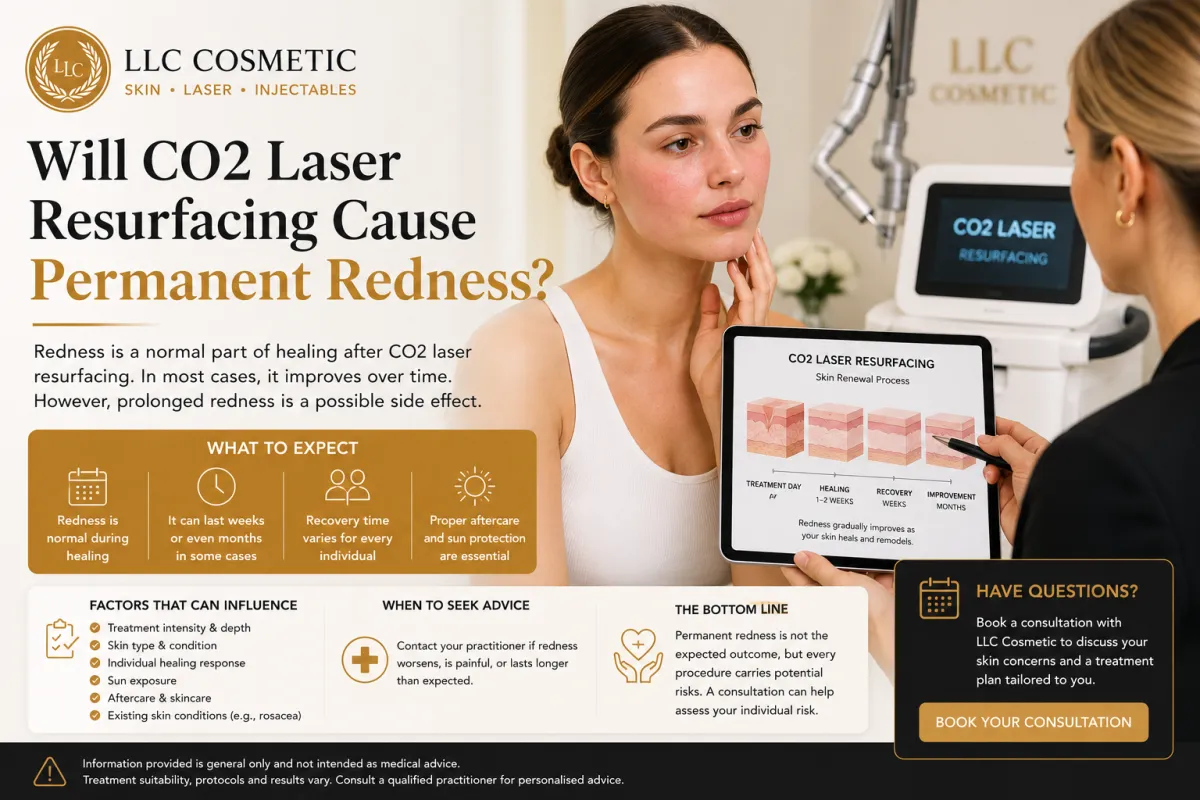
Will CO2 Laser Resurfacing Cause Permanent Redness?
If you're considering CO2 laser resurfacing, one concern can be difficult to ignore:
“Will CO2 laser resurfacing cause permanent redness?”
The short answer is usually no, but prolonged redness is a recognised possible side effect of CO2 laser resurfacing.
Redness is a normal part of healing after ablative laser resurfacing. Depending on the treatment depth, laser settings, treatment area and individual healing response, the skin can remain red or pink for weeks and, in some cases, considerably longer. Mayo Clinic notes that treated skin can look inflamed for several months following ablative laser treatment.
DermNet NZ also lists prolonged redness as a moderate potential side effect of carbon dioxide laser treatment.
That doesn't mean that having CO2 laser will leave you with permanent redness.
In most cases, redness gradually settles as the skin heals.
However, it's important to understand the difference between expected post-treatment redness and redness that is unusually persistent or associated with another complication.
Quick Answer: Can CO2 Laser Cause Permanent Redness?
CO2 laser can cause prolonged redness, but permanent redness is not the expected outcome for most patients.
After ablative CO2 laser resurfacing, redness can be part of the normal healing process. The duration varies considerably depending on:
Treatment intensity
Depth of resurfacing
Fractional versus more extensive treatment
Area treated
Skin type
Individual healing response
Aftercare
Sun exposure
Previous skin conditions
Complications such as infection or inflammation
DermNet NZ reports that ablative laser resurfacing can involve redness and swelling, with complete healing commonly taking around two weeks but varying from approximately one to four weeks depending on the procedure and depth of treatment.
However, visible redness can continue after the initial wound-healing period.
DermNet NZ specifically identifies prolonged redness as a possible complication of CO2 laser treatment.
So the better question isn't simply:
“Will my redness be permanent?”
It's:
“How long should redness reasonably last for the specific CO2 treatment I'm having, and when should persistent redness be assessed?”
Why Does CO2 Laser Cause Redness?
CO2 laser resurfacing works by creating controlled thermal injury in the skin.
With ablative resurfacing, damaged or unwanted superficial skin is removed and the skin then undergoes a healing and regeneration process.
That healing response can produce:
Redness
Swelling
Warmth
Sensitivity
Tightness
Peeling
Crusting
DermNet NZ describes redness and swelling as predictable effects following ablative laser resurfacing.
So if your skin looks red immediately after CO2 treatment, that doesn't automatically indicate that something has gone wrong.
In fact, redness immediately after treatment is expected.
The important issue is what happens as your skin progresses through recovery.
How Long Does Redness Last After CO2 Laser?
There isn't one timeline that applies to everyone.
For some people, the most obvious redness improves substantially during the early healing period.
For others, pinkness or redness can remain visible for weeks.
DermNet NZ explains that redness and tenderness after CO2 laser resurfacing can last several weeks.
Mayo Clinic gives an even broader warning for ablative laser resurfacing, noting that treated skin may look inflamed for several months following treatment.
This is why it's risky for clinics or online articles to promise:
“Your redness will be gone in exactly seven days.”
Your recovery may not follow someone else's timeline.
Is Redness Normal After CO2 Laser?
Yes.
Redness is one of the expected effects of CO2 laser resurfacing.
Immediately after treatment, your skin may appear:
Bright red
Pink
Swollen
Raw
Sensitive
Tight
Sunburn-like
The intensity depends on the treatment performed.
A more superficial treatment may produce less dramatic redness than a deeper ablative treatment.
This is one reason your practitioner should explain the expected recovery before treatment rather than simply giving you a generic downtime number.
The American Academy of Dermatology recommends asking your practitioner about the expected recovery time and how to care for your skin after a cosmetic procedure.
Can Redness Last for Months After CO2 Laser?
Yes, it can.
This doesn't necessarily mean the redness is permanent.
Mayo Clinic specifically states that skin treated with ablative laser resurfacing may remain inflamed for several months.
That distinction is important.
Prolonged redness
The skin remains pink or red for longer than expected but gradually improves.
Permanent redness
The colour change does not resolve and may represent a lasting complication or an underlying skin condition.
These are not the same thing.
If your skin is still noticeably red well after the expected recovery period, don't automatically assume that you have permanent damage.
Instead, have your practitioner assess it.
What Is Post-Laser Redness?
Post-laser redness is essentially an inflammatory response associated with the healing process.
After resurfacing, the skin is repairing itself.
Blood flow increases around the treated area, and inflammatory processes help the skin heal.
This can produce a red or pink appearance.
As healing progresses, the redness generally becomes less intense.
But the speed of this process varies.
That's why two people can receive apparently similar treatments and have noticeably different recovery timelines.
What Can Make CO2 Laser Redness Last Longer?
Several factors can influence recovery.
1. Treatment intensity
One of the biggest considerations is how aggressively the skin is treated.
A deeper treatment generally creates more tissue injury and may require more recovery.
DermNet NZ notes that recovery varies according to the treatment performed and the depth of skin removal.
2. Treatment area
Different parts of the face can respond differently.
The cheeks, forehead, around the mouth and areas close to the eyes may have different healing characteristics.
Your practitioner should explain what to expect for the specific area being treated.
3. Individual healing response
Not everyone's skin heals at the same rate.
Factors such as skin condition, previous treatments and individual inflammatory response can influence recovery.
This is one reason before-and-after photographs should never be treated as a guarantee of your own recovery.
4. Sun exposure
UV exposure can be particularly problematic during the healing period.
The American Academy of Dermatology emphasises sun protection following laser treatments because sun exposure can increase the risk of complications and unwanted skin changes.
Your practitioner should provide specific instructions about sun avoidance and protection.
5. Skin conditions
Existing skin conditions can affect how your skin responds.
For example, people with rosacea may already experience persistent facial redness and increased sensitivity.
If you have rosacea or another inflammatory skin condition, tell your practitioner before CO2 treatment.
Can CO2 Laser Make Rosacea Worse?
This is an important consideration for people who already have facial redness.
DermNet NZ lists rosacea among the possible mild side effects associated with CO2 laser treatment.
If you already have:
Rosacea
Frequent flushing
Facial sensitivity
Persistent redness
Easily irritated skin
make sure your practitioner knows.
Persistent facial redness isn't always caused by the laser.
It may also be related to an underlying condition such as rosacea.
The American Academy of Dermatology explains that rosacea can cause persistent facial redness and that diagnosis is important because different conditions can cause long-lasting facial colour changes.
What Does Normal CO2 Laser Redness Look Like?
Normal recovery can include skin that looks:
Red or pink
Swollen
Tight
Sensitive
Dry
Flaky
Peeling
The appearance can change throughout the recovery process.
You may initially have significant redness, followed by dryness and peeling, and then gradually see the colour become less intense.
The important thing is the overall direction of recovery.
If your skin is gradually becoming less red and more comfortable, that's generally more reassuring than redness that is becoming increasingly intense or accompanied by new symptoms.
However, only your treating clinician can determine whether your recovery is progressing normally.
When Is Redness Not Normal?
You should contact your treating practitioner if you're concerned that your recovery isn't progressing normally.
Particularly seek professional advice if you experience:
Redness that is worsening rather than improving
Increasing pain
Significant swelling
Blistering
Pus or unusual drainage
Fever
Increasing warmth around the treated area
Signs of infection
Significant or unexpected skin colour changes
Poor wound healing
CO2 laser resurfacing has recognised risks including infection, pigment changes and scarring.
You shouldn't try to diagnose a complication from photographs online.
Your treating practitioner knows the laser settings, treatment depth and area used and is therefore best placed to assess your recovery.
Can CO2 Laser Cause Permanent Skin Colour Changes?
It's important to distinguish redness from other permanent colour changes.
Laser resurfacing can cause changes in pigmentation.
Mayo Clinic lists both darkening and lightening of treated skin as potential complications of laser resurfacing.
DermNet NZ also identifies:
Post-inflammatory hyperpigmentation
Delayed hypopigmentation
Scarring
as possible complications of CO2 treatment.
These aren't necessarily the same thing as permanent redness.
If you notice a persistent change in skin colour after treatment, have it assessed rather than assuming it's part of normal healing.
Is Permanent Redness More Likely With Deeper CO2 Laser?
A deeper treatment generally involves more tissue injury and a longer recovery.
DermNet NZ notes that recovery after ablative resurfacing varies according to the depth of skin removal.
This means treatment intensity should be considered when discussing downtime and redness.
If you're hoping for a very aggressive resurfacing treatment, ask:
“How much redness should I realistically expect with this treatment level?”
and:
“How long could the redness remain visible?”
These are better questions than simply asking:
“How much downtime do I get?”
Does Fractional CO2 Cause Less Redness?
Fractional treatment generally targets microscopic treatment zones while leaving surrounding skin intact.
DermNet NZ explains that fractional laser treatment creates microscopic treatment zones and can allow faster healing than treating the entire surface.
However, fractional CO2 can still cause significant redness.
Fractional does not mean:
“No redness.”
Your recovery still depends on treatment settings, depth, density and individual response.
Can Aftercare Reduce Prolonged Redness?
Appropriate aftercare can support healing, but it cannot guarantee a particular recovery timeline.
Your clinic may recommend:
Gentle cleansing
Appropriate moisturising or healing products
Cool compresses
Avoiding unnecessary sun exposure
Avoiding irritating skincare
Avoiding picking or scratching
Following the clinic's wound-care instructions
DermNet NZ describes postoperative care measures used following CO2 resurfacing and emphasises care aimed at reducing infection risk.
The key is to follow the instructions specifically provided for your treatment.
Don't assume that a skincare routine recommended for a mild cosmetic laser is appropriate after ablative CO2 resurfacing.
Should You Use Makeup to Hide CO2 Laser Redness?
This depends on where you are in the healing process.
Immediately after ablative resurfacing, your skin may be too vulnerable for normal makeup.
Once the skin has sufficiently healed, your practitioner can tell you when makeup can safely be reintroduced.
DermNet NZ notes that camouflage makeup may be possible after the initial healing period.
Don't apply makeup to open, weeping or incompletely healed skin simply because you need to return to work.
Healing should come first.
Should You Cancel CO2 Laser If You Have Naturally Red Skin?
Not necessarily.
But you should tell your practitioner.
If you naturally have:
Rosacea
Facial flushing
Sensitive skin
Persistent redness
Previous inflammatory skin conditions
your treatment plan may need to take these factors into account.
The AAD recommends discussing medical history and skin conditions with the practitioner before laser treatment.
A consultation is the appropriate place to determine whether CO2 resurfacing is suitable for your skin.
What About Darker Skin Types?
Skin type matters when planning laser resurfacing.
DermNet NZ identifies darker Fitzpatrick skin types as a consideration for CO2 treatment because of the potential for pigmentary complications.
This does not mean that everyone with a darker skin tone automatically cannot have laser treatment.
It means treatment selection, settings and risk assessment need to be handled carefully.
If you have a darker skin tone, ask your practitioner:
What are my pigmentation risks?
What treatment settings are appropriate?
What recovery should I expect?
How will you reduce the risk of unwanted pigmentation?
Have you treated patients with a similar skin type?
The AAD also recommends asking to see results from patients with a similar skin tone and type when considering cosmetic procedures.
Can CO2 Laser Cause Scarring?
Scarring is a recognised but uncommon potential complication.
DermNet NZ lists fibrosis and hypertrophic scarring among severe potential complications of CO2 laser treatment.
The risk depends on factors including:
Treatment depth
Laser settings
Operator experience
Skin characteristics
Healing response
Infection
Aftercare
This is another reason not to choose a laser treatment based solely on price or advertised intensity.
The person performing the treatment and the treatment plan matter.
How Do You Know If Your Redness Is Improving?
Rather than checking your skin every hour, look at the overall trend.
Signs that may be reassuring include:
Redness gradually becoming lighter
Less warmth
Reduced swelling
Less sensitivity
Skin becoming more comfortable
Gradual return toward your normal skin tone
Recovery doesn't necessarily happen in a straight line.
You may have days when your skin appears more flushed after activity, heat or other triggers.
If you're concerned about the direction of your recovery, contact your practitioner.
Can You Prevent Permanent Redness?
There is no way to guarantee that a complication will never occur.
But appropriate treatment planning can help reduce unnecessary risk.
Before treatment:
Choose an appropriately qualified practitioner
Laser resurfacing is a procedure with potential complications. The AAD recommends considering the practitioner's training and experience when selecting cosmetic laser treatment.
Discuss your medical history
Tell your practitioner about:
Rosacea
Previous scarring
Cold sores
Medications
Previous laser treatments
Previous chemical peels
Skin sensitivity
Recent sun exposure
Follow preparation instructions
Don't improvise your own pre-treatment routine.
Follow aftercare instructions
Your skin needs appropriate care during recovery.
Protect your skin from UV exposure
Sun protection is an important part of post-laser care.
What Should You Ask Before CO2 Laser Treatment?
If you're worried about permanent redness, ask your practitioner these questions before booking.
1. What level of CO2 treatment am I having?
Treatment intensity can affect recovery.
2. How long should I expect to be visibly red?
Ask for a realistic range rather than a guaranteed number.
3. What happens if my redness lasts longer than expected?
Know who to contact.
4. What are my individual risk factors?
Your skin history matters.
5. Do I have any conditions that could affect recovery?
Mention rosacea, eczema, previous scarring and other relevant conditions.
6. What aftercare products should I use?
Get specific instructions.
7. When can I return to work or social events?
Your practitioner can provide a more realistic estimate based on the treatment planned.
8. When should I contact the clinic?
Know which symptoms require assessment.
9. Can I see before-and-after examples from patients with similar skin?
The AAD specifically recommends asking to see results from patients with similar skin tone and type.
CO2 Laser Redness: A Simple Recovery Guide
A simplified recovery pattern can look like this:
Treatment day
Redness, warmth, swelling and sensitivity may be prominent.
First few days
Redness and swelling can remain significant.
Early healing
Dryness, peeling and surface changes may occur depending on the treatment.
Following weeks
The skin continues to settle, while residual redness may remain.
Later recovery
Pinkness or redness can gradually fade, but some people experience a longer period of visible colour change.
Important: This is only a general educational framework. Your actual recovery can be shorter or longer.
DermNet NZ notes that healing after ablative laser resurfacing can vary from roughly one to four weeks depending on the treatment and depth, while Mayo Clinic notes that inflammation can persist for months after ablative resurfacing.
Don't Judge Your Final CO2 Laser Result Too Early
One of the biggest mistakes people make is judging their final result while their skin is still healing.
Immediately after CO2 treatment, you aren't seeing the final result.
You're seeing:
treated skin + inflammation + healing.
As the skin recovers, the appearance can change substantially.
That means a red or swollen face during the early recovery period does not automatically mean the treatment has failed or caused permanent damage.
At the same time, persistent or worsening symptoms shouldn't simply be dismissed as "normal healing."
That's why follow-up matters.
Final Takeaway: Will CO2 Laser Resurfacing Cause Permanent Redness?
Usually, no—but prolonged redness is a recognised possible side effect of CO2 laser resurfacing.
Redness is expected during the healing process, particularly after ablative treatment.
For some people, it settles within the expected recovery period. For others, pinkness or redness can remain visible for several weeks or longer. Mayo Clinic notes that inflammation may persist for several months after ablative laser resurfacing, while DermNet NZ identifies prolonged redness as a possible complication of CO2 treatment.
Permanent redness is not the expected outcome, but no cosmetic laser procedure can be presented as completely risk-free.
Your individual risk depends on factors such as:
Treatment depth
Laser settings
Treatment area
Skin type
Existing skin conditions
Individual healing response
Aftercare
Sun exposure
Practitioner experience
If your redness is gradually improving, that can be reassuring.
If redness is worsening, unusually persistent or accompanied by significant pain, swelling, blistering, drainage or other concerning symptoms, contact your treating practitioner.
And before treatment, ask exactly how much redness you can realistically expect from your specific CO2 protocol.
CO2 laser recovery is a process—not a single-day result.
Frequently Asked Questions
Can CO2 laser cause permanent redness?
Permanent redness is not the expected outcome, but prolonged redness is a recognised possible side effect of CO2 laser resurfacing.
How long does redness last after CO2 laser?
It varies. Redness may last several weeks, and after ablative treatment inflammation can sometimes remain visible for months.
Is redness normal after CO2 laser?
Yes. Redness, swelling and sensitivity are common parts of the healing process after ablative laser resurfacing.
Is Day 2 the worst day after CO2 laser?
Not necessarily. Recovery varies from person to person. Early redness and swelling can be significant, but there is no universal "worst day."
Can CO2 laser make rosacea worse?
Rosacea is a potential side effect or consideration with CO2 treatment. If you have rosacea or persistent facial redness, tell your practitioner before treatment.
Can CO2 laser cause permanent skin colour changes?
Yes, permanent pigment changes are a recognised potential complication of laser resurfacing. These can include both darkening and lightening of the skin.
When should I worry about redness after CO2 laser?
Contact your treating practitioner if redness is worsening or accompanied by significant pain, blistering, unusual drainage, fever or other concerning symptoms.
Does deeper CO2 laser mean more downtime?
Generally, deeper ablative resurfacing involves more tissue injury and can require longer recovery.
Can I wear makeup while my skin is red after CO2 laser?
Not necessarily during the early healing period. Wait until your practitioner confirms that your skin has healed sufficiently for makeup.
Can sun exposure make post-CO2 redness worse?
Sun exposure can interfere with recovery and increase the risk of unwanted skin changes. Follow your practitioner's sun-protection instructions carefully.
Important Publishing Note
Important: CO2 laser recovery and complication risks can vary according to treatment intensity, laser settings, treatment area, skin type, medical history and individual healing response. The information in this article is general educational information and should not be interpreted as individual medical advice or a guarantee of treatment results.
LLC Cosmetic should confirm its current treatment protocols, recovery guidance and clinical claims before publishing or updating this article.
Treatment protocols, safety recommendations and clinical guidance can change over time. Readers should discuss their individual suitability, expected recovery, risks and aftercare requirements with a qualified practitioner before undergoing CO2 laser resurfacing.
Worried About CO2 Laser Recovery?
If you're considering CO2 laser resurfacing but are concerned about prolonged redness or downtime, the best place to start is with an individual consultation.
Your practitioner can assess your skin, discuss your goals and explain what recovery may realistically look like for the specific treatment being considered.
Book a consultation with LLC Cosmetic to discuss whether CO2 laser is suitable for your skin and what to expect during recovery.