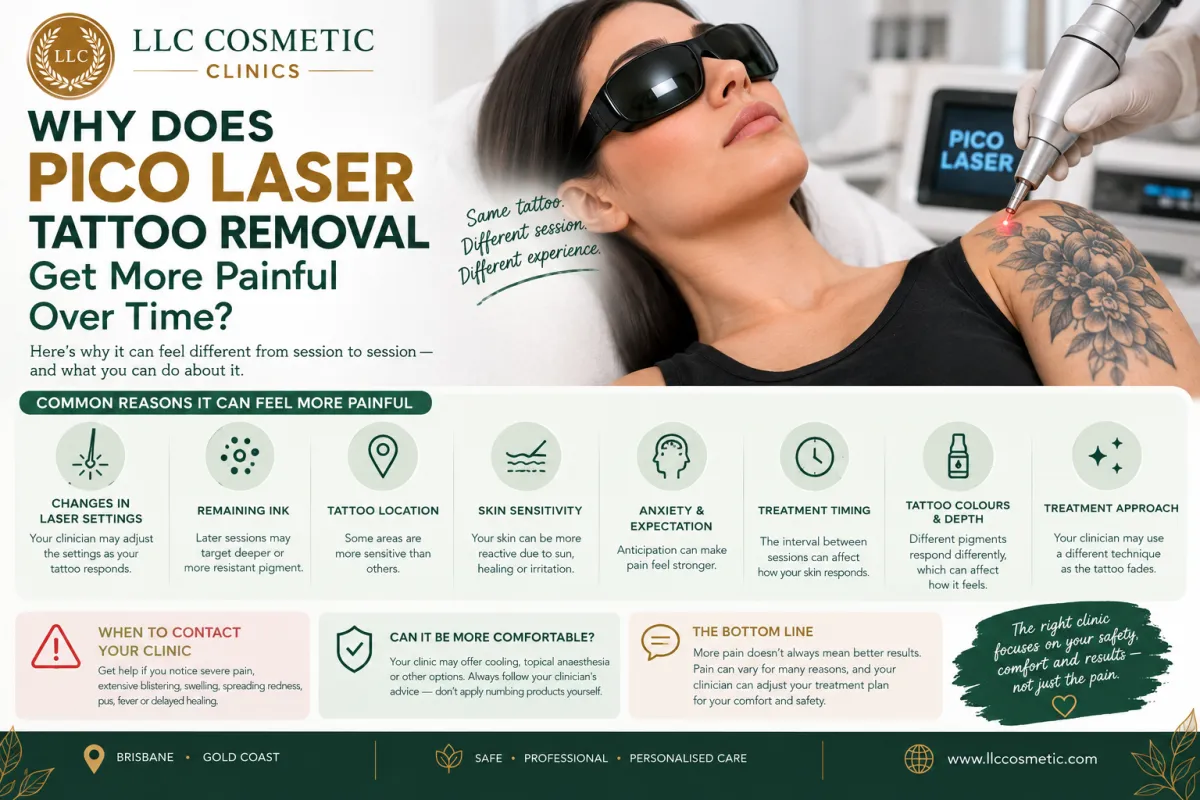
Why Does PICO Laser Tattoo Removal Get More Painful Over Time?
PICO laser tattoo removal is often described as a quick treatment, but that doesn't necessarily mean every session feels exactly the same.
Some people notice that later sessions feel more painful than their first few treatments, while others experience the opposite. If you've started tattoo removal and suddenly find that your PICO laser treatment feels more intense, you may naturally wonder:
“Why does PICO laser tattoo removal get more painful over time?”
There isn't one universal explanation. Pain can change from session to session because of factors such as the remaining ink, treatment settings, tattoo location, skin sensitivity, healing, anxiety and the way the treatment is adjusted as the tattoo fades.
Importantly, increasing pain doesn't automatically mean something is wrong. But a sudden or unusually severe increase in pain is worth discussing with your treating clinician.
Does PICO Laser Tattoo Removal Normally Become More Painful?
Not necessarily.
Research generally suggests that picosecond laser tattoo removal can be relatively well tolerated, with studies reporting lower pain compared with some nanosecond laser treatments.
However, pain is highly individual.
One session may feel different from another because your clinician may change the treatment parameters as your tattoo responds. The remaining pigment may also be distributed differently from the pigment targeted during earlier sessions.
So while some people report increasing discomfort, there isn't strong evidence that PICO tattoo removal inherently becomes more painful with every session.
1. The Laser Settings May Change
One possible explanation is that your treatment settings have changed.
Tattoo removal isn't necessarily performed using exactly the same parameters at every appointment. Your clinician may adjust the treatment based on:
How the tattoo responded to the previous session
Remaining pigment
Ink colour
Ink density
Tattoo depth
Your skin's response
The treatment area
As the tattoo changes, the treatment strategy may change too.
This means comparing the pain of session one with session five isn't always an apples-to-apples comparison.
2. The Remaining Ink May Respond Differently
A tattoo doesn't necessarily contain pigment evenly throughout the skin.
Some areas can contain more concentrated or deeper pigment than others.
As treatment progresses, the easier-to-target pigment may fade first, leaving behind pigment that is more resistant or distributed differently.
That can make later treatments feel different, even though the tattoo is becoming lighter.
Research on tattoo removal shows that treatment response varies according to characteristics such as ink colour and other tattoo-related factors.
This doesn't mean that remaining pigment is automatically harder to remove or that every later session will hurt more. It simply means the tattoo can become a different treatment target over time.
3. Your Tattoo May Be Smaller, But the Treatment Can Still Feel Strong
It's easy to assume:
“My tattoo is fading, so the treatment should hurt less.”
Unfortunately, it doesn't always work that way.
The visible tattoo may be lighter while the remaining pigment still requires treatment.
The laser is targeting pigment rather than simply treating how dark the tattoo looks to your eyes.
A tattoo can therefore look significantly lighter while still requiring additional treatments.
4. Your Skin May Be More Sensitive
Your skin's condition on the day of treatment can influence how the procedure feels.
For example, treatment may feel more uncomfortable if your skin is:
Irritated
Dry
Recently exposed to significant sun
Still recovering from the previous session
Sensitive from another skincare or cosmetic treatment
This is why your clinician should assess the treatment area before proceeding.
If the skin hasn't adequately recovered, treatment may need to be postponed.
5. The Tattoo Location Makes a Big Difference
Not all tattoo locations feel the same.
Areas with thinner skin or less cushioning can feel more sensitive than areas with more underlying tissue.
Pain perception can also vary depending on the individual and the size and density of the tattoo.
This means your experience removing a tattoo on your forearm may be very different from removing one in a more sensitive location.
If you've had tattoos removed from different parts of your body, you may notice that one location feels significantly more uncomfortable than another.
6. Anxiety Can Make the Treatment Feel More Painful
Pain isn't purely physical.
If you remember a previous treatment as painful, you may become tense before the next appointment.
That anticipation can increase anxiety and make the procedure feel more difficult.
Research involving people undergoing laser tattoo removal has found relationships between anxiety, physiological responses and reported pain. One study found that relaxation techniques were associated with reductions in anxiety and reported pain, although more research is needed.
This doesn't mean the pain is “just in your head.”
The pain is real. But your nervous system and emotional state can influence how strongly you experience it.
7. You May Be Expecting It to Hurt More
This is another surprisingly important factor.
Before your first session, you don't know what the sensation will feel like.
After you've experienced it once, you know what to expect.
If your previous session was uncomfortable, you may become more alert to every pulse during the next appointment.
That heightened anticipation can make the experience feel more intense.
Discussing pain-management options with your clinician before treatment can help you feel more prepared.
8. Your Clinician May Be Treating More Resistant Pigment
Tattoo removal isn't simply about making the tattoo look lighter.
The goal is to break down pigment so that the body can gradually clear it.
Different pigments can respond differently to laser treatment.
Black and dark blue pigments are often more responsive, while some other colours can be more challenging.
Research has found that treatment outcomes vary according to tattoo colour and laser wavelength.
If you're now treating pigment that has been more resistant than the pigment removed during earlier sessions, the treatment experience may feel different.
9. A Later Session Shouldn't Automatically Be More Painful
It's important not to create the expectation that:
Session 1 = least painful
Session 2 = more painful
Session 3 = even more painful
That's not how everyone experiences tattoo removal.
In fact, clinical studies of picosecond laser tattoo removal have generally reported manageable pain, and several studies found picosecond treatments to be less painful than the nanosecond comparison treatments used in those studies.
Your experience may fluctuate from appointment to appointment.
What If the Pain Suddenly Becomes Much Worse?
This is where you should stop assuming that increased pain is simply part of the process.
Contact your treating clinic if you notice a significant or unexpected change in pain, especially if it occurs together with:
Severe or increasing pain
Extensive blistering
Significant swelling
Spreading redness
Increasing warmth
Pus or unusual drainage
Fever or feeling unwell
Extensive skin breakdown
Delayed healing
Significant or unexpected colour changes
A normal treatment response and a complication can sometimes look similar at first, so professional assessment is important.
Can Pain Mean the PICO Laser Is Working Better?
Not necessarily.
This is an important misconception.
More pain does not automatically mean better tattoo removal.
You shouldn't judge the effectiveness of your treatment based on how much it hurts.
The objective is appropriate treatment of the tattoo pigment while minimising unnecessary injury to surrounding skin.
Picosecond laser studies have shown that effective tattoo removal can occur with relatively tolerable pain, and a 2025 meta-analysis found lower pain with picosecond lasers compared with nanosecond lasers overall.
So don't assume:
More pain = more effective treatment.
That's not a reliable way to measure progress.
Can Your Clinic Help Make PICO Tattoo Removal More Comfortable?
There are several approaches that clinicians may use to improve patient comfort, depending on the treatment area and individual circumstances.
These can include appropriate cooling and, when suitable, topical anaesthesia.
Research has found that topical anaesthetics can reduce pain during laser procedures, including laser-assisted tattoo removal. However, topical anaesthetics need to be used appropriately because safety depends on factors such as the product, concentration, treatment area and duration of application.
Don't apply a strong numbing cream yourself without asking your clinician first.
More isn't necessarily better, and inappropriate use of topical anaesthetics can cause complications.
Should You Continue Treatment If Each Session Hurts More?
Don't make that decision based on pain alone.
Instead, tell your clinician exactly what you're experiencing.
They can assess:
Your skin's healing
The remaining tattoo pigment
Previous treatment response
Treatment settings
The treatment interval
Your pain level
Whether continuing treatment is appropriate
Your treatment plan may need to be adjusted depending on what they find.
How Long Should You Wait Between PICO Tattoo Removal Sessions?
Your skin needs time to recover between treatments.
The appropriate interval depends on the treatment, tattoo and treatment protocol.
There is no universal rule that every tattoo should be treated at exactly the same interval.
For example, published studies have used different treatment intervals. One recent randomised trial using a 755-nm picosecond laser treated participants at three-month intervals, while other studies have used shorter intervals.
This is another reason not to compare your schedule with someone else's.
Your clinician should determine when the treated area is ready for another session.
What Can You Do Before Your Next Session?
If you're worried about increasing pain, preparation can help.
Before your appointment:
Tell your clinician that the previous session was more painful.
Mention any unusual skin reaction.
Make sure the tattoo has fully recovered before treatment.
Avoid unnecessary irritation to the area.
Follow the clinic's instructions about sun exposure and skincare.
Ask what pain-management options are appropriate for you.
Don't apply numbing products unless your clinician has advised you to do so.
Most importantly, communicate with your clinician before the next treatment rather than simply tolerating increasingly severe pain.
The Bottom Line
So, why does PICO laser tattoo removal get more painful over time?
There isn't one simple answer.
Pain can vary because of changes in laser settings, remaining pigment, tattoo location, skin sensitivity, treatment timing and individual pain perception. Anxiety and anticipation can also influence how intense the experience feels.
However, PICO tattoo removal does not automatically become more painful with every session, and more pain doesn't necessarily mean the laser is working better.
If your pain has suddenly become significantly worse, particularly if it's accompanied by excessive blistering, swelling, spreading redness, severe skin changes or delayed healing, contact your treating clinic for an assessment.
A good tattoo removal plan should focus on appropriate treatment, gradual pigment clearance, skin safety and patient comfort—not simply using more energy or tolerating more pain.
If you're considering PICO laser tattoo removal in Brisbane or the Gold Coast, a professional consultation can help you understand what to expect, how your tattoo may respond and what options may be available to make treatment more comfortable.