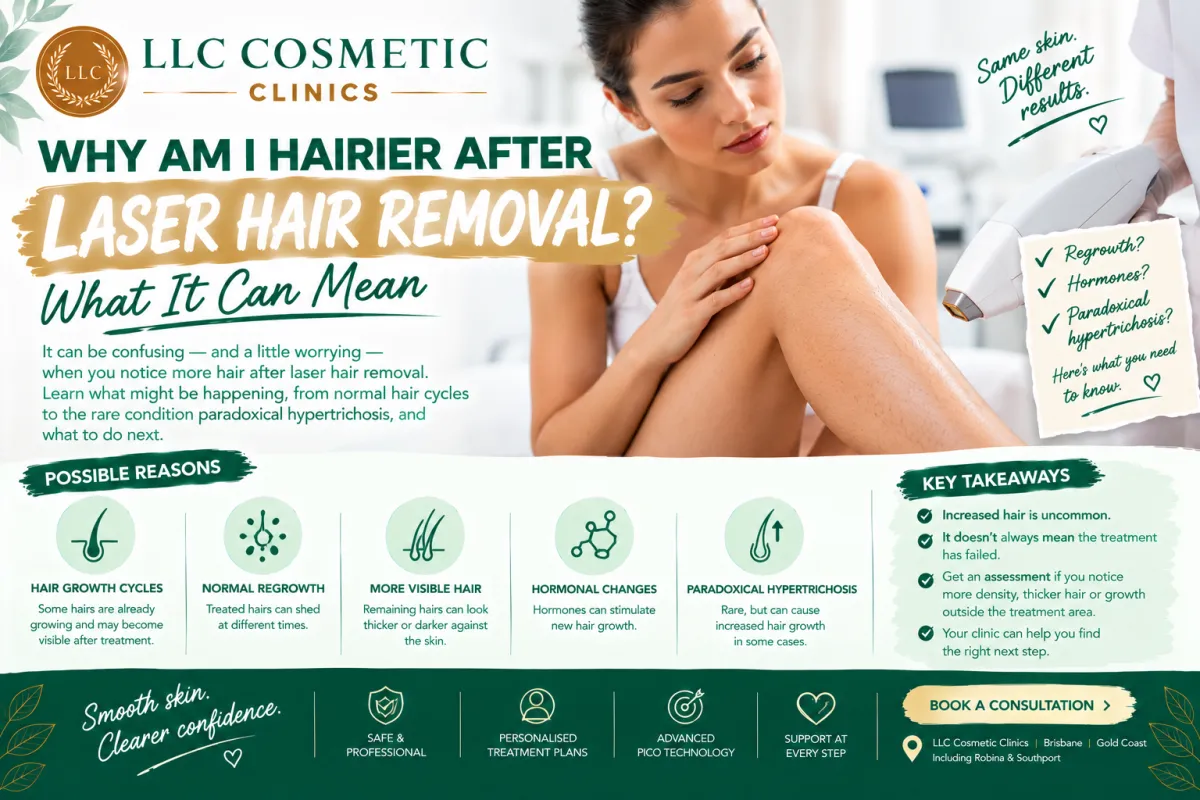
Hairier After Laser Hair Removal? Normal Regrowth vs Hypertrichosis
If you started laser hair removal expecting less hair but noticed more visible or thicker-looking hair afterward, you may be wondering, “Why am I hairier after laser hair removal?”
It can be confusing—and understandably concerning.
In most cases, seeing hair after a laser session does not automatically mean the treatment has made your hair permanently worse. Hair grows in cycles, so some hairs can become visible after treatment even when the laser has already affected the follicles. However, there is also a rare phenomenon called paradoxical hypertrichosis, where laser or light-based hair removal is associated with increased hair growth in or around the treated area.
The good news is that this is uncommon, and it does not mean everyone who notices extra hair has experienced a true complication.
This guide explains what may be happening, why it can occur, which areas are more commonly affected, and what you should do if you think your hair growth has increased.
Quick Answer: Why Am I Hairier After Laser Hair Removal?
There are several possible explanations:
Some hairs were already growing and have become visible as part of the normal hair-growth cycle.
Treated hairs may be shedding at different times.
Fine hair can become more noticeable against the skin.
The treatment may not yet have produced its full hair-reduction effect.
Hormonal changes can stimulate new hair growth.
In rare cases, paradoxical hypertrichosis can occur after laser or IPL treatment.
Research suggests paradoxical hypertrichosis is uncommon overall. A 2021 systematic review and meta-analysis of 22 studies involving 9,733 patients estimated a pooled prevalence of about 3%, with the phenomenon being particularly associated with facial and neck treatment areas. Outside the face and neck, it was reported extremely rarely in that analysis.
So if you notice more hair after treatment, the first step is not to panic. It is to work out whether you're seeing normal regrowth or something that needs reassessment.
What Is Paradoxical Hypertrichosis?
Paradoxical hypertrichosis is the medical term commonly used when unwanted hair appears to increase after laser or light-based hair removal.
Instead of getting the expected reduction, a patient may notice:
More visible hairs
Increased hair density
Darker or thicker-looking hairs
Hair growth extending around the original treatment area
New growth in areas that previously had only fine or barely noticeable hair
It is considered an uncommon adverse effect of laser and intense pulsed light treatment.
The exact biological mechanism is not completely understood. Researchers have proposed that heat or inflammatory changes around the follicle may, in some circumstances, stimulate rather than sufficiently damage certain follicles. Older literature has also suggested that suboptimal thermal injury or lower treatment fluence may play a role, although the evidence is not strong enough to reduce the phenomenon to one simple cause.
This is important because not every case of increased hair is caused by the laser itself.
Could It Just Be Normal Hair Regrowth?
Absolutely.
Laser hair removal works progressively rather than removing every hair permanently in a single appointment.
Hair follicles move through different stages of growth. Laser treatment is most effective when the hair is in an appropriate active growth phase because the pigment in the hair helps deliver energy toward the follicle.
That means follicles are not all equally vulnerable during one appointment.
LLC Cosmetic explains that multiple sessions are needed because hair grows in cycles, with treatment plans tailored according to factors such as hair density, colour, skin type and treatment area.
So you might experience this pattern:
Treatment → some hairs shed → other follicles enter a growth phase → new hairs become visible → subsequent treatment targets those follicles.
That can make it feel as though you're suddenly getting hairier even when the overall treatment course is progressing normally.
Why Does Hair Sometimes Look Thicker After Treatment?
There is another simple possibility: contrast.
Imagine an area that previously had a mixture of fine and darker hairs.
After treatment, some of the more pigmented hairs may shed. Other hairs may continue growing. The remaining hairs can appear more obvious against the surrounding skin.
You may therefore perceive the area as hairier even though the total number of active follicles is changing.
This is one reason before-and-after photographs can be more useful than judging the area from memory.
At LLC Cosmetic, baseline photographs can be used as part of the assessment process to help evaluate treatment progress over time.
What If the Hair Really Is Increasing?
If you've completed several sessions and can clearly see increased density, thickness or growth outside the original treatment area, it is worth discussing this with your provider.
Paradoxical hypertrichosis has been documented in clinical studies.
For example, one study of 489 patients treated with a long-pulsed alexandrite laser identified three cases of increased hair growth, equivalent to 0.6% in that treatment population. The authors noted a possible trend toward darker skin types and black hair, although the small number of cases meant those factors could not be established statistically.
A much larger 2024 retrospective study reported increased hair growth in 25 of 7,381 patients, or approximately 0.34%. The study identified the upper arm and periareolar region among the more commonly affected locations and found an association between daily sun protection and lower incidence, although this type of study cannot establish that sunscreen itself prevents the condition.
The numbers vary between studies because treatment methods, populations and definitions differ.
The important point is that true paradoxical hypertrichosis is possible, but it is not the typical outcome of laser hair removal.
Which Areas Are More Likely to Be Affected?
The face and neck appear to be particularly relevant.
The 2021 systematic review found a strong association between paradoxical hypertrichosis and treatment of the face or neck. It reported that the condition occurred in only 0.08% of non-facial/non-neck cases in the included evidence.
This is one reason facial hair removal requires particularly careful assessment.
Facial hair can also be influenced by hormones, making the situation more complicated than treating something like the lower legs or underarms.
Other studies have reported areas such as the upper arms and around the areola, showing that the phenomenon is not exclusively facial.
Could Hormones Be Causing the Extra Hair?
Yes.
Hormonal influences can affect unwanted hair growth independently of laser treatment.
This matters particularly when you notice increasing facial or body hair alongside other changes.
Hormonal conditions or androgen-related changes have been discussed as possible contributing factors in paradoxical hair growth, although the relationship is complex and not every person with increased hair has an underlying hormonal disorder.
If your hair growth has changed significantly or suddenly, particularly on the:
Chin
Jawline
Upper lip
Neck
Chest
Abdomen
it may be worth discussing the change with an appropriate healthcare professional rather than assuming the laser treatment is responsible.
Can Laser Hair Removal Make Fine Hair More Noticeable?
This is an important distinction.
Laser hair removal generally works best when there is enough pigment in the hair to absorb the laser energy.
Very fine, light or low-pigment hair can be more difficult to treat effectively.
LLC Cosmetic notes that laser hair removal is particularly dependent on hair colour, thickness, density and skin characteristics when determining suitability and treatment settings.
If an area contains lots of very fine hair, your provider may need to assess whether laser treatment is actually appropriate.
More laser is not automatically better.
The correct treatment plan depends on the individual area, hair characteristics and skin type.
Does This Mean My Laser Treatment Was Done Wrong?
Not necessarily.
Paradoxical hypertrichosis is still not fully understood, and research has not established one universal cause.
A 2021 meta-analysis found that the type of treatment modality and interval between treatments did not appear to significantly affect the rate of paradoxical hypertrichosis in the available evidence.
At the same time, older studies and reviews have proposed that inadequate or subtherapeutic thermal injury may contribute in some cases.
This is why it would be misleading to say:
“Your hair increased because the laser setting was too low.”
There isn't enough evidence to make that conclusion from appearance alone.
A proper assessment should consider your treatment history, treatment area, hair characteristics, skin type, treatment settings, timing and photographs.
What Should You Do If You're Hairier After Laser Hair Removal?
Don't immediately abandon the treatment course.
Instead, contact your clinic and ask for an assessment.
1. Take clear photographs
Take photos under similar lighting and from similar angles.
If possible, compare them with photographs from before your first treatment.
This makes it easier to determine whether there has actually been an increase in hair density.
2. Record your treatment dates
Write down:
Treatment dates
Treatment areas
How many sessions you've had
When you first noticed increased hair
Whether the increase is inside or outside the original treatment area
This information can be extremely useful during reassessment.
3. Don't start changing everything yourself
Avoid randomly switching between shaving, waxing, IPL and other treatments without discussing it with your provider.
Your clinician needs to understand what has happened before deciding what should happen next.
4. Ask whether this looks like normal regrowth
Sometimes what looks like increased hair is simply hair cycling between treatments.
5. Ask whether paradoxical hypertrichosis is a possibility
If there is a genuine increase in density or thickness, specifically ask whether your clinician thinks this could represent paradoxical hypertrichosis.
Can You Continue Laser Hair Removal?
Potentially, yes.
Interestingly, the evidence does not suggest that developing paradoxical hypertrichosis automatically means laser treatment must stop.
The 2021 systematic review found that in three of four studies reporting treatment outcomes, paradoxical hypertrichosis gradually improved with continued therapy. The authors concluded that continuing treatment in affected areas may be an appropriate management strategy.
However, that does not mean you should simply keep booking treatments without reassessment.
Your provider should first determine what is happening and whether continuing treatment is appropriate for your particular situation.
How Is Paradoxical Hypertrichosis Managed?
Management depends on the individual case.
In some situations, continued appropriately planned laser treatment may help reduce the unwanted hair.
The literature describes laser treatment of the affected area as one management option, and continued therapy has produced improvement in some reported patients.
However, expectations should remain realistic.
Laser hair removal is better described as long-term hair reduction rather than a guarantee that every follicle will permanently disappear.
If hormonal factors are contributing to the growth, addressing those factors may also be important.
How Can You Reduce the Risk of Problems?
A personalised assessment is one of the most important steps.
Before treatment, your provider should consider:
Your skin type
Hair colour
Hair thickness
Hair density
Treatment area
Previous laser or IPL treatments
Recent tanning or sun exposure
Relevant medications
Hormonal factors
Your treatment goals
Queensland also has specific requirements around the use of cosmetic lasers. Class 4 cosmetic laser operators require the appropriate Queensland radiation-use licensing and competency requirements for the work they perform.
That makes provider selection more important than simply choosing the cheapest laser package.
What About Sun Exposure?
Sun exposure is particularly relevant when you're having laser treatments.
Queensland's strong UV environment means clients need to take sun protection seriously.
Interestingly, a recent retrospective study found an association between daily sun protection and a lower incidence of paradoxical hypertrichosis. This finding is interesting but should not be interpreted as proof that sunscreen prevents the condition.
Regardless, appropriate sun protection remains an important part of safe laser treatment.
If you're regularly exposed to strong Queensland sun, tell your provider before treatment rather than assuming your usual routine is fine.
Is It Worth Getting Laser Hair Removal If You're Worried About This?
For most suitable candidates, laser hair removal remains an established option for long-term reduction of unwanted hair.
The possibility of paradoxical hypertrichosis is worth knowing about, but it shouldn't be confused with the normal regrowth that occurs between sessions.
The key is appropriate patient selection, realistic expectations and professional monitoring.
At LLC Cosmetic, laser hair removal begins with an assessment of your skin and hair characteristics rather than simply applying the same treatment to every client. The clinic currently offers laser hair removal across its Queensland locations, including Brisbane CBD, Sunnybank, Southport and Robina.
When Should You Contact Your Clinic?
Contact your provider if:
Hair appears significantly denser after several treatments.
Hair is becoming noticeably darker or thicker.
Growth appears outside the original treatment zone.
You suddenly develop substantial new facial hair.
You're concerned that each session is making the problem worse.
Your results are very different from what was discussed during your consultation.
You have developed skin changes or other unexpected reactions.
Don't feel embarrassed about bringing it up.
A good clinic should be willing to reassess your progress and explain what may be happening.
The Bottom Line
So, why am I hairier after laser hair removal?
It could be normal hair cycling, incomplete reduction, increased visibility of remaining hairs, hormonal changes—or, less commonly, paradoxical hypertrichosis.
Research suggests paradoxical hypertrichosis is uncommon overall and occurs disproportionately in facial and neck areas.
The most important thing is not to assume that every increase in visible hair means your treatment has failed.
Take photographs, document your sessions and ask your provider to reassess the area.
If you're considering laser hair removal in Brisbane or on the Gold Coast, LLC Cosmetic offers a free consultation where your skin and hair characteristics can be assessed and a personalised treatment plan discussed.
The goal isn't simply to sell you more sessions. It's to work out what your hair is doing and whether laser treatment is actually the right approach for you.
FAQs
Is it normal to have more hair after laser hair removal?
Some visible regrowth between sessions is normal because hair follicles grow at different stages. However, a genuine increase in hair density or thickness can occasionally occur and should be assessed.
Can laser hair removal cause more hair?
Rarely, laser or IPL treatment can be associated with paradoxical hypertrichosis, where hair growth increases rather than decreases. It is most commonly reported around the face and neck.
Does paradoxical hypertrichosis go away?
It can improve. Research has reported gradual improvement with continued treatment in some patients, although outcomes vary.
Should I stop laser hair removal if I am getting hairier?
Don't make that decision based solely on appearance. Have the area reassessed first. Depending on the cause, continuing treatment may still be appropriate.
Can hormones make laser hair removal less effective?
Yes. Hormonal influences can contribute to unwanted hair growth and may affect how your results develop, particularly with facial hair.
Is laser hair removal permanent?
Laser hair removal is generally discussed as long-term or permanent hair reduction, rather than a guarantee that every hair will be permanently eliminated. Maintenance treatments may be needed.