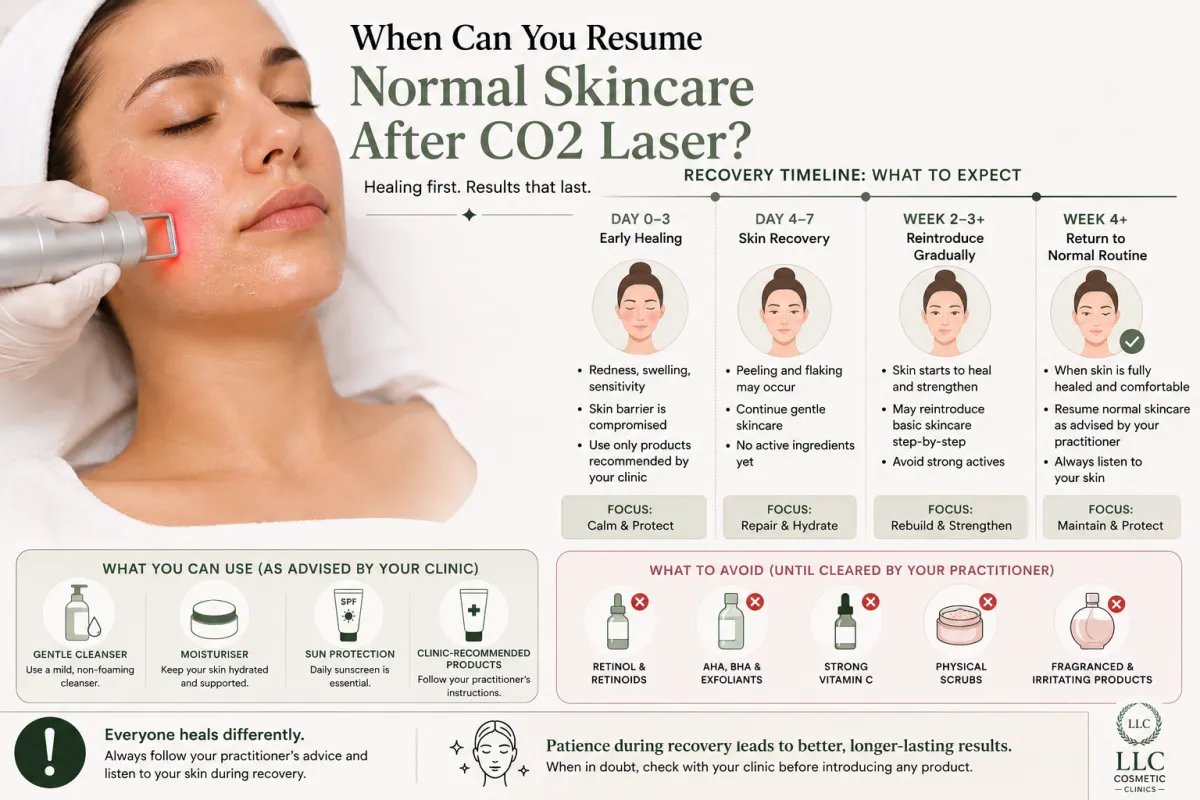
Skincare After CO2 Laser: When to Resume Retinol & Makeup
After CO2 laser treatment, you may be eager to get back to your usual skincare routine.
But one of the most important parts of recovery is knowing when to reintroduce your normal skincare products.
Products that your skin normally tolerates—including retinol, exfoliating acids and other active ingredients—may be too irritating while your skin is healing.
So, when can you resume normal skincare after CO2 laser?
There isn't one exact day that works for everyone. Your timeline depends on the type and intensity of your CO2 laser treatment, your skin's healing response and the advice provided by your practitioner.
The Quick Answer
A simplified recovery approach may look like this:
Immediately after treatment
Keep your routine simple and follow the specific aftercare instructions provided by your practitioner.
During the early healing period
Focus on the products recommended by your clinic. Avoid introducing unnecessary active ingredients.
Once the skin surface has healed
Your practitioner may gradually allow you to reintroduce some of your usual skincare products.
After recovery
You can generally work toward returning to your normal routine, provided your skin is comfortable and your practitioner has advised that it is appropriate.
Don't use the calendar alone to decide when your skin is ready.
Why Can't You Immediately Return to Your Normal Skincare?
CO2 laser resurfacing intentionally creates controlled injury in the skin.
During recovery, your skin barrier can be compromised and your skin may be more sensitive than usual.
As a result, products that normally feel comfortable may cause:
Stinging
Burning
Redness
Dryness
Irritation
This is why post-treatment skincare should generally be simpler than your usual routine.
What Skincare Can You Use After CO2 Laser?
Your practitioner may recommend a simple recovery routine based on the treatment performed.
This may include:
Gentle Cleansing
Use the cleanser recommended by your practitioner.
Avoid scrubbing, exfoliating brushes or aggressive cleansing while your skin is healing.
Moisturisation
A suitable moisturiser or barrier-supporting product may help keep the skin comfortable during recovery.
Sun Protection
Once your practitioner says sunscreen is appropriate, protecting your skin from UV exposure becomes an important part of your skincare routine.
Practitioner-Recommended Products
Your clinic may recommend specific products designed for post-treatment care.
Follow your clinic's instructions rather than adding multiple products yourself.
When Can You Restart Retinol After CO2 Laser?
Retinol and other retinoids can be irritating even when your skin is healthy.
After CO2 laser, your skin may be significantly more sensitive.
For this reason, your practitioner may recommend stopping retinol temporarily and waiting until the skin has sufficiently recovered before restarting it.
Don't restart retinol simply because the peeling has stopped.
Your skin may still be recovering beneath the surface.
Ask your practitioner when you can safely return to your retinoid routine.
When Can You Restart Vitamin C?
Vitamin C can be a useful ingredient in many skincare routines, but some formulations can cause irritation.
Immediately after CO2 laser, the priority is usually to support healing rather than introduce active ingredients.
Your practitioner can tell you when your skin is ready to gradually reintroduce vitamin C.
If a product burns or causes significant irritation, stop using it and contact your treating clinic for advice.
What About AHA and BHA Exfoliants?
Exfoliating acids such as AHA and BHA can be useful for some skincare routines, but they may be too irritating for freshly treated skin.
Your practitioner may advise avoiding:
Glycolic acid
Lactic acid
Salicylic acid
Strong exfoliating products
Physical scrubs
until your skin has recovered sufficiently.
The exact timing depends on your treatment and healing progress.
When Can You Use Your Normal Cleanser?
This depends on what your normal cleanser contains.
A basic, gentle cleanser may be introduced according to your practitioner's instructions relatively early in recovery.
However, cleansers containing exfoliating acids, retinoids or other potentially irritating ingredients may need to be avoided for longer.
Check the ingredients rather than assuming every cleanser is suitable.
When Can You Wear Makeup Again?
Makeup should not automatically be resumed as soon as you feel comfortable.
Your skin needs time to recover, and applying cosmetics too early may cause irritation.
Your practitioner should tell you when it is appropriate to resume makeup based on the treatment performed and the condition of your skin.
A Simple Way to Reintroduce Your Skincare
When your practitioner says your skin is ready, don't restart everything at once.
Instead, consider gradually reintroducing products.
Step 1 — Keep the routine simple
Start with gentle cleansing and moisturisation.
Step 2 — Add products gradually
Introduce one active product at a time.
Step 3 — Monitor your skin
Watch for increased redness, burning, stinging or irritation.
Step 4 — Follow professional advice
If your practitioner recommends waiting longer, follow their advice even if your skin appears mostly healed.
What If Your Skin Still Feels Sensitive?
If your skin is still:
Burning
Very dry
Extremely tight
Unusually red
Irritated
Tender
it may not be ready for your full skincare routine.
Don't feel pressured to return to active ingredients simply because you've reached a certain number of days after treatment.
Your skin's condition matters more than the calendar.
Can You Use Your Old Skincare Products After CO2 Laser?
Possibly, but you may need to introduce them gradually.
Products that were fine before treatment can temporarily become irritating.
This is particularly relevant for products containing:
Retinol
Retinoids
AHAs
BHAs
Strong vitamin C
Benzoyl peroxide
Other active ingredients
Ask your practitioner which products you should stop, when you can restart them and whether any should be avoided altogether.
Why Is Sun Protection So Important?
After resurfacing, your skin can be particularly sensitive to environmental exposure.
Your practitioner will advise you about when and how to use sunscreen during recovery.
Once you are cleared to use it, consistent sun protection can help protect your recovering skin.
It can also be important for reducing the risk of unwanted pigmentation changes following treatment.
What If a Product Burns or Stings?
Don't assume that burning or stinging means the product is working.
If your skin reacts strongly to a product during recovery, stop using it and ask your practitioner for advice.
Your clinic can determine whether the reaction is expected or whether your skincare routine needs to be adjusted.
When Can You Fully Return to Your Normal Routine?
There is no universal day when everyone can return to their complete skincare routine.
Recovery varies based on:
CO2 laser intensity
Fractional or more extensive resurfacing
Treatment area
Skin condition
Individual healing response
Products being used
A lighter treatment may have a different recovery timeline from a more intensive treatment.
That's why your practitioner should give you personalised instructions.
Final Takeaway
So, when can you resume normal skincare after CO2 laser?
The answer depends on how your skin heals and the intensity of your treatment.
During the early recovery period, keep your routine simple and use the products recommended by your practitioner. Avoid rushing back to retinol, exfoliating acids, strong vitamin C or other active ingredients.
Once your skin has sufficiently healed, your practitioner can guide you through gradually reintroducing your normal skincare routine.
When it comes to CO2 laser recovery, patience is part of the treatment.
If you're unsure whether your skin is ready for a particular product, check with your treating practitioner before using it.