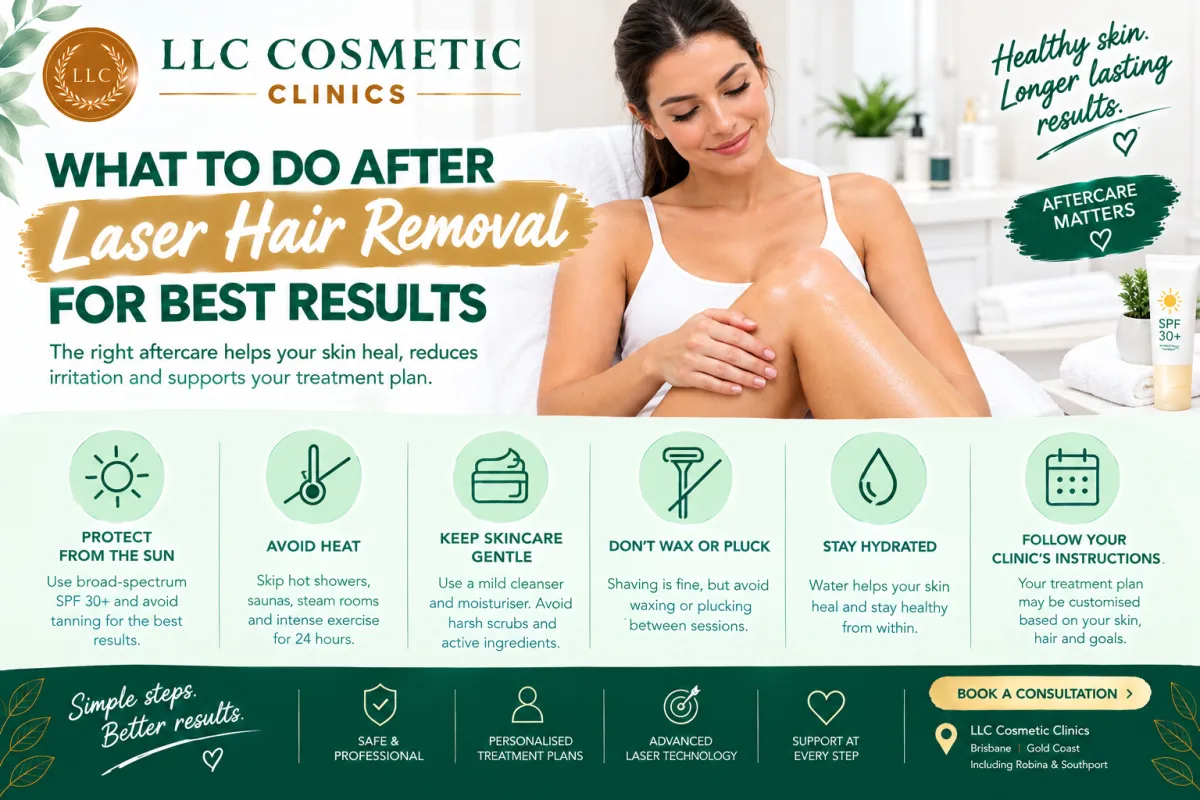
What to Do After Laser Hair Removal for Best Results
Laser hair removal can be a convenient way to reduce unwanted hair and spend less time shaving, waxing, or plucking. But what you do after each treatment matters too.
Your skin may be slightly red, warm, or sensitive immediately after laser hair removal. Giving the treated area the right care can help minimise irritation and protect your skin while your treatment plan progresses.
So, what should you do after laser hair removal for the best results?
The most important steps are simple: protect your skin from the sun, avoid excessive heat and irritation immediately after treatment, keep your skincare gentle, and follow the aftercare instructions provided by your clinic.
Here is what you should know.
What Happens to Your Skin After Laser Hair Removal?
After laser hair removal, it is normal for the treated area to look slightly pink or red and feel warm, similar to a mild sunburn.
Some people may also experience temporary swelling around the hair follicles. These effects usually settle relatively quickly. The American Academy of Dermatology notes that redness, swelling and discomfort are among the most common short-term effects of laser hair removal and often last around one to three days.
At LLC Cosmetic, mild redness after treatment typically settles within a few hours, although everyone's skin can respond differently.
This is why the first 24–48 hours are a good time to be especially gentle with your skin.
1. Protect Your Skin From the Sun
One of the most important things you can do after laser hair removal is limit direct sun exposure.
Laser-treated skin can be more sensitive, and excessive UV exposure may increase the risk of unwanted pigmentation changes.
The American Academy of Dermatology recommends protecting treated skin from direct sunlight and avoiding tanning beds or other indoor tanning equipment after laser hair removal.
If you need to go outside:
Apply broad-spectrum sunscreen.
Wear protective clothing where practical.
Seek shade when possible.
Avoid deliberately tanning the treated area.
Follow your clinic's specific sun-exposure instructions.
For areas such as the face, neck, arms and legs that are regularly exposed to sunlight, making sunscreen part of your everyday routine is particularly important.
2. Avoid Hot Showers, Saunas and Excessive Heat
Your skin may feel warm after treatment, so adding more heat immediately afterward isn't ideal.
For the first 24 hours, LLC Cosmetic recommends avoiding:
Very hot showers
Saunas
Steam rooms
Hot tubs
Intense exercise that causes significant overheating
The goal is to minimise additional heat and irritation while your skin settles.
A comfortably warm or cool shower is generally a better choice immediately after treatment.
3. Keep Your Skincare Routine Gentle
After laser hair removal, your skin may be temporarily more sensitive than usual.
This isn't the best time to experiment with aggressive skincare products.
For the first day or two, keep things simple:
Use a gentle cleanser.
Avoid harsh scrubs.
Avoid unnecessary exfoliation.
Don't rub or scratch the treated area.
Use a gentle moisturiser if your skin feels dry.
Follow any specific skincare instructions given by your practitioner.
If a particular skincare product normally causes stinging or irritation, it may be better to avoid it until your skin has settled.
Your clinician may also recommend temporarily avoiding certain active ingredients depending on the treatment area and your individual skin.
4. Don't Wax, Pluck or Thread Between Sessions
One of the biggest mistakes people make during a laser hair removal treatment course is removing the hair from the root between appointments.
Waxing, plucking and threading can remove the hair follicle target that the laser treatment is designed to act on.
If you need to manage visible regrowth between laser sessions, shaving is generally the preferred option.
This is one reason laser hair removal is different from waxing: you are not trying to pull the hair out from the root between treatments.
5. Shaving Is Usually Fine
Seeing hair after laser treatment doesn't necessarily mean your treatment hasn't worked.
Laser hair removal requires a series of treatments because hair grows in different cycles. Not every hair is in the same growth phase at the same time.
The American Academy of Dermatology explains that multiple treatments are typically needed, and results vary depending on factors such as hair colour, hair thickness, treatment area, skin colour and the laser used.
As the treatment course continues, some patients may notice that regrowth becomes finer, lighter or less noticeable.
If you need to remove hair between appointments, shaving is generally preferable to waxing or plucking.
6. Don't Pick or Scratch the Treated Area
It can be tempting to touch the skin if it feels warm, itchy or slightly irritated.
Try not to.
Scratching or picking at irritated skin can make the area more uncomfortable and may increase the chance of skin irritation or damage.
Instead, give your skin time to settle.
If your skin feels uncomfortable, a cool compress may help. The American Academy of Dermatology specifically notes that a cool compress can help relieve discomfort after laser hair removal.
Avoid applying ice directly to your skin.
7. Give Your Skin a Break From Friction
Immediately after treatment, minimise unnecessary rubbing and friction around the treated area.
For example, if you've had laser hair removal on the underarms, wearing loose, comfortable clothing may be more comfortable than tight clothing that repeatedly rubs against the area.
For bikini-area treatments, breathable and comfortable clothing can also help reduce irritation.
The goal isn't to completely change your lifestyle. It's simply to avoid unnecessary irritation while your skin is settling.
8. Follow Your Clinic's Specific Aftercare Instructions
Online advice can give you a general idea of what to expect, but your own treatment plan should always take priority.
Your recommended aftercare may depend on:
Your skin tone
The treatment area
Hair colour and thickness
The laser system used
Your previous treatments
Your skin's reaction to treatment
Any medications or skin conditions you have
This is particularly important if you have darker or more sensitive skin, a recent tan, a history of pigmentation changes, or a skin condition that could affect treatment.
A personalised approach helps your practitioner choose appropriate treatment settings and aftercare.
9. Be Patient With the Hair-Shedding Process
One common misconception is that all treated hair should disappear immediately.
That's not necessarily how laser hair removal works.
After treatment, some hairs may remain visible before they gradually shed. You may also notice regrowth between sessions because hair follicles are naturally operating on different growth cycles.
This doesn't automatically mean the treatment has failed.
Laser hair removal is generally performed as a series rather than a one-off appointment. The American Academy of Dermatology notes that many patients require multiple treatments, with treatment intervals commonly determined by the practitioner based on the area and individual response.
At LLC Cosmetic, treatment plans are personalised based on your skin, hair and treatment goals.
10. Keep Your Appointments on Schedule
Consistency matters when you're working toward longer-term hair reduction.
Skipping appointments or changing your treatment schedule without speaking with your clinician may make it harder to maintain an appropriate treatment plan.
The exact timing between sessions depends on the area being treated and your individual hair-growth cycle.
Rather than simply booking whenever you notice hair growing back, follow the schedule recommended by your practitioner.
Your clinician can assess your progress and determine when the next treatment is appropriate.
11. Don't Assume More Laser Means Better Results
It can be tempting to think that treating an area more frequently will make the hair disappear faster.
Laser hair removal doesn't work that way.
The treatment needs to be performed at appropriate intervals because hair follicles respond differently depending on their growth cycle.
Your practitioner should determine the appropriate timing rather than increasing treatment frequency on your own.
More treatment is not automatically better treatment.
12. Take Photos to Track Your Progress
Hair reduction can happen gradually, making it difficult to remember exactly how much hair you had at the beginning of your treatment course.
Taking consistent photos can help you and your clinician compare progress over time.
For the most useful comparison, try to:
Photograph the same area.
Use similar lighting.
Take photos from a similar distance.
Keep the angle consistent.
Follow your clinic's instructions about when to photograph the area.
Your clinician may also take baseline photos as part of your treatment assessment.
What Should You Avoid After Laser Hair Removal?
For the first 24 hours, a simple rule is: avoid unnecessary heat, friction and irritation.
Depending on your clinic's instructions, this may mean avoiding:
Hot showers
Saunas and steam rooms
Hot tubs
Very intense exercise
Excessive sun exposure
Tanning
Scrubbing the treated area
Picking or scratching the skin
LLC Cosmetic specifically advises avoiding hot showers, saunas and intense exercise for 24 hours after treatment.
Your practitioner may provide additional instructions depending on your treatment area and skin.
What If My Skin Looks Red After Laser Hair Removal?
Mild redness and warmth can be normal after laser hair removal.
The skin may look similar to a mild sunburn, and small areas around the hair follicles may appear temporarily raised or swollen.
This usually settles without significant downtime.
However, not every skin reaction should be ignored.
Contact your clinic if you experience symptoms that seem unusual, severe or are getting worse rather than improving.
The AAD notes that less common complications can include blistering, infection, scarring and changes in skin colour.
If you are concerned about your skin after treatment, it's better to contact your treating clinic rather than trying to diagnose the reaction yourself.
How Long After Laser Hair Removal Can You Exercise?
At LLC Cosmetic, clients are advised to avoid intense exercise for 24 hours after treatment.
This gives the treated skin time to settle and helps minimise additional heat and irritation.
If you're planning your appointment around your workout schedule, consider booking your laser session at a time when you can comfortably take the rest of the day away from strenuous exercise.
Can I Wear Makeup After Laser Hair Removal?
This depends on the treatment area and how your skin responds.
If you've had laser hair removal on the face and the skin feels sensitive, irritated or unusually warm, keeping the area clean and avoiding unnecessary products may be more comfortable.
Follow the specific instructions provided by your clinician.
Don't apply products simply because you normally use them if your practitioner has advised you to temporarily avoid them.
When Should You Have Your Next Laser Hair Removal Session?
Laser hair removal normally requires a series of treatments rather than one appointment.
The appropriate interval depends on the treatment area, your hair-growth cycle and how your skin responds.
The AAD notes that many patients have treatments spaced around four to six weeks apart, although your practitioner should determine the timing that is appropriate for you.
At LLC Cosmetic, your clinician can assess your progress and recommend when your next appointment should take place.
Your Simple After-Laser Hair Removal Checklist
If you want the short version, remember these basics after your appointment:
Immediately after treatment:
Keep the area clean.
Be gentle with your skin.
Avoid unnecessary rubbing or scratching.
Use a cool compress if needed for temporary discomfort.
For the first 24 hours:
Avoid hot showers.
Avoid saunas and steam rooms.
Avoid intense exercise.
Avoid unnecessary heat and friction.
During your treatment course:
Protect your skin from the sun.
Use appropriate sunscreen on exposed areas.
Don't wax or pluck treated hair.
Shave when necessary.
Attend your scheduled sessions.
Follow your clinician's individual aftercare instructions.
The Bottom Line: Aftercare Is Part of Your Treatment
Getting laser hair removal isn't just about what happens during the few minutes you're under the laser.
What you do afterward can also help protect your skin and support your overall treatment plan.
The most important habits are simple: protect your skin from the sun, avoid excessive heat immediately after treatment, keep your skincare gentle, don't wax or pluck between sessions, and follow your clinic's personalised advice.
Laser hair removal results can vary from person to person, so it's important to have realistic expectations and work with an appropriately trained professional.
At LLC Cosmetic Laser Clinics, consultations can be used to assess your skin and hair characteristics, discuss your goals and develop a personalised treatment plan.
With clinics in Brisbane CBD, Sunnybank, Southport and Robina, you can choose the location that works best for you.
Ready to start your laser hair removal journey?
Book a consultation with LLC Cosmetic Laser Clinics and find out what treatment plan may be right for your skin and hair.