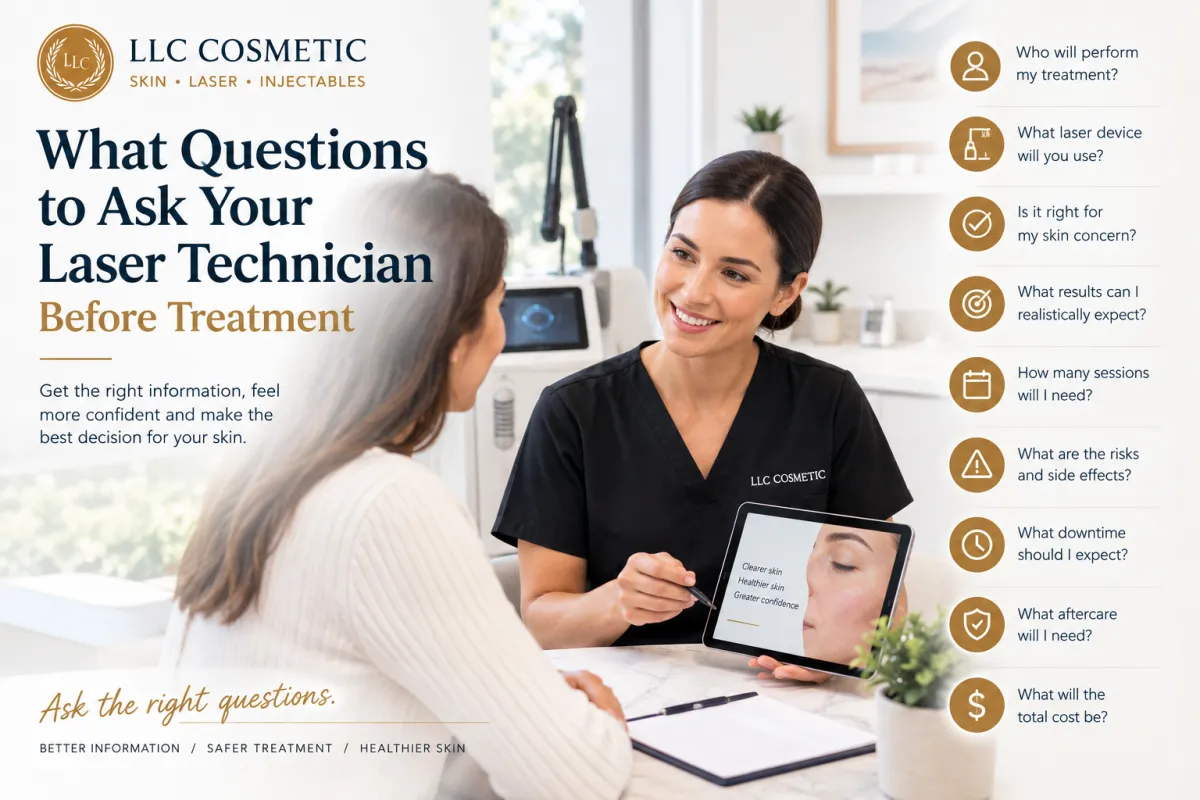
What Questions to Ask Your Laser Technician Before Treatment
Booking a laser treatment can be exciting, but choosing a treatment should involve more than checking the price or looking at before-and-after photos.
Before you book, you should understand who will perform the treatment, whether the treatment is appropriate for your skin, what results are realistic, what risks are involved and what you need to do before and after your appointment.
The American Academy of Dermatology recommends asking about the practitioner's experience, realistic results, risks, number of treatments, recovery, preparation and cost before undergoing a cosmetic procedure.
If you're considering PICO laser, CO₂ resurfacing, pigmentation treatment, tattoo removal or another laser procedure, these are some of the most useful questions to take with you to your consultation.
1. Who Will Actually Perform My Laser Treatment?
This should be one of your first questions.
Don't assume that the person who conducts your consultation will necessarily be the person operating the laser.
Ask:
"Who will actually perform my treatment?"
Then ask about their:
Qualifications
Relevant laser training
Experience with the specific treatment
Experience with your skin type
Experience with the particular device being used
Clinical supervision, where applicable
The skill and experience of the person performing a laser procedure can have a significant impact on safety and results. The AAD specifically recommends asking about the practitioner's experience with the exact procedure and whether they regularly treat people with your skin type.
A useful follow-up question
"How often do you perform this particular laser treatment?"
Someone may have experience with cosmetic treatments generally but much less experience with the specific laser procedure you're considering.
2. What Specific Laser or Device Will You Be Using?
"PICO laser", "CO₂ laser" or "laser treatment" can describe a category of technology rather than one identical treatment.
Ask:
"What device will you be using?"
And if appropriate:
"Which wavelength or treatment mode will you use, and why?"
The answer should relate to what you're actually trying to treat.
For example, treating pigmentation isn't necessarily the same as treating tattoo ink, while CO₂ resurfacing for acne scars isn't the same procedure as a pigment-focused PICO treatment.
LLC Cosmetic's current PICO consultation information recommends discussing the device, wavelengths, treatment settings and why a particular approach has been selected for your concern.
3. Is This Actually the Right Treatment for My Skin Concern?
This is one of the most important questions you can ask.
Don't start with:
"I want PICO laser. When can I book?"
Instead, ask:
"Is this the best treatment for what I'm trying to improve?"
There may be more than one way to approach a cosmetic concern.
For example, LLC Cosmetic currently positions PICO treatments around concerns such as pigmentation, sun spots and uneven tone, while CO₂ resurfacing is used for concerns including acne scarring, texture and fine lines.
The appropriate treatment depends on the actual concern, your skin and your goals.
A good consultation should be about determining suitability rather than simply confirming the treatment you originally searched for.
4. What Results Can I Realistically Expect?
Be careful with promises of perfect or guaranteed results.
Ask:
"What improvement is realistic for my skin?"
You can also ask:
What should improve?
What probably won't change?
How long will results take?
Will I need multiple treatments?
Could the condition come back?
What happens if I don't respond as expected?
The AAD recommends asking what results you can realistically expect and, where appropriate, reviewing before-and-after photographs of patients with similar skin characteristics.
This is particularly important for conditions such as pigmentation and melasma, where improvement does not necessarily mean permanent clearance.
5. How Many Treatments Will I Need?
Don't be surprised if the answer isn't a single number.
Ask:
"How many sessions do you expect I'll need, and what determines that?"
The number of treatments can depend on:
Your specific concern
Severity
Treatment area
Skin type
Pigment or tattoo characteristics
Treatment settings
How your skin responds
Whether maintenance treatments are needed
For some laser treatments, a series of sessions is commonly used rather than relying on one appointment. The AAD notes that multiple treatments may be necessary for certain cosmetic laser procedures.
If you're being offered a package, ask how the recommended number of sessions was determined.
6. What Are the Risks and Possible Side Effects?
Every laser treatment has potential risks.
Ask directly:
"What are the most common side effects, and what are the more serious risks?"
Depending on the treatment, possible effects can include:
Redness
Swelling
Sensitivity
Temporary pigmentation changes
Hyperpigmentation
Hypopigmentation
Burns
Blistering
Infection
Scarring
The exact risks vary considerably depending on the laser, treatment area, settings and individual skin characteristics.
The AAD warns that laser procedures can cause burns, permanent skin-colour changes and scarring when performed improperly, which is why practitioner experience and appropriate assessment matter.
Don't be afraid to ask:
"What is my personal risk of pigmentation changes or other complications?"
7. Is My Skin Type Suitable for This Treatment?
Your skin type matters.
Ask:
"Have you treated people with my skin tone and skin type before?"
This is particularly important if you have a darker skin tone or a history of pigmentation after cosmetic treatments.
The AAD notes that darker skin can have a greater risk of burns and dark marks following some laser treatments and recommends working with practitioners experienced in treating darker skin with lasers.
Your practitioner should consider your individual skin rather than assuming that the same settings are appropriate for everyone.
8. Do I Have a Higher Risk of Pigmentation Changes?
This deserves its own question if you're prone to pigmentation.
Ask:
"Am I at higher risk of hyperpigmentation or hypopigmentation?"
Tell your practitioner if you have previously experienced:
Dark marks after acne
Pigmentation after wounds
Pigmentation after previous laser treatments
Post-inflammatory hyperpigmentation
Melasma
Abnormal scarring
Changes in skin colour following cosmetic procedures
Your history can help your practitioner determine whether a particular treatment is appropriate and how cautiously it should be approached.
9. Do I Need a Test Patch or Test Spot?
Depending on the treatment, a practitioner may recommend testing a small area before treating a larger area.
Ask:
"Would you recommend a test spot for me?"
This can be particularly relevant when the response of the pigment or skin is uncertain.
LLC Cosmetic's current consultation guidance describes patch testing or trial settings as an option when needed as part of treatment planning.
A test spot isn't necessarily required for every treatment, so ask why it is or isn't being recommended in your particular situation.
10. Do I Need to Stop Any Skincare Products Before Treatment?
Your skincare routine can be relevant to laser treatment.
Tell your practitioner about everything you're currently using, including:
Retinoids
Acids
Exfoliants
Prescription creams
Pigment treatments
Strong active ingredients
At-home devices
Then ask:
"Is there anything I should stop using before my treatment, and when should I stop?"
Don't automatically stop prescription medication or prescribed skincare without professional advice.
The AAD recommends telling your practitioner about medications, supplements and skincare products because some can affect skin sensitivity or healing.
11. How Much Sun Exposure Should I Avoid Before Treatment?
This is particularly relevant for anyone living in Australia.
Ask:
"How much sun exposure should I avoid before my appointment?"
Also tell your practitioner if you've recently:
Been on a beach holiday
Spent long periods outdoors
Used a tanning bed
Developed a tan
Had sunburn
The AAD recommends avoiding tanning and protecting your skin from sun exposure around laser treatments. Treating recently tanned or sunburned skin can increase the risk of complications.
12. What Will the Treatment Feel Like?
You shouldn't have to guess what the procedure will feel like.
Ask:
"What should I expect to feel during the treatment?"
Depending on the laser and area, you might experience sensations such as:
Warmth
Tingling
Snapping sensations
Stinging
Heat
Temporary discomfort
You can also ask:
"Will you use cooling or numbing?"
LLC Cosmetic's current PICO information states that settings can be adjusted according to skin type and tolerance, with numbing cream available when preferred.
13. How Much Downtime Should I Expect?
Don't simply ask:
"Is there downtime?"
Ask for specifics.
For example:
"When can I return to work, exercise, makeup, swimming and normal skincare?"
Recovery varies considerably depending on the treatment.
A non-ablative laser treatment may have relatively little downtime, while more intensive resurfacing treatments can involve peeling, redness and a longer recovery period.
The AAD recommends asking about typical recovery time before undergoing a cosmetic procedure.
14. What Will My Skin Look Like Immediately Afterwards?
Ask:
"What should my skin look and feel like immediately after treatment?"
Knowing what is normal can make recovery much less stressful.
Your practitioner should explain what you might experience and which changes would require you to contact the clinic.
LLC Cosmetic's current consultation guidance recommends discussing potential side effects and recovery timelines before treatment.
15. What Aftercare Will I Need?
Ask:
"What exactly do I need to do after treatment?"
Your aftercare may include instructions about:
Cleansing
Moisturising
Sun protection
Makeup
Exercise
Heat exposure
Swimming
Active skincare
Retinoids and exfoliants
When to return for review
Follow the instructions provided for your particular treatment rather than relying on generic advice from social media.
The AAD emphasises following post-treatment care instructions because appropriate aftercare can help reduce complications and support recovery.
16. What Happens If I Have a Problem After Treatment?
This is a question many people forget to ask.
Ask:
"Who do I contact if I have an unexpected reaction after treatment?"
You should know:
Who to contact
During what hours
What symptoms are considered normal
What symptoms require review
Whether follow-up appointments are included
What happens if you need additional assessment
This is especially important for procedures that can produce significant skin changes.
17. How Will You Monitor My Results?
Ask:
"How will we know whether the treatment is working?"
A clinic may use:
Standardised photographs
Clinical assessment
Skin analysis
Follow-up appointments
Your description of changes
Comparison over multiple sessions
LLC Cosmetic's current PICO consultation information describes photography and ongoing assessment as part of treatment planning and progress monitoring.
This is useful because results should be assessed over time rather than judged immediately after a procedure.
18. Can I See Before-and-After Photos of Similar Cases?
Before-and-after photos can be useful, but ask for relevant examples.
Instead of simply asking:
"Can I see your best results?"
Ask:
"Do you have examples involving someone with a similar skin type and the same concern I'm treating?"
The AAD specifically recommends asking to see before-and-after photographs of patients with similar skin tone and type where appropriate.
Also ask:
How many sessions did they have?
How long after treatment was the "after" photo taken?
Were other treatments involved?
Is the lighting comparable?
This gives you more useful context than a single impressive photograph.
19. What Will the Total Cost Be?
Price is important, but the total treatment plan is more useful than the price of one session.
Ask:
"What is the expected total cost for the treatment plan you are recommending?"
You can also ask:
Is the consultation free?
Is each session charged separately?
Are there packages?
Are follow-up appointments included?
Are numbing or additional products charged separately?
Could I need additional treatments?
What happens if I need to change the treatment plan?
The AAD recommends discussing cost before a cosmetic procedure rather than making assumptions about the total expense.
20. What Happens If This Treatment Isn't Right for Me?
This may be the most revealing question of all.
Ask:
"If you don't think this treatment is appropriate for me, what would you recommend instead?"
A proper consultation should be about suitability, not simply selling the treatment you originally requested.
LLC Cosmetic's current PICO consultation information describes assessment of skin type, medical history, treatment goals and previous treatments before determining whether PICO is appropriate.
Sometimes the right answer may be:
A different laser
A different cosmetic treatment
A different skincare approach
Treatment at a later date
Further medical assessment
No treatment at all
That information can be more valuable than being told "yes" immediately.
A Simple Laser Consultation Checklist
Save these questions before your appointment:
Practitioner
Who will perform my treatment?
What qualifications and laser training do they have?
How experienced are they with this particular treatment?
Have they treated people with my skin type?
Treatment
Is this the right treatment for my concern?
What device and wavelength will be used?
Why is this treatment being recommended?
Would another treatment be more appropriate?
Safety
What are the potential side effects?
Am I at higher risk of pigmentation changes?
Do I need a test spot?
Are there any medications or skin conditions that affect my suitability?
Results
What improvement is realistic?
How many sessions might I need?
When should I expect to see changes?
Could the concern return?
Recovery
How much downtime should I expect?
What will my skin look like afterwards?
What should I avoid?
What aftercare do I need?
Cost
What is the cost per session?
What is the estimated total cost?
Are there additional fees?
Follow-up
How will my progress be monitored?
Who do I contact if I have a reaction?
When should I return for review?
Why Asking Questions Matters
Laser treatments can look straightforward from the outside.
A device is placed against the skin, pulses are delivered and the appointment may be over relatively quickly.
But the decision-making behind the treatment can be much more important.
The practitioner needs to consider your skin, concern, treatment history, medications, expectations and risk factors when deciding whether and how treatment should be performed. The AAD emphasises that consultation, practitioner experience, realistic expectations and understanding risks are important parts of cosmetic laser treatment.
That's why a good consultation shouldn't feel like a sales pitch.
You should leave understanding:
What we're treating.
Why we're treating it this way.
What results are realistic.
What the risks are.
What recovery involves.
What the treatment is expected to cost.
Final Takeaway
Knowing what questions to ask your laser technician can help you make a more informed decision before committing to treatment.
You don't need to know everything about lasers yourself.
Instead, ask the right questions about the practitioner, device, suitability, expected results, risks, number of sessions, downtime, aftercare and total cost.
And don't be afraid to ask:
"Is this actually the right treatment for me?"
A good consultation should give you enough information to understand your options and decide whether you want to proceed.
At LLC Cosmetic, the current consultation process includes assessment of your skin concern, history, suitability and treatment goals before a personalised plan is developed.
FAQs
What should I ask my laser technician before treatment?
Ask about their qualifications and experience, the laser device being used, whether the treatment is suitable for your skin, expected results, risks, number of sessions, downtime, aftercare and total cost.
How do I know if my laser technician is qualified?
Ask who will perform the treatment, what relevant training they have completed, how frequently they perform the procedure and whether they have experience treating your skin type and specific concern. Requirements can vary depending on the treatment and jurisdiction.
Should I ask about the laser machine?
Yes. Ask what device is being used, why it has been selected for your concern and, where relevant, which wavelength or treatment mode will be used.
What should I ask about laser side effects?
Ask about both common temporary effects and less common complications. You should also ask whether your skin type, medical history or previous treatments increase your individual risk.
Should I ask how many laser sessions I need?
Yes. Ask for an estimated range and, more importantly, ask what factors could change the number of sessions you need. Some laser treatments require a series of appointments.
What should I ask about laser downtime?
Ask how long redness, swelling or other expected effects may last and when you can return to normal activities, exercise, makeup and your usual skincare routine.
Should I ask about before-and-after photos?
Yes. If photographs are available, ask to see examples involving a similar skin type and the same or a similar concern. The AAD recommends considering this when evaluating cosmetic treatment expectations.
What if the laser technician says I am not suitable?
That isn't necessarily a bad outcome. A responsible consultation should identify when a treatment isn't appropriate and, where possible, explain whether another approach or a later treatment date should be considered.