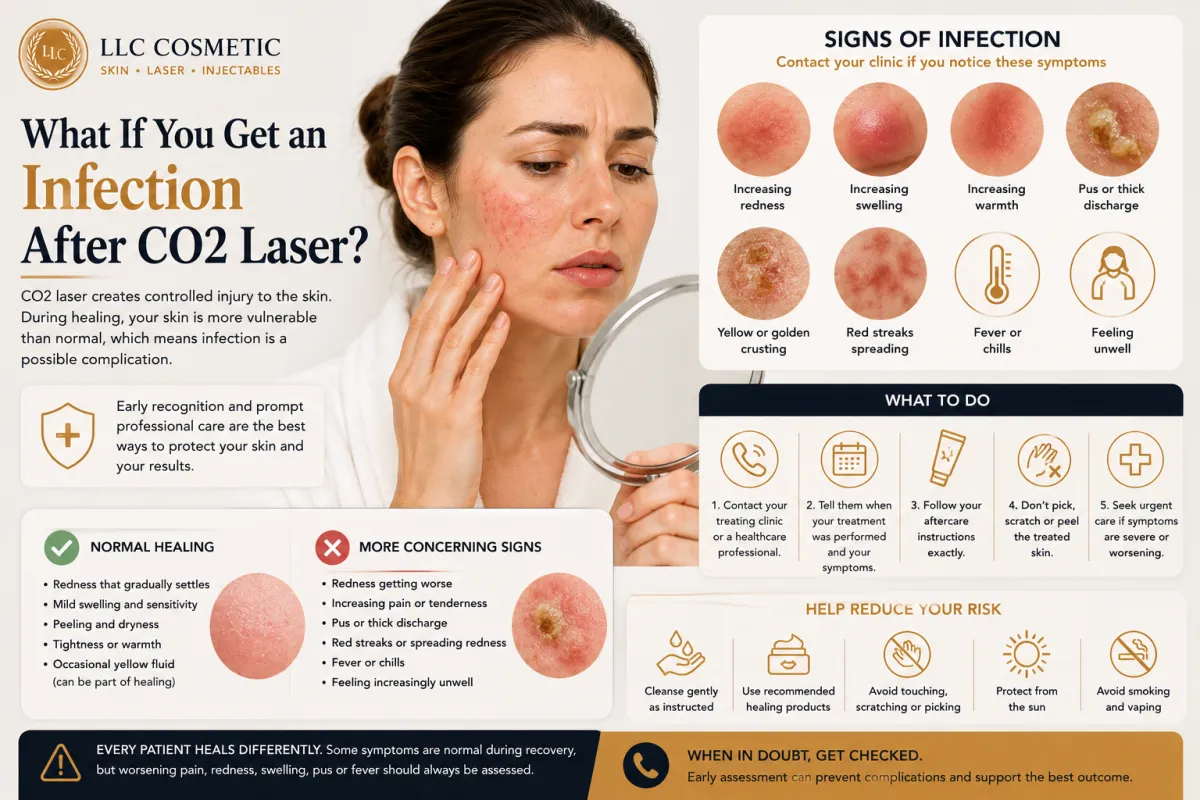
Infection After CO2 Laser: Warning Signs vs Normal Recovery
CO2 laser resurfacing can improve skin texture, acne scars, wrinkles and other signs of skin damage, but it also creates a controlled injury to the skin. During the healing period, the treated area is more vulnerable than normal, which means infection is a possible complication.
So, what if you get an infection after CO2 laser?
The most important thing is not to ignore signs that your recovery may be abnormal.
Some redness, swelling, warmth, sensitivity, peeling and even some drainage can be part of normal CO2 laser recovery. However, symptoms that are becoming worse rather than better — particularly increasing pain, warmth, swelling, pus, spreading redness or fever — can indicate infection and should be assessed by a healthcare professional.
If you are concerned that your CO2-treated skin may be infected, contact your treating clinic or an appropriate healthcare professional promptly rather than trying to diagnose or treat the infection yourself.
Quick Answer: What Should You Do If You Think Your CO2 Laser Skin Is Infected?
If you suspect an infection after CO2 laser:
Contact your treating clinic or healthcare professional.
Tell them when your treatment was performed and what symptoms have developed.
Follow the aftercare instructions you were given.
Don't pick, scratch or peel the treated skin.
Don't add antibiotics, antiseptics or other active products unless advised by a healthcare professional.
Seek urgent medical attention if you develop severe or rapidly worsening symptoms.
Infection after laser resurfacing can include bacterial infection or reactivation of herpes simplex. DermNet lists localised bacterial infections and herpes simplex among possible complications of CO2 laser treatment.
The safest approach is early professional assessment rather than waiting to see whether an infection gets worse.
Is Infection Normal After CO2 Laser?
No. Infection is a possible complication, but it isn't something you should simply assume is part of normal recovery.
CO2 laser resurfacing intentionally creates controlled injury in the skin. During recovery, the skin can be red, swollen, tender and sensitive.
Cleveland Clinic explains that after laser resurfacing, redness, swelling, itching and stinging can last for several days. Depending on the treatment, the skin may also appear raw, ooze yellow fluid or blister.
These symptoms can make it difficult to tell the difference between normal healing and infection.
That's why changes in the pattern of your recovery matter.
For example:
Expected: redness and swelling gradually settling.
More concerning: redness, warmth, swelling or pain that is increasing rather than improving.
What Does an Infection After CO2 Laser Look Like?
Possible warning signs include:
Increasing redness
Increasing warmth
Increasing swelling
Increasing pain or tenderness
Pus or thick discharge
Yellow or golden crusting
Red streaks extending away from the treated area
Fever
Chills or feeling generally unwell
A wound that isn't healing as expected
The American Academy of Dermatology lists pus, yellow or golden crusts, pain, redness, swelling, warmth, red streaks and fever among signs that a wound may be infected.
Cleveland Clinic similarly identifies pus, increasing warmth, spreading redness and significant pain as reasons to seek medical assessment for a potentially infected wound.
CO2 Laser Redness vs Infection: What's the Difference?
This is one of the most important questions during recovery.
Redness alone doesn't necessarily mean infection.
After CO2 laser resurfacing, redness is expected. Cleveland Clinic notes that the treated skin may remain pink or red for weeks or even longer, depending on the treatment.
The question is whether the redness is following the expected recovery pattern.
More consistent with normal recovery
Your skin may have:
Redness
Mild to moderate swelling
Sensitivity
Warmth
Tightness
Peeling
Dryness
These symptoms can occur during normal healing.
More concerning for infection
You may notice:
Redness becoming increasingly intense
Redness spreading beyond the treated area
Increasing warmth
Increasing pain
Pus
Unusual discharge
Fever or chills
Feeling increasingly unwell
If you're unsure, don't try to diagnose the problem from photographs or online articles. Contact your treating practitioner.
Is Yellow Fluid After CO2 Laser Always an Infection?
No.
This is an important distinction.
Cleveland Clinic notes that laser-treated skin can sometimes appear raw and ooze yellow liquid during recovery.
Therefore, the presence of some yellowish fluid alone doesn't automatically prove that you have an infection.
However, thick or purulent drainage can be a sign of infection. Cleveland Clinic describes purulent drainage as thick, milky discharge that commonly indicates infection and requires prompt medical attention.
This is another reason why the overall pattern of symptoms matters.
If drainage is increasing, becomes thick or foul-smelling, or occurs together with worsening pain, warmth, swelling or fever, contact your healthcare provider.
Can CO2 Laser Cause a Bacterial Infection?
Yes.
Bacterial infection is a recognised complication of CO2 laser resurfacing.
DermNet lists localised bacterial skin infections among the moderate complications of carbon dioxide laser treatment and also describes more serious disseminated bacterial infections as possible severe complications.
This doesn't mean that an infection will happen after treatment.
It means that patients should understand the warning signs and know when to seek professional assessment.
Can CO2 Laser Trigger a Cold Sore?
Yes.
CO2 laser resurfacing can reactivate herpes simplex virus, particularly when treatment is performed around the mouth.
Cleveland Clinic identifies herpes simplex reactivation as a potential complication of laser resurfacing.
DermNet also lists herpes simplex as a possible complication of CO2 laser treatment.
This is important because a herpes outbreak can look different from a typical bacterial infection.
If you have a history of cold sores, tell your practitioner before your treatment. Depending on the procedure and your individual circumstances, your healthcare professional may consider antiviral prevention.
What Are the Signs of a Herpes Infection After CO2 Laser?
Herpes reactivation can produce:
Burning or tingling
Painful clustered blisters
Fluid-filled lesions
Crusting
Localised irritation
Because herpes can require specific antiviral treatment, don't assume that every blister or unusual lesion is simply part of CO2 laser recovery.
Contact your treating practitioner promptly if you develop new blistering or lesions, particularly around the mouth or treatment area.
When Does Infection Usually Become Noticeable?
There isn't one universal day when an infection after CO2 laser will appear.
Your recovery depends on:
Treatment intensity
Laser settings
Treatment area
Fractional versus more extensive resurfacing
Your individual healing response
Your medical history
Aftercare
Rather than focusing on a particular day, monitor the direction of your recovery.
If your skin is gradually settling, that is different from skin that initially seemed to be healing but then becomes increasingly painful, swollen, warm or inflamed.
Can Picking Your Skin Cause an Infection?
Yes, picking or scratching healing skin can increase the risk of complications.
Cleveland Clinic specifically advises patients not to scratch or pick at crusting after laser resurfacing because doing so can cause scarring or lead to infection.
After CO2 laser, you may notice:
Dryness
Flaking
Peeling
Crusting
It can be tempting to remove the peeling skin.
Try not to.
Allow the skin to heal according to your practitioner's instructions.
What Should You Do If You Accidentally Picked Your CO2 Laser Skin?
Don't panic.
One accidental touch doesn't automatically mean you've caused an infection.
However:
Stop picking or scratching.
Wash your hands before touching the area.
Follow your clinic's cleansing instructions.
Don't aggressively rub the skin.
Don't pull off additional crusting.
Monitor the area for unusual changes.
If the area becomes increasingly painful, swollen, warm, red or produces pus, contact your treating clinic or healthcare professional.
Should You Put Antibiotic Cream on an Infection?
Don't automatically self-treat with antibiotic cream.
The American Academy of Dermatology explains that most minor wounds don't require topical antibiotics and that unnecessary antibiotic ointments can cause skin irritation or allergic reactions.
If a healthcare professional determines that you have an infection, they can decide whether treatment is required and which treatment is appropriate.
The correct treatment depends on the type and severity of the infection.
Don't use leftover antibiotics or someone else's prescription.
Do You Need Oral Antibiotics After CO2 Laser?
Not necessarily.
Whether antibiotics are appropriate depends on the procedure, the patient's circumstances and whether an infection is actually present.
DermNet notes that some patients may be prescribed antibiotics as part of postoperative care, while Cleveland Clinic describes antibiotic use in certain laser resurfacing protocols.
This does not mean that every person having CO2 laser needs antibiotics.
Your treating clinician should determine whether antibiotics are appropriate.
Can You Prevent Infection After CO2 Laser?
You can't guarantee that an infection won't occur, but appropriate aftercare can help reduce avoidable risks.
Your clinic may provide instructions involving:
Gentle cleansing
Follow the exact cleansing routine recommended for your procedure.
Appropriate wound care
Use only the products recommended by your practitioner.
Avoid touching
Wash your hands before touching treated skin and avoid unnecessary manipulation.
Don't pick
Allow crusting and peeling skin to heal naturally.
Avoid irritating skincare
Don't introduce acids, retinoids or other potentially irritating products until your practitioner says it's appropriate.
Follow activity restrictions
Your practitioner may recommend avoiding activities that cause excessive heat, sweating or flushing during early recovery.
Protect your skin
Once the skin has healed sufficiently, use appropriate sun protection.
Cleveland Clinic recommends careful wound care after laser resurfacing and daily broad-spectrum sunscreen after the treated skin has healed.
Can Poor Aftercare Cause Infection?
Poor aftercare can potentially increase the risk of complications.
For example, repeatedly touching, scratching or picking the treated skin can interfere with healing and potentially introduce bacteria.
Cleveland Clinic specifically warns against scratching or picking crusted skin after laser resurfacing because it can cause infection or scarring.
However, an infection isn't necessarily your fault.
Even when someone follows aftercare instructions carefully, complications can still occur.
That's why recognising symptoms and contacting your practitioner when something seems abnormal is important.
What Should You Avoid During CO2 Laser Recovery?
Depending on your practitioner's protocol, you may be instructed to avoid:
Picking or scratching
Aggressive exfoliation
Retinoids
Glycolic acid and other strong acids
Irritating skincare
Excessive sun exposure
Activities that cause significant flushing
Smoking
Cleveland Clinic advises avoiding aggressive facial treatments and irritating topical products during the early recovery period and notes that smoking can slow healing.
Your own practitioner's instructions should take priority because recovery recommendations can vary depending on the treatment.
When Should You Contact Your CO2 Laser Clinic?
Contact your treating clinic if you notice symptoms that concern you, especially if they are getting worse rather than better.
Examples include:
Increasing pain
Increasing redness
Increasing swelling
Increasing warmth
Pus
Thick or unusual drainage
New blisters
Fever
Chills
Red streaks
Delayed or abnormal healing
Your practitioner knows the treatment settings and products used during your procedure, so they are in the best position to assess whether your recovery appears normal.
When Is an Infection an Emergency?
Some symptoms require more urgent medical assessment.
Seek urgent medical attention if you develop:
Severe or rapidly worsening pain
Rapidly spreading redness or swelling
High fever or significant chills
Severe weakness or feeling very unwell
Extensive blistering
Significant facial swelling
Eye symptoms following treatment near the eyes
Difficulty breathing or other severe systemic symptoms
The American Academy of Dermatology notes that severe cellulitis can cause intense pain, fever, chills, fatigue and other systemic symptoms.
If you believe you have a medical emergency, seek emergency medical care rather than waiting for a cosmetic clinic appointment.
How Is an Infection After CO2 Laser Treated?
Treatment depends on what type of infection is present.
A healthcare professional may need to determine whether the problem is:
Bacterial
Viral, such as herpes simplex
Fungal
Something other than an infection
DermNet lists bacterial infection, herpes simplex and Candida infection among potential complications of CO2 laser treatment.
Because the treatments can be different, it is important not to assume that every infection should be treated with an antibiotic.
Your clinician may examine the treated area and determine the appropriate treatment based on the findings.
Will an Infection Ruin Your CO2 Laser Results?
An infection can interfere with normal healing and may increase the risk of complications such as scarring or prolonged inflammation.
DermNet lists scarring and severe infections among possible complications of CO2 laser treatment.
However, developing a possible infection does not automatically mean your final result will be ruined.
The important step is recognising concerning symptoms and getting appropriate medical assessment as soon as possible.
Early professional guidance can help determine what is happening and what treatment, if any, is required.
Can You Continue Using Healing Cream If You Think You Have an Infection?
Don't make major changes to your aftercare routine without speaking with your practitioner.
The appropriate wound-care product can depend on the stage of healing and the treatment performed.
Cleveland Clinic describes the use of occlusive moisturisers or petroleum jelly as part of wound care after laser resurfacing.
But if you suspect an infection, contact your clinic rather than simply applying more product to cover the symptoms.
Your practitioner can tell you whether to continue, change or stop a particular product.
What About Makeup After CO2 Laser?
Don't rush back to makeup while the treated surface is still healing unless your practitioner specifically says it's appropriate.
Cleveland Clinic advises that makeup can be used after the treated areas have healed, including oil-free makeup to camouflage residual redness.
Applying makeup too early or aggressively removing it can irritate healing skin.
If you're concerned about infection, prioritise professional assessment over trying to cover the appearance with cosmetics.
How Long Does CO2 Laser Skin Take to Heal?
Recovery depends on the treatment.
Cleveland Clinic states that areas treated with CO2 laser generally heal within approximately 10–21 days, depending on the condition treated and the intensity of the laser settings.
That doesn't mean all redness disappears within three weeks.
Residual redness can continue after the surface has healed, and Cleveland Clinic notes that redness can sometimes persist for several months.
Therefore:
Surface healing ≠ complete recovery.
Your skin may continue to change after the initial healing period.
How Can You Tell If Your Skin Is Healing Normally?
Instead of comparing your skin to another person's photos, look at your own recovery pattern.
Ask yourself:
Is the redness gradually settling?
Is swelling improving?
Is discomfort becoming easier to manage?
Is the treated surface progressing through the expected healing stages?
If yes, this may be consistent with normal recovery.
If symptoms are suddenly worsening, particularly after initially improving, contact your practitioner.
Final Takeaway
So, what if you get an infection after CO2 laser?
Don't ignore it and don't try to diagnose it yourself.
CO2 laser resurfacing can naturally cause redness, swelling, sensitivity, peeling and other visible changes during recovery. However, increasing pain, warmth, swelling, spreading redness, pus, unusual drainage, fever or feeling unwell can be warning signs that need professional assessment.
The best approach is to:
Follow your clinic's aftercare instructions
Avoid picking or scratching your skin
Keep the treated area appropriately cared for
Don't add antibiotics or unfamiliar products without professional advice
Contact your treating practitioner if your recovery seems abnormal
Seek urgent medical care for severe or rapidly worsening symptoms
CO2 laser recovery is a process, and not every red or swollen area is an infection. But when symptoms are getting worse instead of better, it's better to have your skin assessed than to wait and see.
Frequently Asked Questions
Is infection common after CO2 laser?
Infection is a recognised complication of CO2 laser resurfacing, but it is not considered a normal part of healing. DermNet lists bacterial infection and herpes simplex among potential complications.
How do I know if my CO2 laser is infected?
Warning signs can include increasing redness, warmth, swelling, pain, pus, unusual discharge, red streaks and fever.
Is yellow fluid normal after CO2 laser?
Some yellowish drainage can occur during normal healing, so yellow fluid alone doesn't prove infection. However, thick or purulent discharge, particularly with worsening symptoms, should be assessed.
Can CO2 laser cause herpes?
Yes. Herpes simplex can reactivate after laser resurfacing, particularly around the mouth.
Should I use antibiotic cream after CO2 laser?
Don't automatically use an antibiotic cream. The American Academy of Dermatology notes that many wounds don't require topical antibiotics and that unnecessary antibiotic products can cause irritation or allergic reactions.
Can picking my skin after CO2 laser cause infection?
Picking or scratching treated skin can interfere with healing and increase the risk of infection and scarring.
When should I contact my clinic after CO2 laser?
Contact your treating clinic if you develop worsening pain, redness, swelling, warmth, pus, unusual drainage, blistering or other symptoms that concern you.
Can an infection affect my CO2 laser results?
Potentially. Infection can interfere with healing and increase the risk of complications such as scarring, so prompt assessment is important.