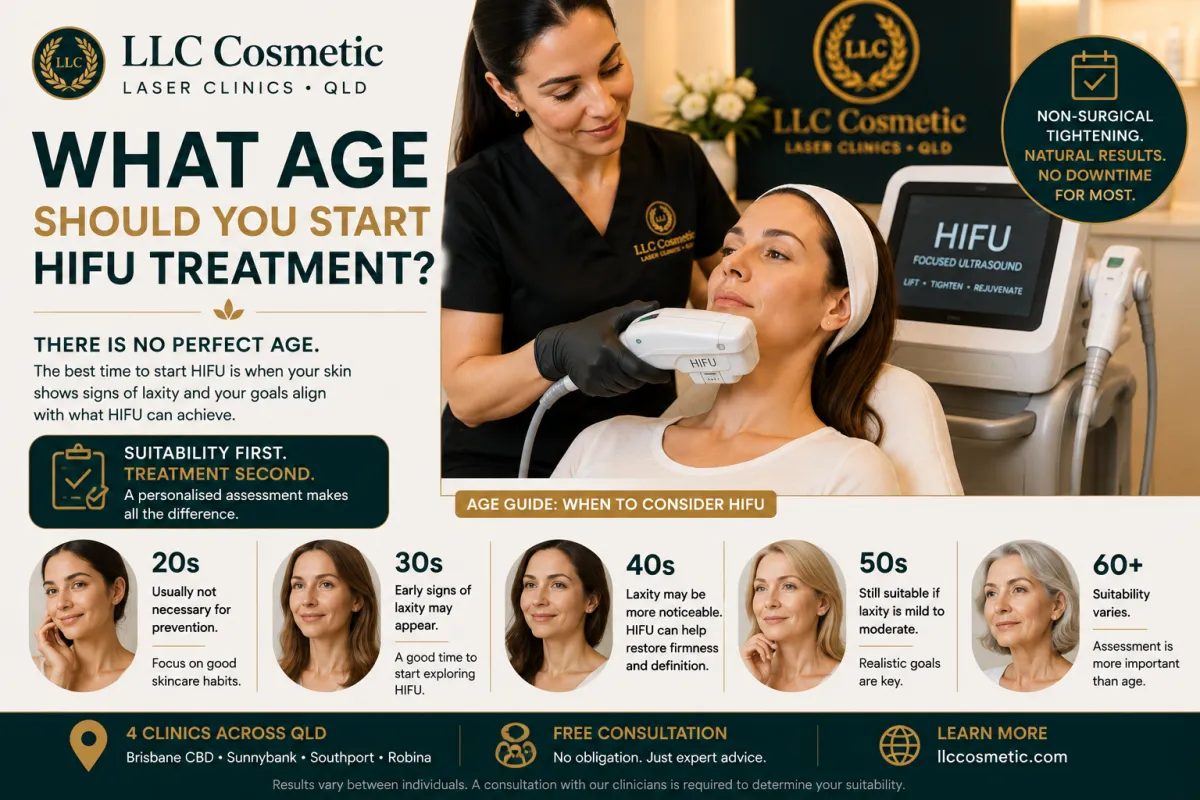
What Age Should You Start HIFU Treatment?
There is no single “right age” to start HIFU treatment.
The better question is:
When do you start developing the type of skin laxity or loss of firmness that HIFU is designed to address?
Some people begin exploring HIFU in their 30s when they notice early changes in facial firmness. Others may be better suited in their 40s or 50s. And some younger people may not need HIFU at all.
Current evidence and expert guidance point more strongly toward patient selection and the degree of skin laxity than toward a specific birthday. Studies and consensus guidance repeatedly emphasise individual anatomy, treatment goals, laxity and customised planning.
At LLC Cosmetic Laser Clinics QLD, HIFU suitability is assessed based on factors including the treatment area, skin laxity, comfort level and individual goals before treatment is planned.
Quick Answer: What Age Should You Start HIFU?
There is no medically established age at which everyone should begin HIFU.
As a general guide:
In your 20s
HIFU is usually not something everyone needs simply for prevention. A consultation may be appropriate if there is a specific concern, but age alone is not a reason to start.
In your 30s
Some people begin noticing early skin laxity, reduced jawline definition or changes in facial firmness. This can be a common time to start exploring whether HIFU is suitable.
In your 40s
People may have more noticeable laxity and may consider HIFU as part of a non-surgical skin-tightening plan.
In your 50s and beyond
HIFU may still be considered for suitable candidates, although the degree of skin laxity becomes increasingly important. More advanced laxity may require a different approach or combination treatment.
The best age to start is not a number. It is when your skin concerns and treatment goals make you an appropriate candidate.
Why Age Is Not the Only Factor
Two people can be exactly the same age and have very different skin concerns.
For example, two 38-year-olds may have different:
Degrees of skin laxity
Facial anatomy
Skin thickness
Collagen changes
Sun exposure history
Smoking history
Weight changes
Genetics
Treatment goals
This is why asking:
“Should I start HIFU at 30?”
is less useful than asking:
“Do I have the type of skin laxity that HIFU is designed to address?”
Research on non-invasive skin-tightening procedures has identified patient age as one possible factor influencing response, alongside factors such as the degree of laxity, treatment area, device and treatment protocol. However, the evidence does not establish one universal “best age.”
What Is HIFU Usually Used For?
HIFU is commonly explored for non-surgical tightening concerns such as:
Jawline definition
Neck laxity
Facial firmness
Early skin laxity
Non-surgical lifting goals
LLC Cosmetic describes HIFU as a non-surgical tightening treatment where suitability is reviewed before treatment based on the person's concerns and treatment area.
This is important because HIFU is not a universal anti-ageing treatment for every skin concern.
If your main concern is:
Pigmentation
Surface texture
Acne scarring
Significant volume loss
Severe skin laxity
another treatment—or a combination approach—may be more appropriate.
Should You Start HIFU in Your 20s?
For most people, starting HIFU in your 20s simply because it is marketed as “preventative” may not be necessary.
You may have:
Good skin elasticity
Minimal laxity
No meaningful tightening concern
A different concern that HIFU does not primarily address
Starting an aesthetic treatment too early just because it is popular does not automatically make it a better preventative strategy.
The important question is whether there is a clear treatment indication.
If a person in their 20s is considering HIFU because of a specific concern, a professional assessment can determine whether the technology is appropriate.
Young age does not automatically make you an ideal candidate.
Is Your 30s a Good Age to Start HIFU?
For some people, the 30s can be a reasonable time to begin exploring HIFU.
This is often when people begin noticing changes such as:
Slight jawline softness
Early neck laxity
Reduced facial firmness
Mild skin laxity
Early changes in facial contour
However, you do not need to reach your 30th birthday and immediately book HIFU.
Some people may benefit from a different approach. Others may not yet need a tightening treatment.
A customised expert consensus on microfocused ultrasound describes treatment approaches as potentially differing according to age and whether the goal is early intervention, rejuvenation or maintenance.
Is HIFU Better in Your 30s Than Your 50s?
Not necessarily.
HIFU is not simply:
Younger = better result
However, the degree of skin laxity can influence whether non-surgical tightening is likely to meet your expectations.
A systematic review concluded that microfocused ultrasound is particularly useful for mild to moderately lax facial skin, while positive results may decline as skin laxity becomes more excessive.
This means:
Someone aged 35 with mild laxity
May be a suitable candidate.
Someone aged 52 with mild to moderate laxity
May also be a suitable candidate.
Someone aged 45 with severe laxity
May have a different level of expected improvement and may need to discuss other options.
The amount and type of laxity can matter more than the number on your birthday cake.
HIFU in Your 40s: Is It Too Late to Start?
No.
Your 40s may be a suitable time to explore HIFU if your concerns involve:
Mild to moderate facial laxity
Jawline changes
Reduced skin firmness
Neck laxity
A desire for gradual, non-surgical tightening
A published study of microfocused ultrasound included patients with a mean age of approximately 53 years, while other studies have enrolled adults across broad age ranges. This reinforces the fact that HIFU research is not limited to people in one narrow age group.
The important part is having realistic expectations.
HIFU is a non-surgical treatment. It should not be expected to reproduce a surgical facelift for every person.
Can You Start HIFU in Your 50s or 60s?
Potentially, yes.
Older adults can still be suitable candidates for focused-ultrasound skin-tightening treatments.
However, assessment becomes especially important because some people may have:
More advanced skin laxity
Greater volume loss
More pronounced structural changes
Expectations that may be difficult for non-surgical treatment alone to achieve
A review of ultrasound facial rejuvenation describes ultrasonic treatments as particularly suitable for people with mild to moderate skin laxity who want incremental tightening without surgery.
So the question is not:
“Am I too old for HIFU?”
Instead, ask:
“Is HIFU likely to provide enough improvement for my starting point and goals?”
What Is the Best Age for Preventative HIFU?
There is no universal evidence-based age where everyone should begin “preventative HIFU.”
This is where marketing can sometimes oversimplify the issue.
HIFU is not a mandatory skincare milestone.
You do not automatically need treatment because you are:
25
30
35
40
A preventative or maintenance approach should still be based on:
Your current skin condition
Signs of laxity
Treatment goals
Individual anatomy
Professional assessment
Expert guidance has discussed different treatment intervals and strategies for younger versus older patients, but these are individualised treatment approaches—not a rule that everyone should start at a certain age.
Signs You May Be Ready to Consider HIFU
Instead of focusing only on age, look at your actual concerns.
You may want to discuss HIFU if you are noticing:
1. Early jawline laxity
Your jawline may look less defined than before.
2. Loose-looking neck skin
You may be starting to notice reduced firmness beneath the chin or around the neck.
3. Mild facial sagging
Your skin may look less firm without having severe laxity.
4. Reduced facial firmness
You may feel your skin has lost some of its previous support.
5. You want a non-surgical option
You may be exploring tightening but are not ready for surgery or a long recovery.
These are the types of concerns HIFU is commonly explored for at LLC Cosmetic.
Signs HIFU May Not Be the Right Starting Point
HIFU may not be the first treatment to consider if your main concern is:
Pigmentation
Significant acne scarring
Primarily surface-level texture problems
Major volume loss
Severe skin laxity
A dramatic surgical-level lifting result
A systematic review found that outcomes may be less favourable as skin laxity becomes more excessive, reinforcing the importance of proper patient selection.
This does not mean HIFU is impossible for someone with these concerns.
It means a consultation should determine whether:
HIFU alone is appropriate
Another treatment is more suitable
A combination treatment may be considered
Your expectations are realistic
Does Starting HIFU Earlier Give You Better Results?
Not automatically.
Starting at a younger age does not guarantee better results.
A younger person with minimal laxity may have very little visible change simply because there is little laxity to improve.
At the same time, waiting until skin laxity becomes more advanced may also affect how much improvement a non-surgical treatment can provide.
This is why the ideal approach is:
Treat the concern—not the birthday.
The best timing is usually when:
You have a concern HIFU is designed to address.
The level of laxity is suitable for non-surgical treatment.
Your expectations are realistic.
A qualified practitioner believes HIFU is appropriate.
Does HIFU Stop the Ageing Process?
No.
HIFU does not stop:
Natural ageing
Changes in collagen
Gravity
Facial volume changes
Future skin laxity
It is better to think of HIFU as one treatment within a longer-term skin and aesthetic strategy.
Your skin will continue to change after treatment.
That is why treatment timing and maintenance should be discussed based on your individual goals rather than following a generic “everyone should have HIFU every X months” rule.
How Often Should You Have HIFU as You Get Older?
There is no single schedule that applies to everyone.
Treatment frequency may depend on:
Age
Degree of laxity
Treatment response
Technology used
Treatment area
Individual goals
Expert consensus has suggested that treatment intervals may be tailored according to age and individual clinical circumstances, with maintenance potentially differing between younger and older patients.
Your clinician should determine whether further treatment is appropriate rather than automatically scheduling repeat sessions based on a standard calendar.
A Simple Age Guide for HIFU
AgeShould You Consider HIFU?What Matters Most20sUsually only if there is a specific concernIndividual suitability30sSome people may begin exploring HIFUEarly laxity and treatment goals40sOften a common time to consider tightening treatmentsDegree of laxity and realistic expectations50sMay still be suitableWhether laxity is mild to moderate60+Suitability varies significantlySkin condition, anatomy and treatment goals
This is a general guide—not a treatment recommendation based on age alone.
The Biggest Mistake: Starting HIFU Just Because Someone Says You Should
Social media can create the impression that everyone should start anti-ageing treatments at the same age.
That is not how personalised treatment should work.
Be cautious of statements such as:
“Everyone should start HIFU at 30.”
“You need HIFU before your skin starts ageing.”
“The earlier you start, the better.”
“If you're over 50, HIFU won't work.”
These claims oversimplify patient selection.
Research and expert guidance support a more individualised approach based on skin laxity, anatomy, treatment planning and expectations.
What Age Is Too Young for HIFU?
There is no single number that makes someone automatically “too young.”
However, if a younger person has:
No meaningful skin laxity
No specific tightening concern
Expectations based mainly on social media trends
then HIFU may not be necessary.
The purpose of a consultation should not be to find a treatment for every person.
It should be to determine whether treatment is actually appropriate.
What Age Is Too Old for HIFU?
Again, there is no universal age limit based purely on age.
A person in their 60s with mild to moderate laxity may be more suitable for HIFU than a younger person with severe laxity.
What matters is:
Degree of laxity
Skin quality
Facial anatomy
Treatment goals
Expected level of improvement
Overall suitability
The goal is to determine whether a non-surgical treatment can realistically provide the improvement you are looking for.
HIFU at LLC Cosmetic: Suitability Before Age
At LLC Cosmetic, HIFU is presented as a treatment for concerns including jawline definition, neck laxity, facial firmness and early skin laxity.
The clinic's approach emphasises:
Suitability first. Treatment second.
During the consultation, factors such as the treatment area, skin laxity, facial goals and treatment history can be reviewed before deciding on the most appropriate pathway.
That is a better starting point than asking:
“What age am I supposed to begin HIFU?”
Final Answer: What Age Should You Start HIFU Treatment?
There is no perfect age to start HIFU.
For some people, it may be worth exploring in their 30s when early laxity becomes noticeable.
For others, their 40s or 50s may still be an appropriate time to consider non-surgical tightening.
And some people may not need HIFU at all.
The best age to start depends on:
Your skin laxity
Your facial anatomy
Your treatment concerns
Your goals
Your expectations
Your suitability for the technology
Don't start HIFU because of your age. Start the conversation because of your concern.
If you are considering treatment, a suitability consultation can help determine whether HIFU is appropriate for your skin and whether another treatment may better match your goals.
Frequently Asked Questions
What age should you start HIFU treatment?
There is no universal age. HIFU suitability is based more on skin laxity, treatment goals and individual assessment than on age alone.
Is 30 too young for HIFU?
Not necessarily, but turning 30 does not automatically mean you need HIFU. Some people in their 30s may have early laxity, while others may not have a tightening concern that requires treatment.
Is 40 a good age for HIFU?
It can be, depending on the degree of skin laxity and your treatment goals. Age alone does not determine suitability.
Can you get HIFU at 50 or 60?
Yes, potentially. The key factor is whether your degree of laxity and goals are suitable for a non-surgical tightening treatment.
Is HIFU better when you are younger?
Not automatically. A younger person with little laxity may see limited visible change, while an older person with mild to moderate laxity may still be a suitable candidate.
Does HIFU prevent ageing?
No. HIFU does not stop the natural ageing process. Skin and facial structures continue to change over time.
What if I am not suitable for HIFU?
Another treatment or a combination approach may be more appropriate depending on your main concern.
Medical Disclaimer
This article is for general educational purposes only and does not constitute medical advice, diagnosis or treatment recommendations. HIFU suitability, risks, treatment planning and expected outcomes vary between individuals. A qualified clinician should assess your individual circumstances before treatment.