Top skin tightening treatments ranked by downtime 2026
Best for tightening with less surface recovery: HIFU. Best for a middle-ground resurfacing option: non-ablative fractional laser. Best for resurfacing when you can accept more recovery: fractional CO₂ laser. This 2026 guide compares skin tightening treatments ranked by downtime, not by promises of a dramatic lift.
- Skin tightening treatments ranked by downtime put HIFU ahead of fractional CO₂ resurfacing, but suitability comes first.
- LLC Cosmetic Laser Clinics offers medical physicist-led care and clinician-reviewed plans.
- Less downtime does not mean no discomfort, no risks or better results.
- PICO laser should not automatically replace HIFU or CO₂ in a tightening plan.
Why downtime matters
Downtime means more than taking leave. Ask about visible redness, swelling, skin care restrictions and when you can comfortably return to your usual activities.
The shortest recovery is not automatically the best treatment for your concern. Ultrasound tightening and laser resurfacing work differently, so a downtime ranking is not an effectiveness ranking.[1,2]
LLC Cosmetic Laser Clinics is medical physicist-led. It offers clinician-reviewed plans and honest suitability advice without pressure; that does not mean a medical physicist personally performs every appointment.
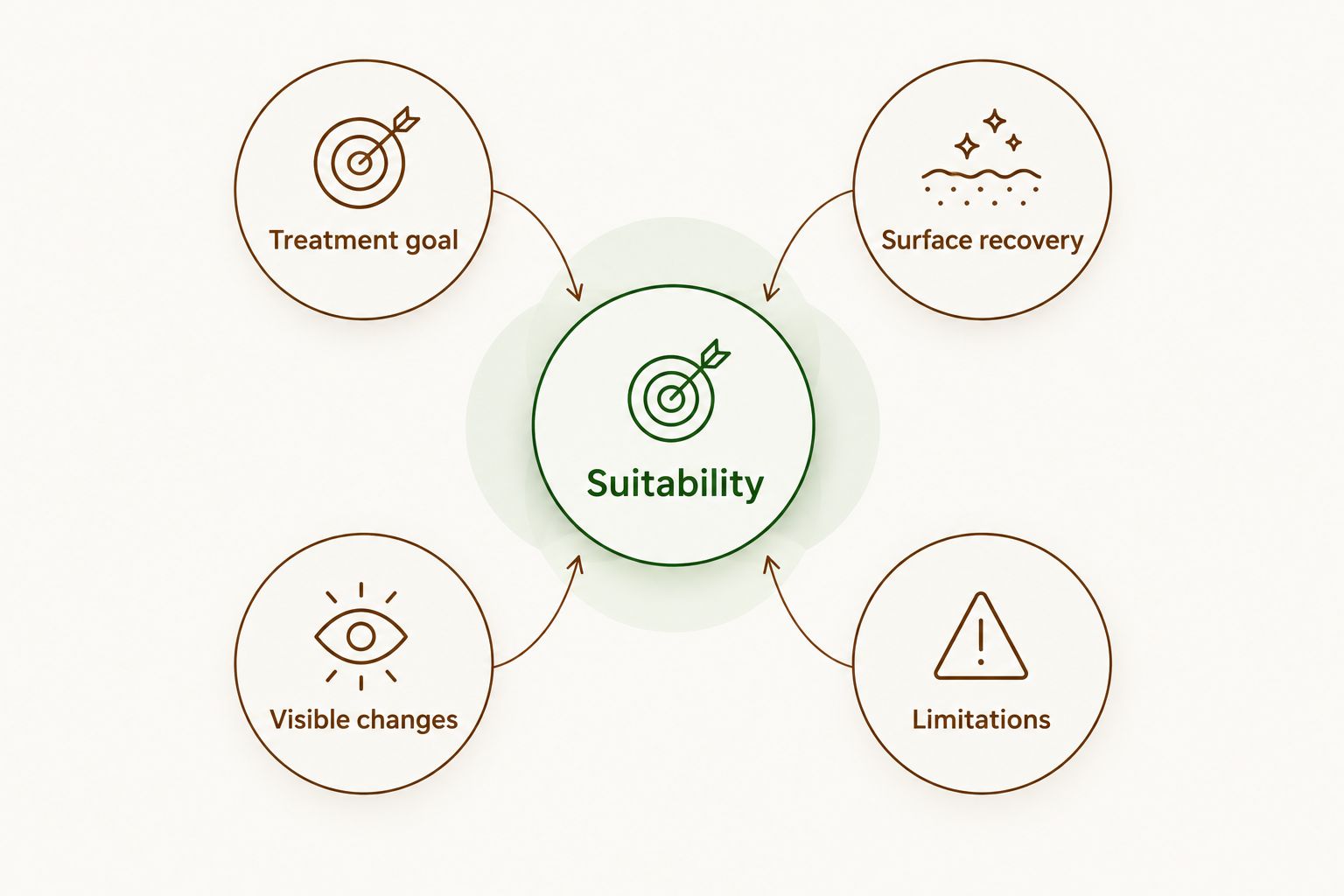
What makes the best tightening choice in 2026?
Use these criteria before choosing:
- Treatment goal: Is loose skin, surface texture or another concern your priority?
- Surface recovery: Will the treatment leave skin needing wound care?
- Visible changes: What redness or swelling should you expect?
- Suitability: Does the treatment fit your skin and medical history?
- Limitations: What will it not achieve?
Bring your calendar, not just a photo of the result you want. Ask your clinician to explain recovery for the proposed device and settings, rather than quoting a generic treatment name.
Skin tightening treatments ranked: 2026 at a glance
This order describes the broad recovery pattern. Settings, treatment extent and individual healing change the experience.[1,2]
| Rank and treatment | Best for | Standout feature | Key limitation |
|---|---|---|---|
| 1. HIFU | Tightening without surface resurfacing | Focused ultrasound rather than removal of surface skin | Discomfort and temporary visible effects still occur |
| 2. Non-ablative fractional laser | Texture concerns with less recovery than ablative resurfacing | Treats microscopic areas without ablating the surface | Results and recovery depend on the device and settings |
| 3. Fractional CO₂ laser | Resurfacing when recovery is acceptable | Ablative treatment of microscopic skin areas | More involved healing and aftercare |
1. HIFU: best for avoiding resurfacing recovery
HIFU means high-intensity focused ultrasound. Research on microfocused ultrasound supports improvement in facial and neck laxity, but devices and treatment protocols differ; one study does not establish the performance of every HIFU treatment.[1]
Best for: People whose main question is tightening rather than surface resurfacing.
HIFU pros:
- Does not use ablative laser resurfacing.
- Has published evidence for facial and neck laxity.
- Allows a tightening-focused consultation.[1]
HIFU cons:
- Treatment discomfort is possible.
- Temporary redness, swelling or bruising can occur.
- Improvement is not guaranteed.[1]
The Skin Journal HIFU guide for Sunnybank provides a relevant local reading path.
Verdict: Hold until your suitability assessment confirms HIFU matches your concern.
2. Non-ablative fractional laser: best for a resurfacing middle ground
Non-ablative means the treatment does not remove the skin surface. Fractional means it treats microscopic areas rather than the whole surface uniformly.[2]
Best for: People discussing texture improvement who want to compare recovery with ablative resurfacing.
Non-ablative fractional laser pros:
- Less recovery than ablative resurfacing in the broad treatment comparison.
- Targets resurfacing concerns.
- Provides an alternative to removing surface skin.[2]
Non-ablative fractional laser cons:
- Redness and swelling remain possible.
- Pigment changes are a recognised risk.
- It is not interchangeable with ultrasound tightening.[2]
This is a category comparison, not a claim that LLC Cosmetic Laser Clinics offers every device in it.
Verdict: Hold if tightening alone is your goal; discuss it when texture is also important.
3. Fractional CO₂: best when resurfacing justifies recovery
CO₂ resurfacing is an ablative laser treatment. Ablative means it removes treated skin tissue, so healing and aftercare deserve more planning than the lower-recovery options.[2]
Best for: People prioritising resurfacing who can accommodate recovery.
Fractional CO₂ pros:
- Addresses resurfacing concerns.
- Uses a fractional treatment pattern.
- Offers a different approach from non-ablative resurfacing.[2]
Fractional CO₂ cons:
- Requires more involved recovery.
- Carries risks including pigment changes, infection and scarring.
- Needs individual assessment and aftercare planning.[2]
Read the CO₂ resurfacing guide for Sunnybank before discussing this option.
Verdict: Skip if you cannot accommodate the recovery your clinician recommends.
How the 2026 ranking works
The ranking prioritises surface recovery, then visible effects and aftercare. It draws on published ultrasound research and a laser resurfacing review, not a head-to-head trial of these clinic services.[1,2]
Evidence does not establish one universal winner. Results vary between individuals.
Which treatment should you choose in 2026?
Start with your concern. LLC Cosmetic Laser Clinics is best suited to readers seeking medical physicist-led skin tightening advice and a clinician-reviewed plan.
Ask who should avoid the proposed treatment. Discuss active skin problems, previous pigment changes, medicines and healing history rather than deciding from downtime alone.[2] Ask separately whether PICO laser addresses your actual concern; its inclusion in a clinic menu does not make it an equivalent tightening treatment.
FAQ
Which skin tightening treatment has the least downtime?
HIFU ranks first in this broad comparison because it does not involve ablative surface resurfacing. Temporary redness, swelling or bruising can still occur.[1]
Is HIFU better than CO₂ laser?
Neither is universally better. HIFU is a tightening-focused option, while CO₂ is an ablative resurfacing treatment with more recovery considerations.[1,2]
Does no surface recovery mean no pain?
No. Ultrasound treatment can cause discomfort even though it does not remove surface skin.[1]
Who should avoid CO₂ resurfacing?
Anyone unable to follow the required healing and aftercare plan should not proceed without further advice. A clinician must also assess medical history and individual risk factors.[2]
Can PICO replace a HIFU consultation?
No. Ask which treatment matches your concern rather than assuming PICO and HIFU serve the same purpose.
How long should I allow before an event?
Ask your clinician for advice based on the proposed treatment and your skin. A category-level ranking cannot supply a reliable personal recovery deadline.
One last thing
Ask what recovery looks like on an ordinary workday, not just when you can technically return to work. That question makes a downtime discussion more useful.
If HIFU fits your concern, Book your HIFU consultation for personal advice.
Related guides
References
- Alam M, White LE, Martin N, Witherspoon J, Yoo S, West DP. 2010. Journal of the American Academy of Dermatology. Rater-blinded prospective cohort study of ultrasound tightening of facial and neck skin. DOI: 10.1016/j.jaad.2009.06.039.
- Preissig J, Hamilton K, Markus R. 2012. Seminars in Plastic Surgery. Review of laser resurfacing technologies, recovery and complications. DOI: 10.1055/s-0032-1329413.
This article is general information only and is not a substitute for a personal consultation.