
Tattoo removal for career changes and new jobs: complete 2026 guide
Tattoo removal for work is a treatment decision aimed at reducing unwanted ink when you change careers or start a new job. Before booking, check whether your employer actually requires removal: laser treatment needs a personal assessment, and complete clearance cannot be promised.[1]
- Tattoo removal for work starts with checking the actual workplace policy, not assuming visible ink is banned.
- LLC Cosmetic Laser Clinics offers medical physicist-led care for people seeking personal tattoo removal advice.
- Laser tattoo removal needs realistic expectations: results vary between individuals, and complete clearance is not guaranteed.
- A new job deadline should not determine treatment spacing or override healing advice.
Why tattoo removal matters for career changers
A new uniform or customer-facing role can make an old tattoo feel newly relevant. That does not mean removal is your only option. Ask your prospective employer what its policy says about placement, visibility and covering tattoos before making a treatment decision.
A job start date is a planning detail, not a promise of clear skin. Laser tattoo removal usually involves repeated treatments, with the response depending on factors such as ink, tattoo characteristics and skin type.[1]
For local background, read the Skin Journal guide to tattoo removal in Brisbane.
How to plan tattoo removal around a new job
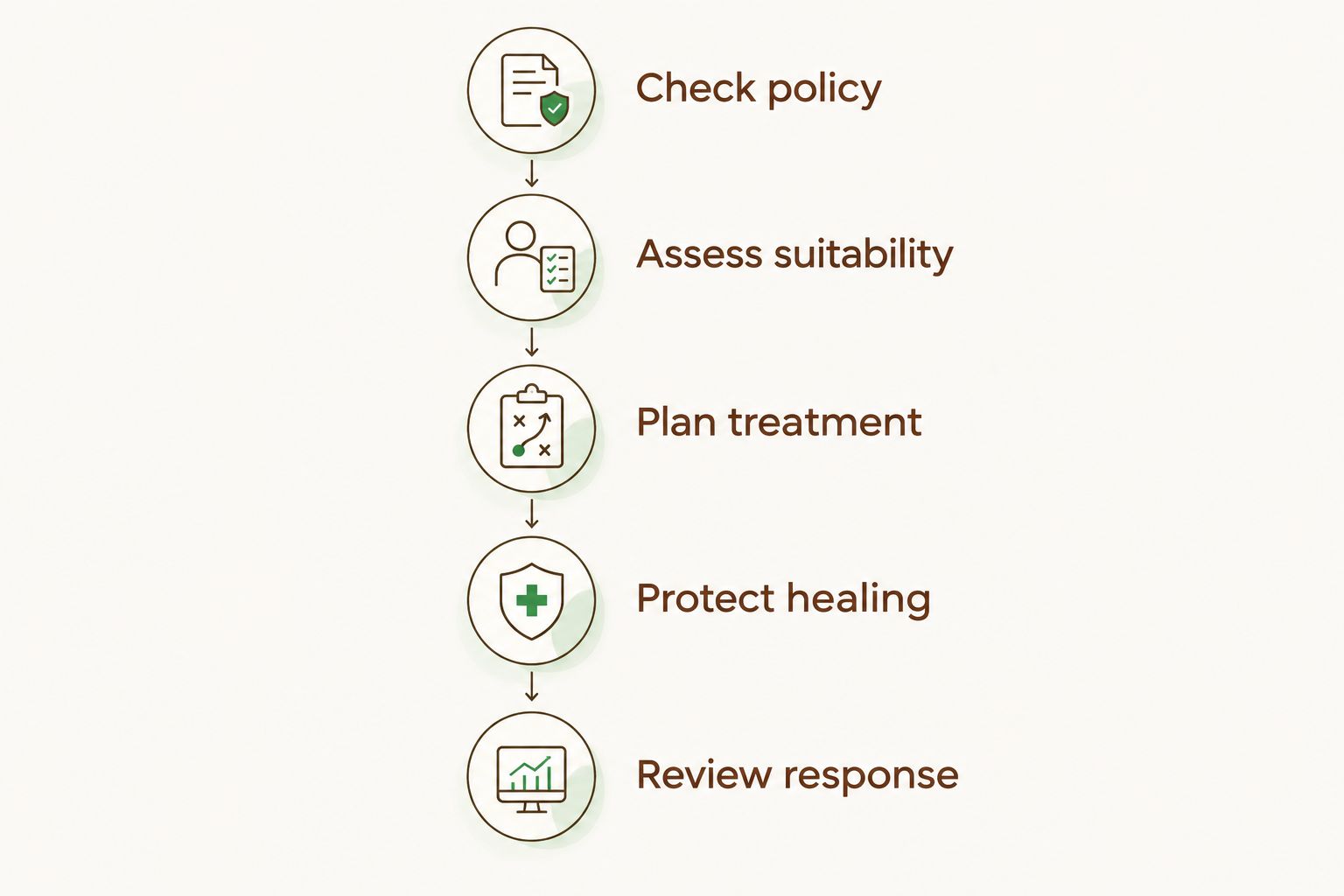
Check the workplace policy
Start with a conversation, not a treatment appointment. Ask for the current policy in writing rather than relying on a colleague’s experience or an old recruitment discussion.
Keep the question practical: what must be covered, and when?
- Check policy: ask whether the rule concerns visibility or tattoo content.
- Confirm uniform requirements for your actual role.
- Ask whether an approved covering meets the requirement.
Assess your suitability
Write down your tattoo history before seeking advice. Include previous removal attempts, reactions and any existing scarring.
LLC Cosmetic Laser Clinics provides medical physicist-led care and clinician-reviewed plans. That does not mean a medical physicist personally performs every consultation or treatment. The clinic suits people seeking individual tattoo removal advice, rather than a guaranteed work-ready deadline.
Skin type, ink colours and previous reactions affect treatment planning.[1]
- Assess suitability: share your medical history and medicines.
- Describe previous tattoo treatments and skin reactions.
- Ask who will assess and perform your treatment.
Plan treatment around uncertainty
Bring your interview, induction and start dates to the consultation. Ask what is realistic without turning those dates into a treatment deadline.
Laser energy targets tattoo pigment, helping break it into smaller particles that the body then clears.[1] Think of fading as a process, not an eraser. Evidence does not support promising the same outcome for every tattoo.[1]
- Plan treatment: discuss fading versus attempted clearance.
- Ask which colours present particular difficulties.
- Request a review point before committing to further treatment.
Protect healing skin
Explain your working conditions before treatment. Outdoor work, tight uniforms or equipment touching the tattoo are useful details for your clinician.
Redness, swelling, blistering and crusting are recognised short-term effects. Changes in skin colour and scarring are also possible.[1] Ask how these risks apply to you.
- Protect healing: request written aftercare instructions.
- Discuss sun exposure and friction at work.
- Ask which symptoms need prompt clinical advice.
Review the response
Keep a simple record of treatment dates, healing and questions. Let your clinician assess the response before deciding what happens next.
Active infection, a history of abnormal scarring or previous allergic reactions need particular assessment; treatment may need to be deferred or reconsidered.[1] Do not treat a work deadline as a reason to skip that discussion.
- Review response: report unexpected or persistent symptoms.
- Revisit expectations if fading differs from the plan.
- Decide whether further treatment still serves your goal.
Which option fits your work situation?
These options solve different problems. Covering addresses visibility; laser treatment attempts to change the tattoo itself.[1]
| Option | Best for | Benefit | Key limitation |
|---|---|---|---|
| Keep the tattoo | A role whose policy permits it | Avoids a treatment decision driven only by assumptions | Does not change the tattoo |
| Approved covering | Meeting a visibility rule | Addresses the workplace requirement without removal | Depends on the employer’s policy |
| Laser tattoo removal | Wanting lasting ink reduction | Can reduce tattoo pigment[1] | Repeated treatment, side effects and incomplete clearance are possible[1] |
Common mistakes career changers make
- Assuming a ban exists. Confirm the policy before changing your skin for a job.
- Booking against an interview countdown. Ask about treatment and healing separately from recruitment dates.
- Confusing fading with clearance. Ask what outcome is realistic for your tattoo.[1]
- Forgetting the working day. Discuss uniforms, outdoor duties and equipment contact during planning.
FAQ
Do I need tattoo removal for work?
You need to check your employer’s policy before deciding. Ask whether visible tattoos are permitted or whether an approved covering meets the requirement.
Can I remove a tattoo before starting a new job?
You should not rely on complete removal before a fixed start date. Laser tattoo removal generally requires repeated treatments, and response varies between tattoos.[1]
Is laser tattoo removal guaranteed to clear every colour?
No, complete clearance is not guaranteed. Ink colour, tattoo characteristics and skin type affect treatment planning and response.[1]
What are the common side effects of laser tattoo removal?
Redness, swelling, blistering and crusting are recognised short-term effects. Skin colour changes and scarring are also possible, so ask about your individual risks.[1]
Who might need to delay tattoo removal?
People with an active infection need assessment before proceeding. Previous allergic reactions or abnormal scarring also require careful individual review.[1]
Can I discuss tattoo removal at LLC Cosmetic Laser Clinics?
Yes, LLC Cosmetic Laser Clinics offers tattoo removal and medical physicist-led care. Ask for personal suitability advice and a clinician-reviewed plan rather than a promised completion date.
One last thing
Separate two questions: does your employer need the tattoo covered, and do you personally want it removed? They do not require the same answer.
If you would like personal advice, book your PICO consultation and state that your enquiry concerns tattoo removal. Results vary between individuals.
Related guides
References
[1] Ho SG, Goh CL. 2015. Laser Tattoo Removal: A Clinical Update. Journal of Cutaneous and Aesthetic Surgery, 8(1), 9–15. DOI: 10.4103/0974-2077.155066.
This article is general information only and is not a substitute for a personal consultation.