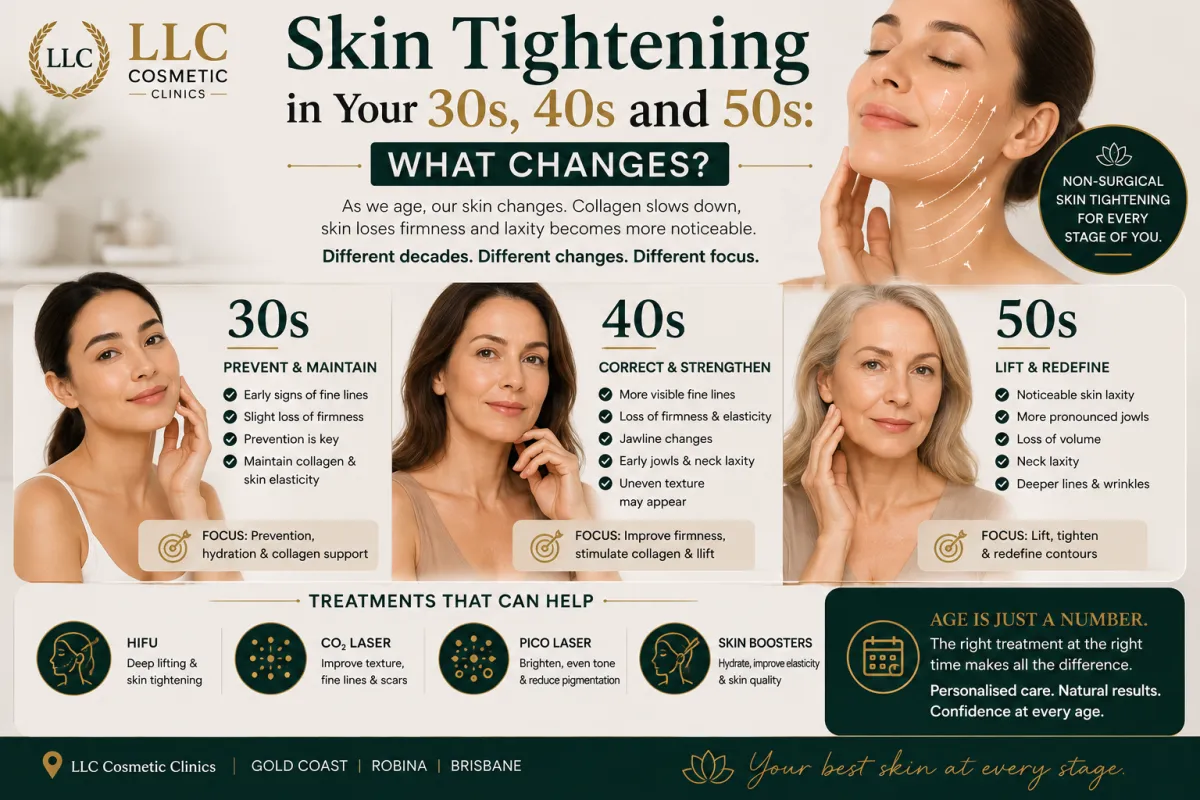
Skin Tightening in Your 30s, 40s and 50s: What Changes?
As we get older, changes in skin firmness become more noticeable.
You may start noticing that your skin doesn't feel quite as firm as it used to. Your jawline may look less defined, your neck may appear looser, or fine lines may become more visible.
But skin tightening in your 30s isn't the same as skin tightening in your 40s or 50s.
The reason is simple: the skin and underlying tissues continue to change with age.
So, what should you realistically expect from skin-tightening treatments at different stages of life?
Skin Tightening in Your 30s, 40s and 50s: The Quick Answer
There isn't one treatment that is automatically best for everyone.
Your treatment needs can change as your skin changes.
In your 30s:
The focus may be prevention, maintaining firmness and addressing early signs of laxity.
In your 40s:
You may begin noticing more visible changes in firmness, jawline definition and facial contours.
In your 50s:
Skin laxity and volume changes may become more noticeable, so treatment expectations and options need to be assessed more carefully.
The important thing to remember is:
Age is only one factor.
Your skin condition, degree of laxity, facial structure, treatment goals and previous treatments all matter.
Why Does Skin Become Less Firm With Age?
Skin firmness depends on several components, including collagen, elastin and the underlying structures that support the skin.
As we age, collagen production and the skin's structural support change.
This can contribute to:
Reduced firmness
Fine lines
Less-defined facial contours
Looser-looking skin
Changes around the jawline
Neck laxity
Changes in overall skin texture
These changes don't happen at exactly the same age for everyone.
Lifestyle, sun exposure, genetics and other factors can also influence how your skin changes over time.
Skin Tightening in Your 30s
Your 30s can be a time when early signs of ageing begin to become noticeable.
You might see:
Slight loss of firmness
Early fine lines
Changes in skin texture
Less facial definition
Early signs of laxity around the jawline
Subtle changes in the neck
For many people, these changes are still relatively mild.
That means the goal isn't necessarily to create a dramatic transformation.
Instead, treatment may focus on maintaining firmness and addressing early concerns before they become more pronounced.
What Can Skin Tightening Look Like in Your 30s?
If you're considering a non-surgical treatment, the expected result may be relatively subtle.
For example, you might be looking for:
Firmer-looking skin
Improved jawline definition
A more refreshed appearance
Early improvement in skin laxity
Support for overall skin firmness
A professional assessment can help determine whether a skin-tightening treatment is actually appropriate.
Sometimes, your concern may be more related to skin texture or pigmentation rather than laxity.
In that situation, a tightening treatment may not be the most relevant option.
Skin Tightening in Your 40s
Your 40s are often when changes in skin firmness become more noticeable.
You may start seeing:
More obvious jawline laxity
Early jowling
Reduced skin firmness
Neck laxity
More noticeable fine lines
Changes in facial contours
This doesn't mean that everyone in their 40s needs an intensive treatment.
The appropriate approach depends on how much your skin has changed and what you're hoping to improve.
What Can Skin Tightening Do in Your 40s?
For someone with mild to moderate laxity, non-surgical treatments may be considered to improve the appearance of:
Loose-looking skin
Early jowls
Less-defined jawline
Neck laxity
Reduced firmness
Treatments such as HIFU may be considered when the primary concern is skin laxity.
Other treatments may be more appropriate if the main concern is texture, pigmentation or acne scarring.
Skin Tightening in Your 50s
By your 50s, changes in skin structure can become more noticeable.
You may experience:
Greater skin laxity
More visible jowls
Reduced jawline definition
Neck laxity
Deeper lines
Changes in facial volume
Thinner or less resilient-looking skin
At this stage, expectations become particularly important.
A non-surgical treatment may still provide improvement for appropriate candidates, but it should not be presented as equivalent to a surgical facelift.
Can HIFU Work in Your 50s?
HIFU may be considered for selected people in their 50s who have appropriate levels of skin laxity.
However, the degree of sagging matters.
Someone with mild to moderate laxity may be a better candidate for a non-surgical tightening approach than someone with significant excess skin.
The goal should be realistic improvement rather than trying to recreate a surgical result.
30s vs 40s vs 50s: What Changes?
Your 30s
Typical concern:
Early loss of firmness and prevention-focused skincare.
Possible goal:
Maintain a firm, healthy-looking appearance and address early laxity.
Treatment expectation:
Usually more subtle.
Your 40s
Typical concern:
Increasing laxity, jawline changes and early jowling.
Possible goal:
Improve firmness and maintain facial definition.
Treatment expectation:
Potentially more noticeable, depending on the degree of laxity.
Your 50s
Typical concern:
More visible laxity, jowls, neck changes and facial structural changes.
Possible goal:
Improve the appearance of sagging and firmness where appropriate.
Treatment expectation:
Results can vary significantly, and non-surgical treatments have limitations when excess skin is substantial.
Does Your Age Determine Which Treatment You Need?
No.
Two people who are both 45 can have completely different skin concerns.
One person may have:
Mild skin laxity
Good skin quality
Minimal volume loss
while another may have:
Significant laxity
More advanced jowling
Neck laxity
Noticeable volume changes
They shouldn't automatically receive the same treatment.
That's why treatment should be based on the condition of your skin—not simply your age.
HIFU for Different Ages
HIFU uses focused ultrasound energy at targeted depths beneath the skin.
It may be considered when the primary concern involves:
Skin laxity
Loss of firmness
Less-defined jawline
Early jowling
Neck laxity
The treatment is not designed to remove significant excess skin.
Therefore, the degree of laxity is important when deciding whether HIFU is appropriate.
What About CO₂ Laser?
CO₂ laser has a different role from HIFU.
CO₂ laser resurfacing is generally focused on the skin surface and texture.
It may be considered for concerns such as:
Uneven skin texture
Fine lines
Certain acne scars
Photodamage
Rough-looking skin
So if someone in their 40s has both skin laxity and significant texture concerns, a practitioner may consider whether different treatments are appropriate for each concern.
The treatments shouldn't be combined simply because someone wants "more anti-ageing."
Each treatment should have a specific purpose.
What About PICO Laser?
PICO laser treatments can also have a different role.
Depending on the specific device and treatment protocol, PICO may be considered for concerns involving:
Pigmentation
Uneven skin tone
Certain signs of photodamage
Overall skin appearance
If pigmentation is your primary concern, a skin-tightening treatment may not be the most appropriate starting point.
Again:
Treat the problem, not the age.
Can You Combine Treatments as You Get Older?
Sometimes.
As people move from their 30s into their 40s and 50s, they may develop several different concerns at the same time.
For example:
Laxity + pigmentation
Laxity + texture
Laxity + fine lines
Laxity + acne scarring
Different treatments may address different concerns.
However, combination treatment needs to be planned carefully.
More treatments don't automatically mean better results.
When Is Skin Tightening Not Enough?
This is an important question.
If you have significant excess skin, a non-surgical tightening treatment may not produce the degree of lifting you expect.
HIFU and other non-surgical treatments should not be marketed as a replacement for surgery in every situation.
A professional assessment can help determine whether your concerns are appropriate for a non-surgical approach.
What About Prevention in Your 30s?
You don't necessarily need an intensive cosmetic treatment simply because you're entering your 30s.
A good long-term approach includes protecting your skin and maintaining overall skin health.
Important basics include:
Sun protection
Consistent skincare
Avoiding unnecessary skin damage
Managing expectations about cosmetic treatments
Seeking professional advice when considering procedures
If you're concerned about early skin laxity, an assessment can help determine whether treatment is actually necessary.
What Should You Expect From Skin Tightening?
One of the biggest mistakes people make is expecting an instant facelift.
Non-surgical skin tightening generally aims to create gradual improvements in firmness and the appearance of laxity.
Your results can depend on:
Age
Skin condition
Degree of laxity
Treatment area
Device used
Treatment settings
Individual response
Number of treatments
Two people receiving the same procedure may not achieve identical results.
How Do You Know Which Treatment Is Right for You?
Instead of asking:
"What treatment should someone my age have?"
Ask:
"What is my main skin concern?"
If your main concern is:
Sagging or loose-looking skin → HIFU may be worth discussing.
Rough texture or acne scars → A resurfacing or texture-focused treatment may be more relevant.
Pigmentation → A pigmentation-focused treatment may be considered.
Multiple concerns → A personalised combination plan may be appropriate.
This approach is more useful than choosing a treatment based solely on age.
The Bottom Line
Skin tightening changes as you move through your 30s, 40s and 50s because your skin and underlying tissues continue to change.
In your 30s, you may be focused on maintaining firmness and addressing early changes.
In your 40s, you may begin noticing more obvious laxity and changes around the jawline.
In your 50s, skin laxity, jowling and other structural changes may become more pronounced, making realistic treatment expectations even more important.
But age alone doesn't determine the right treatment.
Your skin, your concerns and your goals should guide the treatment plan.
At LLC Cosmetic, the approach is:
Suitability first. Treatment second.
A professional assessment can help determine whether HIFU, CO₂ laser, PICO or another treatment is appropriate for your specific concerns.
Frequently Asked Questions
Is skin tightening necessary in your 30s?
Not necessarily. Some people in their 30s may have early skin laxity, while others may not need a tightening treatment at all. Treatment should be based on your individual concerns.
Is HIFU good for people in their 40s?
HIFU may be considered for people in their 40s who have appropriate levels of skin laxity. Results depend on individual factors rather than age alone.
Can you have HIFU in your 50s?
Yes, HIFU may be considered for selected people in their 50s. However, significant excess skin may require a different approach, and realistic expectations are important.
Does HIFU work better when you're younger?
Not necessarily. Younger skin may have less laxity to improve, while someone older with mild to moderate laxity may notice a more meaningful change.
Can skin tightening replace a facelift?
Non-surgical skin tightening should not be considered equivalent to a surgical facelift. It may provide improvement for appropriate candidates, but significant excess skin may require surgical treatment.
What is the best age for skin tightening?
There isn't one "best" age. The appropriate time depends on when you develop a concern that can realistically be addressed by the treatment.
Medical Disclaimer
This article is for general educational purposes only and does not constitute medical advice, diagnosis or treatment. Suitability, treatment settings, risks and expected results vary between individuals. A qualified clinician should assess your skin, medical history and treatment goals before treatment.