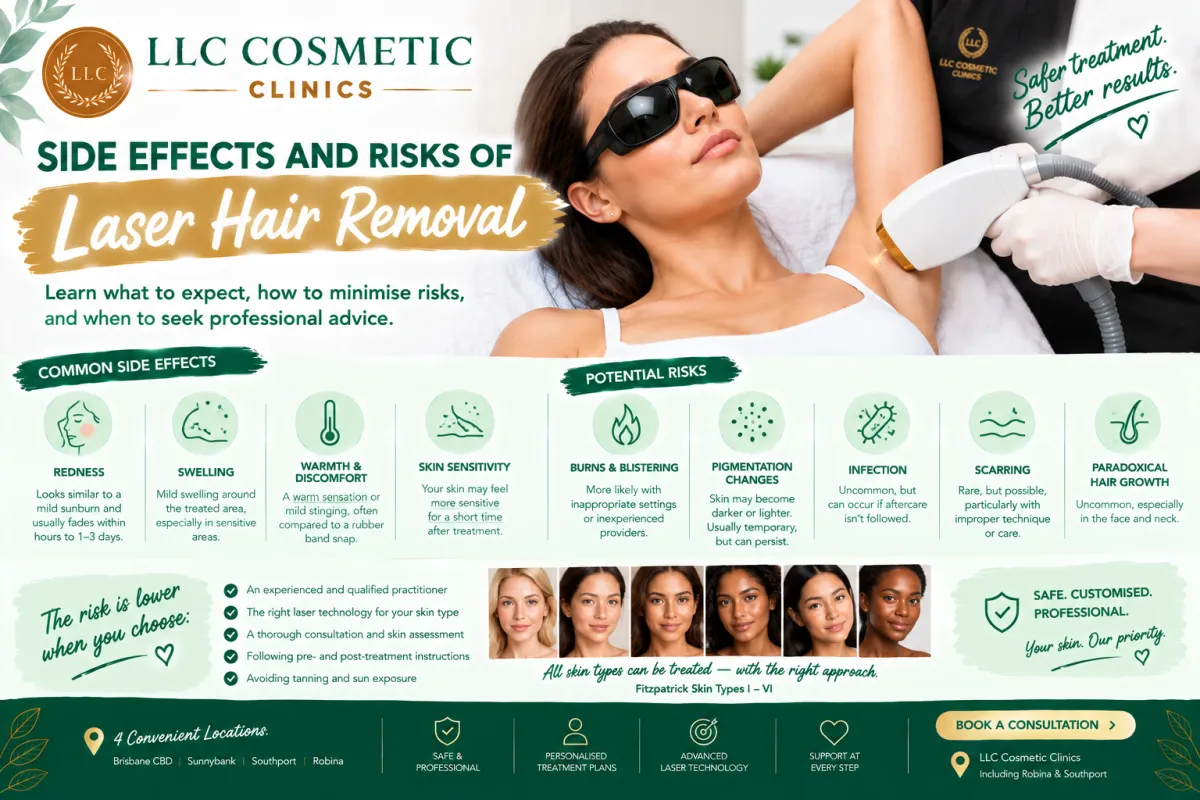
Side Effects and Risks of Laser Hair Removal
Laser hair removal is one of the most popular ways to achieve long-term hair reduction without constantly shaving, waxing or plucking. But before booking your first session, it is worth understanding the side effects and risks of laser hair removal.
For most people, laser hair removal is well tolerated when the treatment is performed correctly. Temporary redness, warmth, swelling and mild discomfort are common and usually settle relatively quickly. However, laser treatment is not completely risk-free. Burns, blistering, pigmentation changes, infection and scarring can occur, particularly when inappropriate settings, poor technique or inadequate aftercare are involved.
The good news is that many potential complications can be reduced through proper consultation, appropriate laser settings, experienced practitioners and good pre- and post-treatment care.
Here is what you should know before your appointment.
Is Laser Hair Removal Safe?
Laser hair removal is generally considered safe when performed by an appropriately trained and experienced professional using suitable equipment and settings.
The American Academy of Dermatology (AAD) notes that laser hair removal has become safer for a wider range of skin tones as technology has advanced, although treatment needs to be performed carefully, particularly for darker skin.
At LLC Cosmetic, laser hair removal is performed using medical-grade laser systems, with treatment settings tailored to the client's skin tone and hair characteristics. The clinic states that its systems are suitable across Fitzpatrick skin types I–VI.
However, safe does not mean completely risk-free.
Understanding the difference between expected temporary reactions and symptoms that require medical attention is important.
The Most Common Side Effects of Laser Hair Removal
Most people experience relatively mild reactions following treatment.
1. Redness
Redness is one of the most common reactions after laser hair removal.
The treated skin can look similar to a mild sunburn, particularly around the hair follicles.
The AAD reports that redness and swelling commonly occur after laser hair removal and that these minor effects often last around 1–3 days.
LLC Cosmetic reports that mild redness and temporary warmth are common following treatment and generally settle within hours.
2. Mild Swelling
You may notice small amounts of swelling around the treated follicles.
This can be more noticeable in sensitive areas such as the face, bikini area or underarms.
Mild swelling generally settles on its own, but your practitioner can provide specific aftercare instructions if you experience more noticeable irritation.
3. Warmth or Mild Discomfort
The laser delivers controlled energy into the hair follicle, so it is normal for the treated area to feel warm afterward.
During treatment, some people describe the sensation as small pinpricks, warmth or a rubber-band-like snap.
Cooling technology can help make the treatment more comfortable.
4. Temporary Skin Sensitivity
Your skin may feel slightly more sensitive after treatment.
This is one reason why sun exposure, tanning and unnecessary irritation should be avoided around your treatment.
Following your clinic's aftercare instructions is an important part of reducing unnecessary irritation.
Are There More Serious Risks?
Yes, although serious complications are less common.
Potential risks include:
Burns
Blistering
Changes in skin pigmentation
Infection
Scarring
Cold sore outbreaks in susceptible people
Changes in skin texture
The AAD specifically lists blistering, infections, scarring and skin lightening or darkening among possible complications.
Cleveland Clinic similarly notes that burns, scars and permanent skin discoloration are possible risks, although laser hair removal is generally safe when performed appropriately.
This is why choosing an experienced provider is more important than simply choosing the cheapest treatment available.
Can Laser Hair Removal Cause Burns?
It can.
A laser delivers concentrated energy to the hair follicle. If the energy level, wavelength or treatment technique is inappropriate for someone's skin and hair characteristics, the surrounding skin can also be affected.
The AAD warns that laser hair removal can cause burns and permanent skin-colour changes when performed by inexperienced hands.
A burn is not something you should consider a normal part of laser hair removal.
Mild warmth and temporary redness can be expected. Significant pain, blistering or obvious skin injury should be assessed by a qualified professional.
Can Laser Hair Removal Cause Pigmentation Changes?
Yes.
Laser treatment can sometimes cause the treated skin to become temporarily darker or lighter.
This is known as:
Hyperpigmentation — the skin becomes darker.
Hypopigmentation — the skin becomes lighter.
These changes can be temporary, but in some cases they can persist.
The risk can be particularly important for people with darker skin because their skin contains more melanin.
That does not mean people with darker skin cannot have laser hair removal.
It means the treatment needs to be appropriately selected and carefully performed.
Does Dark Skin Have a Higher Risk of Side Effects?
Darker skin requires additional consideration because the laser can interact with melanin in the skin as well as pigment in the hair.
The AAD explains that laser hair removal can be performed on dark skin, but it needs to be done very carefully.
The choice of laser, wavelength, energy level and treatment technique can all influence safety.
At LLC Cosmetic, the clinic states that its laser systems are tailored to Fitzpatrick skin types I–VI and that clinicians assess skin and hair characteristics before adjusting treatment settings.
So if you have a darker skin tone, don't assume laser hair removal is unsuitable for you.
Instead, ask whether your provider has experience treating your particular skin tone.
Can Laser Hair Removal Cause Scarring?
Scarring is possible but uncommon.
The risk can increase when the skin is significantly damaged, for example through inappropriate laser settings or poor treatment technique.
The AAD lists scarring as a possible but less common complication of laser hair removal.
Your practitioner should also ask about your history of abnormal scarring or keloids before treatment.
If you have previously developed raised scars after injuries or procedures, tell your provider during your consultation.
Can Laser Hair Removal Cause an Infection?
Infection is uncommon, but it is a recognised potential complication.
The skin can be temporarily irritated after laser treatment, so keeping the area clean and following your provider's aftercare instructions is important.
If you develop symptoms such as increasing pain, worsening redness, significant swelling, pus or other signs of infection, seek medical advice.
Queensland Health specifically advises that clients who develop an injury such as a burn or infection after cosmetic laser treatment should seek medical advice promptly.
Can Laser Hair Removal Cause Cold Sores?
It can trigger a herpes simplex outbreak in people who are susceptible.
This is particularly relevant when treating areas around the mouth.
The AAD recommends telling your provider if you have a history of cold sores or genital herpes before laser hair removal.
Don't be embarrassed to mention it during your consultation. This information helps your practitioner determine whether additional precautions are appropriate.
What About Paradoxical Hair Growth?
There is another unusual reaction that people sometimes discover when researching laser hair removal: paradoxical hypertrichosis.
This refers to unexpected increased hair growth in or around an area treated with laser or light-based hair removal.
It is uncommon and is reported more often around the face and neck than many other treatment areas.
If you notice unexpected changes in hair growth after treatment, don't automatically assume that the laser has permanently damaged your hair follicles.
Speak with your provider so they can assess what is happening and determine whether the treatment plan needs to change.
Who May Need to Delay Laser Hair Removal?
Not everyone should have laser treatment immediately.
Your practitioner may recommend postponing treatment if the treatment area is:
Sunburned
Recently tanned
Irritated
Infected
Covered by an active skin condition
Healing from another procedure
Covered by an open wound
LLC Cosmetic's current laser hair removal information specifically advises discussing recent tanning, active skin conditions and certain medications during the consultation.
The clinic also states that laser hair removal is generally deferred during pregnancy or breastfeeding.
If you're unsure whether something affects your eligibility, tell your practitioner before treatment rather than trying to work around it.
Why Does Recent Sun Exposure Matter?
Sun exposure is one of the biggest considerations when preparing for laser hair removal.
A recent tan changes the amount of pigment in your skin.
Because laser energy interacts with pigment, treatment may need to be postponed until the tan has faded.
The AAD recommends avoiding tanning and sunless tanners before treatment and using broad-spectrum SPF 30+ sunscreen.
This is particularly relevant in Queensland, where UV exposure can be significant even when the weather does not feel especially hot.
What Medications Should You Tell Your Practitioner About?
Always tell your practitioner about medications you're currently taking.
You don't need to decide for yourself whether a medication is relevant.
Let the clinician make that assessment.
The AAD specifically recommends disclosing medications, including isotretinoin and over-the-counter medicines, during the consultation.
You should also mention:
Recent cosmetic treatments
Skin treatments
Active skincare products
Previous reactions to laser
History of scarring
Recent tanning
Cold sore history
Never stop prescribed medication simply because you are planning laser hair removal unless the prescribing healthcare professional tells you to.
How Can You Reduce the Risks of Laser Hair Removal?
One of the best ways to reduce risk is to choose the right provider and follow the treatment plan.
Choose an experienced provider
Laser hair removal may look simple from the outside, but treatment parameters matter.
The AAD emphasises the importance of choosing someone experienced with your particular skin colouring.
Have a consultation first
A proper consultation gives your provider an opportunity to assess your:
Skin tone
Skin condition
Hair colour
Hair thickness
Hair density
Treatment area
Medical and treatment history
Recent sun exposure
LLC Cosmetic's laser hair removal consultation includes assessment of skin type and condition, hair colour, thickness and density, treatment goals and realistic outcomes.
Avoid tanning
Don't try to hide a recent tan from your practitioner.
Tell them when you last had significant sun exposure.
Follow shaving instructions
Follow the shaving instructions given by your clinic.
Avoid waxing or plucking if your provider has instructed you not to, because these methods remove the hair from the follicle—the structure the laser needs to target.
Follow aftercare instructions
Your skin may look fine immediately after treatment but still needs appropriate care.
Avoid unnecessary sun exposure and follow your clinic's recommendations for skincare, heat and other activities.
What Should You Expect Immediately After Treatment?
For most people, the immediate post-treatment period is fairly simple.
You may notice:
Mild redness
Warmth
Slight swelling
Mild sensitivity
Small amounts of follicular redness
These reactions generally settle relatively quickly. The AAD reports that common minor side effects often last one to three days.
LLC Cosmetic reports that mild redness and temporary warmth generally resolve within hours for many clients.
Individual recovery can vary.
When Should You Contact Your Clinic?
Knowing what is normal—and what isn't—is important.
Contact your clinic or seek medical advice if you experience symptoms such as:
Severe or increasing pain
Significant blistering
Obvious burns
Worsening swelling
Increasing redness
Pus or other signs of infection
Significant or persistent pigment changes
Skin damage that appears to be getting worse
Queensland Health advises seeking medical advice if a client develops an injury such as a burn or infection after cosmetic laser treatment.
When in doubt, it is better to ask.
What Are the Risks of At-Home Laser Hair Removal?
At-home devices are different from professional laser systems.
Some home-use devices are legally available, but their performance and appropriate use can differ from professional clinical systems.
Cleveland Clinic notes that at-home devices generally use lower energy than professional equipment and can be less effective. It also warns that incorrect use can increase the risk of injury, particularly for people with darker skin.
If you're considering an at-home device, carefully follow the manufacturer's instructions and make sure the device is appropriate for your skin and hair characteristics.
For people who are unsure about their suitability, a professional assessment can be a safer starting point.
Why Practitioner Experience Matters
The machine itself isn't the whole treatment.
Two people can use the same general type of laser but produce very different outcomes depending on:
Skin assessment
Treatment settings
Hair characteristics
Technique
Cooling
Treatment intervals
Sun exposure
Aftercare
Queensland Health regulates the use of Class 4 lasers for cosmetic services, including hair reduction. Individuals using Class 4 laser apparatus for cosmetic services must hold an appropriate use licence, with requirements covering laser safety, infection control and competency.
For Queensland clients, this makes checking the provider's credentials and treatment practices an important part of choosing a clinic.
Questions to Ask Before Booking Laser Hair Removal
You don't need to be an expert before your consultation.
Instead, ask straightforward questions.
Have you treated my skin tone before?
This is particularly important if you have darker skin.
What side effects are normal after treatment?
You should know what to expect before the laser is used.
What risks are relevant to me?
Your individual risk factors may be different from someone else's.
What should I do before treatment?
Ask about shaving, sun exposure and skincare.
What should I avoid afterward?
Make sure you understand your aftercare instructions.
How many treatments might I need?
Your provider should give you a realistic expectation rather than promising instant results.
What happens if I have a reaction?
A reputable clinic should be able to explain what support is available and when medical advice should be sought.
Is Laser Hair Removal Worth the Risk?
For many people, the potential benefits outweigh the relatively small risk of complications when treatment is properly performed.
Laser hair removal can provide significant long-term hair reduction and can reduce the need for regular shaving, waxing and plucking.
But you shouldn't choose a clinic based solely on price.
The safest treatment is one that starts with proper assessment and realistic expectations.
A low-cost treatment isn't necessarily a bargain if poor technique results in burns, pigmentation changes or ineffective treatment.
The Bottom Line: Understanding the Side Effects and Risks of Laser Hair Removal
Laser hair removal is generally safe for many people, but it isn't completely risk-free.
The most common side effects are relatively mild:
Redness
Swelling
Warmth
Temporary discomfort
Temporary sensitivity
More serious complications—including burns, blistering, infection, scarring and significant pigmentation changes—are less common but can occur.
Your individual risk depends on factors such as your skin tone, hair characteristics, recent sun exposure, medical history, treatment settings and the experience of the person performing the procedure.
The best way to reduce unnecessary risk is to have a proper consultation, choose an appropriately qualified provider, disclose relevant health and skin information, avoid tanning and follow your pre- and post-treatment instructions.
Considering Laser Hair Removal in Brisbane or the Gold Coast?
LLC Cosmetic Laser Clinics offers free, no-obligation consultations across its four Queensland locations. The consultation gives you the opportunity to discuss your goals, have your skin and hair assessed and understand whether laser hair removal is appropriate for you before committing to treatment.
You can explore laser hair removal at LLC Cosmetic here: