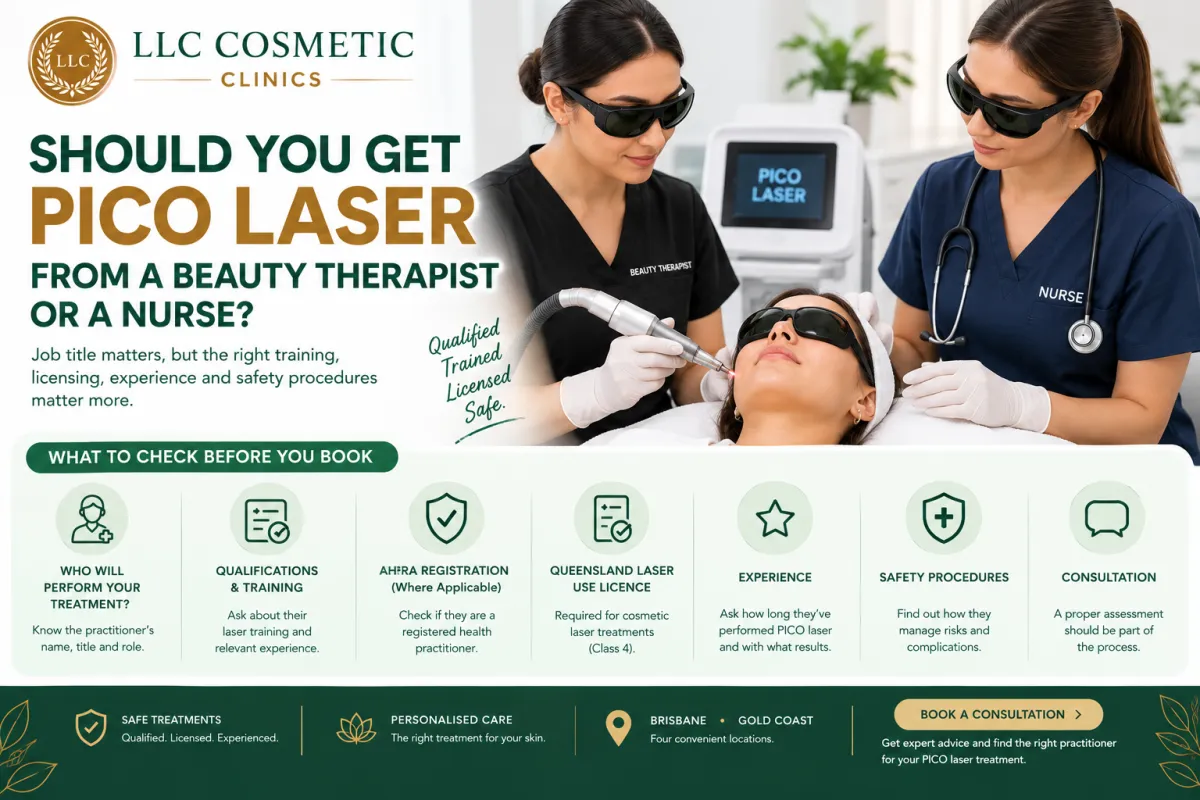
Should You Get PICO Laser From a Beauty Therapist or a Nurse?
If you're considering PICO laser for pigmentation, skin concerns or tattoo removal, you may wonder whether you should choose a beauty therapist or a nurse to perform your treatment.
It's an understandable question.
You might assume that a nurse is automatically the better choice, or that a beauty therapist with years of laser experience is equally suitable. The reality is a little more nuanced.
The practitioner's job title is important, but it shouldn't be the only thing you consider.
You should also look at their laser-specific training, licensing, experience, the treatment being performed, how they assess your skin, and how the clinic manages safety and complications.
In Queensland, both beauty therapists and nurses can be among the people who use cosmetic laser equipment, provided they meet the relevant licensing and competency requirements. Queensland Health specifically lists beauty therapists and nurses among people who may use cosmetic laser apparatus.
So, should you get PICO laser from a beauty therapist or a nurse?
The better question is:
Who is appropriately qualified, licensed, trained and experienced to perform your specific PICO laser treatment safely?
Beauty Therapist vs Nurse for PICO Laser: The Quick Answer
A nurse may bring a broader health-care background, while an experienced beauty or dermal therapist may have substantial specialised experience in cosmetic laser treatments.
Neither job title automatically guarantees a better PICO laser result.
For a cosmetic laser treatment, look for someone who has:
Appropriate laser training
The required Queensland laser Use Licence
Experience with the specific PICO laser procedure
Knowledge of skin assessment and laser safety
Appropriate infection-control training
Experience recognising and managing potential complications
A willingness to explain risks and realistic results
Queensland Health requires people using Class 4 laser apparatus for cosmetic services to hold an appropriate Use Licence. This applies to people such as laser technicians, dermal technicians, beauty therapists, nurses and medical practitioners.
Does Being a Nurse Make Someone Better at PICO Laser?
Not necessarily.
A registered nurse has a professional health-care qualification and registration, which can be valuable when assessing a client's overall health and managing clinical concerns.
However, being a registered nurse does not automatically mean that someone is highly experienced with PICO laser.
PICO laser requires specific knowledge and practical competency.
A nurse who has limited experience with the particular laser may not necessarily be a better choice than a beauty or dermal therapist who has extensive, relevant laser training and experience.
This is why you shouldn't choose a practitioner based solely on the word "nurse."
Instead, ask:
"What specific PICO laser training and experience do you have?"
Can a Beauty Therapist Perform PICO Laser in Queensland?
Yes, depending on the treatment and their licensing and competency.
Queensland Health's cosmetic laser licensing information specifically identifies beauty therapists as one of the groups that may use cosmetic laser apparatus.
However, the person must meet the applicable requirements for the laser procedure they perform.
Queensland Health states that a cosmetic laser Use Licence requires theoretical and practical training and competency in safely and effectively using the relevant radiation source for the relevant procedure.
So the question isn't simply:
"Are they a beauty therapist?"
It's:
"Are they appropriately licensed and competent to perform this particular PICO laser treatment?"
What About a Nurse Performing PICO Laser?
A nurse can also perform cosmetic laser treatments when appropriately trained, competent and licensed for the relevant procedure.
For registered health practitioners, the professional title provides an additional layer of health-care training, but specific cosmetic procedure competence still matters.
Ahpra's guidelines state that registered health practitioners performing non-surgical cosmetic procedures need appropriate education, knowledge, training, competence, authorisation where required and experience for the specific procedure. They also need to be able to manage routine care and likely complications.
In other words:
Registered nurse + appropriate PICO laser training and experience = important combination.
But:
Registered nurse alone ≠ automatic PICO laser expertise.
What Should You Actually Check Before Choosing?
Instead of focusing only on whether the practitioner is a nurse or beauty therapist, use these checks.
1. Check Their Laser Licence
If you're having cosmetic laser treatment in Queensland, ask whether the practitioner holds the appropriate laser Use Licence.
Queensland Health says every person who uses Class 4 laser apparatus for cosmetic purposes must hold an appropriate Use Licence.
The licence needs to cover the relevant type of cosmetic laser procedure.
This is particularly important because laser training and competency can be specific to the procedure being performed.
2. Ask About PICO-Specific Training
Don't stop at:
"Are you laser trained?"
Ask:
"Have you specifically been trained to use this PICO laser for the treatment I'm considering?"
PICO is a category of very short-pulse laser technology rather than one single universal treatment protocol.
Different devices and wavelengths can be used for different concerns.
Queensland Health's approved training information says cosmetic laser training should include areas such as radiation risks, appropriate operating settings for individual clients, safety measures, tools used to reduce risks and recognising what to do if an incident occurs.
3. Ask How Much Experience They Have
Training is important.
Experience matters too.
Ask:
How long have you performed PICO treatments?
How frequently do you perform them?
Do you perform pigmentation treatments?
Do you perform tattoo removal?
Have you treated people with different skin characteristics?
How do you choose the laser settings?
What do you do if the skin doesn't respond as expected?
Someone who performs the same procedure regularly may have more relevant practical experience than someone who has only recently completed training.
PICO Laser for Pigmentation vs Tattoo Removal
Another important consideration is what you're actually having treated.
PICO laser can be used for different cosmetic purposes, including skin rejuvenation and tattoo removal.
The practitioner should understand the specific purpose of the treatment rather than treating every concern in exactly the same way.
For example, tattoo removal requires consideration of factors such as:
Ink colour
Ink density
Tattoo depth
Tattoo location
Previous treatment
Skin characteristics
Appropriate wavelength
Treatment intervals
Pigmentation treatments involve different considerations.
This means you should ask about the practitioner's experience with your specific treatment, not just "laser" in general.
Does a Nurse Have Better Knowledge of Medical Risks?
A nurse has a formal health-care background, which can be particularly useful when considering medical history, medications, wound healing and potential complications.
However, that doesn't mean every nurse has extensive cosmetic laser experience.
Likewise, an experienced laser therapist may have highly specialised practical experience with cosmetic laser procedures.
The important question is whether the practitioner has the appropriate scope of training, experience and authorisation for the treatment they are providing.
Ahpra's guidance for registered health practitioners emphasises that they must have sufficient education, training and competence for the specific cosmetic procedure they perform.
What About Managing Complications?
This is one area you shouldn't overlook.
Laser treatments can cause unwanted reactions, particularly when the treatment is unsuitable or the skin responds unexpectedly.
Potential reactions can include:
Redness
Swelling
Sensitivity
Pigmentation changes
Blistering in some treatments
Burns
Infection
Scarring
Queensland Health specifically states that if a client presents with an injury such as a burn or infection after cosmetic laser use, they should be advised to seek medical advice immediately.
Before treatment, ask:
"What happens if I have a significant reaction?"
You should know who to contact and what the clinic's process is for follow-up.
What Should Happen During Your Consultation?
A good PICO laser consultation shouldn't simply involve someone looking at your skin and saying:
"Yes, we can treat that."
The practitioner should discuss your concern and assess whether PICO laser is appropriate.
Depending on the treatment, they may need to consider:
Your skin characteristics
Treatment area
Previous laser treatments
Previous reactions
Current skincare
Medications
Recent sun exposure or tanning
History of pigmentation problems
Previous scarring
Your expectations
The likely benefits and limitations
The practitioner should also explain potential risks and aftercare.
Should You Choose a Nurse If You Have Sensitive Skin?
Not automatically.
Sensitive or reactive skin may require more careful assessment, but the practitioner's relevant training and experience remain important.
If you have a history of unusual pigmentation, scarring or reactions to cosmetic procedures, mention it during your consultation.
Your practitioner should determine whether PICO laser is appropriate and how treatment should be approached.
If there are concerns outside the practitioner's scope, appropriate medical advice may be needed.
Should You Choose a Beauty Therapist for Tattoo Removal?
A properly trained and licensed cosmetic laser practitioner can perform tattoo removal within the scope of their licence.
Queensland Health's cosmetic laser licensing framework specifically includes tattoo removal among cosmetic laser services.
For tattoo removal, ask about their experience with:
PICO laser technology
Different tattoo colours
Dark versus light pigments
Professional versus amateur tattoos
Treatment intervals
Skin reactions
Expected number of sessions
Tattoo removal complications
Don't choose someone simply because they advertise the lowest price per session.
What If the Clinic Has Both Nurses and Beauty Therapists?
This can actually be useful.
A clinic may have different professionals with different areas of training and experience.
Rather than asking:
"Which profession is better?"
ask:
"Who is the most appropriate practitioner for my particular treatment?"
A well-run clinic should be able to explain why a particular practitioner is performing your treatment and what their relevant qualifications and experience are.
Red Flags to Watch For
Regardless of whether the practitioner is a nurse or beauty therapist, be cautious if a clinic:
Guarantees Your Results
Laser outcomes vary between individuals.
Promises Complete Tattoo Removal
Complete tattoo removal isn't guaranteed for every tattoo.
Doesn't Ask About Your Skin or Medical History
A proper assessment matters.
Can't Explain Their Laser Training
You should be able to ask reasonable questions about the practitioner's qualifications.
Won't Explain the Risks
Every cosmetic procedure has potential risks.
Doesn't Explain Aftercare
You should know how to look after your skin after treatment.
Pressures You Into Buying a Package
You should have enough information to make an informed decision.
Focuses Only on Price
The cheapest treatment isn't necessarily the safest or most appropriate treatment.
Questions to Ask Before Booking PICO Laser
Save these questions before your consultation:
1. Who will perform my PICO laser treatment?
2. Are they a nurse, beauty therapist, dermal therapist or another practitioner?
3. What specific laser training have they completed?
4. Do they hold the required Queensland laser Use Licence?
5. How much experience do they have with this particular PICO laser?
6. How often do they perform this treatment?
7. How do they determine the appropriate settings for my skin?
8. What are the potential side effects?
9. What happens if I experience a complication?
10. What results are realistic for my particular concern?
If a practitioner answers these questions clearly and honestly, you'll have much more useful information than simply knowing their job title.
So, Should You Choose a Beauty Therapist or a Nurse?
There's no universal rule that says a nurse is always better than a beauty therapist for PICO laser.
In Queensland, both nurses and beauty therapists can be among the practitioners who use cosmetic laser equipment, provided they meet the relevant licensing and competency requirements.
A nurse may offer a broader clinical background.
An experienced beauty or dermal therapist may have extensive specialised experience with cosmetic laser treatments.
What matters most is whether the person treating you has:
The right training.
The right licence.
The right experience.
The right assessment process.
The right safety procedures.
And the ability to recognise and respond to complications.
The Bottom Line
So, should you get PICO laser from a beauty therapist or a nurse?
Don't choose based on the title alone.
Instead, check the practitioner's specific PICO laser training, Queensland laser licensing, relevant experience and approach to safety.
If you're considering PICO laser for pigmentation or tattoo removal, ask who will actually perform your treatment and whether they are appropriately trained and licensed for that procedure.
The goal isn't simply to find a nurse or a beauty therapist.
The goal is to find the right practitioner for your treatment.
At LLC Cosmetic, treatment planning begins with a suitability assessment so that your concerns, skin and treatment goals can be considered before treatment.