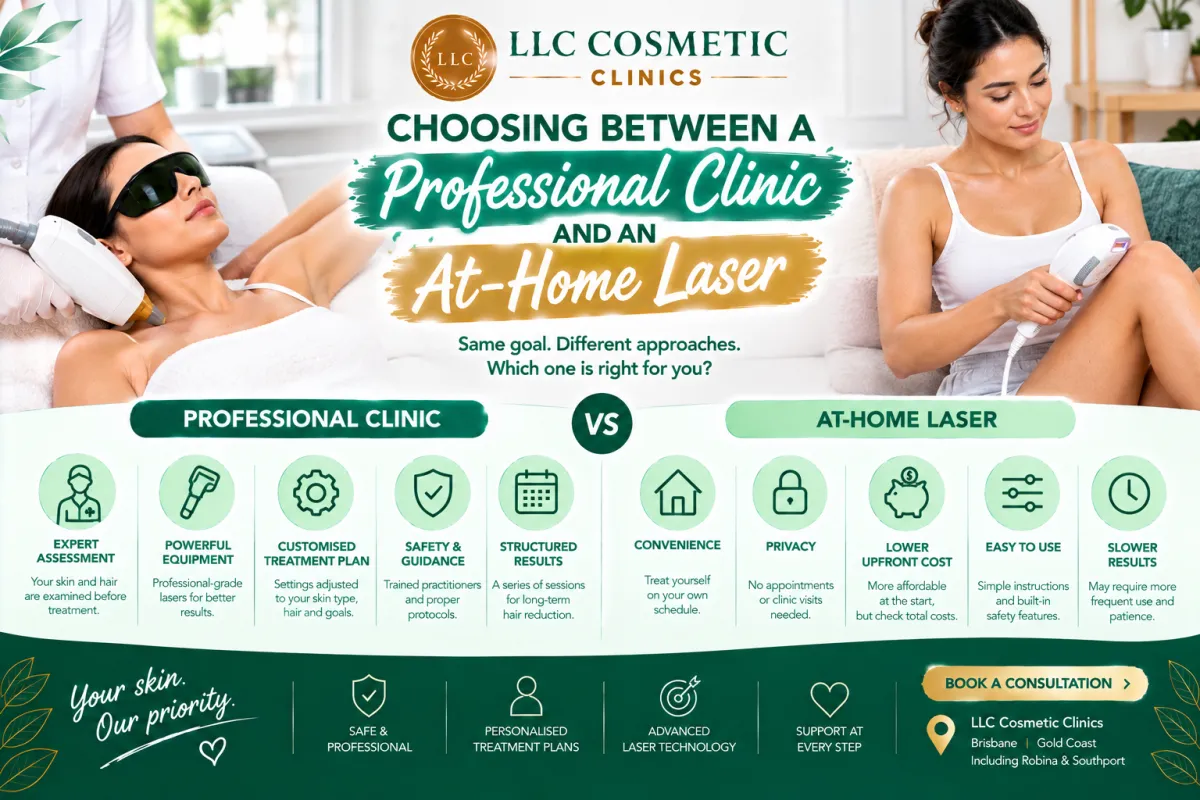
Choosing Between a Professional Clinic and an At-Home Laser
Laser hair removal has become much more accessible in recent years.
You can book a treatment at a professional cosmetic clinic, or you can purchase a device and treat unwanted hair at home.
Both options can sound appealing.
A professional clinic gives you access to trained practitioners, more powerful professional equipment and personalised treatment planning. An at-home device gives you privacy, convenience and the ability to treat yourself on your own schedule.
So which option should you choose?
The answer depends on your skin tone, hair colour, treatment area, goals, budget, time and comfort level with doing the treatment yourself.
It's also important to understand that not every device sold as an "at-home laser" is actually a laser. Some consumer hair-removal devices use intense pulsed light (IPL), while others use lower-powered laser technology.
Understanding these differences can help you make a more informed decision.
Professional Laser Hair Removal vs At-Home Laser: What's the Difference?
The biggest difference is not simply where the treatment happens.
It is the combination of device capability, treatment settings, professional assessment and consistency.
Professional laser hair removal is performed using equipment designed for clinical or professional treatment. The practitioner can assess your skin and hair, select appropriate settings and adjust the treatment as your hair becomes finer or your skin characteristics change.
At-home devices are designed so consumers can operate them without professional supervision. Because of this, they generally operate at lower power than professional devices.
Cleveland Clinic notes that at-home devices are less powerful than professional models. The trade-off is that lower power can make home devices easier for consumers to use, but they may also be less effective and require repeated use to maintain results.
That doesn't automatically make an at-home device a bad choice.
It simply means the two options are designed for different situations.
How Does Professional Laser Hair Removal Work?
Professional laser hair removal uses concentrated light energy to target pigment within the hair follicle.
The absorbed energy is converted into heat, which damages the follicle and reduces its ability to produce hair over time.
Because hair grows in cycles, multiple treatments are normally required.
The American Academy of Dermatology explains that results depend on factors including hair colour and thickness, the treatment area, the laser used and skin colour. Multiple treatments are generally needed, and maintenance treatments may be required when hair regrows.
At a professional clinic, treatment can be customised based on these variables.
For example, your practitioner may consider:
Your Fitzpatrick skin type
Hair colour
Hair thickness
Hair density
Treatment area
Recent tanning or sun exposure
Previous laser treatments
Skin conditions
Medications
Your previous response to treatment
That level of individual assessment is one of the major differences between professional treatment and doing it yourself at home.
How Do At-Home Laser Devices Work?
At-home hair-removal devices use light energy to target hair pigment.
However, consumer devices are generally designed with lower energy levels and additional safety limitations so that people can use them without a trained practitioner operating the device.
Some are marketed as lasers, while others use IPL technology.
The exact technology, wavelength, energy level and treatment instructions vary between products, so it is important to read the manufacturer's specifications rather than assuming every home device works like a professional laser.
According to Cleveland Clinic, at-home devices can reduce visible hair over repeated sessions, but they generally don't deliver the same level of power or effectiveness as professional equipment.
The American Academy of Dermatology also notes that people considering an at-home device should first determine whether the device is appropriate for their skin and hair characteristics.
What Are the Advantages of Professional Laser Hair Removal?
1. Your skin can be assessed before treatment
One of the biggest advantages of professional treatment is that someone can assess your skin before using the device.
Skin tone isn't just about appearance.
It can affect how much light energy is absorbed by the skin and how the treatment should be performed.
The AAD notes that laser hair removal can be performed on people with different skin tones, but treatment needs to be carried out carefully, particularly when there is more skin pigment.
A professional consultation allows your practitioner to consider these factors before treatment begins.
2. Treatment settings can be customised
An at-home device generally gives you a limited number of settings.
A professional system can offer considerably more control over treatment parameters, depending on the device.
Your practitioner can assess your response and adjust treatment settings during your course.
This matters because your hair may become finer as treatment progresses.
The setting that was appropriate at one stage may not necessarily be the same setting used later.
3. Professional equipment can be more powerful
This is one of the biggest practical differences.
At-home devices are intentionally designed with lower power than professional systems.
Lower power can make home treatment more manageable for consumers, but it can also mean that achieving noticeable hair reduction may require more frequent or longer-term use.
Professional treatment may therefore be more suitable for someone who wants a structured treatment program rather than managing the entire process themselves.
4. Large treatment areas can be easier
Trying to treat both full legs with a small home device can become time-consuming.
The American Academy of Dermatology notes that professional laser treatment can cover large areas, while at-home devices may require considerably more time and repeated use.
If you're treating:
Full legs
Full arms
Back
Chest
Multiple areas
the time involved with an at-home device is worth considering.
5. You have professional guidance
A professional treatment isn't just about the laser.
You also have someone who can explain:
How to prepare
When to shave
What to avoid before treatment
What reactions are normal
When to return for your next session
How to care for your skin afterwards
When treatment should be postponed
That guidance can be particularly useful if you're new to laser hair removal.
What Are the Advantages of an At-Home Laser?
There are also legitimate reasons someone may prefer an at-home device.
1. Convenience
You don't need to travel to a clinic.
You can treat yourself at home when it suits your schedule.
For someone with a busy lifestyle, that convenience can be significant.
2. Privacy
Some people simply feel more comfortable treating certain areas themselves.
An at-home device allows you to manage the treatment privately.
3. No appointment scheduling
You don't need to coordinate clinic appointments around work, family or other commitments.
You can follow the manufacturer's treatment schedule from home.
4. Potentially lower upfront cost
Buying a home device can appear less expensive than paying for a full professional treatment course.
However, don't compare only the purchase price.
Consider:
The cost of the device
Replacement cartridges, if required
How frequently you'll need to use it
How long you'll need to continue treatment
Whether you will actually use it consistently
Whether you eventually decide to move to professional treatment
The cheapest option upfront isn't necessarily the lowest-cost option over time.
Are At-Home Lasers Safe?
At-home devices are designed for consumer use, but "at home" does not mean "risk-free."
You still need to follow the manufacturer's instructions carefully.
Cleveland Clinic notes that at-home devices can be appropriate for some people, but their effectiveness and suitability depend on skin and hair characteristics. Some devices may also have limitations for people with darker skin because of the interaction between light energy and skin pigment.
The AAD similarly recommends getting professional advice before using an at-home device and points out that these devices are not appropriate for everyone.
You should also pay attention to areas where the device should not be used.
Depending on the device, restrictions may include tattoos, moles, areas close to the eyes or certain sensitive body areas.
Always follow the manufacturer's instructions for the specific device you own.
What About Darker Skin Tones?
This is one area where choosing the right technology becomes particularly important.
Laser and light-based hair removal interact with pigment.
If there is significant pigment in the skin as well as the hair, inappropriate treatment settings can increase the risk of unwanted skin reactions.
The AAD notes that people with darker skin can have laser hair removal, but treatment needs to be performed carefully by someone experienced with that skin tone.
Cleveland Clinic also notes that some at-home devices are limited in the skin tones they can safely treat, with certain devices using sensors that prevent operation on darker skin.
This is why someone with a deeper skin tone should not assume that any device labelled "laser hair removal" is automatically suitable.
Check the manufacturer's skin-tone compatibility information carefully.
If you're uncertain, professional assessment may provide a safer way to determine which treatment approach is appropriate.
What About Blonde, Grey, White or Red Hair?
Hair colour is another important consideration.
Laser hair removal relies heavily on pigment in the hair.
The AAD explains that laser hair removal does not work effectively on blonde, white, grey or red hair because these hair colours provide less of the pigment the laser is designed to target.
This can be particularly important when purchasing an expensive home device.
Before buying one, check whether your hair colour falls within the manufacturer's recommended range.
If the device isn't appropriate for your hair colour, buying it may simply lead to disappointment.
Is Professional Laser More Effective Than At-Home Treatment?
Generally, professional systems have greater power and flexibility than consumer devices.
That doesn't mean every person will have the same results.
The outcome of laser hair removal depends on multiple factors, including:
Hair colour
Hair thickness
Skin colour
Treatment area
Hair growth cycle
Device technology
Treatment settings
Number of treatments
Consistency
Cleveland Clinic notes that at-home devices can reduce visible hair over multiple sessions but may not achieve the same level of hair reduction as professional treatment.
The AAD also explains that laser hair removal results vary between patients and that multiple treatments are normally necessary.
So instead of asking only, "Which is stronger?", it can be more useful to ask:
"Which option is appropriate for my skin, hair and treatment goals?"
What About the Risk of Burns or Pigmentation Changes?
Any light-based treatment needs to be used appropriately.
Professional laser hair removal can have side effects including redness, swelling and discomfort. Less common complications can include blistering, scarring and changes in skin colour.
At-home devices can also cause unwanted reactions if they are used incorrectly or on unsuitable skin.
This is another important difference between professional and home treatment.
At a clinic, a practitioner can assess your skin before treatment and respond to how your skin reacts.
At home, you are responsible for selecting the setting, following the instructions and recognising when something isn't right.
If you experience significant pain, blistering, severe swelling or an unusual skin reaction, stop using the device and seek appropriate medical advice.
Professional Laser Hair Removal in Queensland: What Should You Check?
If you're considering professional treatment in Queensland, licensing is another useful consideration.
Queensland Health states that people using Class 4 laser apparatus for cosmetic services need an appropriate Use Licence. Cosmetic laser services covered by the licensing framework include hair reduction, skin rejuvenation, capillary reduction and tattoo removal.
Queensland Health also states that operators need relevant theoretical and practical training and competency for the cosmetic procedure they perform.
So when comparing clinics, don't be afraid to ask:
Who performs the treatment?
What training do they have?
Are they appropriately licensed?
What laser technology is being used?
How is my skin type assessed?
What happens if my skin reacts?
How many sessions might I need?
What preparation is required?
What aftercare will I receive?
A reputable provider should be comfortable answering these questions.
How LLC Cosmetic Approaches Professional Laser Hair Removal
At LLC Cosmetic, laser hair removal is approached as a personalised treatment rather than a one-setting-fits-everyone procedure.
The clinic states that its medical-grade laser systems can be tailored to different skin tones and hair characteristics, including Fitzpatrick skin types I–VI. Treatment planning includes assessing factors such as skin type, hair colour, thickness and density, treatment goals and realistic expectations.
LLC Cosmetic currently has clinics in:
Brisbane CBD
Sunnybank
Southport
Robina
The clinic's published information states that most clients require around 6–8 treatments, generally spaced several weeks apart, although individual treatment plans can vary.
A consultation can help determine whether professional laser hair removal is appropriate for your skin and hair profile before you commit to a full treatment course.
Which Option Makes Sense for You?
Rather than saying that everyone should choose a clinic or everyone should buy an at-home device, consider your priorities.
An at-home device may appeal to you if:
You strongly value privacy
You want to treat yourself at home
Your skin and hair fall within the device's recommended range
You are comfortable following instructions carefully
You have the patience to use the device consistently
You understand that results may be slower or less pronounced than professional treatment
A professional clinic may be worth considering if:
You want your skin assessed before treatment
You have a darker or more complex skin tone
You're unsure which technology is appropriate
You want treatment settings customised to you
You want to treat large areas
You want professional guidance throughout the process
You have experienced poor results with home devices
You have a history of pigmentation changes or unusual skin reactions
You want a structured treatment schedule
Neither option needs to be viewed as universally right or wrong.
The important thing is matching the treatment approach to your individual circumstances.
Questions to Ask Before Buying an At-Home Laser
Before spending money on a device, ask yourself:
Does it actually use a laser or IPL?
Read the technical specifications rather than relying only on marketing language.
Is my skin tone suitable?
Check the manufacturer's skin-tone guidance carefully.
Is my hair colour suitable?
Light blonde, white, grey and some red hair may not respond effectively to light-based hair removal.
How often will I need to use it?
Consistency matters.
Can I realistically treat the areas I want to treat?
A small device may be manageable for an upper lip but much more time-consuming for full legs or a full back.
What happens if my skin reacts?
Know the manufacturer's safety instructions before beginning.
Questions to Ask a Professional Laser Clinic
If you're considering professional treatment, ask:
How do you assess my skin type?
Which technology do you use and why?
Who will perform my treatment?
What training and licensing do they have?
How many sessions are likely to be required?
What results are realistic for my hair type?
What side effects should I expect?
What should I do before and after treatment?
What happens if I experience an unexpected reaction?
These questions can help you compare clinics based on more than price alone.
Frequently Asked Questions
Is an at-home laser the same as professional laser hair removal?
Not necessarily. Consumer devices may use lower-powered laser technology or IPL, while professional systems can provide greater power and more treatment flexibility. Always check the technology and specifications of the individual device.
Does at-home laser hair removal permanently remove hair?
You should be cautious about promises of completely permanent hair removal. At-home devices can reduce visible hair with repeated use, but maintenance may be necessary and results vary.
Is professional laser hair removal safer?
Safety depends on appropriate technology, treatment settings, operator training, skin assessment and following safety protocols. Professional treatment provides the additional benefit of assessment and trained guidance. In Queensland, Class 4 cosmetic laser operators require an appropriate Use Licence.
Can I use an at-home laser on dark skin?
It depends on the specific device. Some consumer devices have limited compatibility with darker skin tones because of the way light interacts with skin pigment. Always follow the manufacturer's skin-tone guidance.
Which is cheaper: professional or at-home laser?
An at-home device may have a lower upfront cost, but the total cost depends on the device, treatment frequency, maintenance and how long you need to use it. Professional treatment costs more upfront but provides equipment, treatment and professional guidance as part of the service.
How many professional laser sessions do I need?
There is no universal number. Hair growth cycles, skin type, hair colour, hair thickness and treatment area all affect the treatment plan. LLC Cosmetic states that many clients complete around 6–8 sessions, with spacing between treatments determined by the treatment plan.
Can I switch from at-home treatment to professional laser?
In many cases, professional treatment may still be an option, but tell the clinic about any recent at-home treatments. Your practitioner can assess your skin and determine an appropriate treatment plan.
Final Thoughts: Choosing Between a Professional Clinic and an At-Home Laser
Choosing between a professional clinic and an at-home laser ultimately comes down to what you need from the treatment.
An at-home device can provide privacy, convenience and flexibility for people who are suitable candidates and are willing to use the device consistently.
Professional laser hair removal offers individual assessment, more powerful professional equipment, customised settings and ongoing practitioner guidance.
For some people, convenience will be the biggest priority.
For others, treatment customisation and professional oversight may matter more.
Before making your decision, look beyond the device's advertising claims and consider your skin tone, hair colour, treatment area, expected results, safety, time commitment and long-term costs.
If you're considering professional laser hair removal in Brisbane, Sunnybank, Southport or Robina, LLC Cosmetic offers consultations where your skin and hair characteristics can be assessed and a personalised treatment approach discussed.
The goal isn't simply to choose the most powerful device.
It's to choose the treatment approach that makes sense for your skin, your hair and your goals.