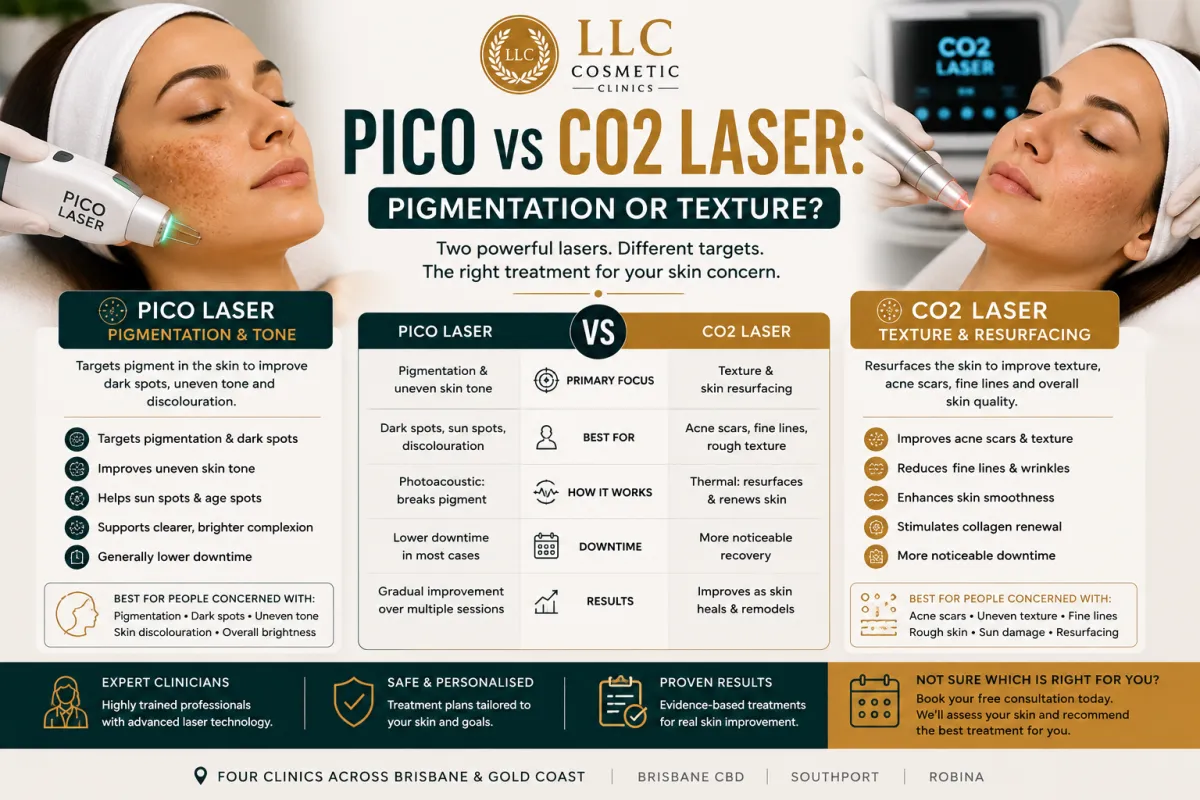
PICO vs CO2 Laser: Pigmentation or Texture?
If you're comparing PICO vs CO2 laser, the right treatment often depends on what you're actually trying to improve.
Are you mainly concerned about pigmentation, dark spots and uneven skin tone?
Or is your biggest concern acne scars, rough texture, fine lines and uneven skin surface?
PICO laser and CO2 laser can both be used as part of a skin rejuvenation plan, but they work differently and are generally chosen for different skin concerns.
A simple way to remember the difference is:
PICO = pigmentation and skin tone
CO2 = resurfacing and skin texture
However, the best treatment isn't determined by the keyword you're searching for. Your skin type, pigmentation, scar type, previous treatments and overall skin condition all need to be considered before treatment.
In this guide, we'll explain the difference between PICO vs CO2 laser, what each treatment is designed to address, downtime, expected results and how to decide which treatment may be worth discussing with a qualified clinician.
PICO vs CO2 Laser: The Quick Answer
If you want the simplest explanation:
PICO laser may be worth exploring if your main concern is:
Pigmentation
Dark spots
Uneven skin tone
Certain types of sun-related pigmentation
Overall skin rejuvenation
Improving the appearance of uneven complexion
PICO is commonly used to target pigmentation and improve the appearance of uneven skin tone.
CO2 laser may be worth exploring if your main concern is:
Acne scars
Uneven skin texture
Fine lines
Rough skin
Resurfacing
Certain signs of skin ageing
CO2 laser is primarily focused on resurfacing and skin texture.
This doesn't mean that PICO only treats pigmentation or that CO2 only treats texture.
There can be overlap, and treatment suitability depends on the individual.
What Is PICO Laser?
PICO laser is a laser treatment that delivers very short pulses of energy to the skin.
It can be used for different cosmetic concerns depending on the device, settings and treatment protocol.
One of the reasons PICO treatments are popular in skin clinics is their ability to target concerns involving pigmentation and uneven skin tone.
Depending on the individual's skin and treatment plan, PICO laser may be used to address concerns such as:
Pigmentation
Dark spots
Uneven complexion
Certain forms of sun-related pigmentation
Skin tone irregularities
General skin rejuvenation
The treatment parameters need to be selected according to the individual's skin characteristics and treatment goals.
What Is CO2 Laser Resurfacing?
CO2 laser resurfacing takes a different approach.
Instead of primarily targeting pigment, CO2 laser is designed to resurface the skin and stimulate skin renewal.
CO2 laser treatment may be considered for concerns such as:
Acne scars
Uneven skin texture
Fine lines
Rough skin
Certain signs of sun damage
Skin resurfacing
Collagen remodelling
The treatment creates controlled thermal injury to the skin, triggering a healing and remodelling process.
Because CO2 resurfacing is more intensive than many low-downtime laser treatments, recovery can be more noticeable.
PICO vs CO2 Laser: How Are They Different?
The easiest way to understand the difference is to focus on the main problem you're trying to solve.
PICO
Think: pigmentation and tone.
PICO laser may be considered when the main concern involves:
Dark spots
Pigmentation
Uneven skin tone
Certain sun-related pigmentation
CO2 Laser
Think: texture and resurfacing.
CO2 laser may be considered when the main concern involves:
Acne scars
Uneven texture
Fine lines
Rough skin
Resurfacing
So if you're asking:
"PICO vs CO2 laser—which one should I choose?"
Start with the concern.
Pigmentation → PICO may be worth exploring.
Texture and acne scars → CO2 may be more relevant.
PICO vs CO2 Laser for Pigmentation
If pigmentation is your primary concern, PICO laser may be the treatment you would discuss first.
Pigmentation can appear in different forms and can have different causes.
You may notice:
Brown spots
Uneven pigmentation
Sun spots
Darker areas of skin
Uneven complexion
PICO treatments can be used to target pigment in the skin, depending on the specific pigmentation and the treatment settings selected.
However, not every type of pigmentation should be treated in exactly the same way.
Some pigmentation conditions can become more noticeable or recur after treatment, particularly when the underlying triggers aren't addressed.
That's why proper assessment is important before treating pigmentation.
If your main concern is:
"My skin tone looks uneven and I have dark spots."
PICO laser may be worth discussing with a qualified clinician.
PICO vs CO2 Laser for Acne Scars
If your primary concern is acne scarring, the answer is different.
CO2 laser is generally more relevant when the problem is primarily skin texture and scarring.
Acne scars can include different types of textural changes, including depressed scars and uneven skin surfaces.
CO2 resurfacing works by creating controlled injury that encourages the skin's healing and collagen-remodelling processes.
This makes it a treatment commonly considered for improving the appearance of certain acne scars.
PICO laser isn't primarily a resurfacing treatment for significant textural acne scarring.
If your main concern is:
"My skin has uneven texture and acne scars."
CO2 laser may be the treatment worth discussing.
PICO vs CO2 Laser for Fine Lines
Fine lines can be caused by several factors, including:
Natural ageing
Collagen changes
Sun exposure
Skin texture
Repeated facial movement
Loss of skin elasticity
CO2 laser may be more relevant when fine lines are associated with skin texture and resurfacing.
PICO may be useful when pigmentation or uneven tone is contributing to an aged or uneven appearance.
So the distinction becomes:
Fine lines + texture → CO2 may be more relevant
Fine lines + pigmentation → PICO may be worth exploring
If both concerns are present, a personalised treatment plan may be more appropriate than choosing a single treatment based on a general comparison.
PICO vs CO2 Laser for Skin Texture
If texture is your biggest concern, CO2 laser generally becomes the more relevant treatment to discuss.
You may notice:
Rough skin
Uneven skin surface
Acne scars
Fine lines
Enlarged-looking pores
Irregular texture
CO2 resurfacing is specifically designed to improve the appearance of skin texture through controlled resurfacing and skin remodelling.
PICO laser may improve the overall appearance of the skin depending on the treatment protocol, but it isn't primarily a deep resurfacing treatment.
Simple rule:
Pigment → PICO
Texture → CO2
Which Has More Downtime: PICO or CO2?
Downtime is another major difference between the two treatments.
PICO Laser Downtime
PICO laser treatments are generally associated with less downtime than more intensive CO2 resurfacing, although the recovery experience depends on the treatment settings and the individual's skin.
Depending on the treatment, you may experience temporary:
Redness
Sensitivity
Swelling
Darkening or lightening of treated pigmentation
Mild skin irritation
Your clinician should explain what to expect for the specific PICO treatment being performed.
CO2 Laser Downtime
CO2 laser resurfacing generally involves more noticeable recovery.
Depending on treatment intensity, recovery may include:
Redness
Swelling
Sensitivity
Peeling
Crusting
Temporary changes in skin appearance
The recovery period can vary considerably depending on how aggressively the treatment is performed.
This is one reason CO2 laser should be properly planned around work, travel and important events.
Simple comparison:
PICO → generally lower downtime
CO2 → generally more noticeable recovery
Which Treatment Is More Intensive?
CO2 laser resurfacing is generally the more intensive option when comparing it with a typical low-downtime PICO treatment.
But more intensive doesn't automatically mean better.
It means the treatment is designed to address a different type of concern.
If your biggest problem is pigmentation, choosing CO2 simply because it is more intensive may not make sense.
Likewise, if your biggest concern is significant acne scarring and texture, a pigmentation-focused treatment may not address your main problem.
The goal is to match the treatment to the concern.
Can PICO and CO2 Laser Be Used Together?
Potentially, yes.
Some people have both pigmentation and textural concerns.
For example:
Uneven pigmentation + acne scars + fine lines
In this situation, one treatment may not address every concern equally.
A clinician may consider whether PICO, CO2 or a combination of treatments could form part of an appropriate treatment plan.
However, combining treatments shouldn't be done simply because two treatments are available.
The treatment plan should consider:
Skin type
Pigmentation
Scar type
Previous treatments
Skin sensitivity
Recovery time
Treatment intensity
Individual goals
The timing between procedures should also be determined by the treating clinician.
PICO vs CO2 Laser: What About Sensitive Skin?
This is an important consideration.
Not every person is automatically a suitable candidate for every laser treatment.
Your skin may react differently depending on:
Skin type
Existing pigmentation
Recent sun exposure
Previous procedures
Active skin conditions
Medications
Treatment settings
This is especially important when treating pigmentation because inappropriate treatment or excessive inflammation can sometimes contribute to unwanted pigmentation changes.
A proper consultation helps determine whether treatment is appropriate and what settings may be suitable.
PICO vs CO2 Laser: Which Treatment Is Better?
There isn't one universal winner.
Instead, consider your main concern.
If your main concern is pigmentation:
PICO may be worth exploring.
If your main concern is acne scars:
CO2 laser may be more relevant.
If your main concern is uneven skin tone:
PICO may be worth discussing.
If your main concern is uneven texture:
CO2 laser may be more appropriate to explore.
If you have both pigmentation and texture:
A clinician can determine whether one treatment or a staged treatment plan is more appropriate.
PICO vs CO2 Laser: What Results Can You Expect?
It's important to have realistic expectations from any cosmetic laser treatment.
Neither PICO nor CO2 laser should be viewed as a way to create completely flawless skin.
The goal is usually to improve the appearance of specific skin concerns.
With PICO, improvement may involve:
More even-looking pigmentation
A more uniform complexion
Reduced appearance of certain dark spots
Overall skin rejuvenation
With CO2 laser, improvement may involve:
Smoother-looking texture
Reduced appearance of certain acne scars
Softer-looking fine lines
More refined skin surface
Results vary from person to person and may require more than one treatment depending on the concern.
Why Your Skin Assessment Matters
One of the biggest mistakes people make when researching laser treatments is choosing the procedure before identifying the problem.
For example:
You see pigmentation and immediately search for a laser.
But the important question is:
What type of pigmentation is it?
Likewise, you see acne scars and immediately search for CO2 laser.
But the important question is:
What type of acne scars do you have?
Different skin concerns can require different approaches.
A professional consultation allows your clinician to assess the skin and determine whether the treatment you're considering is appropriate.
How to Decide Between PICO and CO2 Laser
Before booking, ask yourself these questions:
1. What bothers me most?
Is it:
Pigmentation?
or
Texture?
2. How much downtime can I manage?
PICO treatments may involve less recovery, while CO2 resurfacing generally requires more visible recovery.
3. What result am I expecting?
Do you want to improve:
Skin tone?
or
Skin texture?
4. Have I had laser treatments before?
Tell your clinician about previous laser treatments, peels, injectables and other cosmetic procedures.
5. Have I had pigmentation problems before?
This is particularly important when considering laser treatment for pigmentation.
PICO vs CO2 Laser: The Bottom Line
When comparing PICO vs CO2 laser, the most important distinction is simple:
PICO = Pigmentation
PICO laser may be worth exploring if your main concerns are:
Dark spots
Pigmentation
Uneven skin tone
Certain sun-related pigmentation
Overall complexion
CO2 = Texture
CO2 laser may be more relevant if your main concerns are:
Acne scars
Uneven texture
Fine lines
Rough skin
Resurfacing
But your skin doesn't necessarily fit into one category.
You may have pigmentation and acne scars.
You may have fine lines and uneven tone.
That's why a professional assessment is important before deciding which laser treatment is right for you.
The best laser treatment isn't necessarily the strongest treatment. It's the treatment that matches your skin concern and is appropriate for your skin.
Ready to Find Out Which Laser Treatment Is Right for You?
If you're unsure whether PICO or CO2 laser is more suitable for your skin, don't feel that you have to make the decision based on an online comparison alone.
A professional consultation can help assess your pigmentation, skin texture, scarring, skin type and treatment goals.
At LLC Cosmetic, the focus should be on creating a treatment approach based on your individual skin concerns, rather than simply choosing the most intensive treatment.
Start with your skin concern. Then choose the treatment.
Frequently Asked Questions
Is PICO better than CO2 laser?
Neither treatment is universally better. PICO laser is commonly considered for pigmentation and uneven skin tone, while CO2 laser is primarily used for resurfacing and improving skin texture.
Is PICO or CO2 better for pigmentation?
PICO may be more relevant when pigmentation is the primary concern. However, the type and cause of pigmentation should be assessed before treatment.
Is CO2 laser better than PICO for acne scars?
CO2 laser is generally more relevant for textural acne scars because it is a resurfacing treatment designed to stimulate skin renewal and collagen remodelling.
Which has more downtime, PICO or CO2?
CO2 laser resurfacing generally involves more noticeable downtime than many PICO treatments. Recovery depends on treatment settings and individual skin response.
Can PICO and CO2 laser be used together?
They may potentially be incorporated into a broader treatment plan for people with both pigmentation and textural concerns. Treatment timing and suitability should be determined by a qualified clinician.
Does PICO laser resurface the skin?
PICO laser can be used for skin rejuvenation, but it is not primarily the same type of resurfacing treatment as CO2 laser.
Can CO2 laser treat pigmentation?
CO2 laser may affect pigmentation and can be used in some resurfacing protocols, but it is primarily known as a resurfacing treatment. Pigmentation concerns should be assessed before selecting a laser.
Which treatment should I choose?
If your main concern is pigmentation or uneven tone, PICO may be worth exploring. If your main concern is acne scars, texture or resurfacing, CO2 laser may be more relevant. A clinician can determine whether either treatment is suitable for you.
Medical Disclaimer
This article is for general educational purposes only and does not constitute medical advice, diagnosis or treatment recommendations. PICO laser and CO2 laser may not be suitable for everyone. Individual results, risks, recovery and treatment requirements vary. A qualified clinician should assess your skin and circumstances before treatment.