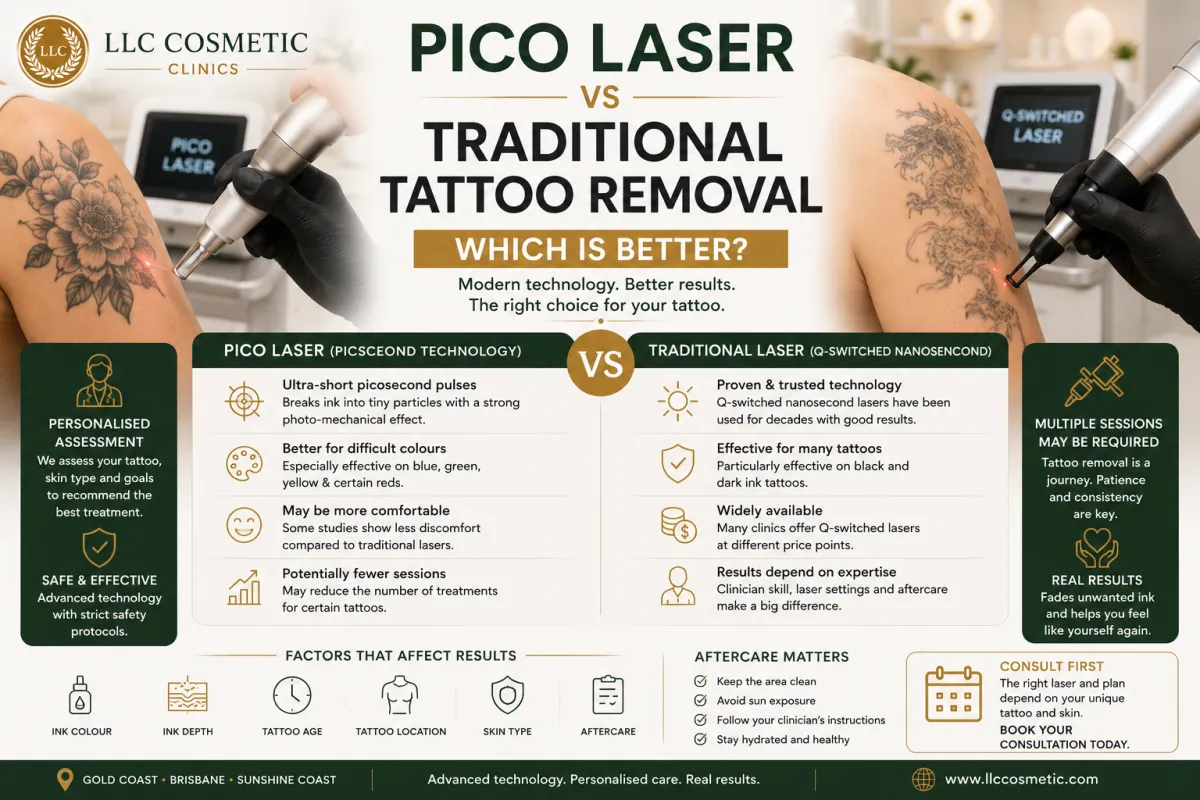
Pico Laser vs Traditional Tattoo Removal: Which Is Better for Your Tattoo?
Removing an unwanted tattoo is rarely a one-session process. The type of ink, tattoo colour, depth, age, location and your individual skin response can all influence how well it responds to treatment.
One of the biggest questions people ask is:
Is Pico laser better than traditional tattoo removal?
The short answer is that Pico laser technology can offer advantages for certain tattoos, particularly some difficult colours, but traditional Q-switched nanosecond lasers can still be effective.
The right choice depends on your tattoo and your skin rather than simply choosing the newest technology.
What Is Pico Laser Tattoo Removal?
Pico laser technology uses extremely short pulses of laser energy measured in picoseconds — trillionths of a second.
Instead of relying primarily on heat, these very short pulses create a strong photomechanical effect that helps break tattoo pigment into smaller particles.
The body's natural processes can then gradually clear the fragmented pigment.
This is one reason picosecond technology has become an important development in laser tattoo removal. Research has found evidence that picosecond lasers can be effective for tattoo pigment, although results vary depending on the tattoo and laser wavelength used.
What Is Traditional Laser Tattoo Removal?
When people say "traditional laser tattoo removal," they often mean Q-switched nanosecond lasers.
These lasers have been used for tattoo removal for decades and remain an established treatment option.
They deliver laser energy in nanosecond pulses — billionths of a second — to target tattoo pigment.
The laser energy is absorbed by the ink, helping break the pigment into smaller particles that the body can gradually remove.
Traditional laser technology can still produce good results, particularly for certain black and dark pigments.
In other words, traditional doesn't necessarily mean ineffective or outdated.
Pico Laser vs Traditional Tattoo Removal: What's the Difference?
The main technological difference is the length of the laser pulse.
Pico laser:
Uses picosecond pulses
Produces a strong photomechanical effect
Can be particularly useful for certain stubborn tattoo pigments
May cause less discomfort in some treatment comparisons
Can potentially reduce the number of treatments for some tattoos
Traditional Q-switched laser:
Uses nanosecond pulses
Has decades of clinical use in tattoo removal
Can be effective for many tattoo colours
Remains a suitable option for many tattoos
Treatment results depend heavily on wavelength, settings and tattoo characteristics
Clinical research comparing picosecond and nanosecond lasers has found promising advantages for picosecond technology, although results are not identical across every tattoo type.
Is Pico Laser More Effective Than Traditional Laser?
Not necessarily for every tattoo.
This is an important distinction.
A 2020 systematic review found that picosecond lasers showed advantages particularly for blue, green and yellow tattoo pigments, while both picosecond and Q-switched lasers were effective for black tattoos.
More recent research continues to investigate the differences.
A 2026 randomised split-tattoo study comparing 755-nm picosecond and nanosecond alexandrite lasers found higher clearance scores with the picosecond treatment in the tattoos studied. However, the study involved a specific laser wavelength and a relatively small group, so its results shouldn't be interpreted as meaning every Pico treatment will outperform every traditional laser.
The technology matters, but the treatment plan matters too.
Which Tattoo Colours Respond Best to Pico Laser?
Tattoo colour is one of the most important factors when determining treatment options.
Black ink is generally considered one of the more responsive colours to laser treatment.
Other colours can be more challenging.
Depending on the specific laser wavelength and technology available, Pico laser may be particularly useful for colours such as:
Blue
Green
Yellow
Certain red pigments
Black and dark pigments
However, there isn't one laser wavelength that removes every tattoo colour equally well.
A professional assessment should consider the actual pigments in your tattoo before a treatment plan is recommended.
Does Pico Laser Hurt Less?
Laser tattoo removal can be uncomfortable regardless of the technology used.
Patients commonly describe the sensation as:
A snapping or rubber-band-like feeling
Heat
Stinging
Short bursts of discomfort
Some studies have found picosecond treatment to be less painful than nanosecond treatment in certain circumstances. For example, one randomised study involving black tattoos reported significantly lower pain scores with picosecond treatment.
However, pain varies depending on:
Tattoo location
Tattoo size
Ink density
Treatment settings
Individual pain tolerance
Previous treatments
Skin sensitivity
So it would be inaccurate to say that Pico laser is completely painless.
Does Pico Laser Require Fewer Sessions?
Possibly — but there is no guaranteed number of sessions.
Tattoo removal usually requires multiple treatments because the laser cannot safely remove all tattoo pigment in one session.
The number of sessions depends on factors such as:
Tattoo age: Older tattoos may sometimes respond differently from newer tattoos.
Ink colour: Some pigments are more difficult to treat than others.
Ink depth: Tattoo pigment located deeper in the skin may require more treatments.
Ink density: Heavily saturated professional tattoos may take longer to clear.
Tattoo location: Blood circulation and other factors can influence the body's ability to clear fragmented pigment.
Previous treatments: Tattoos that have already undergone laser removal may respond differently.
A systematic review of picosecond tattoo removal studies found that more than 70% pigment clearance was reported in 69–100% of tattoos across the included human studies, but the number of treatments varied from 1 to 10 and the evidence had important limitations.
That's why a clinic should avoid promising a specific number of sessions before assessing your tattoo.
What About Scarring and Skin Discolouration?
Laser tattoo removal is designed to target tattoo pigment while limiting unnecessary damage to surrounding skin, but side effects can still occur.
Possible reactions include:
Redness
Swelling
Temporary sensitivity
Blistering
Crusting
Hyperpigmentation
Hypopigmentation
Rarely, textural changes or scarring
Research comparing picosecond and nanosecond technologies has reported differences in side-effect profiles, but neither technology should be considered completely risk-free.
Your skin type, treatment settings and aftercare all matter.
This is particularly important for people who are prone to pigmentation changes.
So, Which Is Better: Pico or Traditional Laser?
There isn't one universal winner.
Pico laser may be a particularly useful option when:
You have difficult-to-treat tattoo colours
Your tattoo has previously responded poorly to treatment
You want access to newer picosecond technology
Your clinician determines that the available Pico wavelength is appropriate for your tattoo
Traditional Q-switched laser may still be appropriate when:
Your tattoo responds well to the available wavelength
You have primarily black or dark pigment
The clinic has appropriate technology and experienced practitioners
Your clinician determines that nanosecond treatment is suitable
The best treatment isn't simply the one with the newest name.
It's the one that matches your tattoo, your skin and your treatment goals.
What Should You Ask Before Booking Tattoo Removal?
Before committing to a treatment plan, ask the clinic:
1. What type of laser will you use?
Ask whether the clinic uses picosecond or nanosecond technology and which wavelengths are available.
2. Which colours in my tattoo can you treat?
Different wavelengths interact differently with different pigments.
3. How many sessions might I need?
Remember that this should be an estimate rather than a guarantee.
4. What side effects should I expect?
Ask specifically about redness, blistering and temporary or persistent pigment changes.
5. How long should I wait between treatments?
Your skin needs time to recover and your body needs time to clear fragmented pigment.
6. What aftercare will I need?
Proper aftercare can be an important part of reducing complications.
7. Who will perform the treatment?
Ask about the practitioner's qualifications, experience and the clinic's laser safety protocols.
Is Pico Laser Worth It for Tattoo Removal?
For many people, Pico laser technology can be an excellent option for unwanted tattoo pigment.
Its ultra-short pulse duration has helped expand the options available for tattoo removal, and research suggests potential advantages for certain colours and tattoo types.
But Pico isn't automatically better for every tattoo.
The best approach is to have your tattoo assessed before deciding which technology to use.
At LLC Cosmetic, a suitability assessment can help determine whether Pico laser is appropriate for your tattoo and treatment goals.
Final Thoughts: Pico Laser vs Traditional Tattoo Removal
When comparing Pico laser vs traditional tattoo removal, the biggest difference is the technology's pulse duration and how that energy interacts with tattoo pigment.
Pico lasers use picosecond pulses, while traditional Q-switched lasers generally use nanosecond pulses.
Pico technology may provide advantages for certain colours and difficult tattoos, while traditional laser systems remain useful for many tattoo-removal cases.
The right choice isn't simply Pico versus traditional.
It's about choosing the appropriate laser, wavelength, settings and treatment plan for your specific tattoo and skin.
If you're considering tattoo removal, a professional assessment is the best place to start.