PICO vs IPL for Tattoo Removal: Why IPL Can't Remove Ink
If you're looking into tattoo removal, you may have come across both PICO laser and IPL and wondered which one is better.
They are not simply two different versions of the same treatment.
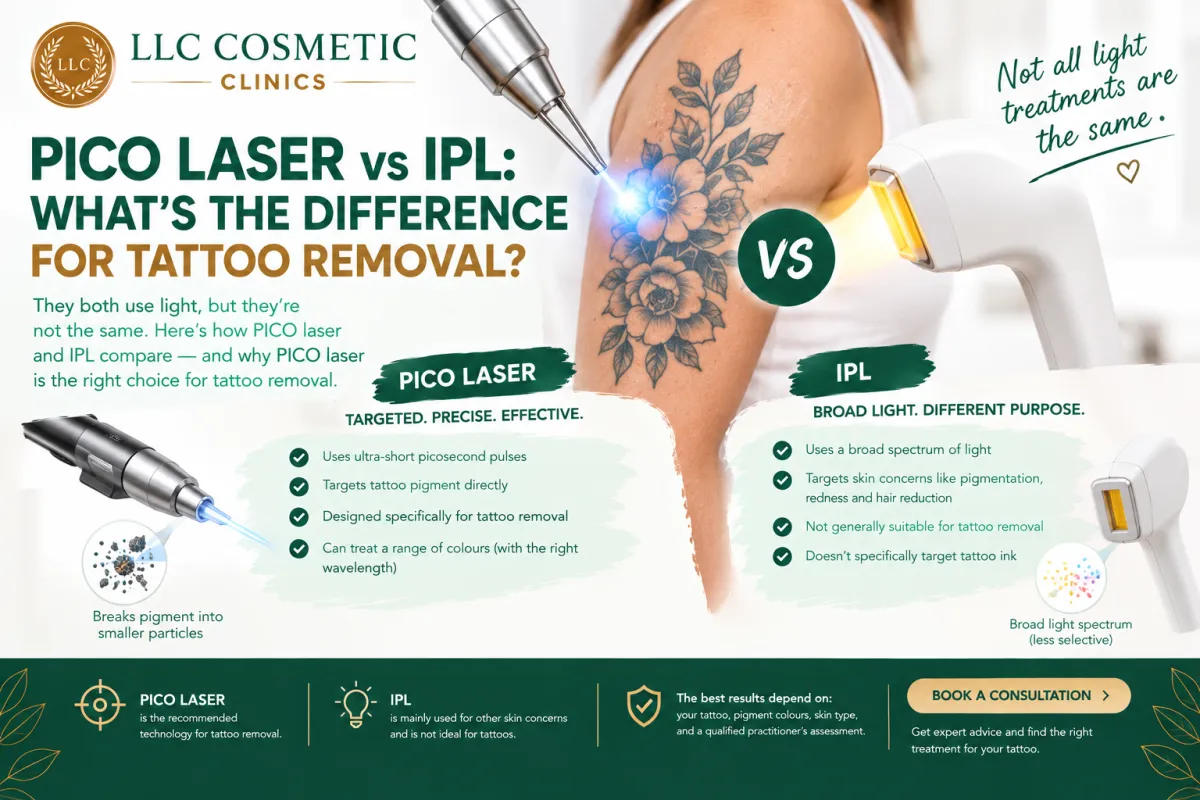
PICO laser and IPL use fundamentally different technologies, and IPL is generally not considered an appropriate treatment for removing tattoo ink. Modern tattoo removal relies on specific laser wavelengths and very short pulses designed to target tattoo pigment.
PICO lasers are specifically designed to deliver ultra-short pulses that can fragment tattoo pigment. IPL, on the other hand, delivers a broad range of light wavelengths and is commonly used for concerns such as pigmentation, redness and hair reduction rather than tattoo removal.
So if your goal is tattoo removal, PICO laser is the more relevant technology to discuss with a qualified practitioner.
PICO Laser vs IPL: The Quick Answer
PICO laser: Uses extremely short picosecond pulses of laser energy to target tattoo pigment. It is specifically used in modern tattoo-removal treatments.
IPL: Uses a broad spectrum of light rather than a single specific laser wavelength. It is commonly used for hair reduction, pigmentation and some vascular concerns, but it is not generally suitable for tattoo removal.
Research on tattoo removal has found that IPL devices are not appropriate for effectively breaking down tattoo pigment and may cause unwanted heating of surrounding tissue.
That's an important distinction if you're comparing treatments for an unwanted tattoo.
What Is PICO Laser?
PICO laser refers to laser technology that delivers pulses measured in picoseconds, or trillionths of a second.
The extremely short pulse duration allows the laser to produce a strong photoacoustic effect that can help break tattoo pigment into much smaller particles.
The body then gradually clears the fragmented pigment over time.
A systematic review of picosecond lasers found evidence supporting their use for tattoo removal, although results vary depending on the tattoo colour, laser wavelength and other factors.
PICO technology isn't a single universal wavelength.
Different PICO systems may use different wavelengths, and wavelength selection matters because different tattoo pigments absorb different wavelengths.
For example, research has examined picosecond wavelengths including 532 nm, 755 nm and 1064 nm for different tattoo colours.
What Is IPL?
IPL stands for Intense Pulsed Light.
Unlike a conventional laser, IPL produces a broad spectrum of light rather than one specific wavelength.
It is commonly used in cosmetic treatments for concerns such as:
Hair reduction
Sun spots
Uneven pigmentation
Some forms of redness
Photo-rejuvenation
IPL can be useful for certain skin concerns, but that doesn't mean it should be used for tattoo removal.
The way IPL delivers energy is fundamentally different from the highly targeted laser pulses used for tattoo pigment.
Why Isn't IPL Recommended for Tattoo Removal?
The main issue is how the energy interacts with the tattoo pigment and surrounding skin.
Tattoo removal requires energy to be delivered in a way that can fragment pigment particles while limiting unnecessary injury to surrounding tissue.
Research has reported that IPL devices are unsuccessful for tattoo ink removal because their broad wavelength range and longer pulse durations aren't sufficiently selective for tattoo pigment. The energy can instead heat the pigment and surrounding tissue.
This can increase the risk of unwanted complications such as:
Burns
Blistering
Scarring
Pigment changes
Incomplete tattoo removal
Residual or retained ink
For this reason, IPL should not be confused with PICO laser simply because both use light energy.
How Does PICO Laser Remove Tattoo Ink?
Tattoo ink sits within the skin rather than simply on its surface.
When a suitable laser wavelength is delivered to the tattoo, the energy is absorbed by the pigment.
The very short pulse duration helps create a photoacoustic effect that fragments the pigment into smaller particles.
Your body then gradually removes some of those particles.
This is why tattoo removal isn't an instant process.
The American Academy of Dermatology explains that multiple laser treatments are usually necessary because tattoo ink is layered and the body needs time to clear the fragmented pigment between treatments.
Does PICO Laser Work Better Than IPL for Every Tattoo?
For tattoo removal, the more accurate answer is:
PICO laser is an appropriate tattoo-removal technology; IPL generally isn't.
However, that doesn't mean every PICO treatment will produce the same result.
Tattoo removal depends on many variables, including:
Ink colour
Ink density
Ink depth
Tattoo size
Tattoo location
Skin type
Wavelength
Previous treatments
Age of the tattoo
Type of tattoo
How your body clears pigment
A review of laser tattoo-removal studies found that picosecond lasers have shown advantages for some blue, green and yellow pigments, while both picosecond and Q-switched lasers can be effective for black tattoos.
So the question shouldn't simply be:
"Is PICO better?"
It should be:
"Which wavelength and treatment approach is appropriate for my tattoo?"
PICO Laser vs IPL for Black Tattoos
Black tattoo ink is generally considered one of the more responsive tattoo colours for laser removal.
PICO laser systems using appropriate wavelengths can target black pigment effectively.
Research has demonstrated that 1064 nm lasers are commonly used for black tattoo ink, and studies have found both picosecond and nanosecond 1064 nm lasers can be effective.
IPL, however, is not a recommended alternative for removing black tattoo ink.
So if you have a black tattoo you want removed, IPL isn't a substitute for a dedicated tattoo-removal laser.
PICO Laser vs IPL for Coloured Tattoos
Coloured tattoos can be more complicated.
Different pigments absorb different wavelengths.
For example, research has found that picosecond lasers can have advantages for certain blue, green and yellow pigments.
This is one reason why a practitioner needs to assess the tattoo before deciding how to treat it.
A tattoo containing:
Black
Red
Blue
Green
Yellow
White
Purple
may require different considerations for each pigment.
A single laser wavelength cannot necessarily treat every colour equally effectively.
The American Academy of Dermatology also notes that a single laser cannot remove all tattoo colours.
Can IPL Make a Tattoo Worse?
Using IPL over tattooed skin can carry risks.
Published reports have described complications following IPL exposure to tattooed areas, including inflammatory reactions.
More importantly, research specifically examining tattoo removal has found that IPL is not appropriate for effectively destroying tattoo pigment and may transfer heat to surrounding tissue.
This is why you shouldn't assume that a clinic offering IPL for pigmentation or hair removal can automatically use the same device for tattoo removal.
Tattoo removal requires the right technology, settings, wavelength and clinical knowledge.
Is PICO Laser Safer Than IPL for Tattoo Removal?
It's better not to describe any laser treatment as completely "safe."
PICO laser tattoo removal can still cause temporary or, less commonly, more significant side effects.
Possible reactions include:
Redness
Swelling
Tenderness
Blistering
Crusting
Temporary hyperpigmentation
Temporary hypopigmentation
Scarring or textural changes in some cases
Systematic reviews of tattoo laser treatments have reported these types of adverse effects.
PICO technology may have advantages in some situations, but treatment settings and patient factors matter.
A 2025 meta-analysis comparing picosecond and nanosecond lasers found broadly comparable efficacy in some pigment conditions and reported less pain and some lower rates of pigmentation complications with picosecond lasers, although the evidence varied by patient group and treatment type.
Does PICO Laser Hurt More Than IPL?
This comparison can be misleading because IPL isn't normally an appropriate tattoo-removal treatment.
Instead of comparing PICO and IPL based on comfort, it's more useful to consider the correct treatment for the tattoo.
PICO laser tattoo removal can feel uncomfortable, and pain varies depending on:
Tattoo location
Tattoo size
Laser settings
Ink density
Individual sensitivity
Treatment area
Cooling or other comfort measures
Interestingly, some clinical studies have found picosecond laser treatment to be less painful than comparable nanosecond laser treatment.
But that doesn't mean PICO tattoo removal will be painless.
What About IPL for a Tattooed Area?
If you're having IPL for another cosmetic concern, make sure the practitioner knows you have a tattoo in or near the treatment area.
Tattoo pigment can interact with light-based treatments differently from surrounding skin.
One published case report described a granulomatous reaction involving an old cosmetic tattoo following IPL treatment for facial rejuvenation.
This doesn't mean every tattoo exposed to IPL will develop a complication.
It does highlight why tattooed areas should be identified and considered during treatment planning.
Can PICO Completely Remove a Tattoo?
Not necessarily.
Even with dedicated tattoo-removal lasers, complete clearance cannot be guaranteed.
Some tattoos respond very well, while others can leave residual pigment.
Factors that can affect results include:
Colour
Density
Depth
Location
Tattoo age
Professional versus amateur tattooing
Skin type
Previous laser treatments
A systematic review of picosecond tattoo removal found that 69–100% of tattoos in the included human studies achieved more than 70% pigment clearance after 1–10 treatments, but the studies varied considerably and much of the evidence involved black and blue tattoos.
That is why a consultation is more useful than promising a specific number of sessions before seeing the tattoo.
What Should You Choose for Tattoo Removal?
If your goal is tattoo removal, PICO laser is the technology you should be discussing with a practitioner experienced in tattoo removal.
IPL is generally used for different cosmetic concerns and shouldn't be selected as a tattoo-removal alternative.
Before booking, ask:
What laser technology do you use for tattoo removal?
Then ask:
What wavelengths are available?
Which wavelength would be appropriate for my tattoo?
Have you treated this tattoo colour before?
How many sessions might I realistically need?
How long will I need between treatments?
What side effects should I expect?
What happens if some colours don't respond?
What aftercare will I need?
Who will perform the treatment?
These questions can help you make a more informed decision.
PICO Laser vs IPL: The Bottom Line
If you're searching for PICO laser vs IPL because you want to remove a tattoo, the difference is important.
PICO laser is specifically used for tattoo pigment removal.
IPL is a broad-spectrum light treatment primarily used for other cosmetic concerns and is not generally suitable for tattoo removal.
PICO laser uses ultra-short pulses and specific wavelengths to target tattoo pigments. Research supports picosecond lasers as an established option for tattoo removal, although results vary by pigment, wavelength, skin type and tattoo characteristics.
So rather than choosing based on the word "laser" or "light," choose a clinic that can properly assess your tattoo and explain the technology, wavelength, expected results and risks.
If you're considering tattoo removal in Brisbane or the Gold Coast, LLC Cosmetic offers PICO laser tattoo removal assessments and can assess the colours, density and characteristics of your tattoo before recommending a treatment approach.