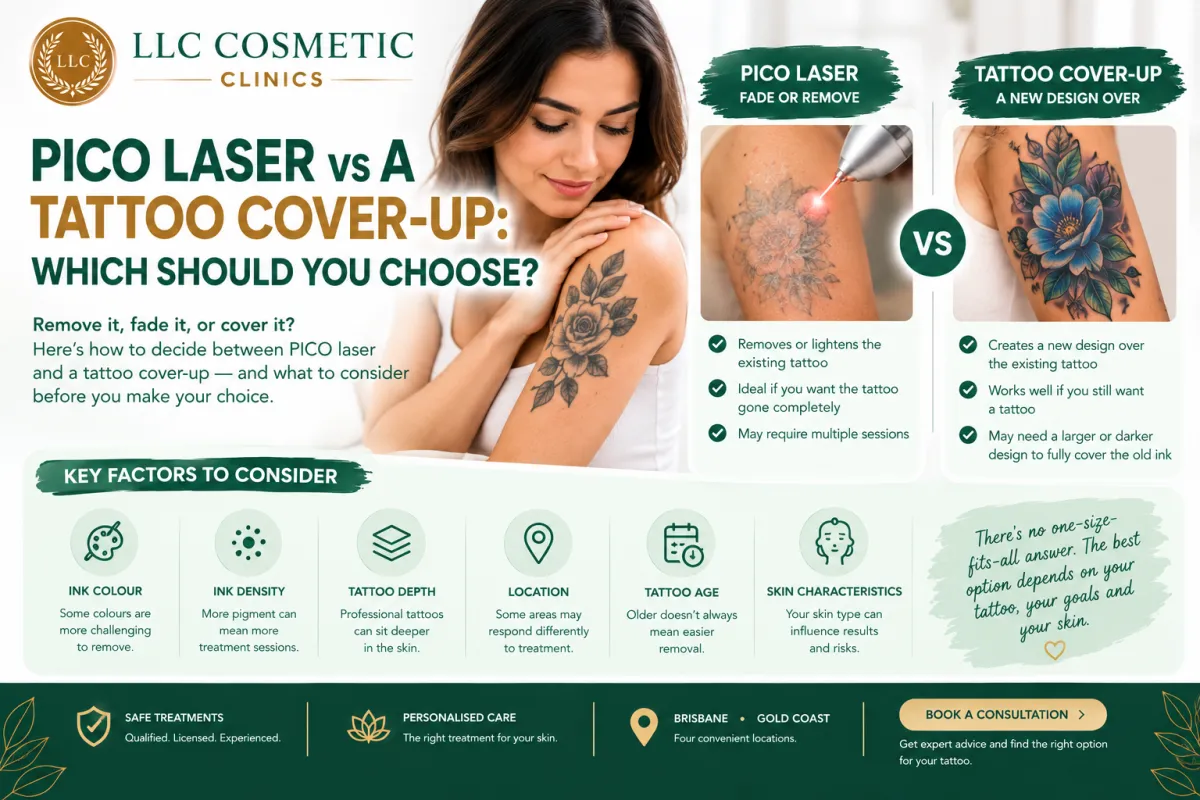
PICO Laser vs a Tattoo Cover-Up: Which Should You Choose?
Removing a tattoo doesn't always mean making it disappear completely.
If you're unhappy with an existing tattoo, you generally have two main options:
Option 1: Use PICO laser tattoo removal to fade or remove the existing ink.
Option 2: Have a tattoo artist create a new design over the existing tattoo.
So, which should you choose?
The answer depends on your tattoo, how much of it you want to change, the design you're considering, your timeline and your expectations.
In some cases, a cover-up can be the simplest option. In others, PICO laser fading first can give your tattoo artist a much better canvas for the new design.
Here's how to decide.
PICO Laser vs a Tattoo Cover-Up: The Quick Answer
If you still like the idea of having a tattoo but dislike the existing design, a cover-up may be worth considering.
If you want the tattoo gone completely, PICO laser removal is the more appropriate option.
If you want a new tattoo that is lighter, cleaner or more detailed than what can realistically be placed over your existing ink, partial PICO laser fading followed by a cover-up may be the best approach.
There isn't one solution that's right for everyone.
Your tattoo artist and laser practitioner can help you determine how much fading may be needed before starting either process.
What Is PICO Laser Tattoo Removal?
PICO laser tattoo removal uses extremely short laser pulses measured in picoseconds.
The laser targets tattoo pigment and breaks it into smaller particles, which your body gradually clears over time.
Research suggests that picosecond lasers can be effective for tattoo removal, with some evidence showing advantages for certain blue, green and yellow pigments compared with traditional nanosecond approaches. However, results vary depending on the tattoo and the laser system used.
PICO laser doesn't necessarily mean complete removal.
It can also be used to fade a tattoo before a cover-up.
That distinction is important.
What Is a Tattoo Cover-Up?
A tattoo cover-up involves creating a new tattoo over an existing tattoo.
Instead of removing the original ink, the tattoo artist designs around or over it to incorporate the existing pigment into a new design.
A skilled tattoo artist may be able to transform:
An unwanted name
An old symbol
A faded design
A small tattoo
A simple black tattoo
An outdated piece
into a completely different-looking tattoo.
However, the original ink doesn't disappear.
It remains underneath the new design.
When Is a Cover-Up a Good Option?
A cover-up may make sense if you're happy to keep having a tattoo but simply want a different design.
For example, you might want to:
Replace an old design
Cover a name or symbol
Turn a small tattoo into a larger artwork
Incorporate an existing tattoo into a new design
Avoid the time and cost of complete tattoo removal
Get a new design relatively quickly
The important part is finding an experienced tattoo artist who specialises in cover-ups.
Not every tattoo can be covered with every design.
When Might PICO Laser Be the Better Choice?
PICO laser may be more appropriate if your goal is to remove the tattoo rather than replace it.
You may also benefit from laser fading if your desired cover-up design cannot realistically hide the existing tattoo.
For example, a dark, dense tattoo underneath a delicate or lighter design may remain visible even after a cover-up.
In that situation, fading the original tattoo first can give the tattoo artist more flexibility.
You Don't Always Have to Remove the Whole Tattoo
This is one of the biggest things people misunderstand about laser tattoo removal.
You don't necessarily need to pursue complete removal before getting another tattoo.
Sometimes the goal is simply:
“Make the old tattoo light enough for my new tattoo artist to work with.”
LLC Cosmetic specifically offers PICO laser tattoo fading for people who want to prepare an existing tattoo for a cover-up.
This can potentially mean fewer laser sessions than pursuing maximum possible removal.
However, the exact number of sessions depends on the original tattoo.
How Much Should You Fade a Tattoo Before a Cover-Up?
There is no universal percentage that applies to every cover-up.
The amount of fading needed depends on:
Original tattoo colour
Ink density
Tattoo depth
Size
Location
Existing design
New tattoo design
Colours being used in the cover-up
Tattoo artist's technique
A simple, lightly inked tattoo may require less fading than a dense black professional tattoo.
Your tattoo artist should ideally be involved in the planning process.
They can tell you what the new design requires before you start laser treatment.
PICO Laser + Cover-Up Can Be a Combination Strategy
For some people, the best answer isn't:
PICO laser OR cover-up.
It can be:
PICO laser → partial fading → tattoo cover-up.
Here's what that might look like:
Step 1: Assess the Existing Tattoo
A laser practitioner examines the tattoo's colour, density, depth, age and location.
Step 2: Plan the Desired Cover-Up
Your tattoo artist determines what type of new design you want.
Step 3: Determine How Much Fading Is Needed
The laser practitioner and tattoo artist can work around the requirements of the new design.
Step 4: Complete the Necessary PICO Sessions
The tattoo is gradually faded, with appropriate healing time between treatments.
Step 5: Allow the Skin to Heal
Don't rush straight from laser treatment into a tattoo appointment.
The treated skin needs time to recover.
Step 6: Get the Cover-Up
Once the skin has adequately healed and the tattoo has reached the desired level of fading, your tattoo artist can create the new design.
Why You Shouldn't Rush From PICO Laser to a Cover-Up
Laser treatment affects the skin as well as the tattoo pigment.
After a treatment, you may experience temporary reactions such as redness, swelling, blistering or crusting.
The American Academy of Dermatology recommends following aftercare instructions and protecting treated skin from the sun while it heals.
Putting a new tattoo over skin that hasn't properly recovered isn't something you should rush.
Your laser practitioner should tell you when the area has adequately healed.
What If You Choose a Cover-Up Without Laser Fading?
A cover-up can work very well in the right circumstances.
But your options may be more limited.
The tattoo artist has to work with the existing pigment underneath the new tattoo.
This can influence:
Design
Size
Colour
Shading
Placement
Detail
Overall darkness
A cover-up often needs to be larger or darker than the original tattoo to successfully disguise it.
That's why laser fading can sometimes give an artist more creative flexibility.
PICO Laser vs Cover-Up: What About Cost?
It's important to compare the total cost, not just the price of one treatment.
A cover-up may involve:
Consultation
Design work
Tattoo session
Additional tattoo sessions
Larger artwork than originally planned
PICO laser treatment involves:
Consultation
Multiple laser sessions in many cases
Healing periods
Aftercare
LLC Cosmetic currently lists tattoo removal from $158 per session, but the total number of sessions varies according to the tattoo.
A proper assessment is therefore more useful than assuming a fixed treatment price.
What About Tattoo Age?
The age of your tattoo can be relevant, but it isn't the only factor.
Older tattoos may have naturally faded over time, while newer tattoos may contain relatively dense pigment.
However, an old tattoo isn't automatically easier to remove.
Factors such as ink colour, density, depth, location, previous treatment and individual skin response can all influence results.
This is another reason why a practitioner should assess the actual tattoo rather than simply estimating treatment based on its age.
Can Every Tattoo Be Completely Removed Before a Cover-Up?
No.
Laser tattoo removal doesn't guarantee complete removal of every tattoo.
Some colours and pigments can be particularly stubborn, and some cosmetic tattoo pigments can behave unpredictably when exposed to laser energy. Research has also documented unexpected colour changes in some cosmetic tattoos after laser treatment.
Your practitioner should assess the pigment before treatment and explain realistic expectations.
What If Your Tattoo Contains Multiple Colours?
Multicoloured tattoos can require more careful planning.
Different pigments respond to different laser wavelengths.
Dark black and blue inks often respond well, while some green, light blue and yellow pigments can be more challenging.
If you're planning a cover-up, the important question isn't necessarily:
“Can every colour be removed?”
It may instead be:
“Can enough of this tattoo be faded to make my desired cover-up possible?”
That's a much more useful question.
Questions to Ask Before Choosing PICO Laser or a Cover-Up
Before making your decision, consider asking your tattoo artist:
Can my existing tattoo be covered as it is?
How large would the cover-up need to be?
Would the original tattoo still show through?
What colours can realistically be used?
Would laser fading improve the design?
Then ask your laser practitioner:
How much fading might I need?
Which parts of my tattoo are likely to respond best?
How many sessions might be required?
How far apart will treatments need to be?
What side effects should I expect?
How long should I wait before getting the cover-up?
Could any pigment change colour during treatment?
Which Option Is Right for You?
Choose a Cover-Up If:
You still want a tattoo and your existing design can realistically be incorporated into a new one.
Consider PICO Laser If:
You want the tattoo removed or significantly faded rather than replaced.
Consider PICO Laser Fading + Cover-Up If:
You want a completely different design but your existing tattoo is too dark, dense or prominent to cover effectively.
For many people, this third option is the middle ground worth discussing.
The Bottom Line
When comparing PICO laser vs a tattoo cover-up, there isn't a universal winner.
A cover-up can be a practical option when an experienced tattoo artist can successfully incorporate the existing ink into a new design.
PICO laser can be a better option when your goal is removal—or when you need to lighten the existing tattoo before getting a new one.
And sometimes, the best approach is a combination:
Fade first. Cover later.
The most important step is to have your existing tattoo assessed and, if you're planning a cover-up, discuss your intended design with your tattoo artist before starting laser treatment.
At LLC Cosmetic, tattoo assessments consider factors such as ink colour, depth, age, location and skin, and the clinic can provide an estimate of the sessions needed.
Book a PICO laser tattoo removal assessment with LLC Cosmetic