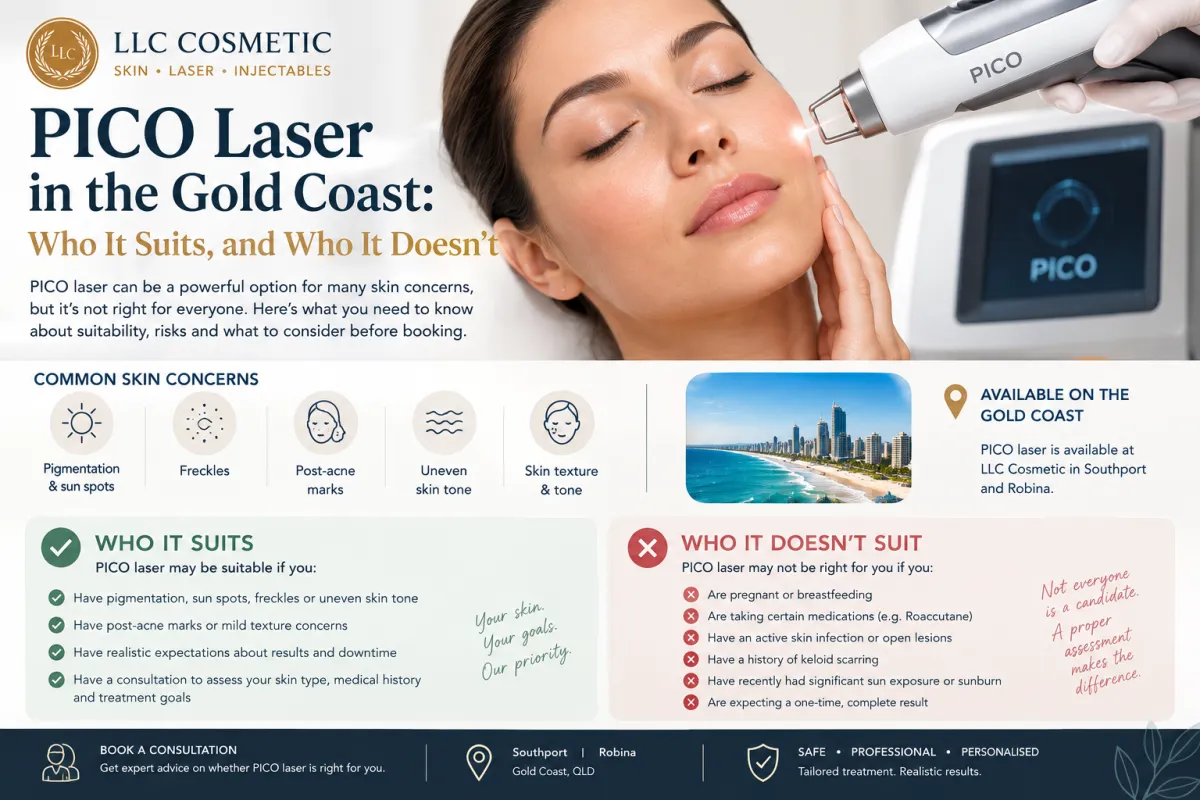
PICO Laser in the Gold Coast: Who It Suits, and Who It Doesn't
If you're searching for PICO laser suitability on the Gold Coast, you're probably asking a more important question than simply whether PICO laser is effective.
You're asking:
"Is PICO laser actually right for my skin?"
PICO laser is commonly used to target concerns such as pigmentation, sun spots, freckles, melasma-prone skin, post-acne marks and uneven-looking skin tone. LLC Cosmetic currently describes PICO as a non-ablative treatment with sessions generally lasting around 15–30 minutes and minimal downtime for most clients.
However, PICO laser isn't automatically suitable for everyone.
Your skin type, the condition being treated, previous treatments, medications, current skin health and treatment goals can all affect whether PICO is an appropriate option.
The safest approach is therefore not to choose a laser simply because it is popular. It is to have your skin assessed and determine whether the treatment matches the problem you're trying to solve.
Who Is PICO Laser Designed For?
PICO laser may be considered for people who are concerned about:
Sun spots
Freckles
Uneven pigmentation
Post-acne marks
Uneven-looking skin tone
Certain pigmentation concerns
Melasma-prone skin
Selected skin texture concerns
Some tattoo pigments, where tattoo removal is the treatment goal
LLC Cosmetic's current PICO treatment page specifically lists pigmentation, sun damage and dull tone as its main treatment concerns, while its broader educational material discusses additional applications such as freckles, melasma, post-acne marks and tattoo removal.
Scientific reviews have also found evidence supporting picosecond laser use across several dermatological applications, including benign pigmented lesions, photodamage, melasma, acne scarring and tattoo removal.
But that doesn't mean every person with pigmentation needs PICO.
The diagnosis matters.
A brown spot caused by sun exposure isn't necessarily managed in exactly the same way as melasma, post-inflammatory pigmentation or another pigmented lesion.
PICO Laser May Suit You If Your Main Concern Is Pigmentation
One of the most common reasons people consider PICO laser is pigmentation.
You may be considering treatment if you've noticed:
Brown sun spots
Freckles
Uneven pigmentation
Dark marks left after acne
Uneven skin tone
Pigment that makes your complexion look dull or inconsistent
PICO laser uses extremely short pulses of laser energy. Depending on the device, wavelength and treatment settings, this energy can target pigment without relying on the same type of prolonged heat exposure associated with some conventional laser approaches.
LLC Cosmetic currently positions its PICO treatment specifically around pigmentation, sun spots and uneven tone.
However, pigmentation is not one single condition.
That distinction is particularly important if you suspect you have melasma.
What If You Have Melasma?
This is where suitability becomes more complicated.
PICO laser has been studied for melasma, but melasma can be persistent and difficult to manage. Treatment needs to be carefully selected because laser procedures can sometimes trigger or worsen pigmentation.
A recent 2026 systematic review and meta-analysis of picosecond alexandrite laser treatment for melasma found that post-inflammatory hyperpigmentation was more common in the picosecond laser group than in the topical-therapy group.
That doesn't mean PICO can never be used for someone with melasma.
It means melasma should not be treated as if it were simply another sun spot.
If your pigmentation is hormonal, recurrent, widespread or behaves like melasma, your clinician may need to consider your history, current pigmentation pattern and previous treatments before deciding whether PICO is appropriate.
Is PICO Laser Suitable for Darker Skin?
This is one of the most common questions people ask about laser treatment.
The answer is potentially, but treatment needs to be individualised.
PICO technology has been studied in people with darker skin types. One retrospective study of a 755-nm picosecond laser with a diffractive lens array included people with Fitzpatrick skin types IV to VI and reported temporary adverse effects such as redness and hyperpigmentation, with those reported effects resolving in the study population.
Research has also examined picosecond laser treatment in Asian skin types III and IV, with studies reporting treatment of selected pigmentary conditions and relatively low rates of persistent complications in the studied groups.
However, "PICO is suitable for darker skin" should never be interpreted as "there is no risk."
Darker skin can be more prone to post-inflammatory pigmentation after laser treatment. The American Academy of Dermatology also advises people with darker skin to work with practitioners experienced in treating darker skin with lasers because of the increased risk of burns and dark marks from some laser procedures.
Your skin type is therefore an important part of the consultation.
PICO Laser May Be an Option for Asian Skin
Many people searching for PICO laser on the Gold Coast are also specifically looking for treatments appropriate for Asian skin.
This is understandable because skin pigmentation can be particularly persistent and because some laser treatments that rely heavily on heat may carry a greater risk of post-inflammatory pigmentation in more pigmented skin.
Picosecond lasers have been studied in Asian populations, including people with Fitzpatrick III and IV skin types.
However, ethnicity alone shouldn't determine whether you're suitable.
A clinician should consider factors such as:
Your actual skin type
Your current pigmentation
Your history of pigmentation after procedures
Whether your skin is currently irritated
The treatment area
The condition being treated
Your previous laser or cosmetic treatments
Your medications and relevant medical history
The goal is to choose the treatment for your skin, rather than assuming that one laser setting works for everyone.
Who May Not Be Suitable for PICO Laser?
PICO laser is not necessarily appropriate for everyone at every point in time.
You may be advised to postpone or avoid treatment if you have certain conditions or circumstances that increase the risk of complications.
For example, LLC Cosmetic's current educational information states that treatment may need to be postponed or avoided in situations including pregnancy or breastfeeding, certain acne medications including Roaccutane, active skin infections or open lesions in the treatment area, and a history of keloid scarring.
This is why a consultation isn't simply a formality.
It's part of deciding whether treatment is appropriate.
1. You Have an Active Skin Infection
If the area you want treated has an active infection, open wound or significant skin irritation, laser treatment may need to be delayed.
The priority is allowing the skin to recover rather than adding another source of irritation.
Tell your clinician about:
Active acne lesions
Cold sores
Skin infections
Open wounds
Significant irritation
Recent sunburn
Your treatment provider can determine when it is appropriate to proceed.
2. You're Taking Certain Medications
Some medications can affect how your skin responds to laser treatment.
This is why you should disclose all relevant medications, supplements and skincare products during your consultation.
LLC Cosmetic specifically notes that certain acne medications, including Roaccutane, may mean PICO treatment needs to be postponed or avoided.
Don't stop prescribed medication simply because you're planning a cosmetic treatment.
Instead, tell your clinician what you're taking and allow them to determine whether treatment should proceed.
3. You're Pregnant or Breastfeeding
LLC Cosmetic's current PICO educational information lists pregnancy and breastfeeding among circumstances in which treatment may be postponed or avoided.
If you're pregnant, breastfeeding or recently postpartum, mention this during your consultation.
Your clinician can advise whether it is appropriate to wait before beginning treatment.
4. You Have a History of Keloid Scarring
If you have previously developed keloid scars, make sure your clinician knows.
A history of abnormal scarring can be relevant when assessing suitability for procedures that affect the skin.
It doesn't mean every cosmetic laser procedure will automatically be unsuitable, but it is important information for treatment planning.
5. Your Skin Is Recently Tanned or Sunburned
Sun exposure matters when you're considering laser treatment.
The American Academy of Dermatology recommends avoiding tanning and protecting the skin from sun exposure before laser treatment.
For people living on the Gold Coast, this can be particularly relevant.
Beach days, outdoor activities, holidays and regular Queensland sun exposure can all affect the condition of your skin before treatment.
If your skin has recently been heavily exposed to the sun or is sunburned, tell your clinician before booking or proceeding.
6. You Expect One Treatment to Fix Everything
This isn't a medical contraindication, but it is an important suitability issue.
PICO laser isn't a magic eraser.
The number of sessions required depends on the concern being treated, its severity, your skin and how it responds.
For tattoo removal, for example, a systematic review of picosecond laser studies found that multiple treatments were generally required, with the evidence particularly focused on black and blue tattoo pigments.
For pigmentation and other skin concerns, treatment plans can also vary.
If you're looking for an instant, permanent result from one appointment, PICO may not match your expectations.
7. Your Main Concern Isn't Actually Pigmentation
This is another important point.
Sometimes people search for PICO because they have:
Sagging skin
Significant skin laxity
Deep wrinkles
Severe acne scarring
Pronounced textural changes
Redness or rosacea
Enlarged pores
Another condition that may require a different treatment
PICO may have applications beyond pigmentation, but the fact that a treatment can be used for a concern doesn't mean it is necessarily the best option for that concern.
LLC Cosmetic currently offers several different treatment pathways, including PICO, CO₂ resurfacing and HIFU, with the treatment selected according to the concern being addressed.
This is where a proper assessment can save you from choosing a treatment simply because you saw it advertised.
PICO Laser vs CO₂ Laser: Which One Is More Suitable?
These treatments aren't interchangeable.
PICO laser
PICO is generally considered when the main concern involves:
Pigmentation
Sun spots
Freckles
Uneven tone
Selected post-acne marks
Certain pigment-related concerns
LLC Cosmetic currently describes PICO as a non-ablative treatment with minimal downtime for most clients.
CO₂ fractional resurfacing
CO₂ is generally considered when the treatment goal involves deeper resurfacing concerns such as:
Acne scars
Rough texture
Fine lines
Skin resurfacing
LLC Cosmetic currently positions CO₂ fractional resurfacing around acne scars, texture and fine lines.
The two treatments can therefore serve very different purposes.
If pigmentation is your primary concern, PICO may be worth discussing. If deeper textural damage is the main concern, another treatment may be more appropriate.
What Happens at a PICO Suitability Consultation?
A consultation should help answer a simple question:
Is PICO the right treatment for your skin and your goal?
At LLC Cosmetic, the current PICO pathway begins with a suitability assessment before treatment. The clinic says treatment is planned around factors including skin tone, pigment pattern and history, with suitability confirmed before treatment begins.
You can expect your clinician to consider factors such as:
Your skin type
Your skin's natural pigmentation can affect treatment planning and risk.
Your concern
A clinician needs to understand whether you're treating sun spots, freckles, melasma-prone pigmentation, post-acne marks or another concern.
Your treatment history
Previous lasers, peels, cosmetic procedures and skincare can be relevant.
Your medical history
Certain medications and medical circumstances can affect whether treatment is appropriate.
Your expectations
Your clinician should explain what PICO can realistically achieve rather than promising a particular result.
How Long Does PICO Laser Take?
LLC Cosmetic currently lists PICO treatment sessions at approximately 15–30 minutes, depending on the treatment.
The actual appointment may take longer when consultation, preparation and post-treatment care are included.
The treatment itself is relatively short, which is one reason PICO is attractive to people who want a cosmetic laser option without the longer recovery associated with some resurfacing treatments.
Is There Downtime After PICO Laser?
LLC Cosmetic currently describes PICO as having minimal downtime for most clients.
However, minimal downtime doesn't mean zero skin response.
Depending on the treatment and individual skin response, you may experience temporary:
Redness
Sensitivity
Mild swelling
Temporary darkening of treated pigment
Other short-term changes
The AAD notes that laser procedures can produce temporary light or dark spots and that outcomes and risks depend on the treatment and practitioner.
Your clinician should provide specific aftercare instructions based on the treatment performed.
How Many PICO Sessions Will You Need?
There isn't one number that applies to everyone.
Your treatment plan depends on:
The condition being treated
Pigment depth
Severity
Treatment area
Skin type
Laser wavelength and settings
Individual response
Whether you are treating one concern or several
LLC Cosmetic's current educational material gives treatment pathways that can involve multiple sessions depending on the concern, rather than presenting PICO as a one-treatment solution.
A consultation is therefore more useful than choosing a package before knowing what your skin actually needs.
Is PICO Laser Worth Considering on the Gold Coast?
For the right person, PICO laser can be a useful option for pigmentation-focused skin concerns.
The important part is determining whether you're the right candidate.
You may be a potential candidate if your main concern is pigmentation, sun spots, freckles, uneven tone or selected post-acne marks and your skin is healthy enough for treatment.
You may need to postpone treatment or consider another approach if you have an active skin condition, certain medication use, recent significant sun exposure or another factor that makes treatment inappropriate.
And if your main concern isn't pigmentation, another treatment may be more suitable.
Where Can You Get PICO Laser on the Gold Coast?
LLC Cosmetic currently offers PICO laser across its Queensland clinic network, including Southport and Robina on the Gold Coast. The Southport clinic is at 138 Queen Street, while the Robina clinic is at The Wharf Apartments, 133 Laver Drive, Robina.
The clinic currently offers a free suitability consultation, allowing clients to discuss their skin concerns and treatment options before proceeding.
This can be particularly useful if you're unsure whether PICO, CO₂, HIFU or another treatment is the right starting point.
Questions to Ask Before Booking PICO Laser
Before booking your treatment, consider asking:
1. What exactly is causing my pigmentation?
Knowing whether you're dealing with sun spots, freckles, melasma or post-inflammatory pigmentation matters.
2. Is PICO actually the best treatment for my concern?
Don't assume that the treatment you searched for is automatically the right one.
3. Is my skin type suitable for this treatment?
This is particularly important if you have a darker or highly pigmented skin tone.
4. What are the risks of pigmentation changes?
Ask specifically about hyperpigmentation and hypopigmentation.
5. How many treatments might I need?
You should receive realistic expectations rather than a guaranteed number.
6. What should I avoid before treatment?
Ask about sun exposure, tanning and skincare products.
7. What will my downtime look like?
Even treatments described as having minimal downtime can produce temporary skin changes.
8. What happens if PICO isn't the right treatment?
A good consultation should be about choosing the appropriate treatment, not simply selling the treatment you initially asked about.
Final Answer: Who Does PICO Laser Suit?
So, who does PICO laser suit on the Gold Coast?
PICO may be suitable for adults looking to address concerns such as pigmentation, sun spots, freckles, uneven skin tone and selected post-acne marks, provided their skin and medical history make treatment appropriate.
It may also be considered for certain other dermatological applications, but suitability depends on the specific condition. Research supports picosecond lasers for several pigmentary and tattoo-related applications, while also showing that treatment response and risk can vary.
PICO may not be appropriate right now if you have an active infection or open lesion, certain medication-related contraindications, pregnancy or breastfeeding, a relevant history of keloid scarring, or skin that has recently been significantly exposed to the sun.
And even when you are technically suitable, PICO may not be the best treatment for your particular concern.
That's why the most useful first step is an individual assessment.
If you're considering PICO laser on the Gold Coast, start with suitability rather than the laser itself.
FAQs: PICO Laser Suitability Gold Coast
Is PICO laser suitable for everyone?
No. PICO laser is not automatically suitable for everyone. Your skin type, concern, medical history, medications, current skin condition and treatment goals all need to be considered before treatment.
Is PICO laser suitable for darker skin?
PICO laser has been studied in darker skin types, including Fitzpatrick IV–VI, but darker skin can still be more susceptible to pigmentation changes following laser treatment. Appropriate settings and experienced clinical assessment are important.
Can I have PICO laser if I have melasma?
Possibly, but melasma requires careful assessment. Laser treatment can sometimes trigger post-inflammatory pigmentation, and recent evidence suggests this risk needs to be considered when using picosecond laser for melasma.
Can I have PICO laser if I am pregnant?
LLC Cosmetic's current PICO information lists pregnancy and breastfeeding among circumstances where treatment may be postponed or avoided. Discuss your circumstances with your clinician.
Can I have PICO laser if I am taking Roaccutane?
LLC Cosmetic currently lists Roaccutane among medications that may mean PICO treatment needs to be postponed or avoided. Do not stop prescribed medication without medical advice; disclose your medication history during your consultation.
How do I know whether PICO or CO₂ is better for me?
It depends on your concern. PICO is currently positioned by LLC Cosmetic primarily around pigmentation, sun spots and uneven tone, while CO₂ fractional resurfacing is positioned around acne scars, texture and fine lines. A consultation can help determine which treatment better matches your goal.
Where can I get PICO laser on the Gold Coast?
LLC Cosmetic currently has Gold Coast clinics in Southport and Robina, with PICO laser available through its treatment network. Treatment suitability is confirmed before treatment.