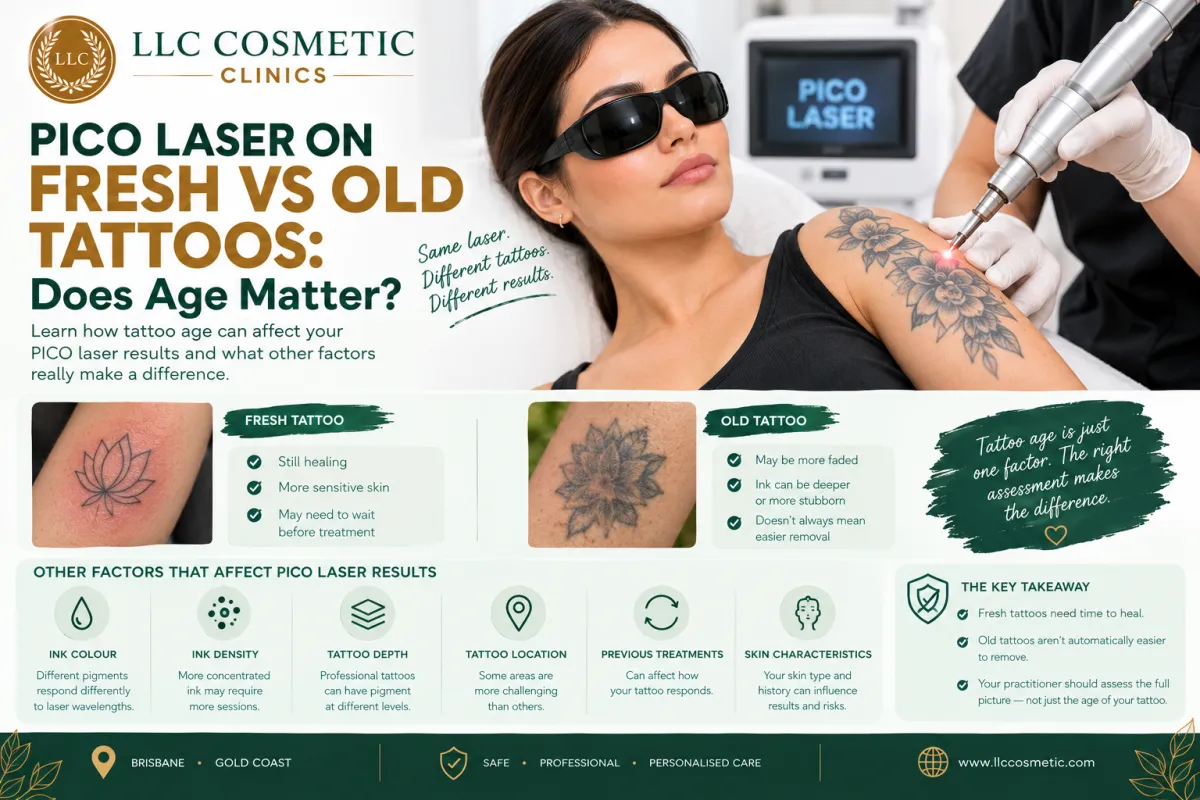
PICO Laser on Fresh vs Old Tattoos: Does Age Matter
If you're thinking about tattoo removal, you may wonder whether the age of your tattoo affects how well PICO laser works.
Does an old tattoo come off more easily?
Should you wait for a tattoo to become older before starting removal?
Or can a relatively new tattoo be treated with PICO laser?
The answer isn't as simple as "old tattoos are easier to remove."
Tattoo age can influence treatment response, but it is only one factor. Ink colour, ink density, tattoo depth, location, previous treatments, skin characteristics and the specific laser wavelength used can all affect how a tattoo responds.
Most importantly, a fresh tattoo should not be treated simply because you want it removed quickly. The skin needs time to heal before laser removal is considered.
PICO Laser on Fresh vs Old Tattoos: The Quick Answer
Old tattoos may sometimes respond differently from newer tattoos, but older does not automatically mean easier to remove.
Research has found mixed results regarding tattoo age.
One large cohort study found that tattoos older than 36 months were associated with a reduced response to laser removal. Other research has reported different findings, including studies where older tattoos cleared more quickly or newer tattoos showed better responses.
This tells us something important:
Tattoo age matters, but it isn't a reliable predictor on its own.
Your practitioner needs to assess the tattoo as a whole.
What Happens to Tattoo Ink Over Time?
Tattoo ink is placed into the deeper layers of the skin.
Your body doesn't simply remove the ink because the tattoo gets older. Instead, some pigment can gradually become altered or fragmented over time, while much of the tattoo pigment can remain in the skin for years.
During laser tattoo removal, laser energy targets the tattoo pigment and breaks it into smaller particles. Your body then gradually clears those particles. This is one reason tattoo removal requires multiple treatment sessions rather than one appointment.
So an old tattoo isn't necessarily "loose ink" that can simply be removed quickly.
Can You Remove a Fresh Tattoo With PICO Laser?
This is where timing becomes particularly important.
If your tattoo is very fresh, the skin is still healing from the tattooing process.
Laser tattoo removal should not be approached as an immediate solution for tattoo regret.
Your practitioner needs to determine whether the tattooed skin has healed sufficiently before treatment.
Trying to treat recently tattooed or damaged skin too soon can increase the risk of unwanted reactions and interfere with normal healing.
If you've only recently had the tattoo done, tell the clinic exactly when it was tattooed.
Don't try to speed up the process by booking a laser session before your skin is ready.
How Long Should You Wait Before Tattoo Removal?
There isn't one universal waiting period that applies to every tattoo.
The appropriate timing depends on factors such as:
How recently the tattoo was applied
Whether the skin has completely healed
Redness or swelling
Scabbing or crusting
Skin sensitivity
Tattoo size and location
Whether there were complications during tattoo healing
Your individual skin response
Your practitioner should assess the area before starting treatment.
A tattoo that looks relatively normal on the surface may still be recovering underneath.
The goal isn't to remove the tattoo as quickly as possible. The goal is to treat the skin safely while working toward gradual pigment reduction.
Is an Old Tattoo Easier to Remove?
Not necessarily.
This is one of the biggest misconceptions about tattoo removal.
Some older tattoos may respond well, particularly if they have characteristics that make them easier to treat.
For example, older tattoos may sometimes have:
Less saturated pigment
Faded areas
Less dense ink
Amateur application
More naturally faded sections
But tattoo age alone doesn't determine how quickly the ink will clear.
A large, dense, professionally applied tattoo that is 15 years old can still be challenging.
Meanwhile, a smaller tattoo with less dense pigment may respond more readily even if it is relatively new.
What Does the Research Say About Tattoo Age?
Research doesn't provide a simple rule that "older is better."
A large observational study involving 352 patients found that tattoos older than 36 months were associated with a reduced clinical response to Q-switched laser treatment. Other factors associated with response included tattoo size, location, colour, density and treatment intervals.
However, another study of blue-black tattoos found that tattoos more than 10 years old cleared more quickly than tattoos less than 10 years old.
An earlier study also reported a trend toward better treatment results with newer tattoos rather than older tattoos.
More recent research specifically examining picosecond laser removal of black tattoos found that ink density and tattoo location had a stronger influence on the number of treatments than tattoo age, although tattoo age still had a measurable effect.
So the evidence doesn't support a simple formula such as:
Older tattoo = easier removal.
Instead:
Tattoo age is one factor among several.
What Matters More Than Tattoo Age?
Several characteristics may have a major influence on your PICO laser treatment plan.
1. Ink Colour
Different pigments absorb different laser wavelengths.
Dark inks, particularly black, can respond well to certain wavelengths.
Other colours can be more challenging.
A systematic review found that picosecond lasers showed advantages for some blue, green and yellow pigments, while both picosecond and Q-switched lasers were effective for black tattoos.
This is why your practitioner needs to assess the actual colours in your tattoo.
2. Ink Density
A heavily saturated tattoo contains more pigment than a lightly applied tattoo.
More pigment can mean that more treatment sessions are required.
Recent research involving 116 patients undergoing picosecond laser treatment for black tattoos found ink density was the most significant factor influencing the number of treatments needed in that study.
3. Tattoo Depth
Professional tattoos can contain pigment at different depths within the skin.
The depth and distribution of the pigment can influence how it responds to laser treatment.
4. Tattoo Location
Where your tattoo is located can matter.
Research has identified tattoo location as a factor associated with treatment response.
This is one reason two tattoos that look similar can respond differently.
5. Previous Tattoo Removal
If your tattoo has already been treated with another laser or removal technique, tell your practitioner.
Previously treated tattoos can behave differently from untreated tattoos.
A 2026 practitioner-reported study found complications were reported more frequently in previously treated tattoos and tattoos younger than one year, although this type of evidence reflects practitioner reports rather than a controlled clinical trial.
6. Your Skin Characteristics
Your skin also matters.
The practitioner should consider your skin characteristics when selecting treatment parameters.
This is particularly important because temporary pigmentation changes can occur following laser tattoo removal.
Does PICO Laser Work Better on Old Tattoos?
PICO laser can be effective on both older and newer tattoos once the tattooed skin is appropriate for treatment.
But there is no guarantee that an old tattoo will clear faster.
PICO laser research has demonstrated tattoo lightening across different tattoo types, colours and treatment protocols, but the number of sessions varies considerably.
A 2026 randomised study of 755-nm picosecond versus nanosecond alexandrite lasers included black and blue tattoos and found higher clearance scores with the picosecond treatment after five sessions. However, this was a specific laser wavelength and study population, so the findings shouldn't be applied to every PICO laser or every tattoo.
Can a Fresh Tattoo Be Harder to Remove?
A fresh tattoo isn't necessarily harder to remove because it's new.
The bigger issue is whether the skin has healed enough to safely undergo treatment.
A newly tattooed area has already experienced controlled skin trauma from the tattooing process.
Adding laser treatment before adequate healing could increase unnecessary irritation and complications.
That's why your practitioner should assess the skin rather than simply asking:
"How old is the tattoo?"
A better assessment is:
"How old is the tattoo, and is the tattooed skin fully healed and suitable for laser treatment?"
Should You Wait for Your Tattoo to Get Older?
Generally, you shouldn't deliberately wait for years simply because you think an older tattoo will be easier to remove.
If you want tattoo removal, the more useful approach is to allow the tattoo to heal properly and then have it professionally assessed.
Your practitioner can consider:
Tattoo age
Tattoo colour
Ink density
Tattoo size
Tattoo location
Skin characteristics
Previous treatments
Your desired outcome
Then they can determine whether PICO laser is appropriate.
What If You Regret a Tattoo Immediately?
Tattoo regret is common, particularly after a design doesn't turn out as expected or your circumstances change.
But don't attempt DIY tattoo removal.
Avoid home tattoo-removal creams, acids, abrasive methods or other products designed to damage the skin.
These approaches can cause burns, infection, pigment changes and scarring.
Professional laser removal allows the tattoo and surrounding skin to be assessed before treatment.
How Many PICO Laser Sessions Will You Need?
There's no reliable number that applies to everyone.
PICO laser tattoo removal generally requires multiple sessions because the tattoo pigment is removed gradually.
Studies have reported a wide range of treatment sessions depending on the tattoo and laser used. A systematic review of picosecond tattoo removal studies found that human studies reported more than 70% pigment clearance after between one and ten treatments, although the studies varied substantially and many had limitations.
A clinical study using a dual-wavelength 1064/532-nm picosecond laser reported at least 50% clearance in 86% of tattoos after three treatments, with treatment intervals of roughly five weeks in that particular study.
These numbers should not be interpreted as a guarantee for your tattoo.
Your practitioner should assess your tattoo and give you realistic expectations.
Why Can't PICO Laser Remove a Tattoo in One Session?
Tattoo ink is deposited in layers and at different depths.
A laser cannot safely remove all the pigment in one aggressive treatment.
Instead, laser energy breaks pigment into smaller particles, and your body gradually clears them.
Your skin also needs time to recover between sessions.
The American Academy of Dermatology explains that multiple sessions are necessary because tattoo ink is layered and the body needs time to clear the fragmented pigment.
This is why patience is part of the tattoo removal process.
Does Tattoo Age Affect the Pain of PICO Laser?
Tattoo age alone doesn't determine how painful treatment will feel.
Pain can be affected by:
Tattoo location
Tattoo density
Treatment settings
Remaining pigment
Individual pain sensitivity
Skin condition
Anxiety or anticipation
The type of laser and wavelength used
PICO laser treatment can still be uncomfortable, even when the tattoo is old.
Your practitioner can discuss appropriate comfort measures before treatment.
What Happens After PICO Laser Tattoo Removal?
After treatment, the skin may experience temporary reactions such as:
Redness
Swelling
Tenderness
Whitening or "frosting" of the tattoo immediately after treatment
Crusting
Blistering in some cases
These reactions can vary depending on the treatment.
Laser tattoo removal also requires time between sessions so the skin can heal and the body can clear fragmented pigment.
Follow the aftercare instructions provided by your clinic and avoid picking or scratching the treated area.
When Should You Wait Before Starting PICO Laser?
Your practitioner may recommend delaying treatment if:
The tattoo is still healing
There is active redness or swelling
There are open areas of skin
There is significant crusting
You have an infection
The skin has recently been heavily sun-exposed or tanned
You have another condition affecting the treatment area
Your clinician believes the timing isn't appropriate
The exact decision should be made after assessing the tattoo and your skin.
Fresh vs Old Tattoos: What Should You Remember?
Instead of thinking:
"Old tattoos are easier."
Think:
"Tattoo age is one part of the assessment."
A tattoo's response depends on multiple factors.
A newer tattoo may be suitable for treatment once the skin has completely healed.
An older tattoo may still be difficult to remove if it contains dense pigment, challenging colours or deeply embedded ink.
And an old tattoo isn't automatically a good candidate simply because it has been there for many years.
The Bottom Line
So, does tattoo age matter when using PICO laser?
Yes, tattoo age can influence treatment response, but it doesn't determine the outcome by itself.
Research has produced mixed findings about whether older tattoos are easier or harder to remove. More recent picosecond laser research suggests that factors such as ink density and tattoo location can be highly important as well.
If your tattoo is fresh, the priority is allowing the skin to heal properly before considering laser removal.
If your tattoo is old, don't assume that it will automatically disappear faster.
The best approach is to have the tattoo professionally assessed before treatment.
At LLC Cosmetic, a tattoo removal assessment can help determine whether PICO laser is appropriate for your tattoo and what factors may influence your treatment plan.