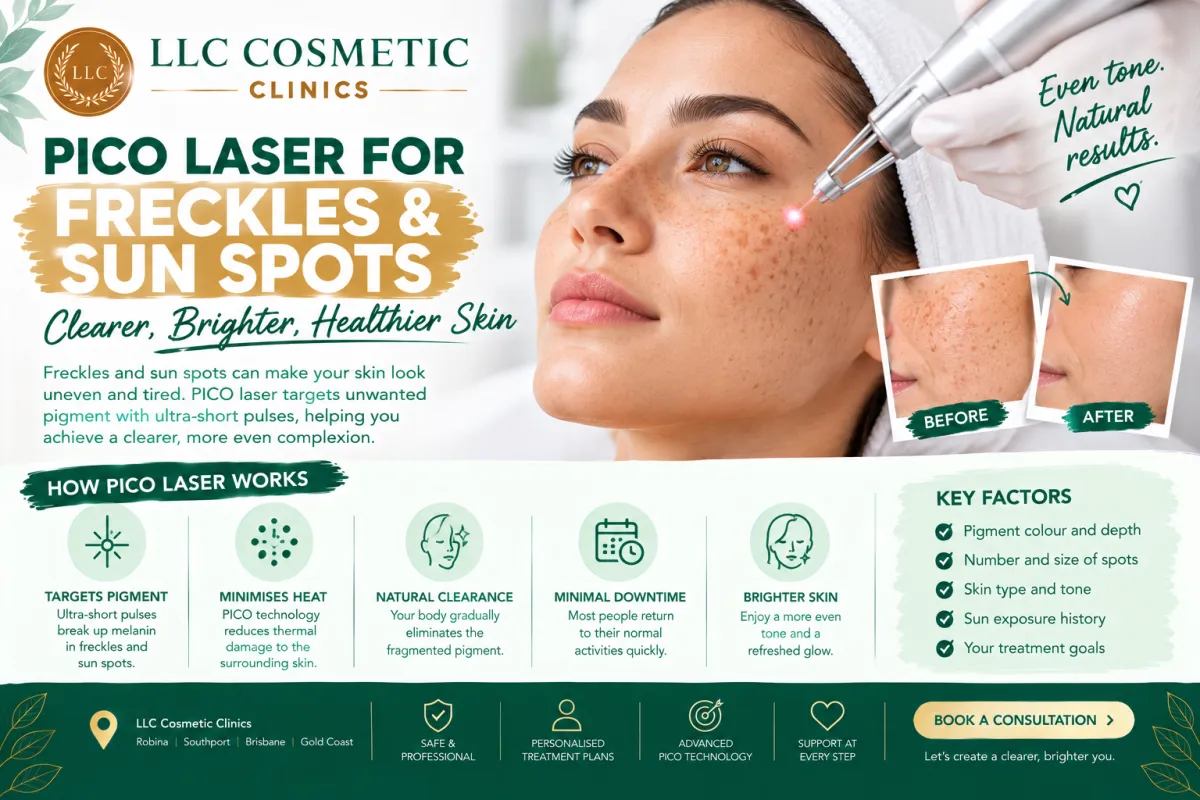
PICO Laser for Freckles and Sun Spots: What You Need to Know
Freckles and sun spots are among the most common pigmentation concerns people notice on the face, hands, shoulders and other areas regularly exposed to the Queensland sun.
For some people, freckles are simply part of their natural appearance. For others, increasing pigmentation can make their complexion look uneven, especially when individual spots become darker or more noticeable over time.
If you've tried skincare products and still have stubborn pigmentation, you may have come across PICO laser for freckles and sun spots.
PICO laser is a type of picosecond laser technology that can be used to target certain forms of pigmentation. Clinical research has found promising results for picosecond laser treatment of solar lentigines, although outcomes vary depending on the pigmentation, skin type and treatment approach.
But freckles and sun spots aren't exactly the same thing, and not every brown mark should automatically be treated with a laser.
Here's what you need to know before considering treatment.
What Are Freckles and Sun Spots?
Although people often use the terms interchangeably, freckles and sun spots are different types of pigmentation.
Freckles, medically known as ephelides, are small, flat areas of increased pigmentation that commonly appear on sun-exposed areas such as the nose and cheeks. They can become more noticeable after UV exposure and may fade during periods of lower sun exposure.
Sun spots, often called solar lentigines or age spots, are usually more persistent. They are associated with cumulative UV exposure and commonly appear on the face, hands and other sun-exposed areas. Unlike typical freckles, solar lentigines generally don't disappear during winter.
This distinction matters because your practitioner needs to understand exactly what type of pigmentation they're treating.
How Does PICO Laser Work on Pigmentation?
PICO laser technology uses extremely short pulses of laser energy.
Rather than simply heating the surrounding skin for a prolonged period, picosecond technology delivers energy in very short bursts that can target pigment.
The goal is to disrupt unwanted pigment so the body can gradually clear the fragmented pigment.
Different wavelengths may be appropriate for different pigment characteristics. The correct wavelength and treatment settings depend on the individual and the device being used.
DermNet notes that picosecond lasers have been used for pigmentation concerns including solar lentigines, although treatment outcomes can vary.
Can PICO Laser Remove Freckles?
PICO laser may help reduce the appearance of freckles in suitable patients.
However, it is important to understand that freckles are influenced by genetics and UV exposure.
Even if existing freckles become lighter after treatment, new pigmentation can develop again with ongoing sun exposure.
DermNet notes that pigment laser treatment may temporarily lighten freckles, while careful sun protection can reduce their darkening.
So the goal shouldn't necessarily be to think of laser treatment as a permanent cure for freckles.
Instead, think of it as one potential way of reducing existing pigmentation while protecting your skin from further UV exposure.
Can PICO Laser Treat Sun Spots?
Sun spots, or solar lentigines, can be suitable for pigment laser treatment when appropriately assessed.
A 2025 systematic review examined 41 clinical trials involving 3,234 patients with solar lentigines. Picosecond laser studies included in the review reported success rates ranging from approximately 67.9% to 93.02%, although the studies used different devices, treatment protocols and outcome measures.
That is promising, but it doesn't mean every person will achieve the same result.
Your individual response depends on the type and depth of pigmentation, your skin characteristics and the treatment protocol selected.
PICO Laser Isn't Suitable for Every Brown Spot
This is one of the most important points.
Not every brown spot on your skin is simply a cosmetic sun spot.
Some pigmented lesions can look similar to harmless pigmentation but may require medical assessment.
DermNet specifically notes that atypical pigmented lesions need to be distinguished from conditions such as melanoma and lentigo maligna.
That's why you shouldn't assume that every new, changing or unusual dark spot can simply be treated with a cosmetic laser.
If a spot is:
New or rapidly changing
Asymmetrical
Developing an irregular border
Changing significantly in colour
Bleeding
Crusting
Itching persistently
Different from the other spots on your skin
it should be appropriately assessed before cosmetic treatment.
A laser treatment should never replace appropriate skin assessment.
What Can You Expect During PICO Laser Treatment?
If you're considered suitable for treatment, the process generally begins with an assessment.
Your practitioner may look at:
The type of pigmentation
Pigment colour
Size and number of spots
Location
Skin tone
Previous treatments
Sun exposure
Your medical and skin history
Your treatment goals
The actual treatment can be relatively quick, depending on the size of the area being treated.
You may feel warmth, snapping or brief discomfort during treatment. The exact sensation depends on the device, settings and area being treated.
Your practitioner should explain what you are likely to experience before treatment begins.
What Happens After PICO Laser for Sun Spots?
Immediately after treatment, the treated area may appear different.
Depending on the treatment and individual response, you may experience:
Redness
Warmth
Mild swelling
Tenderness
Temporary darkening of pigmentation
Flaking or crusting
These effects can vary depending on the treatment settings and your skin.
Pigment laser treatments can sometimes cause temporary pigment changes, including post-inflammatory hyperpigmentation. DermNet notes that pigmentation can occasionally become worse after treatment.
This is particularly important when treating pigmentation because the goal is to improve uneven tone—not create another pigmentation problem.
How Many PICO Laser Treatments Will You Need?
There isn't a single number of sessions that applies to everyone.
Some pigmentation responds after relatively few treatments, while other cases require a longer treatment plan.
The number of treatments can depend on:
The type of pigmentation
Pigment depth
Number of spots
Skin type
Treatment settings
Previous sun exposure
How your skin responds
Your desired level of improvement
A consultation allows your practitioner to give you a more realistic treatment plan rather than promising a fixed result.
What About Darker Skin Types?
Skin tone matters when treating pigmentation with lasers.
People with darker skin can have a greater risk of post-inflammatory pigmentation or other pigmentary changes after certain laser treatments.
DermNet notes that picosecond lasers require particular caution in darker skin types because of the potential for side effects.
That doesn't automatically mean darker skin cannot be treated.
It means treatment needs to be carefully selected and individualised.
A qualified practitioner should assess your skin and determine whether the treatment is appropriate before proceeding.
PICO Laser vs Skincare for Sun Spots
Skincare can play an important role in managing pigmentation.
Ingredients such as vitamin C, retinoids, azelaic acid and other pigment-focused ingredients may help improve the appearance of uneven pigmentation over time. DermNet lists several topical options for brown marks and lentigines.
However, skincare and laser treatment work differently.
Skincare generally requires consistent use over time.
Laser treatment can target selected pigmentation more directly.
That doesn't necessarily make one option universally "better."
For some people, a combination of professional treatment and a suitable skincare routine may make more sense.
Your practitioner can help determine which approach fits your skin and goals.
Why Sun Protection Matters After Treatment
If you're treating pigmentation but continuing to expose your skin to significant UV radiation, you're working against your own results.
Sun exposure can stimulate pigmentation and contribute to the development of new freckles and solar lentigines.
DermNet recommends careful sun protection for people prone to freckles and sun spots and notes that pigmentation can recur following treatment.
This is particularly relevant in Queensland, where sun exposure can be significant throughout the year.
After treatment, follow your clinic's specific instructions regarding sun exposure, sunscreen and skincare.
Can Sun Spots Come Back After PICO Laser?
Yes.
Laser treatment can reduce existing pigmentation, but it doesn't stop your skin from responding to future UV exposure.
Think of it this way:
PICO laser can address the pigmentation you currently have. Sun protection helps reduce the factors that contribute to new pigmentation.
This is why long-term sun protection is an important part of maintaining results.
Is PICO Laser Better Than Traditional Laser Treatment?
Not necessarily in every situation.
Picosecond technology is one of several laser approaches used for pigmentation.
A 2025 meta-analysis comparing picosecond and nanosecond lasers across hyperpigmentation disorders and tattoos found that the two approaches had comparable clearance for endogenous hyperpigmentation overall, although picosecond lasers showed a tendency toward better outcomes for exogenous pigmentation.
The best treatment isn't simply determined by whether a device is newer.
It depends on:
What type of pigmentation you have
Where the pigment sits
Your skin tone
Your treatment history
The device and wavelength available
Practitioner experience
Your risk of pigmentary complications
Is PICO Laser Painful?
Everyone experiences laser treatment differently.
Pigment treatments are generally designed to be tolerable, but you may feel short bursts of heat or a snapping sensation.
The treatment area and laser settings can influence how it feels.
Your practitioner should explain what to expect and discuss appropriate comfort measures where needed.
How Quickly Will You See Results?
Results don't necessarily appear immediately.
Your skin needs time to respond to treatment, and pigment may change gradually following the procedure.
Some pigmentation can appear darker before it fades.
Your practitioner will be able to explain what changes are expected during the healing process and when you should contact the clinic if something doesn't seem right.
It's also important not to judge the final outcome too early.
What About Freckles That Keep Coming Back?
This is one of the most common frustrations with pigmentation.
If you are naturally prone to freckles, treatment doesn't change your underlying tendency to develop them.
UV exposure can make freckles more visible again.
That means long-term management may involve:
Daily broad-spectrum sunscreen
Protective clothing
Hats and shade
Avoiding intentional tanning
Following a consistent skincare routine
Periodic professional treatments when appropriate
Think of pigmentation management as an ongoing process rather than a one-time procedure.
Who May Be a Good Candidate for PICO Laser?
A suitable candidate depends on an individual assessment.
PICO laser may be considered for people concerned about certain types of:
Freckles
Solar lentigines
Sun spots
Uneven pigmentation
Certain superficial pigment concerns
However, suitability depends on the diagnosis, skin tone, pigment characteristics, treatment history and overall skin health.
The consultation is therefore an important part of the process.
Why a Consultation Matters
It can be tempting to see a photo online and assume your pigmentation will respond in exactly the same way.
Real skin doesn't work that way.
Two people can have spots that look similar but respond differently to treatment.
During a consultation, the practitioner can assess your pigmentation and determine whether PICO laser is appropriate.
You can also discuss:
Your desired outcome
Expected treatment sessions
Potential side effects
Downtime
Sun exposure
Aftercare
Other treatment options
This gives you a much more realistic understanding of what treatment can and cannot achieve.
PICO Laser for Freckles and Sun Spots at LLC Cosmetic Clinics
At LLC Cosmetic Clinics, PICO laser is used for selected pigmentation concerns following an individual assessment.
The clinic's PICO treatment information includes concerns such as pigmentation, sun spots, freckles, melasma-prone skin, post-acne marks and uneven skin tone.
PICO treatments are available across LLC Cosmetic Clinics' Brisbane and Gold Coast locations, including Robina and Southport.
The clinic recommends a suitability consultation so your skin and pigmentation can be assessed before treatment.
The Bottom Line
PICO laser for freckles and sun spots can be an effective option for appropriately selected pigmentation concerns, but it isn't a one-size-fits-all treatment.
Freckles and solar lentigines are different types of pigmentation, and your practitioner needs to determine what is actually causing the brown marks before treatment.
Clinical evidence for picosecond laser treatment of solar lentigines is promising, but individual results vary.
Most importantly, successful pigmentation management isn't just about treating existing spots.
Sun protection is essential for helping reduce new pigmentation and protect your results.
If you're considering PICO laser, start with an assessment rather than simply choosing a laser because it is advertised as the newest technology.
The right treatment is the one that is appropriate for your skin, your pigmentation and your goals.