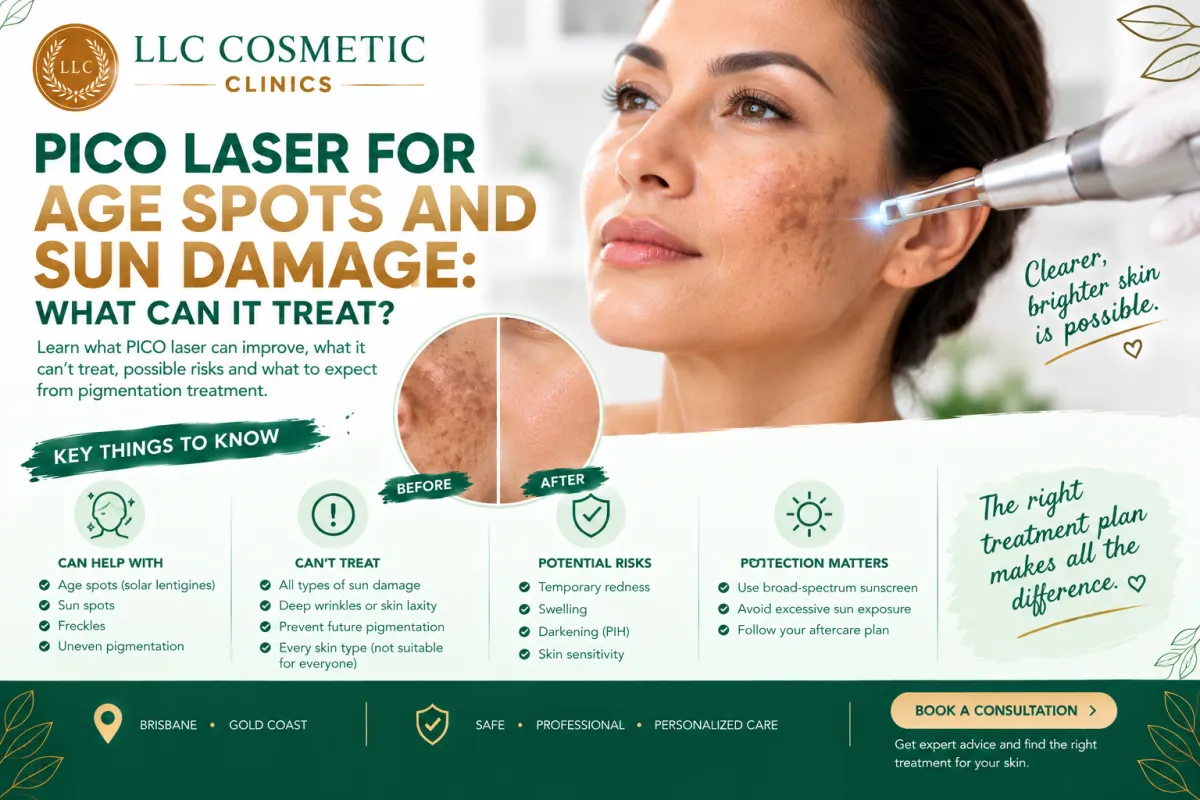
PICO Laser for Age Spots and Sun Damage: What It Can Really Treat
If you’re noticing brown spots, freckles, uneven pigmentation or visible signs of sun exposure, you may have come across PICO laser as a treatment option.
PICO laser is increasingly used for pigmentation and other signs of photo-damage because its ultra-short pulses can target pigment without relying on the same heat-based approach as some traditional laser treatments.
But there’s an important distinction: PICO laser can improve certain types of pigmentation, but it cannot reverse every type of sun damage.
So, if you’re considering PICO laser for age spots and sun damage, what can you realistically expect?
Let’s look at what PICO laser can treat, how it works, what results may look like, and why a proper skin assessment matters before treatment.
What Are Age Spots and Sun Damage?
“Age spots” are commonly used to describe solar lentigines — flat, brown or darker patches that develop after years of ultraviolet (UV) exposure.
They commonly appear on areas that receive regular sun exposure, including:
Face
Cheeks
Forehead
Hands
Shoulders
Chest and décolletage
Despite the name, age spots aren't only caused by getting older. Cumulative sun exposure is a major factor.
Solar lentigines are considered a visible sign of photoaging. A 2025 systematic review of clinical trials found that laser treatments can be effective for solar lentigines, with picosecond laser studies showing promising results, although treatment outcomes vary between patients and treatment approaches.
Other forms of sun damage can include:
Uneven skin tone
Freckles
Pigmented marks
Rough or uneven skin texture
Fine lines
Loss of skin elasticity
Changes associated with long-term photoaging
This is where it's important not to think of PICO laser as a treatment for all sun damage.
PICO is primarily relevant when pigmentation is one of the main concerns.
How Does PICO Laser Work on Pigmentation?
PICO stands for picosecond, referring to the extremely short duration of the laser pulses.
Rather than simply heating the skin for a prolonged period, picosecond technology delivers very short pulses of energy that can target pigment.
The goal is to break up unwanted pigment into smaller particles that the body can gradually clear.
This makes PICO particularly interesting for pigmentation concerns.
Research into picosecond lasers has found evidence for their use in benign pigmented lesions and photodamage, although the strength of evidence varies depending on the specific condition and laser application.
In simple terms:
PICO targets pigment.
It doesn't simply “erase sun damage” from the skin.
That distinction is important when deciding whether it's the right treatment for you.
Can PICO Laser Treat Age Spots?
It can be an option for certain age spots, particularly solar lentigines.
Clinical research has found promising results for picosecond laser treatment of solar lentigines. A 2025 systematic review reported success rates of approximately 67.9% to 93.02% across the picosecond laser studies included in its review. However, these figures came from different studies and treatment protocols, so they shouldn't be interpreted as a guaranteed result for every patient.
Your results can depend on factors such as:
The type of pigmentation
Pigment depth
Skin tone
The area being treated
Previous treatments
Laser wavelength and settings
Number of treatment sessions
How your skin responds
Your sun exposure before and after treatment
This is why a consultation is more useful than simply choosing a laser based on the name of the technology.
What About Freckles?
PICO laser may also be considered for some types of pigmentation such as freckles.
However, freckles can behave differently from isolated solar lentigines.
Freckles are often strongly influenced by genetics and UV exposure. Even if existing pigmentation becomes lighter, continued sun exposure can contribute to pigmentation returning or becoming more noticeable.
That means treating the visible pigment is only one part of the picture.
Sun protection remains important after treatment.
If you're prone to pigmentation, your practitioner may also recommend a broader skincare and sun-protection strategy rather than relying on laser treatment alone.
Can PICO Laser Remove All Sun Damage?
No.
This is one of the biggest misconceptions about PICO laser.
PICO may help improve pigmentation-related signs of sun damage, but it isn't a complete photoaging treatment.
For example, PICO may be relevant when your main concern is:
Brown spots
Certain sun spots
Freckles
Uneven pigmentation
Some forms of uneven skin tone
But other concerns may require a different approach.
Fine lines and wrinkles
PICO isn't necessarily the first or only treatment considered for significant wrinkles.
Skin laxity
Pigment-targeting laser treatment doesn't replace treatments designed specifically for skin tightening.
Significant texture changes
Depending on the concern, another resurfacing treatment may be more appropriate.
Precancerous or suspicious lesions
A cosmetic laser should not be used to simply treat a suspicious pigmented lesion without appropriate clinical assessment.
A new, changing or unusual spot should be assessed by an appropriate medical professional before cosmetic treatment.
PICO Laser vs Other Treatments for Age Spots
PICO isn't the only technology used for pigmentation.
Depending on the type of pigmentation and your skin, a practitioner may consider different options, including:
Picosecond laser
Q-switched laser
Intense pulsed light (IPL)
Other laser technologies
Topical treatments
Chemical peels
Combination treatment approaches
Research comparing treatments for lentigines suggests that laser-based and combination approaches can be effective, but there isn't one treatment that is automatically best for every person.
The correct treatment depends on what the pigmentation actually is.
That's why “What is the strongest laser?” isn't necessarily the best question.
A better question is:
“What treatment is appropriate for this type of pigmentation and my skin?”
Is PICO Laser Good for Sun-Damaged Skin?
It can be useful when pigmentation is a significant part of the concern.
Picosecond laser research has expanded beyond tattoo removal into areas including benign pigmented lesions and photodamage.
Some patients may notice that their skin looks more even after pigmentation has been reduced.
However, it's important to have realistic expectations.
PICO isn't a way to completely undo years of UV exposure.
Think of it as a treatment that may help improve specific visible signs of pigmentation, rather than a complete reset of sun-damaged skin.
What Results Can You Expect?
Results vary from person to person.
Some pigmentation may become lighter after treatment, while other areas may require multiple sessions.
You may also notice temporary changes immediately following treatment, depending on the settings used and the pigmentation being treated.
Over time, treated pigment can become less noticeable as the skin recovers and the pigment is cleared.
Your practitioner should be able to explain:
What they believe the pigmentation is
Whether PICO is appropriate
How many sessions may be reasonable to consider
Expected recovery
Possible side effects
What you should do before treatment
What aftercare will be required
A good treatment plan should be based on your skin, rather than a generic number of sessions.
Can PICO Laser Cause Pigmentation?
Yes.
Although PICO is designed to target pigment, laser treatments can sometimes cause temporary pigmentation changes.
One concern is post-inflammatory hyperpigmentation (PIH), where the skin becomes darker following inflammation or injury.
This is particularly important for people who are more prone to pigmentation changes.
Research into picosecond lasers has found that outcomes and adverse effects can vary depending on the pigmentation condition, skin type and treatment approach.
This doesn't mean that PICO is unsuitable for everyone with pigmentation.
It means treatment needs to be appropriately selected and performed.
Why Your Skin Type Matters
Pigmentation treatment isn't simply about identifying a brown spot and pointing a laser at it.
Your skin's natural pigmentation can influence how it responds to laser energy.
This is particularly important when treating people who are prone to post-inflammatory pigmentation.
During a consultation, a qualified practitioner should consider factors such as:
Your natural skin tone
Your pigmentation pattern
Previous laser treatments
Recent tanning
Your history of pigmentation
Current skincare
Medications or products that may affect treatment
Whether the spot has been appropriately assessed
The goal isn't necessarily to use the highest possible energy.
The goal is to choose an approach that balances pigment clearance with skin safety.
What About Sun Exposure After PICO?
This is especially important in Queensland.
If you're treating pigmentation caused or worsened by UV exposure, ongoing sun exposure can work against your results.
Sun protection should be part of your long-term skin routine.
That can include:
Broad-spectrum sunscreen
Reapplying sunscreen as directed
Wearing a hat when outdoors
Seeking shade
Avoiding unnecessary prolonged sun exposure
Following your clinic's specific post-treatment instructions
PICO can address existing pigmentation, but it cannot stop your skin from responding to future UV exposure.
The laser treats the pigment. Your daily habits help protect the result.
How Many PICO Laser Sessions Will You Need?
There isn't one number that applies to everyone.
A small number of isolated sun spots may respond differently from widespread pigmentation.
The number of sessions can depend on:
Pigment type
Pigment depth
Size and number of spots
Skin type
Treatment settings
Previous treatments
Individual response
It's better to think in terms of a treatment plan rather than a guaranteed number of sessions.
Your practitioner can reassess your skin between treatments and determine whether further treatment is appropriate.
Is PICO Laser Painful?
Most people describe PICO treatment as a sensation of warmth, snapping or small pinpricks, although comfort varies depending on the treatment area and settings.
Treatment time can also vary according to the area being treated.
Your clinic should explain what you may feel and what to expect immediately afterward.
Following your aftercare instructions is just as important as the treatment itself.
What Is Recovery Like?
Recovery depends on the treatment performed and your individual skin response.
You may experience temporary:
Redness
Warmth
Mild swelling
Sensitivity
Darkening or temporary changes in treated pigment
Your practitioner should give you specific instructions for cleansing, moisturising, sun protection and when to return to your normal skincare routine.
Avoid picking, scratching or aggressively exfoliating treated areas unless your clinician specifically tells you otherwise.
When Should You Avoid Treating a Pigmented Spot?
Not every brown spot should automatically be treated as cosmetic pigmentation.
If you have a spot that is:
New
Changing in size
Changing in colour
Irregular in shape
Bleeding
Crusting
Persistently itchy
Different from your other spots
it should be appropriately assessed before cosmetic laser treatment.
A cosmetic laser should not be used as a substitute for diagnosing a suspicious skin lesion.
When in doubt, get the spot assessed first.
Is PICO Laser Worth It for Age Spots and Sun Damage?
If your main concern is visible pigmentation such as certain age spots, freckles or uneven tone, PICO laser may be worth discussing with a qualified practitioner.
The evidence for picosecond lasers in benign pigmentation and solar lentigines is promising, but treatment outcomes aren't guaranteed and the technology isn't suitable for every type of sun damage.
The most important step is identifying what you're actually treating.
A good consultation should answer three questions:
1. What type of pigmentation do I have?
2. Is PICO appropriate for my skin?
3. What results and risks are realistic for me?
That approach is much safer than choosing a treatment simply because it is marketed as the latest laser technology.
PICO Laser for Age Spots and Sun Damage: The Bottom Line
PICO laser can be a useful option for certain pigmentation concerns associated with sun exposure, including some solar lentigines and uneven pigmentation.
But it isn't a universal solution for every form of sun damage.
It won't permanently prevent new pigmentation, reverse every sign of photoaging or guarantee completely clear skin.
The best results come from combining an appropriate treatment plan with realistic expectations and consistent sun protection.
If you're considering PICO laser for age spots or sun damage, a professional skin assessment can help determine whether PICO is appropriate for your pigmentation, skin type and goals.