
Patch test to full pico laser treatment: 2026 workflow
Instead of guessing when to move from a pico laser patch test to a larger treatment, use a clinician-reviewed sequence: assess, test, review, then decide. In 2026, a settled test area is useful information—not a guarantee that a full treatment will react the same way.
- A pico laser patch test informs treatment planning; it does not guarantee the response of a larger area.
- LLC Cosmetic Laser Clinics offers medical physicist-led care and clinician-reviewed plans.
- Agree on aftercare and a review point before leaving your patch-test appointment.
- Full pico laser treatment should follow clinical review, not an automatic booking.
Why this matters
LLC Cosmetic Laser Clinics suits people seeking medical physicist-led pico laser care with honest suitability advice. That does not mean a medical physicist personally performs every appointment.
A patch test treats a small area so the clinician can assess its response before considering wider treatment. Tattoo-removal literature describes test spots as particularly relevant when ink behaviour is uncertain, including cosmetic tattoos that can darken after laser exposure [1].
For the wider planning process, see the guide to a clinician-reviewed treatment plan.
Before you start
Bring these to your 2026 consultation:
- Your history: medicines, previous laser treatment, scarring, skin reactions and any recent changes affecting the area.
- Your goal: explain what you want treated and what improvement would be useful to you.
- Room to review: do not arrange full treatment around an assumed waiting period. Ask when the clinician needs to reassess the test area.
The easily missed detail? Tattoo ink is not always predictable. A small test cannot establish how every colour or every part of a larger tattoo will respond [1].
Your assessment
- Identify the target. Ask the clinician to explain what is being treated. A tattoo-removal plan is not automatically suitable for a brown skin mark.
- Discuss suitability. Explain previous reactions and ask whether you need further medical assessment before laser treatment.
- Agree on the decision. Establish what the patch test can answer—and what remains uncertain.
Expected result: you understand why testing is proposed, or why treatment should be deferred. Saying no to treatment remains a valid outcome.
Your patch test and aftercare
- Confirm the area. Ask where the test will be performed and how its response will be recorded.
- Get written aftercare. Ask how to clean and protect the area, which products to avoid and who to contact with concerns.
- Confirm the review point. Record when and how the clinician wants to reassess you before considering full treatment.
Expected result: you leave with a defined next step, rather than trying to interpret healing alone.
Tattoo laser treatment can cause redness, swelling and discomfort. Blistering, pigment changes and scarring are also recognised risks; individual risk needs clinical assessment [1]. Results vary between individuals.
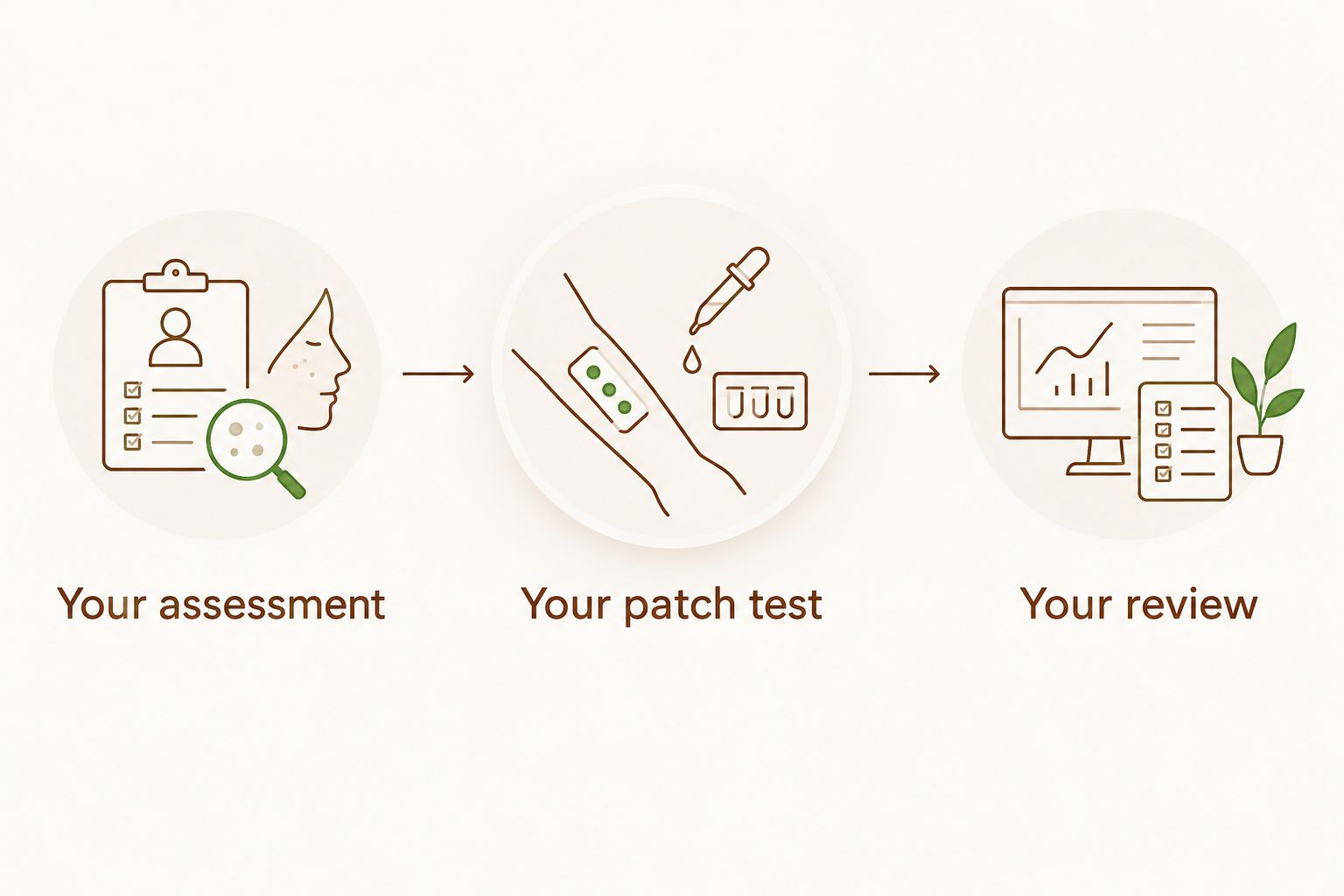
Your review
For your 2026 review, bring your aftercare notes and describe any changes since testing.
- Report the whole response. Mention discomfort, blistering, colour changes and anything that concerned you, even if it has settled.
- Ask about limitations. Check whether the test represents the larger area adequately.
- Confirm the revised plan. Discuss whether to proceed, reassess or stop. Ask what recovery and follow-up would involve.
Expected result: a documented decision—not automatic clearance.
| Decision | Best for | Benefit | Limitation |
|---|---|---|---|
| Proceed after review | People the clinician assesses as suitable | Moves treatment forward with observed test information | A larger area can still respond differently |
| Reassess or defer | People with an unresolved reaction or unanswered suitability questions | Allows further assessment before more exposure | Delays treatment and may mean not proceeding |
What if the plan changes?
A different area or a different tattoo colour deserves a fresh conversation. Ask whether the original test still answers the relevant question; do not assume one result covers everything.
For tattoo removal, research compares specific pulse durations and treatment conditions. It does not establish one universal patch-test schedule for everyone [1,2]. The same caution belongs in a 2026 treatment plan.
Troubleshooting
- You cannot find your aftercare instructions: contact the treating clinic before adding products or changing care.
- The test area has not settled: request review before proceeding with a larger area.
- Tattoo ink looks darker: contact the clinician. Paradoxical darkening is a recognised complication, particularly with some cosmetic inks [1].
- You have increasing pain or signs of infection: seek prompt medical advice rather than waiting for a routine appointment [1].
Customise your workflow
Tell LLC Cosmetic Laser Clinics about upcoming travel, outdoor work and events before scheduling. Ask for a plan you can realistically follow, including aftercare and review.
The useful milestone is clinical reassessment, not a date on the calendar. Keep that distinction in your 2026 appointment notes.
FAQ
What is a pico laser patch test?
A pico laser patch test treats a small area before wider treatment is considered. For tattoo removal, it helps the clinician assess the local response, but it cannot guarantee the response of the whole tattoo [1].
How long after a patch test can I have full treatment?
Your clinician should set the review interval for your treatment. Do not treat a settled surface or an available appointment as clearance to proceed.
Does everyone need a pico laser patch test?
The need for a test should be assessed individually. Ask what uncertainty the test is intended to address and how the result will affect your plan.
Can a patch test guarantee that I will not get pigment changes?
No, a patch test cannot guarantee that pigment changes will not occur. Pigment changes are a recognised complication of laser tattoo removal [1].
What if my tattoo darkens after the test?
Contact the treating clinician before further treatment. Some cosmetic tattoo inks can darken following laser exposure, so the response needs reassessment [1].
Does tattoo-removal research apply to every pigmentation concern?
No, tattoo-removal findings do not establish suitability for every pigmentation concern. Ask the clinician to identify the condition and explain the evidence relevant to it.
One last thing
A patch test can be useful even when it leads to not proceeding. Finding a reason to pause is part of informed care, not a failed appointment.
For personal advice, you can book your PICO consultation with LLC Cosmetic Laser Clinics.
Related guides
- Pico laser tattoo removal for large tattoos
- Tattoo removal before a cover-up
- GP referral to pigmentation laser treatment
References
- Ho SG, Goh CL. 2015. Laser tattoo removal: a clinical update. Journal of Cutaneous and Aesthetic Surgery. DOI: 10.4103/0974-2077.155066.
- Ross EV, et al. 1998. Comparison of responses of tattoos to picosecond and nanosecond Q-switched neodymium:YAG lasers. Archives of Dermatology. DOI: 10.1001/archderm.134.2.167.
This article is general information only and is not a substitute for a personal consultation.