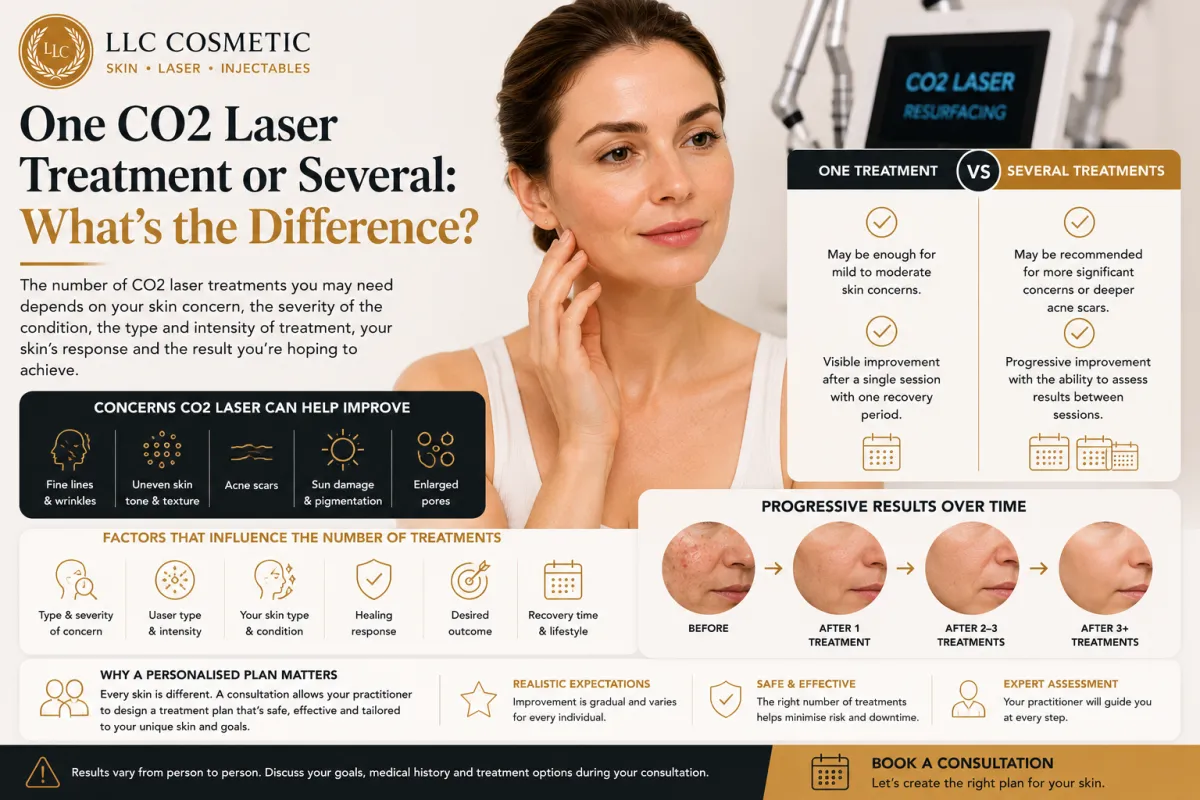
One CO2 Laser Treatment or Several: What's the Difference?
If you're considering CO2 laser resurfacing, one of the first questions you may have is:
“Do I need one CO2 laser treatment, or will I need several?”
There isn't a single answer that applies to everyone.
The number of CO2 laser treatments you may need depends on what you're treating, the severity of the concern, the type and intensity of the laser treatment, your skin's response and the result you're hoping to achieve.
For some people, one treatment may provide a noticeable improvement. For others, a series of treatments may be recommended to progressively address concerns such as acne scars, uneven texture, fine lines or other signs of skin damage.
The important point is that more treatments aren't automatically better.
A treatment plan should be based on an assessment of your skin and realistic goals rather than a predetermined number of sessions.
Quick Answer: One CO2 Laser Treatment or Several?
One CO2 laser treatment may be enough for some people, while others may benefit from a series of treatments.
A single treatment can produce visible improvement, particularly when the treatment is appropriately selected and the concern is relatively mild.
Multiple treatments may be considered when:
The concern is more significant
Acne scarring is deeper
More gradual resurfacing is preferred
A practitioner wants to stage treatment intensity
Additional improvement is desired after the first treatment
The treatment protocol is designed as a series
Research into fractional CO2 laser treatments for acne scarring has used both single and multiple-session approaches, with outcomes varying according to treatment protocol, scar severity and patient factors.
So rather than asking “How many treatments does everyone need?”, a better question is:
“What treatment approach is appropriate for my skin and my goals?”
What Is the Difference Between One and Several CO2 Laser Treatments?
The biggest difference is how the treatment plan is approached.
With one treatment, the practitioner aims to achieve an appropriate level of improvement during a single session.
With several treatments, the skin is treated progressively, allowing the practitioner to assess the response before deciding whether additional treatment is appropriate.
This can be particularly useful when the goal requires gradual improvement rather than attempting to achieve everything during one intensive treatment.
What Can One CO2 Laser Treatment Do?
A single treatment can provide meaningful improvement for some patients.
Depending on the treatment and the concern being addressed, you may notice changes in:
Skin texture
Uneven tone
Fine lines
Surface irregularities
The appearance of some scars
Overall skin smoothness
However, one treatment does not guarantee complete correction of a skin concern.
For example, deeper acne scars may require a more comprehensive treatment strategy because different scar types respond differently to resurfacing.
Clinical studies of fractional CO2 laser for acne scars have reported improvement after treatment, but treatment protocols and the number of sessions vary between studies.
When Might Several CO2 Laser Treatments Be Considered?
A series may be considered when the desired result is unlikely to be achieved with one treatment alone.
Deeper acne scars
More established or deeper scars may require progressive treatment.
A recent systematic review found that treatment outcomes for fractional CO2 laser can vary according to scar depth and treatment parameters, with deeper scars potentially requiring additional treatment.
Significant texture concerns
If the skin has more extensive textural irregularities, a staged treatment approach may be considered.
Gradual improvement
Some patients may prefer a treatment plan that allows improvement to occur progressively rather than undergoing one more intensive procedure.
Additional improvement after the first session
Your practitioner may reassess your skin after the first treatment and determine whether another session could provide additional benefit.
Does More CO2 Laser Mean Better Results?
Not necessarily.
This is one of the most important points to understand.
CO2 laser is not a situation where simply adding more sessions automatically produces a better outcome.
Treatment intensity and number of sessions need to be balanced against:
Recovery time
Skin sensitivity
Risk of pigmentation changes
Potential complications
Your treatment goals
Your individual response
More intensive CO2 resurfacing can involve longer recovery. Cleveland Clinic notes that recovery after CO2 laser resurfacing can generally take around 10–21 days, depending on the condition being treated and the intensity of the laser settings.
That is why treatment planning matters.
One Intensive Treatment vs Several Gradual Treatments
There is an important distinction between one more intensive treatment and several less intensive treatments.
A practitioner may consider different approaches depending on the patient's goals.
One treatment
Potential advantages may include:
Fewer appointments
One primary recovery period
A more concentrated treatment approach
Potential considerations include:
The treatment may be more intensive
Recovery may be more significant
Not every concern can be appropriately addressed in one session
Several treatments
Potential advantages may include:
Progressive improvement
Ability to assess the skin between sessions
Potentially less aggressive treatment per session
More flexibility in adjusting the treatment plan
Potential considerations include:
More appointments
Multiple recovery periods
Greater overall treatment commitment
Additional cost
Neither approach is automatically better.
The appropriate choice depends on your skin and the treatment being considered.
How Many CO2 Laser Treatments Are Usually Needed?
There is no universal number.
You may see clinics or online articles suggesting a specific number of sessions, but those numbers shouldn't be treated as a guarantee.
The number of treatments can depend on:
Your skin concern
Fine lines, acne scars, pigmentation and texture concerns may require different approaches.
The severity of the concern
More established concerns may require more treatment.
Laser intensity
A more intensive treatment can produce a different level of resurfacing than a lighter fractional approach.
Treatment area
The face, neck and other areas can respond differently.
Your skin's healing response
Individual results vary.
Your desired outcome
Someone wanting a subtle improvement may have different treatment goals from someone seeking more significant resurfacing.
What About CO2 Laser for Acne Scars?
Acne scarring is one area where multiple-treatment approaches have been studied.
Fractional CO2 laser can stimulate skin remodeling and improve the appearance of atrophic acne scars.
However, the number of treatments varies across studies.
One study involving patients with atrophic acne scars treated people with one to three fractional CO2 laser sessions and found that the number of treatment sessions was among the factors associated with treatment outcomes.
Another clinical trial compared two fractional CO2 treatments delivered at different intervals and found improvement in acne scar atrophy with both schedules.
This illustrates an important point:
There isn't one fixed CO2 laser schedule that applies to every acne-scar patient.
Can One CO2 Laser Treatment Remove Acne Scars Completely?
It's better not to think of CO2 laser as a treatment that simply “removes” acne scars.
The goal is generally to improve the appearance and texture of the scarred skin.
Results can vary according to:
Scar type
Scar depth
Skin type
Treatment settings
Number of sessions
Individual healing
Whether other treatments are needed
Some acne scars may respond well to resurfacing, while others may require a different or combined treatment strategy.
A systematic review of fractional CO2 laser for acne scars found that treatment effectiveness depends on factors including scar depth and laser parameters.
Why Your First CO2 Laser Treatment May Not Be the Final Treatment
One reason practitioners may use a staged approach is that your skin's response provides useful information.
After the first treatment, your practitioner can assess:
How well your skin healed
How much improvement occurred
How your skin responded to the treatment intensity
Whether additional improvement is realistic
Whether the treatment approach should be adjusted
This can allow the next stage of treatment to be considered based on your actual response rather than an assumption.
How Long Should You Wait Between CO2 Laser Treatments?
There isn't one universal interval.
The appropriate interval depends on:
Treatment intensity
Treatment depth
Type of CO2 laser treatment
Area treated
Your healing progress
Your practitioner's protocol
For example, clinical research has evaluated fractional CO2 treatments at different intervals, including one-month and three-month intervals for acne scars.
That doesn't mean either interval is appropriate for every patient.
Your next treatment should be scheduled according to your recovery and your practitioner's assessment.
Why You Shouldn't Rush Into Another CO2 Laser Treatment
Seeing improvement after your first treatment can make you excited to continue.
But your skin needs time to recover.
Immediately after treatment, your skin can be red, swollen, sensitive or peeling. Recovery from CO2 resurfacing can take days to weeks depending on the treatment intensity.
The visible healing period is also not necessarily the same as the time required for the full treatment result to develop.
Therefore, rushing into another session simply because you want faster results isn't necessarily the best approach.
Let your skin recover before deciding whether additional treatment is appropriate.
Does Several CO2 Laser Treatments Mean More Downtime?
Potentially, yes—but it depends on the treatment plan.
If each session involves a recovery period, a series means you will have multiple recovery periods rather than one.
However, a staged treatment plan may involve different treatment intensities from a single aggressive resurfacing procedure.
This is why session number alone doesn't tell you how much downtime you'll experience.
The intensity and type of treatment matter.
What Are the Risks of Having Multiple CO2 Laser Treatments?
CO2 laser resurfacing has potential side effects and complications, including:
Redness
Swelling
Sensitivity
Pigmentation changes
Infection
Scarring
Prolonged redness
Cleveland Clinic notes that hyperpigmentation and, less commonly, hypopigmentation can occur after CO2 laser resurfacing, while scarring is a rare potential complication.
Repeated treatments don't mean complications are guaranteed, but they do reinforce why treatment should be properly planned.
If your skin hasn't recovered appropriately, your practitioner may recommend waiting before considering another session.
What About Darker Skin Types?
Skin type is an important consideration when planning laser resurfacing.
People with darker skin tones can have a higher risk of post-inflammatory hyperpigmentation following certain laser treatments.
Recent research also highlights the importance of considering skin type and pigmentation risk when selecting treatment approaches for acne scars.
This doesn't automatically mean CO2 laser isn't appropriate.
It means individual assessment and appropriate treatment settings are important.
If you are concerned about pigmentation after laser treatment, discuss your skin type and previous reactions to treatments with your practitioner before proceeding.
How Do You Know If You Need Another CO2 Laser Treatment?
The decision shouldn't be based simply on the number of weeks since your previous appointment.
Your practitioner may consider:
Your original treatment goal
Your response to the first session
Your current skin condition
Whether the skin has fully recovered
Remaining concerns
Your tolerance for downtime
Potential risks
Whether another treatment is likely to provide meaningful improvement
Sometimes the best decision may be another treatment.
Sometimes it may be to wait.
And sometimes another treatment may not be the most appropriate option.
What Questions Should You Ask Before Booking CO2 Laser?
Before committing to one treatment or a series, ask your practitioner:
1. Do you recommend one treatment or a series for my concern?
Ask for the reasoning behind the recommendation.
2. What level of CO2 laser treatment is being proposed?
Treatment intensity can affect both results and recovery.
3. How much downtime should I expect?
Make sure the recovery period fits your schedule.
4. What results are realistic after one treatment?
This can help you decide whether a single session matches your expectations.
5. If I need another treatment, when would it be considered?
Your practitioner can explain the expected assessment and recovery timeline.
6. What are my pigmentation risks?
This is particularly important if you have previously experienced pigmentation changes after skin treatments.
7. What happens if I decide not to continue after the first treatment?
You should understand what you can realistically expect from one session before beginning a treatment plan.
One CO2 Laser Treatment or Several: Which Is Better?
There isn't a universal winner.
One treatment may be appropriate when:
Your concern is relatively mild
You want a single treatment approach
Your practitioner believes the expected improvement is achievable in one session
You are comfortable with the proposed recovery
Several treatments may be appropriate when:
Your concern is more significant
You want progressive improvement
Your practitioner recommends staged resurfacing
Additional improvement is desired after assessing the first result
The right approach is the one that balances your goals, expected benefits, recovery and potential risks.
The Biggest Mistake: Choosing a Number Before Your Skin Is Assessed
It's understandable to search for an exact answer such as:
“Do I need one treatment or three?”
But the number shouldn't be chosen before your skin is assessed.
Two people can have the same concern and receive different treatment plans.
For example, two people with acne scars may have completely different scar depths, skin types and tolerance for downtime.
That means the appropriate treatment strategy may also be different.
A personalised assessment is more useful than a predetermined session number.
Final Takeaway
So, what's the difference between one CO2 laser treatment and several?
One treatment can provide meaningful improvement for some people, while others may benefit from a staged series of treatments.
Multiple sessions may be considered when the concern is more significant or when gradual improvement is preferred.
However, more treatments do not automatically mean better results.
The appropriate number depends on your skin concern, treatment intensity, goals, recovery and individual response.
Research on fractional CO2 laser demonstrates that both single- and multiple-session approaches can be used, particularly for concerns such as acne scarring, but treatment protocols vary considerably.
The best starting point is therefore not:
“How many CO2 laser treatments should I buy?”
It's:
“What treatment plan is appropriate for my skin, and what result can I realistically expect from one session?”
Frequently Asked Questions
Is one CO2 laser treatment enough?
It can be for some people, depending on the concern being treated and the desired outcome. Others may benefit from additional sessions.
Is three CO2 laser treatments better than one?
Not necessarily. The appropriate number depends on your skin, treatment goal, laser intensity and response to treatment.
Can you see results after one CO2 laser treatment?
Some people can notice improvement after one treatment, but the extent of improvement varies and results can continue developing during recovery and skin remodeling.
How many CO2 laser treatments do you need for acne scars?
There is no universal number. Studies have used different protocols, including one to three sessions and other multi-session approaches.
How far apart should CO2 laser treatments be?
The appropriate interval depends on the treatment and how your skin heals. Your practitioner should determine when another session is appropriate.
Does more CO2 laser mean more downtime?
A series of treatments means multiple recovery periods, but the downtime associated with each session depends on treatment intensity and technique.
Can CO2 laser be repeated?
It can be repeated in appropriate circumstances, but another treatment should be considered only after your skin has recovered and your practitioner has assessed whether further treatment is appropriate.
Is CO2 laser suitable for everyone?
No. Treatment suitability depends on individual factors including skin characteristics, the condition being treated, medical history and the potential risks and benefits.