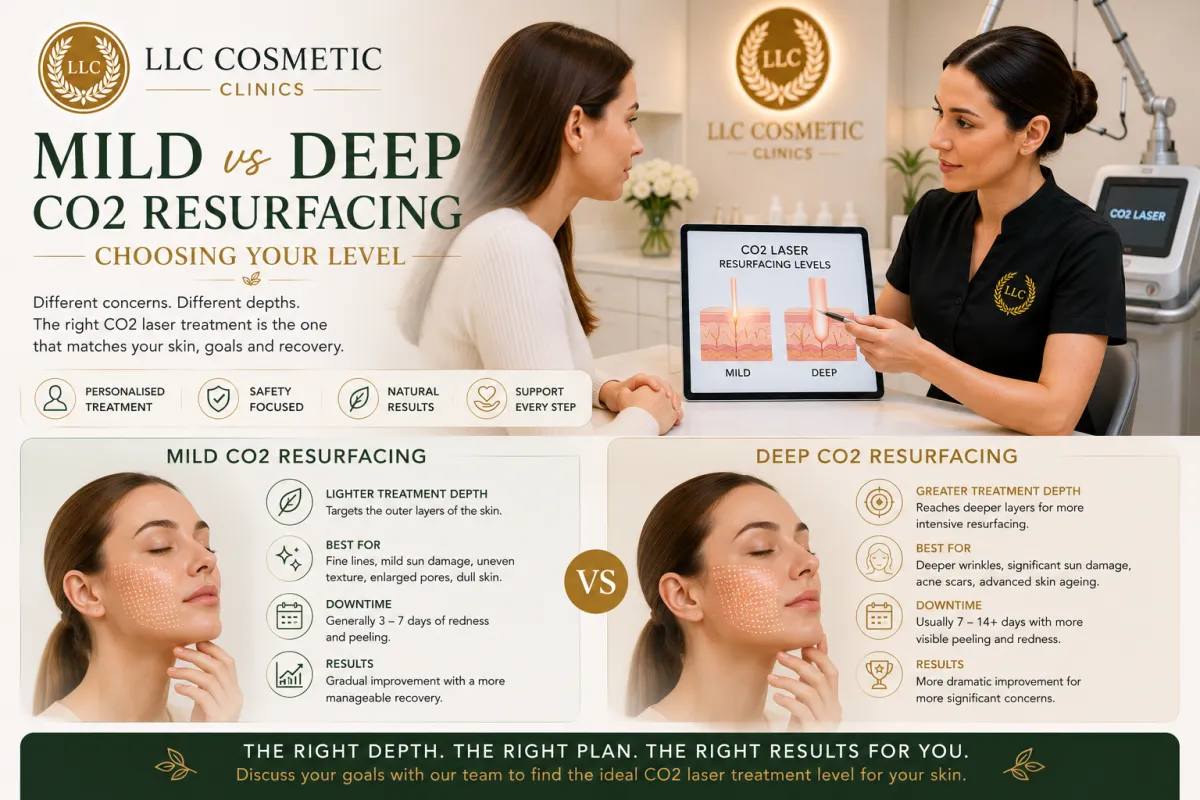
Mild vs Deep CO2 Resurfacing: Choosing Your Level
CO2 laser resurfacing is not a one-size-fits-all treatment. The intensity of the treatment can be adjusted depending on your skin concerns, treatment goals, skin condition and how much downtime you are comfortable with.
That is why understanding mild vs deep CO2 resurfacing is important before booking your treatment.
A milder treatment may be appropriate when you want to improve early signs of ageing, skin texture or overall skin quality with a more manageable recovery. A deeper treatment may be considered when concerns such as more noticeable wrinkles, significant sun damage or deeper acne scarring require a more intensive approach.
But deeper does not automatically mean better.
The right CO2 resurfacing level is the one that matches your skin, goals and ability to recover safely.
What Is CO2 Laser Resurfacing?
CO2 laser resurfacing uses carbon dioxide laser energy to create controlled treatment zones in the skin.
Depending on the technique and settings, the laser can remove or vaporise targeted tissue while stimulating a healing response and collagen remodelling.
The goal may include improving the appearance of:
Fine lines and wrinkles
Uneven skin texture
Acne scarring
Sun-damaged skin
Enlarged-looking pores
Certain pigmentation concerns
Overall skin quality
The exact results and recovery depend heavily on the treatment settings and how your skin responds.
Mild vs Deep CO2 Resurfacing: The Quick Answer
Mild CO2 resurfacing generally uses a less intensive treatment approach. It may be suitable for people looking for gradual improvement in skin texture, tone and early signs of ageing without committing to the recovery associated with a more aggressive resurfacing treatment.
Deeper CO2 resurfacing involves a more intensive treatment and may be considered when there are more significant concerns that require greater resurfacing.
The trade-off is important:
More intensive treatment can mean greater downtime and a more involved recovery.
So the decision should not simply be about choosing the strongest available treatment.
What Is Mild CO2 Resurfacing?
Mild resurfacing is generally designed around controlled skin improvement with a more conservative treatment approach.
It may be considered when your concerns include:
Mild texture irregularities
Early fine lines
Dull-looking skin
Mild sun damage
Enlarged-looking pores
Early signs of skin ageing
General skin rejuvenation
The objective is often to make the skin look smoother, fresher and more refined without using the most aggressive resurfacing settings.
What Can You Expect From a Mild Treatment?
Recovery is generally more manageable than with a deeper treatment, although you can still experience redness, sensitivity, swelling and peeling.
Your skin may look noticeably different for several days while the surface heals.
The exact downtime depends on the settings used, the area treated and your individual skin response.
What Is Deep CO2 Resurfacing?
Deep resurfacing is a more intensive approach that delivers a stronger treatment effect to the skin.
It may be considered for more significant concerns such as:
Deeper wrinkles
More pronounced sun damage
Significant skin texture irregularities
Certain deeper acne scars
More advanced signs of photoageing
Because the treatment is more intensive, the recovery can also be more involved.
You may experience greater:
Redness
Swelling
Sensitivity
Peeling
Crusting
Skin tenderness
A deeper treatment also requires greater commitment to aftercare and recovery.
Mild vs Deep CO2 Resurfacing: Which One Is Better?
There isn't one treatment level that is universally better.
Think of it this way:
Mild CO2:
A more conservative approach when your concerns are relatively mild or when minimising downtime is an important priority.
Deeper CO2:
A more intensive approach when your skin concerns may justify a stronger resurfacing treatment and you are prepared for a longer or more involved recovery.
The ideal treatment is not necessarily the most aggressive one.
It is the treatment that provides an appropriate balance between expected improvement, treatment intensity and recovery.
Your Skin Concern Matters
The same CO2 treatment level may not be appropriate for everyone.
For example, someone primarily concerned about mild skin texture may have very different treatment needs from someone seeking improvement in deeper acne scarring.
During a consultation, your provider may consider:
Your primary skin concerns
Severity of the concern
Previous treatments
Current skincare routine
Skin sensitivity
Previous reactions to treatments
Desired results
Available recovery time
Treatment area
Appropriate laser settings
This is why choosing your CO2 level should ideally happen after an assessment rather than simply selecting the deepest option from a menu.
Does Deeper CO2 Mean Better Results?
Not necessarily.
A deeper treatment may be capable of producing a stronger resurfacing effect, but it also comes with greater treatment intensity and potentially more downtime.
There is a point where increasing treatment intensity may no longer be appropriate for a particular person's goals or skin.
For someone with mild concerns, an aggressive treatment could mean unnecessary recovery.
For someone with significant concerns, a very conservative treatment may not provide the level of improvement they are hoping for.
The goal is appropriate treatment—not maximum treatment.
What About Fractional CO2?
This is an important distinction.
“Fractional” and “deep” are not opposite categories.
Fractional describes how the laser energy is delivered across the skin—in microscopic treatment zones while leaving surrounding areas untreated.
The terms mild, moderate and deep generally refer more to treatment intensity and depth.
This means you can have a fractional ablative CO2 treatment at different levels of intensity.
Your provider may therefore discuss both the delivery pattern and the treatment level when creating your treatment plan.
Recovery: Mild vs Deep CO2
Recovery can vary significantly depending on the exact treatment.
A simplified comparison is:
Mild treatment:
You may experience redness, warmth, sensitivity and peeling, with generally less intensive recovery.
Deeper treatment:
Redness, swelling, tenderness, peeling and crusting may be more pronounced, and the healing period may be longer.
Your actual recovery can also be affected by the treatment area, laser settings, skin response and how closely you follow your aftercare instructions.
Do not plan your recovery based solely on someone else's experience.
How Much Downtime Should You Expect?
There is no single number of recovery days that applies to every CO2 treatment.
A more intensive CO2 resurfacing procedure generally requires more recovery than a mild treatment.
Before treatment, ask your provider:
“How many days should I expect my skin to look visibly treated?”
Also ask:
“When can I return to work?”
“When can I exercise?”
“When can I wear makeup?”
“When can I return to my normal skincare routine?”
These questions are more useful than simply asking for a generic number of downtime days.
Who Might Prefer Mild CO2 Resurfacing?
A milder approach may be worth discussing if:
Your concerns are relatively mild
You are new to laser resurfacing
You have limited time for recovery
You want gradual improvement
Your treatment goals don't require aggressive resurfacing
You prefer a more conservative starting point
However, suitability still needs to be assessed individually.
Who Might Consider Deeper CO2 Resurfacing?
A deeper treatment may be discussed if:
You have more pronounced skin texture concerns
You have deeper lines or wrinkles
You have significant photoageing
You have certain deeper acne scars
You are comfortable with more recovery
Your clinician believes a more intensive treatment is appropriate
Again, this does not mean that everyone with these concerns should receive a deep treatment.
Questions to Ask Before Choosing Your CO2 Level
Before booking, consider asking your provider:
1. What level of CO2 treatment do you recommend for my skin?
Ask them to explain why that level is appropriate.
2. What improvement should I realistically expect?
A qualified provider should explain expected outcomes without promising unrealistic results.
3. How much downtime should I plan for?
Ask about work, social events, exercise and makeup.
4. What will my skin look like during recovery?
Knowing what is normal can make the healing period much easier to manage.
5. What are the potential risks for my skin?
Your provider should discuss relevant risks and how they are managed.
6. What aftercare will I need?
Ask about cleansing, moisturising, sun protection and when you can restart active skincare.
7. Could a less intensive treatment achieve my goal?
This is an especially useful question.
You don't always need the strongest treatment to achieve an appropriate improvement.
Don't Choose Your Treatment Level Based on Price Alone
When comparing CO2 treatments, it can be tempting to choose based on cost.
But the cheapest option isn't necessarily the most appropriate, and the most expensive or intensive option isn't automatically the best.
Consider the entire treatment plan:
Provider qualifications
Treatment assessment
Technology used
Treatment settings
Expected results
Recovery requirements
Aftercare
Follow-up support
Overall suitability
A good treatment decision should consider both results and safety.
When Should You Avoid Choosing the Level Yourself?
If you are unsure which CO2 level is appropriate, don't try to determine the treatment intensity solely from online information.
Your provider needs to assess your skin and treatment goals.
This is particularly important if you:
Have very sensitive skin
Have previously reacted to laser treatments
Have active skin inflammation or infection
Are taking medications that may affect healing
Have a history of problematic scarring
Are unsure whether your concern is suitable for CO2 resurfacing
Always disclose relevant medical and treatment history during your consultation.
Mild vs Deep CO2 Resurfacing: The Bottom Line
Choosing between mild vs deep CO2 resurfacing isn't about finding the strongest treatment.
A mild approach may make sense for someone seeking more conservative skin rejuvenation and less intensive recovery, while deeper resurfacing may be considered for more significant concerns when a stronger treatment is clinically appropriate.
The best starting point is a professional skin assessment.
Your provider should explain why a particular treatment level is recommended, what improvement is realistic, how much recovery to expect and what aftercare will be required.
At LLC Cosmetic, CO2 treatment planning can be based on your skin, treatment history and resurfacing goals rather than simply choosing a treatment level from a list.
If you're unsure whether mild or deeper CO2 resurfacing is right for you, a suitability consultation is a useful first step.
This article is for general educational purposes only and does not replace an individual medical assessment or personalised advice from a qualified healthcare professional.