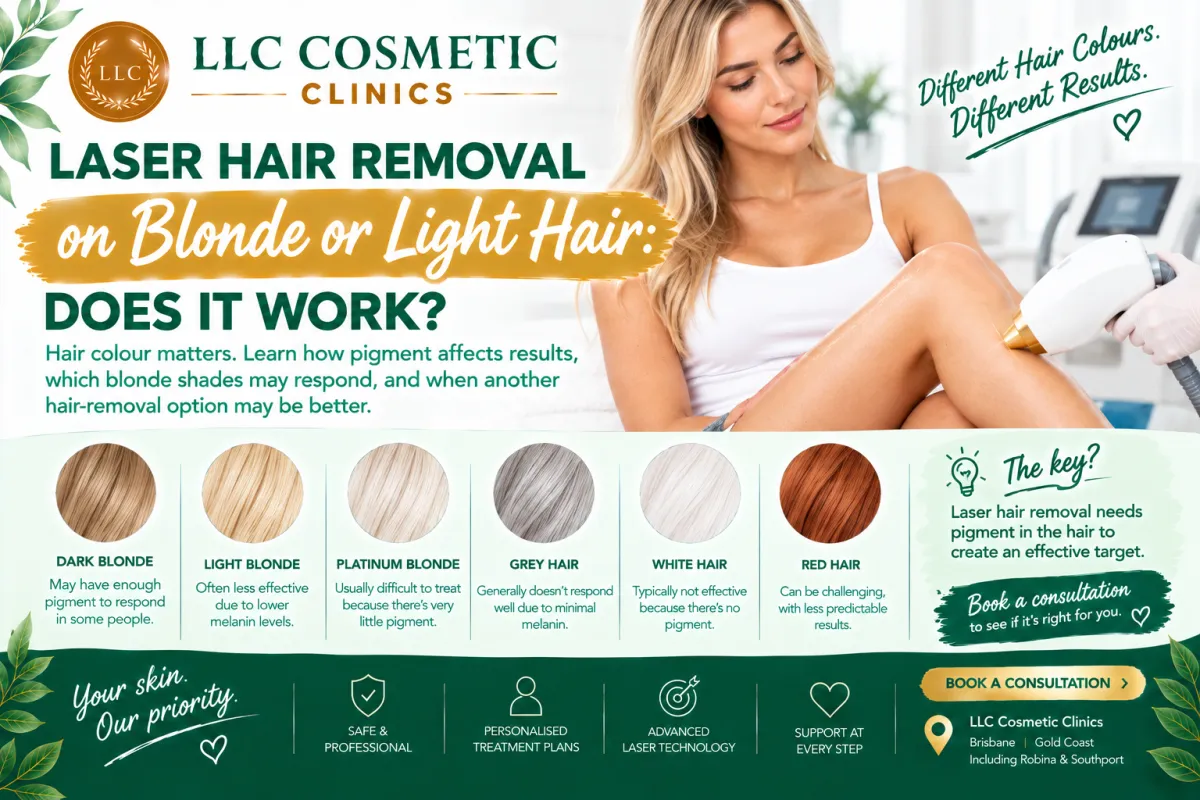
Laser Hair Removal on Blonde or Light Hair: Does It Work?
If you have blonde, light or very fine hair, you may have wondered:
“Will laser hair removal actually work for me?”
It’s a good question—and the answer isn't as simple as yes or no.
Laser hair removal works by targeting pigment (melanin) in the hair. Generally, the more pigment there is in the hair, the easier it is for the laser to identify and heat the hair follicle.
That means dark hair usually responds better than very light hair.
Very light blonde, white, grey and some red hairs can be much more difficult to treat because they contain little pigment for the laser to target. The American Academy of Dermatology states that laser hair removal does not work well on blonde, white, grey or red hair because lasers have difficulty effectively targeting light-coloured hair.
However, there is an important nuance.
Not all blonde hair is the same.
Dark blonde hair with some visible pigment may respond differently from very pale blonde or almost-white hair.
So if you're considering laser hair removal on blonde or light hair, the best first step is an individual assessment rather than assuming you're either automatically suitable or unsuitable.
How Does Laser Hair Removal Work on Hair?
To understand why blonde hair can be challenging, it helps to understand what the laser is actually targeting.
Laser hair removal uses concentrated light energy that is absorbed by pigment in the hair.
That energy is converted into heat, which can damage the hair follicle and reduce its ability to produce hair.
The process depends heavily on the contrast between the hair pigment and the surrounding skin.
Dark hair contains more melanin, giving the laser a stronger target.
Very light hair contains much less melanin, so there may not be enough pigment to absorb the laser energy effectively.
This is why traditional laser hair removal has historically worked best on darker hair with lighter skin.
Does Laser Hair Removal Work on Blonde Hair?
Sometimes—but it depends on how blonde the hair is.
This is probably the most important distinction to understand.
If your hair is dark blonde or has noticeable pigment, there may be some potential for treatment.
If your hair is very pale blonde, platinum blonde or almost white, conventional laser hair removal is much less likely to produce a meaningful result.
LLC Cosmetic's current laser hair removal information similarly notes that blonde or grey hair tends to be less responsive because of its lower melanin content.
So instead of asking:
“Is blonde hair suitable for laser?”
A better question is:
“How much pigment does my hair actually contain?”
That is something a trained practitioner can assess during a consultation.
What About Dark Blonde Hair?
Dark blonde hair sits somewhere between the ideal and difficult categories.
It may contain enough pigment for some response, but the results can be less predictable than with dark brown or black hair.
Several factors may affect the outcome, including:
How dark the blonde hair is
Hair thickness
Hair density
Skin tone
Treatment area
Laser wavelength
Treatment settings
Individual response
Research comparing laser systems has found reduced efficacy in people with red or light-coloured hair compared with darker hair.
This doesn't mean treatment is automatically pointless.
It means expectations need to be realistic.
What About Very Light Blonde or Platinum Hair?
This is where laser hair removal becomes much more challenging.
Very pale blonde or platinum hair contains relatively little melanin.
If there isn't enough pigment in the hair shaft, the laser has a weak target.
Increasing the laser intensity isn't necessarily the answer.
Using more energy simply to compensate for a lack of hair pigment can increase the risk of heating the surrounding skin without guaranteeing better hair reduction.
This is one reason a professional assessment is important.
A good clinic should be willing to tell you if laser hair removal is unlikely to provide worthwhile results rather than promising that every hair colour can be treated successfully.
What About White or Grey Hair?
White and grey hair is generally among the most difficult hair types to treat with conventional laser hair removal.
The problem is straightforward:
There is very little melanin in the hair.
The AAD specifically identifies white and grey hair among the hair colours that laser hair removal does not effectively target.
This can be frustrating if you're experiencing unwanted grey facial or body hair.
But it is important to understand the limitation before purchasing a treatment package.
What About Red Hair?
Red hair can also be challenging.
Red hair contains a different pigment profile from dark brown or black hair, and conventional laser hair removal may produce less predictable results.
Some red hairs contain enough pigment to respond to certain treatment approaches, but results can vary significantly.
The AAD includes red hair among colours that may not respond effectively to conventional laser hair removal.
If you have red or strawberry-blonde hair, a consultation can help determine whether there is enough pigment for a reasonable treatment response.
Why Does Hair Colour Matter So Much?
Think of the laser as looking for a target.
The target is the pigment in the hair.
With dark hair, that target is relatively easy to identify.
With very light hair, the target becomes much weaker.
This is also why laser hair removal can be more complicated when both the skin and hair contain significant pigment.
The ideal treatment involves finding an appropriate balance between targeting the hair and protecting the surrounding skin.
The AAD notes that treatment results depend on several variables, including hair colour and thickness, skin colour, treatment area and the type of laser used.
Can Modern Lasers Treat Blonde Hair Better?
Modern laser technology has expanded the range of people who can potentially receive laser hair removal safely.
However, technology hasn't completely removed the fundamental issue of hair pigment.
The laser still needs an appropriate target.
LLC Cosmetic uses clinical diode systems with different wavelengths, including 755 nm, 808 nm and 1064 nm, and states that treatments are personalised according to hair colour, density and skin type.
Different wavelengths can be useful for different combinations of skin and hair characteristics.
But that doesn't mean that switching wavelengths automatically makes very light blonde or white hair treatable.
Technology can improve treatment options, but it cannot create pigment that isn't present in the hair.
Can a Higher Laser Setting Make Blonde Hair Respond?
This is a common misconception.
You might think:
“If the laser isn't working, can't they just turn it up?”
Not necessarily.
The objective isn't to use the highest possible energy.
The objective is to use an appropriate treatment parameter for the individual's skin, hair and treatment area.
If the hair contains very little pigment, increasing energy may increase heat exposure to the surrounding skin without producing the desired follicular effect.
That's why professional assessment matters.
A trained practitioner should consider whether there is enough pigment to make treatment worthwhile before simply increasing the energy.
What About Fine Blonde Hair?
Fine hair can be challenging for another reason.
Laser hair removal tends to work better when there is sufficient pigment and a suitable hair structure for the laser to target.
Very fine, light-coloured hair can provide an especially weak target.
LLC Cosmetic's current guidance notes that hair colour, thickness and density are important factors when determining suitability and treatment settings.
If you have very fine blonde facial hair, for example, your practitioner may recommend against treating an area if the expected benefit is too limited.
That's not a treatment failure.
Sometimes not treating an unsuitable area is the more appropriate decision.
Does Skin Tone Make a Difference?
Yes.
Laser hair removal isn't determined by hair colour alone.
The contrast between your hair and skin also matters.
Historically, light skin with dark hair has been considered the easiest combination to treat because the laser can distinguish the darker hair pigment from the surrounding skin.
Modern laser technology has made treatment possible for many more skin tones, but appropriate device selection and settings remain important.
For someone with very light hair, the situation can be more complicated because there may be little difference in pigment between the hair and skin.
This is another reason why a consultation is more useful than choosing a treatment based solely on an online advertisement.
What If You Have Blonde Hair and Darker Skin?
This combination deserves particularly careful assessment.
If the hair is blonde and the skin is more deeply pigmented, there may be relatively little hair pigment for the laser to target while the skin itself contains significant melanin.
That can reduce the treatment's selectivity.
Research and clinical guidance emphasise that skin pigmentation needs to be considered when choosing laser parameters because darker skin can have a higher risk of adverse pigmentary effects from inappropriate treatment.
This does not mean that people with darker skin cannot have laser hair removal.
It means the practitioner needs to determine whether the hair provides a sufficient target and whether the treatment can be performed appropriately for the skin.
How Many Sessions Would Blonde Hair Need?
There isn't a reliable number of sessions that applies to everyone with blonde hair.
Even when there is enough pigment for treatment, results may be slower or less complete than with dark hair.
Laser hair removal generally requires multiple treatments because hair follicles go through different growth stages.
The AAD notes that most patients require a series of treatments and that results vary according to hair colour, thickness, treatment area, laser type and skin colour.
For blonde hair, the more important question may be:
“Is there enough pigment for repeated treatments to provide worthwhile reduction?”
That should be assessed before committing to a full course.
Can You Tell if the Laser Is Working?
There are several signs that treatment may be having an effect.
Over a series of sessions, you may notice:
Slower visible hair growth
Less dense hair
Finer regrowth
Patchier growth
Longer periods between shaving
Fewer visible hairs in treated areas
However, blonde hair can make progress harder to judge visually.
Very light regrowth may already be difficult to see, and some hairs may not contain enough pigment to respond.
Your clinic may therefore use photographs, treatment history and changes in hair density to evaluate progress rather than relying only on what you can see immediately after a session.
What Happens If Laser Doesn't Work on Blonde Hair?
Don't keep increasing treatment simply because you aren't seeing the result you expected.
If several sessions produce little or no meaningful reduction, the next step should be reassessment.
Your practitioner may consider:
Whether the hair contains enough pigment
Whether the hair is too fine
Whether the treatment area is appropriate
Whether the technology is suitable
Whether treatment settings need adjustment
Whether another hair-removal method would be more appropriate
The AAD recommends discussing whether another treatment may be a better option during the consultation when laser hair removal isn't suitable.
Is Electrolysis an Alternative for Very Light Hair?
For people with very light, white or grey hair, electrolysis may be worth discussing as an alternative.
Unlike laser hair removal, electrolysis does not rely on hair pigment in the same way.
Instead, a very fine probe is inserted into the hair follicle and electrical energy is used to treat the follicle.
It is a different treatment with different advantages, limitations, time requirements and potential side effects.
If your hair is too light for laser treatment, a qualified practitioner or appropriate healthcare professional can help you determine whether another method is more suitable.
The important point is not to force a laser treatment to work when the biological target simply isn't there.
Should You Dye Blonde Hair Before Laser Treatment?
No.
Dyeing the hair does not solve the underlying problem in the same way as having naturally pigmented hair within the follicle.
Laser hair removal targets pigment associated with the hair follicle, not simply the visible colour sitting on the outside of the hair.
Changing the surface colour of the hair does not automatically create the appropriate target inside the follicle.
If someone suggests dyeing or colouring your hair specifically to make laser hair removal work, ask exactly how the proposed technique works and whether there is evidence supporting it.
Can You Wax or Pluck Blonde Hair Before Laser?
If you're proceeding with laser hair removal, avoid waxing, plucking or epilating unless your provider specifically tells you otherwise.
Laser treatment needs the hair and follicle connection present for the energy to be delivered to the target.
Shaving is different because it cuts the visible hair at the surface while leaving the follicle intact.
LLC Cosmetic currently advises clients to avoid waxing or plucking for at least four weeks before treatment and to shave approximately 24 hours before their appointment.
Is Blonde Hair Completely Unsuitable for Laser Hair Removal?
Not necessarily.
This is where online advice can become misleading.
Saying “laser never works on blonde hair” is too broad.
But saying “modern lasers can treat every blonde hair” is also misleading.
The reality is somewhere in between.
Some darker blonde hairs may contain enough pigment to respond.
Very pale blonde, white and grey hairs are much less likely to respond effectively.
Individual results can also vary depending on hair thickness, skin type, treatment area and the specific technology used.
The AAD's patient guidance currently cautions that blonde, white, grey and red hair may not respond effectively, while its broader FAQ also notes that advances in laser medicine have expanded treatment options.
The safest approach is therefore to assess the actual hair and skin combination, rather than relying on hair colour labels alone.
How LLC Cosmetic Assesses Laser Hair Removal Suitability
At LLC Cosmetic Laser Clinics, suitability is assessed according to individual characteristics rather than treating every client with the same settings.
The clinic's current laser hair removal information identifies hair colour, hair thickness, hair density and skin type as important considerations when planning treatment.
LLC Cosmetic also states that its laser systems are designed for a range of skin types and that treatment settings are adjusted according to the individual.
If you have blonde or light hair, this assessment becomes particularly important.
Instead of automatically booking a full course, you can discuss:
Your exact hair colour
Hair thickness
Hair density
Skin tone
Treatment area
Previous laser or IPL treatments
Your expected outcome
Whether laser is likely to provide enough benefit
The clinic operates across Brisbane CBD, Sunnybank, Southport and Robina.
Frequently Asked Questions
Does laser hair removal work on blonde hair?
It can work on some darker blonde hair, but results are generally less predictable than with dark hair. Very pale blonde hair contains less melanin, making it harder for conventional laser hair removal to target effectively.
Does laser hair removal work on platinum blonde hair?
Usually, platinum or very pale blonde hair is difficult to treat effectively because it contains little pigment. A consultation can help determine whether there is enough pigment for treatment to be worthwhile.
Does laser hair removal work on grey hair?
Grey hair is generally difficult to treat because it contains little melanin. The AAD specifically lists grey hair among hair colours that laser hair removal does not effectively target.
Does laser hair removal work on white hair?
Conventional laser hair removal generally performs poorly on white hair because there is little or no melanin for the laser to target.
Does laser hair removal work on red hair?
Red hair can be more difficult to treat than dark hair. Some red hair may respond, but results are less predictable, and the AAD lists red hair among colours that may not respond effectively.
Can a stronger laser remove blonde hair?
Not necessarily. Increasing energy does not automatically compensate for insufficient pigment in the hair. Using inappropriate settings can increase the risk of unwanted skin reactions.
Is IPL better than laser for blonde hair?
There is no simple rule that IPL is better for blonde hair. Both technologies rely on pigment to some degree, and very light hair remains challenging. The appropriate option depends on the individual device, hair characteristics and skin type.
What is the best hair removal method for white or very blonde hair?
If conventional laser hair removal is unlikely to work because the hair has very little pigment, another method such as electrolysis may be worth discussing with a qualified provider.
Should I book laser hair removal if I have blonde hair?
You can arrange a consultation to determine whether your particular hair contains enough pigment for treatment. If the expected benefit is low, a reputable provider should explain that before you commit to a full treatment course.
Final Takeaway
Does laser hair removal work on blonde or light hair?
Sometimes—but the shade and pigment of the hair matter.
Dark blonde hair may have enough pigment to respond in some people, while very pale blonde, white and grey hair are much more difficult to treat with conventional laser hair removal.
The reason comes down to melanin.
Laser hair removal needs pigment in the hair to provide an effective target.
Modern technology has expanded treatment options, but it hasn't eliminated this fundamental limitation.
If you're considering laser hair removal and have blonde, light, grey or red hair, don't rely solely on online claims or device advertisements.
Have your hair colour, thickness, density, skin type and treatment area assessed first.
That way, you can find out whether laser hair removal is likely to provide meaningful results—or whether another hair-removal approach may make more sense.
The right treatment isn't the one that promises the most. It's the one that's appropriate for your hair, your skin and your goals.