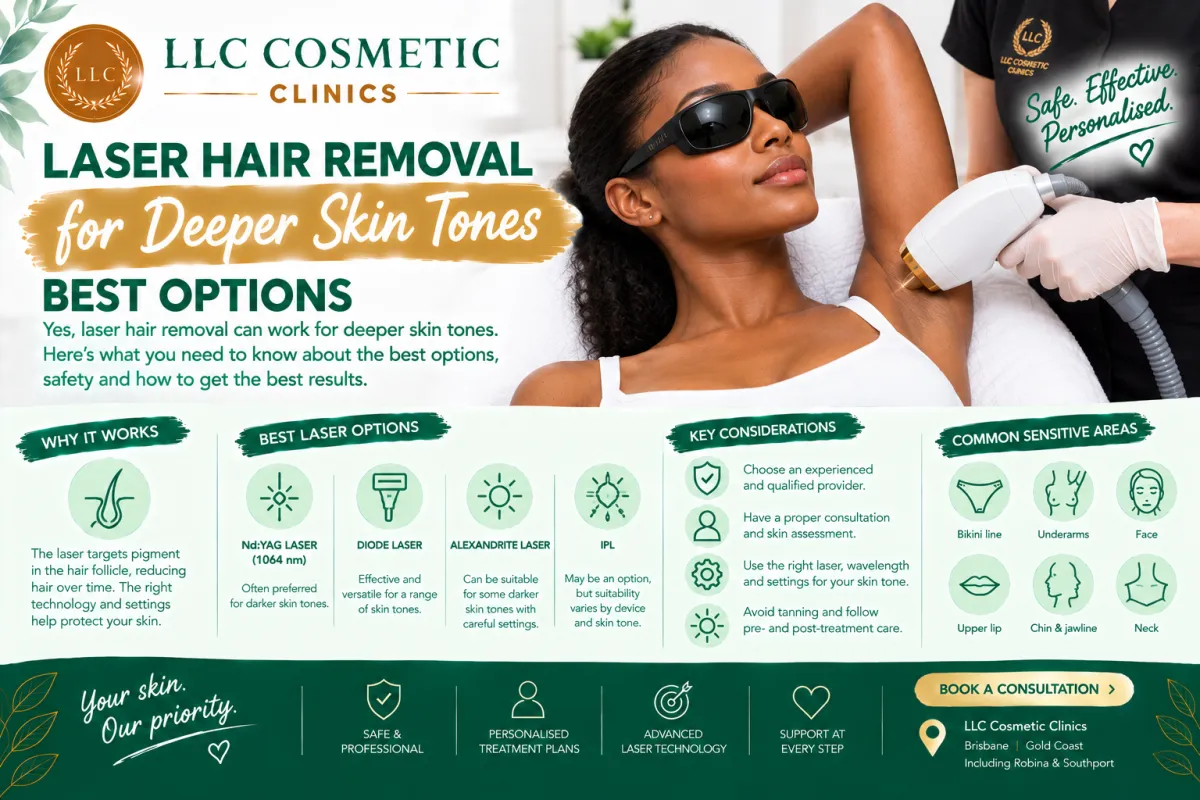
Laser Hair Removal for Deeper Skin Tones: Best Options
If you have a deeper skin tone, you may have heard that laser hair removal is too risky for your skin.
That advice is outdated.
Today, laser hair removal can be performed on a wide range of skin tones, including deeper Fitzpatrick skin types, when the appropriate laser technology, settings and safety precautions are used. The American Academy of Dermatology notes that people with dark skin can have laser hair removal, but treatment needs to be performed carefully by someone experienced with darker skin.
At the same time, deeper skin tones require more careful treatment planning because the skin contains more melanin. The laser needs to distinguish between pigment in the hair and pigment in the surrounding skin.
So, what is the best laser hair removal option for deeper skin tones?
The answer isn't simply one machine or one wavelength. The best option is the technology and treatment settings that are appropriate for your individual skin tone, hair characteristics and treatment area.
Why Does Skin Tone Matter for Laser Hair Removal?
Laser hair removal works by targeting pigment, or melanin, in the hair follicle.
The laser energy is absorbed by the pigment and converted into heat, which damages the follicle and reduces its ability to produce hair over time.
The challenge is that darker skin also contains more melanin.
This means there is potentially more pigment in the surrounding skin for the laser energy to interact with.
That's why treatment settings need to be selected carefully.
With the right approach, laser hair removal can be performed on Fitzpatrick skin types I through VI. LLC Cosmetic states that its medical-grade laser systems are tailored to different skin tones and hair colours, including Fitzpatrick I–VI.
What Are Fitzpatrick Skin Types?
The Fitzpatrick scale is commonly used to classify how skin responds to ultraviolet exposure.
It ranges from:
Type I: Very fair skin that usually burns easily
Type II: Fair skin that generally burns easily
Type III: Medium skin that may gradually tan
Type IV: Olive or light-brown skin that tans more easily
Type V: Brown skin that rarely burns
Type VI: Deeply pigmented brown or very dark skin that rarely burns
People often use the terms "dark skin," "deep skin tone," "brown skin," "melanin-rich skin" or "skin of colour" interchangeably.
But your skin tone is only one part of the treatment assessment.
Your hair colour, hair thickness, treatment area, recent tanning, medications and previous skin reactions can also influence treatment planning.
Can Laser Hair Removal Be Used on Fitzpatrick Skin Types V and VI?
Yes, laser hair removal can be an option for people with Fitzpatrick V and VI skin types.
However, this doesn't mean that every laser, every setting or every clinic is equally appropriate.
The American Academy of Dermatology specifically notes that laser hair removal can now be an option for people with dark skin, but it must be performed carefully.
This is why choosing an experienced provider matters.
A clinic should be able to assess your skin and hair before treatment rather than applying the same settings to every patient.
Which Laser Is Best for Deeper Skin Tones?
You may see different laser wavelengths mentioned when researching laser hair removal.
One of the most commonly discussed options for darker skin is the Nd:YAG laser at 1064 nm because its longer wavelength penetrates more deeply and is less strongly absorbed by epidermal melanin than shorter wavelengths.
However, choosing a laser should not be based on wavelength alone.
The appropriate technology depends on the patient's skin, hair, treatment area, device characteristics and the practitioner's experience.
Some modern systems use multiple wavelengths or other technologies designed to accommodate a wider range of skin and hair combinations.
The important question isn't simply:
"Does this clinic have an Nd:YAG?"
A better question is:
"Does this clinic have appropriate technology and experience treating my specific skin tone and hair type?"
Why Nd:YAG Is Often Considered for Darker Skin
The 1064 nm Nd:YAG wavelength is widely used when treating darker skin because it is less absorbed by melanin in the epidermis than some shorter wavelengths.
That can allow the laser energy to reach the deeper hair follicle while reducing, though not eliminating, the risk of excessive absorption by the surrounding skin.
However, "safer" does not mean "risk-free."
Incorrect settings, recent tanning, inappropriate treatment parameters or inexperienced treatment can still result in burns or pigment changes.
This is why technology and practitioner skill need to work together.
What About Diode Lasers?
Diode lasers can also be used for laser hair removal, and some modern systems are designed to treat a broader range of skin tones.
Whether a diode laser is appropriate for deeper skin depends on the specific device, wavelength, settings and clinical protocol.
Don't assume that a diode laser is automatically unsuitable simply because you have dark skin.
Likewise, don't assume that any diode laser is automatically safe for every darker skin tone.
The device should be selected and adjusted according to the individual.
What About Alexandrite Lasers?
Alexandrite lasers use a shorter wavelength and are commonly associated with lighter skin types.
They can be highly effective for suitable combinations of skin and hair colour.
However, as skin becomes more deeply pigmented, the risk of unwanted absorption by melanin in the skin becomes an important consideration.
For deeper skin tones, your practitioner may recommend another wavelength or a more conservative treatment approach.
The decision should be made after assessing your actual skin rather than relying on a generic skin-type chart alone.
What About IPL?
IPL, or intense pulsed light, is technically different from laser hair removal.
IPL uses a broad spectrum of light rather than a single laser wavelength.
Some IPL devices can be used for hair reduction, but suitability varies considerably by device, skin tone and treatment protocol.
If you have a deeper skin tone, don't assume that an inexpensive IPL treatment is equivalent to professional laser hair removal.
Ask exactly what technology the clinic uses and whether the practitioner has experience treating your skin tone.
Why Professional Assessment Is So Important for Darker Skin
One of the biggest factors affecting laser hair removal safety is the person performing the treatment.
The AAD states that laser hair removal can cause burns, permanent skin-colour changes and scars when performed in inexperienced hands. It also recommends choosing an appropriately qualified and experienced professional.
For deeper skin tones, ask your clinic:
Do you regularly treat Fitzpatrick V and VI skin?
What laser technology do you use?
How do you determine treatment settings?
Do you assess my skin before treatment?
What happens if I've recently been in the sun?
What should I do before and after treatment?
What side effects should I watch for?
You should feel comfortable asking these questions before allowing anyone to treat your skin.
Is Laser Hair Removal Safe for Darker Skin?
When appropriately selected and performed by a trained professional, laser hair removal can be a suitable treatment for deeper skin tones.
However, there are still potential side effects.
These may include:
Temporary redness
Warmth
Swelling around hair follicles
Temporary discomfort
Changes in skin pigmentation
Burns or blistering in more significant reactions
Scarring in uncommon cases
Darker skin can be more prone to post-inflammatory pigmentation following skin injury, which makes appropriate treatment settings and aftercare especially important.
What Causes Pigmentation Problems After Laser Hair Removal?
Pigmentation changes can happen when the skin experiences excessive heat or inflammation.
For example, inappropriate settings or treating recently tanned skin may increase the risk of an unwanted reaction.
That's why your practitioner should ask about:
Recent sun exposure
Recent tanning
Fake tan
Previous laser treatments
Skin conditions
Medications
Previous reactions to laser or light treatments
Your tendency to develop dark marks after skin irritation
If you are prone to hyperpigmentation, tell your practitioner before treatment.
What If You Have a Recent Tan?
This is particularly important for deeper skin tones.
A recent tan can increase the amount of melanin in the skin, potentially changing how the skin interacts with the laser.
The AAD recommends avoiding tanning and waiting for a tan to fade before laser hair removal.
At LLC Cosmetic, recent suntan or self-tan is specifically listed as a factor that should be discussed during consultation.
If you've recently spent a lot of time outdoors, don't hide it from your practitioner.
Your appointment may need to be adjusted or postponed depending on your circumstances.
What Should You Do Before Laser Hair Removal?
Preparation is especially important when treating deeper skin tones.
Avoid tanning
Stay out of deliberate tanning and follow your clinic's instructions regarding sun exposure before treatment.
Don't wax or pluck
Shaving is generally preferred because the hair follicle needs to remain present for the laser to target it.
Tell your practitioner about your medications
Some medications and skincare products can affect how your skin responds to light-based treatments.
Always disclose medications, supplements and relevant skincare products during your consultation.
Tell your practitioner about previous reactions
If you've ever experienced burns, blistering, prolonged pigmentation or another unusual reaction after laser or IPL, mention it.
Follow your clinic's preparation instructions
Your clinic may recommend specific shaving and skincare instructions depending on the area being treated.
Does Laser Hair Removal Hurt More on Darker Skin?
Skin colour itself doesn't necessarily determine how uncomfortable laser hair removal will feel.
You may experience warmth, tingling or a light snapping sensation during treatment.
The sensation can vary according to:
Hair thickness
Hair density
Treatment area
Laser settings
Individual sensitivity
Cooling technology
At LLC Cosmetic, the clinic describes treatment sensations as generally mild warmth or a light snapping feeling, with settings adjusted according to skin tone and hair characteristics.
Can Laser Hair Removal Treat Dark Hair on Dark Skin?
This combination can actually be quite suitable because the laser is designed to target pigment in the hair.
The challenge is creating enough difference between the hair pigment and surrounding skin pigment to selectively target the follicle.
This is where the right wavelength and carefully selected parameters become important.
Your practitioner should assess both your skin and hair rather than considering skin tone alone.
What About Light Hair on Deeper Skin?
Laser hair removal relies on pigment in the hair.
This means very light blonde, white, grey or some red hairs can be more difficult to treat because they contain less of the pigment the laser targets.
The AAD notes that laser hair removal does not work well on blonde, white, grey or red hair.
If you have darker skin and very light hair, ask your practitioner whether laser hair removal is likely to be effective before starting a treatment course.
What About Facial Hair and Hormonal Hair Growth?
Facial hair can be more complicated than hair on the body.
Hormonal factors can influence facial hair growth, particularly around the:
Upper lip
Chin
Jawline
Neck
Conditions such as PCOS can contribute to increased hair growth.
Laser hair removal can reduce unwanted hair, but it doesn't treat an underlying hormonal condition.
If you have recently developed significant facial hair growth or noticed a sudden change, discuss the underlying cause with an appropriate healthcare professional.
What Should You Do After Treatment?
After laser hair removal, protect your skin while it settles.
For deeper skin tones, this is particularly important if you're prone to pigmentation changes.
Your aftercare may include:
Avoiding excessive sun exposure
Using appropriate sunscreen on exposed skin
Avoiding hot showers and saunas immediately after treatment
Avoiding intense exercise for the period recommended by your clinic
Keeping skincare gentle
Avoiding unnecessary rubbing or scratching
Following your practitioner's specific instructions
If you develop significant blistering, severe pain, unusual swelling or other concerning symptoms, contact your treating clinic and seek medical advice as appropriate.
How Many Treatments Will You Need?
Laser hair removal is normally performed as a series of treatments rather than a single appointment.
Hair grows in different cycles, and the laser is most effective when the target hair is in an appropriate growth phase.
LLC Cosmetic currently advises that most patients achieve their best results with around 6–8 treatments, generally spaced approximately 4–6 weeks apart, although individual requirements vary.
People with hormonal hair growth may require additional treatments or maintenance.
Your practitioner should give you an individualised recommendation rather than guaranteeing a fixed number of sessions.
How to Choose the Best Laser Hair Removal Clinic for Deeper Skin Tones
If you have a deeper skin tone, don't choose a clinic based only on price.
Look for a provider that:
Has experience treating darker skin tones.
Uses appropriate professional laser equipment.
Performs a proper consultation.
Assesses your skin and hair before treatment.
Adjusts settings for the individual.
Explains potential risks.
Provides clear preparation and aftercare instructions.
Can explain what technology they use and why.
Operates within relevant licensing requirements.
In Queensland, commercial cosmetic laser operators using Class 4 laser apparatus must hold an appropriate Use Licence, with requirements covering laser safety, infection control, training and competency.
That gives consumers another useful question to ask when comparing providers.
Why Experience With Darker Skin Matters
Laser hair removal isn't a one-setting-fits-all treatment.
Two people can have the same general skin tone but require different treatment parameters because their hair density, hair thickness, treatment area, tanning history and skin response may differ.
The practitioner needs to understand how to balance effective energy delivery with protection of the surrounding skin.
This is why experience matters just as much as the equipment itself.
Can You Have Laser Hair Removal on Fitzpatrick VI Skin?
People with Fitzpatrick VI skin should not automatically assume laser hair removal is unavailable to them.
The AAD states that people with dark skin can receive laser hair removal when appropriate precautions are taken, and LLC Cosmetic states that its medical-grade laser systems are designed for Fitzpatrick I–VI.
However, individual suitability still needs to be assessed.
A consultation is the best way to determine whether treatment is appropriate for your specific skin and hair characteristics.
The Bottom Line
Having a deeper skin tone does not automatically mean you have to avoid laser hair removal.
Modern laser technology and careful treatment protocols can make laser hair reduction an option across a wide range of skin tones.
But the safest approach is not simply finding the "strongest" laser.
It's finding the right technology, appropriate settings and an experienced practitioner who understands how to treat melanin-rich skin.
If you have Fitzpatrick V or VI skin, a recent tan, a history of hyperpigmentation, sensitive skin or previous reactions to laser treatments, make sure you discuss these factors during your consultation.
At LLC Cosmetic Laser Clinics, the team assesses skin tone, hair characteristics and treatment goals before developing a personalised laser hair removal plan. The clinic states that its medical-grade systems are suitable for Fitzpatrick I–VI, including deeper skin tones.
LLC Cosmetic has clinics in Brisbane CBD, Sunnybank, Southport and Robina, giving clients across Brisbane and the Gold Coast access to professional laser hair removal consultations.
Have a deeper skin tone and considering laser hair removal? Book a consultation with LLC Cosmetic to discuss whether the treatment and technology are appropriate for your skin and hair.