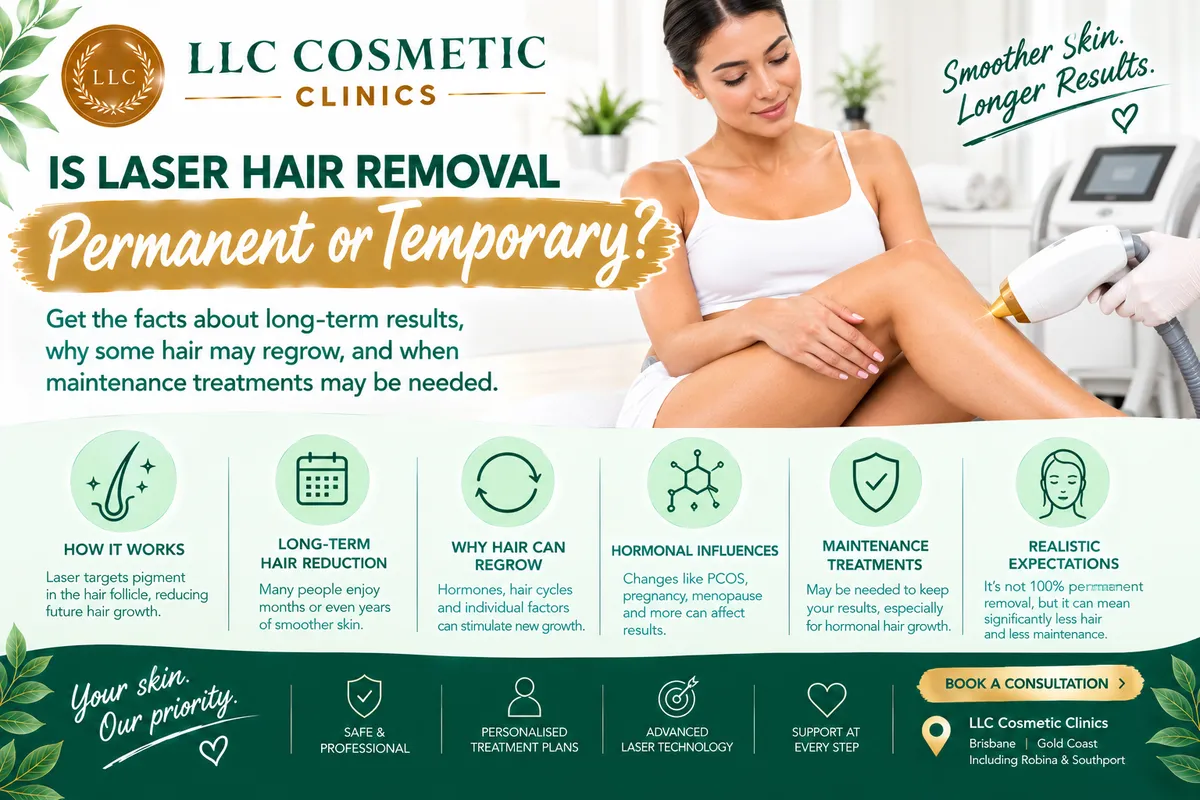
Is Laser Hair Removal Permanent or Temporary?
If you're considering laser hair removal, one of the first questions you're probably asking is:
“Is laser hair removal permanent or temporary?”
After all, there is a big difference between reducing your hair for a few weeks and significantly reducing hair growth for months or years.
The short answer is that laser hair removal is best described as long-term or permanent hair reduction, rather than a guarantee that every hair will be permanently eliminated.
For many people, a full course of professional laser treatment can produce a substantial and long-lasting reduction in unwanted hair. Some people remain largely hair-free for months or even years, while others experience some regrowth and may benefit from maintenance treatments.
So, what actually happens to the hair follicle? How long can results last? And why can hair sometimes grow back?
Let's break it down.
Is Laser Hair Removal Actually Permanent?
Laser hair removal can provide permanent hair reduction, but it's important to understand what that phrase means.
It doesn't necessarily mean:
“You will never see another hair in this area for the rest of your life.”
Instead, permanent hair reduction refers to a long-term, stable decrease in the number of hairs that regrow after an appropriate course of treatment.
The FDA definition used for certain laser devices describes permanent hair reduction as a long-term, stable reduction in the number of hairs regrowing after a treatment regimen, measured months after treatment.
This distinction matters because your body continues to change after your treatment course.
Hormones can change. New follicles can become active. Some follicles may not have been effectively targeted during earlier treatment cycles.
As a result, some regrowth can occur even after an otherwise successful treatment course.
How Does Laser Hair Removal Work?
Laser hair removal uses concentrated light energy to target pigment in the hair.
The pigment absorbs the laser energy, which travels toward the hair follicle and creates heat that can damage the follicle's ability to produce hair.
The process is selective: the goal is to affect the hair follicle while protecting the surrounding skin.
Over multiple treatments, the treated area can experience progressively less hair growth.
The American Academy of Dermatology explains that laser hair removal can damage hair follicles so that they are unable to produce hair, with multiple treatments generally needed because hairs are in different stages of their growth cycle.
That's why one treatment isn't usually enough.
Why Do You Need Multiple Laser Hair Removal Sessions?
Hair doesn't all grow at the same time.
Individual follicles move through different phases of the hair growth cycle.
Laser treatment is most effective when the hair is in an appropriate active growth phase. Because not every follicle is at that stage during your appointment, a single session cannot effectively target every follicle that may eventually produce visible hair.
Think of your first treatment as catching some of the follicles at the right time.
A later treatment catches others.
This is why laser hair removal is normally performed as a series of appointments rather than a one-time treatment.
The American Academy of Dermatology says most patients require multiple treatments and notes that many patients have 2–6 treatments, while LLC Cosmetic commonly recommends around 6–8 treatments depending on the individual and treatment area.
How Long Does Laser Hair Removal Last?
This is where the answer becomes individual.
The AAD reports that after completing treatment, many patients remain hair-free for months or even years. When hair does regrow, it tends to be less noticeable, and maintenance treatments may be used to keep the area relatively hair-free.
Your results can depend on several factors, including:
Hair colour
Hair thickness
Skin tone
Treatment area
Laser technology
Treatment settings
Hair growth cycle
Hormonal factors
Consistency with appointments
Individual biology
So two people can complete similar treatment courses and experience different long-term results.
Will Hair Grow Back After Laser Hair Removal?
It can.
Some people may experience little visible regrowth for a long period, while others may notice occasional hairs returning.
But regrowth doesn't necessarily mean the treatment has failed.
In many cases, the hair that returns may be:
Finer
Lighter
Less dense
Slower growing
Easier to manage
The AAD notes that when hair regrows after laser treatment, there tends to be less of it and the hairs may be finer and lighter.
This is an important difference between regrowth and returning to your original level of hair growth.
Does Laser Hair Removal Permanently Remove Every Hair?
No treatment should be presented as a guarantee that every single hair will disappear permanently.
Even after a successful treatment course, some follicles may continue producing hair.
Other follicles may become active later.
This can happen because of the natural hair-growth cycle, hormonal changes and individual biological differences.
That's why reputable clinics generally talk about permanent hair reduction rather than promising 100% permanent removal of every hair.
LLC Cosmetic similarly describes its treatment as permanent or long-term hair reduction rather than guaranteeing complete lifelong removal of every hair.
What Causes Hair to Grow Back After Laser Treatment?
There isn't always one single reason.
1. Hair Growth Cycles
Not every follicle is in the same growth phase when you have your treatment.
Some follicles may become active later.
This is one of the main reasons a series of treatments is required.
2. Hormonal Changes
Hormones can influence hair growth.
This is particularly relevant for facial hair.
Hormonal changes associated with conditions such as PCOS, pregnancy, menopause or other changes in hormone levels can stimulate new or increased hair growth.
The AAD notes that facial laser hair removal in women may require maintenance because hormonal changes can stimulate additional facial hair growth.
If you notice significant new facial or body hair, it can be worth discussing the change with both your laser practitioner and your healthcare professional where appropriate.
3. Individual Biology
Everyone's hair follicles behave differently.
Genetics, hormones, age and hair characteristics can all influence how your body responds.
That's why another person's treatment schedule shouldn't automatically become your treatment schedule.
4. Treatment Area
Different areas of the body can respond differently.
For example, facial hair can be more hormonally influenced than hair on some other body areas.
This is one reason maintenance requirements can vary between the face, underarms, legs, bikini area and other treatment zones.
Do You Need Maintenance Laser Treatments?
You may.
Maintenance treatments are not necessarily a sign that your original treatment failed.
Think of them as top-up treatments for new or returning growth.
The AAD specifically notes that maintenance laser treatments may be needed when hair regrows.
Some people may go a long time between maintenance sessions, while others may require them more regularly.
Your practitioner can assess the amount and type of regrowth before recommending additional treatment.
How Often Do You Need Maintenance Treatments?
There isn't one maintenance schedule that applies to everyone.
Your practitioner may consider:
The treatment area
Amount of regrowth
Hair thickness
Hair colour
Hormonal influences
Previous treatment response
Skin condition
Time since your last treatment
Rather than automatically booking a treatment every few months, it can make more sense to assess whether there is enough suitable hair growth to treat.
LLC Cosmetic's existing guidance notes that maintenance treatments may be required depending on individual hair growth and hormonal factors.
Is Laser Hair Removal Permanent on the Face?
Facial hair needs a little more explanation.
Laser hair removal can significantly reduce facial hair, but hormonal influences can make long-term results less predictable than in some other areas.
The AAD specifically states that laser hair removal is not considered permanently effective on a woman's face in the same way it can be on many other body areas because hormones can stimulate additional facial hair growth.
This doesn't mean facial laser treatment is ineffective.
It means expectations need to be realistic.
You may achieve significant reduction while still requiring occasional maintenance.
Is Laser Hair Removal Temporary Like Waxing?
No.
Laser hair removal works differently from shaving and waxing.
Shaving
Shaving cuts the hair at the surface of the skin.
The follicle remains intact, so the hair continues to grow.
This means the results are temporary and frequent shaving is usually required.
Waxing
Waxing removes the hair from the root, but the follicle remains capable of producing another hair.
As the new hair grows, waxing needs to be repeated.
Laser Hair Removal
Laser treatment aims to damage the hair follicle so that it becomes less capable of producing hair.
With an appropriate course of treatment, this can produce much longer-lasting hair reduction than shaving or waxing.
That is why laser hair removal is generally considered a long-term hair reduction treatment, rather than simply another temporary hair-removal method.
What Results Can You Expect From a Full Course?
Results vary from person to person.
At LLC Cosmetic, the clinic currently describes laser hair removal as providing up to 90% permanent hair reduction after a complete treatment course, with many patients requiring around 6–8 treatments spaced approximately 4–6 weeks apart.
This should be viewed as a treatment target rather than a guarantee for every individual.
Your actual results can depend on your skin tone, hair characteristics, treatment area, hormones and how your body responds to treatment.
Why You Shouldn't Judge Results After One Session
It can be tempting to look at the treated area after your first appointment and think:
“Is this all the hair that's going to disappear?”
Not necessarily.
Laser hair removal is progressive.
After the first session, some treated hairs may shed while other follicles continue through their natural growth cycle.
You may notice some reduction, but the bigger change generally happens over a series of treatments.
The AAD reports that patients may see around a 10%–25% reduction after the first treatment, although results vary considerably between individuals.
This is why consistency matters.
Can Laser Hair Removal Results Last for Years?
Yes, they can.
Many patients experience long periods of significant hair reduction after completing their treatment course.
The AAD reports that many patients remain hair-free for months or even years following treatment.
However, “lasting for years” doesn't mean that no maintenance will ever be necessary.
Your hair growth can change over time.
For some people, occasional maintenance treatments can help manage new or returning growth.
Does Laser Hair Removal Work on All Skin Types?
Laser hair removal can be performed on a broad range of skin tones when the treatment is appropriately selected and delivered.
However, the laser technology, wavelength, settings, cooling and practitioner experience all matter.
The AAD notes that people with darker skin can undergo laser hair removal, but treatment needs to be performed carefully.
LLC Cosmetic states that its medical-grade laser systems are tailored to skin tone and hair colour and can be used across Fitzpatrick skin types I–VI.
If you have a deeper skin tone, recent tan or a history of pigmentation changes, make sure your practitioner knows this before treatment.
Does Hormonal Hair Growth Mean Laser Won't Work?
Not necessarily.
Laser can still reduce unwanted hair when hormones contribute to hair growth.
The important point is that laser treatment doesn't change the underlying hormonal driver.
For example, someone with PCOS may achieve significant hair reduction but continue developing new hormonal hair over time.
That person may need additional treatments or maintenance.
If you've recently noticed a major change in hair growth, don't simply assume you need more laser sessions. It may also be worth discussing the change with your doctor.
How Can You Make Your Laser Results Last Longer?
You can't control every factor affecting hair growth, but there are practical ways to support your treatment plan.
Follow Your Recommended Treatment Schedule
Skipping appointments or treating at random intervals can make it harder to target hair during appropriate growth phases.
Your clinic can recommend timing based on the area being treated and your individual response.
Don't Wax or Pluck Between Sessions
Waxing and plucking remove the hair from the follicle.
Your practitioner may recommend shaving instead when hair removal is needed between laser sessions.
Protect Your Skin From Sun Exposure
Sun exposure is an important consideration before and after laser treatment.
Follow your clinic's instructions about sun avoidance and sunscreen use.
The AAD recommends avoiding direct sun exposure and tanning as part of laser hair removal preparation and aftercare.
Follow Your Clinic's Aftercare Instructions
Good aftercare helps protect your skin and reduce the risk of treatment-related complications.
Don't assume that more aggressive skincare will produce better results.
Your practitioner should provide instructions appropriate for your treatment and skin.
What If You See Hair Growth Years Later?
Don't panic.
Seeing a few hairs years after treatment doesn't necessarily mean your entire treatment has been reversed.
It may simply mean that some follicles are producing hair again.
The right response is usually to have the area assessed.
Your practitioner can determine whether the hair is suitable for another laser treatment and whether a maintenance session makes sense.
Is Laser Hair Removal Worth It for Long-Term Hair Reduction?
For people who are tired of repeatedly shaving, waxing or plucking, laser hair removal can offer a much longer-term approach to managing unwanted hair.
The main benefit isn't necessarily the promise of never seeing another hair.
It's the potential to dramatically reduce:
Hair density
Hair thickness
Shaving frequency
Waxing appointments
Razor irritation
Time spent managing unwanted hair
For many people, that difference can make laser hair removal a practical long-term investment.
The Bottom Line: Is Laser Hair Removal Permanent or Temporary?
So, is laser hair removal permanent or temporary?
The most accurate answer is:
Laser hair removal provides long-term, and often permanent, hair reduction — but it should not be understood as a guarantee of 100% permanent removal of every hair.
After a complete treatment course, many people experience months or years of significant hair reduction. Some may need occasional maintenance treatments, particularly when hormones or other factors contribute to new hair growth.
The goal is not necessarily to promise completely hair-free skin forever.
The goal is to achieve substantial, long-lasting reduction that makes unwanted hair much easier to manage.
Thinking About Laser Hair Removal?
If you're tired of temporary hair-removal methods and want to understand what kind of long-term reduction you could realistically expect, a professional consultation is a good place to start.
At LLC Cosmetic, laser hair removal begins with an assessment of your skin tone, hair characteristics, treatment area and individual goals. The clinic currently offers laser hair removal across Brisbane and Gold Coast locations, including Brisbane CBD, Sunnybank, Southport and Robina.
Your practitioner can explain how many sessions may be appropriate, what type of results you might reasonably expect and whether maintenance treatments are likely to be part of your longer-term plan.
Ready to spend less time shaving and waxing? Book a consultation with LLC Cosmetic to discuss whether laser hair removal is suitable for you.
This article is for general educational purposes only and is not a substitute for personalised medical advice. Individual laser hair removal results vary based on factors including skin tone, hair characteristics, treatment area, hormonal influences and treatment response.