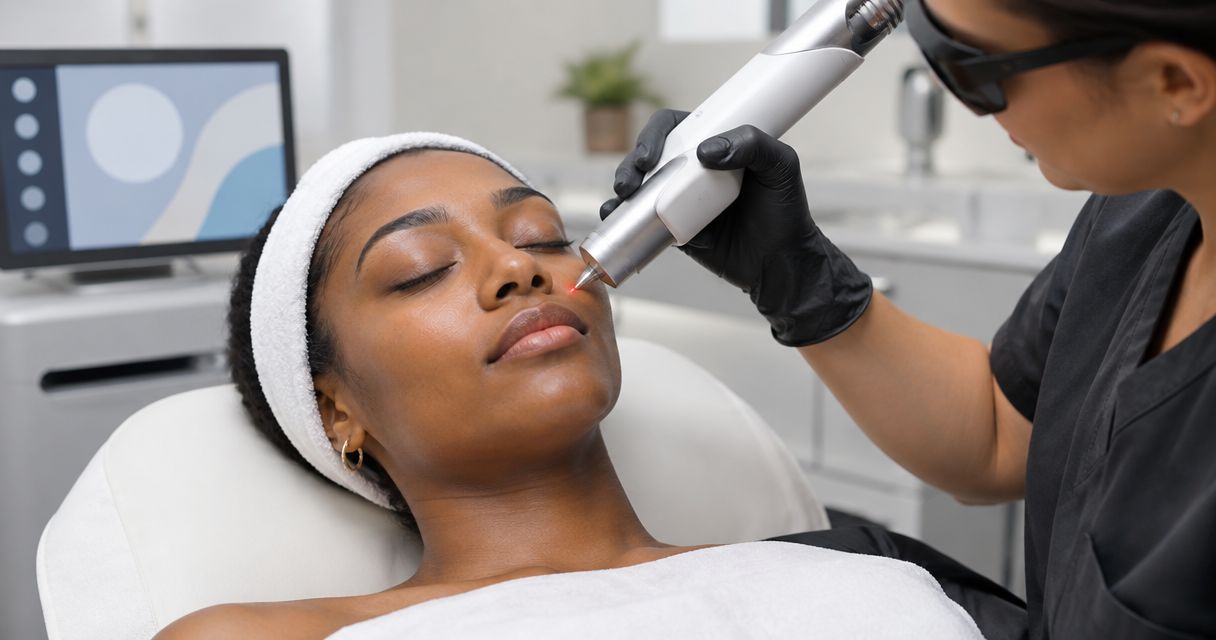
Is CO2 laser resurfacing safe for darker skin tones?
CO₂ laser resurfacing is not automatically suitable for darker skin tones: it can improve acne scars, but treatment can also cause lasting pigment changes. Fractional treatment leaves some surrounding skin untreated, yet it does not remove that risk. Your skin’s response to inflammation matters more than a blanket promise that a laser suits everyone.[1]
- CO2 laser resurfacing darker skin tones suitability needs individual assessment, not a blanket safety claim.
- Fractional CO₂ treatment still carries pigment-change risks, especially in darker skin.[1]
- LLC Cosmetic Laser Clinics offers medical physicist-led care and clinician-reviewed treatment plans.
- Results vary between individuals; choosing not to treat is a valid outcome.
Is CO2 laser resurfacing safe for darker skin tones?
Darker skin needs an individual risk assessment before CO₂ resurfacing. A published review of acne-scar treatments describes pigment changes as a concern with resurfacing, particularly in darker skin. Fractional techniques offer a different balance of treatment and recovery, not a guarantee against complications.[1]
If scars are your main concern, the Skin Journal guide to CO₂ resurfacing for acne scars explores that treatment goal. Start with what you want to change, rather than choosing a device first.
| Approach | Best suited to discussing | Potential benefit | Important limitation |
|---|---|---|---|
| Fully ablative CO₂ | Whether extensive resurfacing is justified | Treats the skin surface across the treatment area | Greater healing demands; pigment changes and scarring are concerns.[1] |
| Fractional ablative CO₂ | Whether targeted resurfacing fits your scars and skin | Treats small columns while leaving surrounding skin untreated | Pigment changes, infection and scarring remain possible.[1] |
These are discussion points, not treatment recommendations for your skin.
Why this matters
An acne scar and a dark mark are not the same problem. A scar changes the skin’s texture; post-inflammatory hyperpigmentation means darkening after inflammation or injury. You can have both, so treating the texture does not automatically solve the colour change.[1]
Ask your clinician to explain which concern they are treating. That distinction helps you judge whether the expected benefit justifies the recovery and pigment risk.
Why the risk varies
Skin colour alone cannot answer every suitability question. A useful assessment considers the treatment, your history and how your skin heals.[1]
- Pigment response: Mention dark marks that linger after pimples, scratches or previous procedures.
- Scar pattern: Different acne-scar shapes need different treatment approaches.
- Treatment coverage: Fractional and fully ablative resurfacing do not treat the same amount of skin.
- Treatment intensity: Settings affect the extent of injury and the recovery involved.
- Healing history: Discuss previous scarring, complications and infections before treatment.[1]
Bring photographs of past reactions if you have them. They help explain your experience without relying on a description such as sensitive skin.
Who might need to postpone or avoid treatment?
Active infection, ongoing inflammatory acne and a history of abnormal scarring need attention during assessment. Previous pigment problems also deserve a clear discussion before resurfacing. A clinician should consider these issues alongside your medical history rather than treating a skin-tone label as permission to proceed.[1]
A consultation can end with a recommendation not to have CO₂. That is useful advice, not a failed appointment. Ask what would need to change before treatment could be reconsidered, or whether a different approach better matches your concern.
What side effects should you discuss?
Redness, swelling and crusting are recognised effects after ablative resurfacing. Complications include infection, persistent pigment changes and scarring. Darkening after treatment is especially relevant when discussing darker skin; lighter patches are another possible pigment complication.[1]
Before deciding, ask for written recovery instructions and an explanation of which symptoms need prompt clinical attention. Make sure you know whom to contact if healing does not follow the plan. Do not substitute someone else’s recovery diary for advice about your treatment.
What should your consultation cover?
Your consultation should connect a specific concern with a specific plan. Use these questions to keep the conversation practical:
- What exactly are we treating: texture, dark marks or both?
- Why are you considering fractional or fully ablative treatment?
- How does my previous pigment response affect the recommendation?
- What improvement is realistic, and what will treatment not address?
- What recovery instructions and follow-up will I receive?
- What are the reasons to choose another approach or no treatment?
LLC Cosmetic Laser Clinics provides medical physicist-led care and clinician-reviewed plans. That leadership description does not mean every consultation or treatment is personally performed by a medical physicist.
Ask who will assess you and who will deliver treatment. You should understand the proposed approach before agreeing to it, including its limitations and the possibility of an unwanted result.
Does another acne-scar treatment make more sense?
For acne scars, comparing alternative treatments for acne scars starts with identifying the scar pattern, not finding a supposedly gentler device. Published treatment reviews describe different approaches for different scar types; no single method addresses every scar equally.[1]
Changing treatments does not remove the need for assessment. Ask the same questions about pigment changes, healing and likely benefit, whichever option you discuss. Evidence comparing procedures has limitations, and an older review cannot establish which current protocol is best for your skin.[1]
FAQ
Can darker skin have fractional CO₂ laser?
Fractional CO₂ requires individual assessment in darker skin. Leaving surrounding skin untreated does not eliminate pigment-change risk.[1]
Can CO₂ laser cause dark patches?
CO₂ resurfacing can cause post-inflammatory hyperpigmentation, meaning darkening after skin inflammation or injury.[1]
Is fractional CO₂ the same as fully ablative CO₂?
No. Fractional CO₂ treats small columns, while fully ablative resurfacing treats the surface across the treatment area.[1]
Will CO₂ remove every acne scar?
CO₂ cannot guarantee removal of every acne scar. Scar type affects treatment choice, and results vary between individuals.[1]
Should I mention dark marks after pimples?
Yes. Previous pigment changes are relevant to a discussion about resurfacing risk.[1]
Does medical physicist-led mean the medical physicist treats everyone?
No. Ask who will assess you and perform your treatment at LLC Cosmetic Laser Clinics.
One last thing
Ask what would make your clinician advise against CO₂. The answer is as important as the expected benefit. If you would like personal advice, book your CO₂ consultation.
Related guides
References
[1] Fabbrocini G, Annunziata MC, D’Arco V, et al. 2010. Acne Scars: Pathogenesis, Classification and Treatment. Dermatology Research and Practice. DOI: 10.1155/2010/893080. Review of acne-scar assessment and treatments, including resurfacing benefits and complications.
This article is general information only and is not a substitute for a personal consultation.