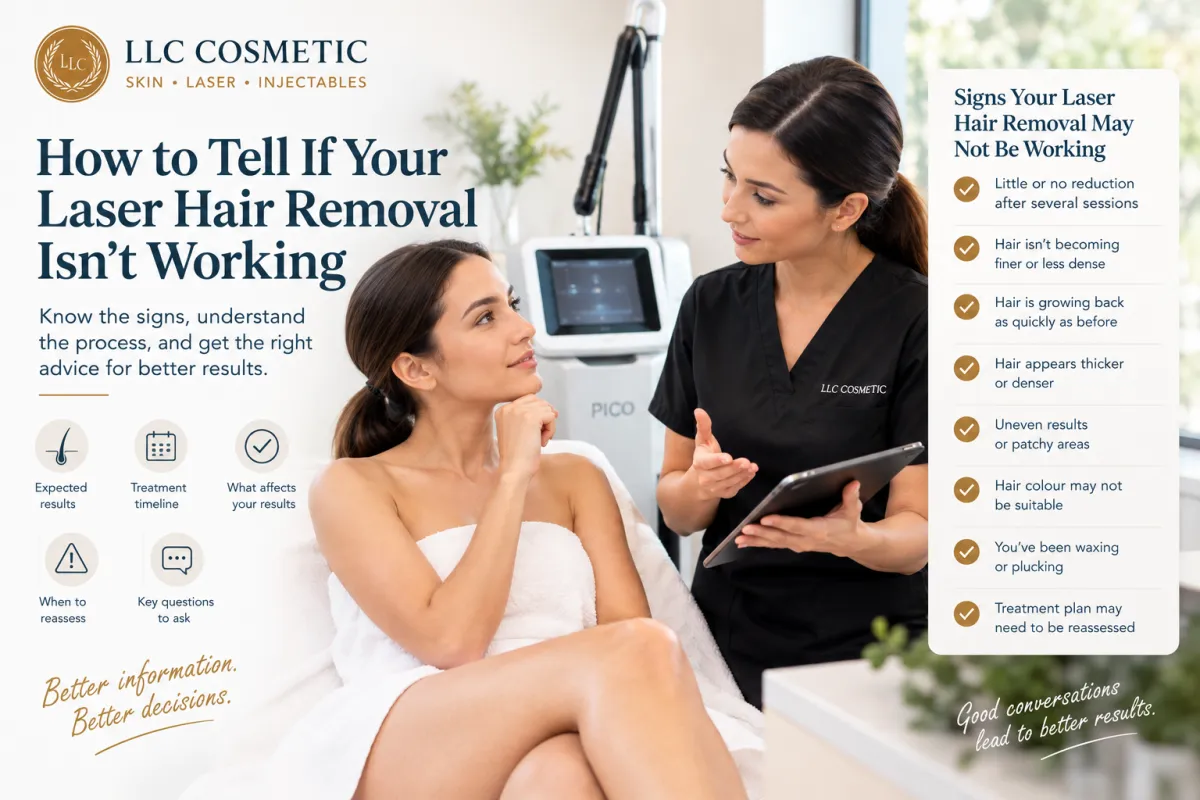
How to Tell If Your Laser Hair Removal Isn’t Working
Laser hair removal usually takes a series of treatments, so seeing some hair between appointments does not automatically mean the treatment has failed.
However, there are signs that your treatment may need to be reassessed.
If the hair is not becoming finer or less dense over time, you are seeing little or no reduction after several properly spaced sessions, or the treated area appears to be getting noticeably denser, it is worth speaking with your clinic.
This guide explains how to tell if your laser hair removal isn’t working, what can affect your results, and when you should ask your provider to review your treatment plan.
Key Takeaways
Laser hair removal usually requires multiple sessions rather than one treatment.
Some regrowth between sessions is normal.
Hair should generally become less dense, finer or slower-growing as treatment progresses.
Hair colour, thickness, skin tone, treatment settings and hair-growth cycle can affect results.
Blonde, white, grey and some red hairs can be difficult for laser to target because they contain less suitable pigment.
Shaving between treatments does not undo laser treatment, but waxing and plucking can interfere with the treatment process.
If there is little improvement after several sessions, your treatment plan should be reassessed.
Unexpectedly increased or thicker growth should be discussed with your provider.
What Should Laser Hair Removal Results Look Like?
Laser hair removal works by directing laser energy toward pigment in the hair and damaging the targeted follicle. Because hairs are not all in the same growth phase at the same time, a series of treatments is generally required.
The American Academy of Dermatology notes that many patients require multiple treatments, commonly around 2–6 sessions, and that results vary according to factors including hair colour and thickness, treatment area, laser type and skin colour.
A successful treatment course does not necessarily mean that every hair disappears permanently after a few appointments.
Instead, you may notice changes such as:
Less hair growing between appointments
Slower visible regrowth
Finer hairs
Less dense hair
Longer periods between shaving
Fewer ingrown hairs for some people
A gradual reduction in the amount of noticeable hair
The exact response varies between people.
1. You Are Seeing Hair Between Every Treatment
This is one of the most common reasons people wonder whether laser hair removal is working.
Seeing hair after a session does not necessarily mean the treatment has failed.
Hair grows through different phases, and laser is most effective when the targeted hair is in an appropriate growth phase. This is one reason treatments are spaced apart rather than performed every few days.
The AAD explains that the success of laser hair removal depends partly on where the hair is in its growth cycle.
So if you notice some regrowth after treatment, look at the overall trend rather than one appointment.
Ask yourself:
Is there less hair than before?
Is the hair becoming finer?
Is it taking longer to grow back?
Are you shaving less frequently?
If the answer is gradually becoming yes, the treatment may be producing the expected response even though some hair remains.
2. There Is Little or No Reduction After Several Sessions
A more important warning sign is when there is almost no noticeable change after multiple treatments.
If you have completed several appropriately spaced sessions and the treated area looks essentially the same as it did before starting, your clinic should review the situation.
Possible factors include:
Hair colour
Hair thickness
Skin tone
Treatment area
Hair-growth cycle
Laser technology
Treatment settings
Treatment intervals
Sun exposure or tanning
Whether the hair was waxed or plucked between sessions
Individual hormonal factors
Whether the treatment is appropriate for the specific hair characteristics
The AAD specifically recommends discussing expected results, number of treatments, potential side effects and individual suitability during consultation.
A lack of progress should therefore be investigated rather than simply assuming that you need to keep buying more sessions.
3. Your Hair Is Not Becoming Finer or Less Dense
One useful way to monitor laser hair removal is to compare the quality and density of regrowth over time.
If treatment is producing a response, you may eventually notice that remaining hairs are:
Finer
Less noticeable
Less dense
Slower to return
The AAD notes that after treatment, regrowth tends to be less noticeable, with hairs often becoming finer and lighter.
If your hair remains just as thick, dark and dense after multiple treatments, it may be appropriate to ask your provider to reassess the treatment settings, technique, timing or suitability.
4. You Are Treating Hair That the Laser Cannot Target Effectively
Hair colour matters.
Laser hair removal relies on pigment in the hair to absorb the laser energy. This means some hair colours are considerably harder to treat.
The AAD states that laser hair removal generally does not work effectively on blonde, white or grey hair because these hairs do not contain enough of the target pigment. Red hair can also be difficult to treat depending on its characteristics and the technology being used.
This is an important point if you have mixed hair colours.
For example, you might have:
Dark hairs that respond relatively well
Fine lighter hairs that remain
White or grey hairs that show little response
That does not necessarily mean the laser itself has failed.
It may mean that the remaining hairs are less suitable targets.
5. You Are Waxing or Plucking Between Sessions
Your hair-removal method between laser appointments can also matter.
Laser treatment targets the hair follicle, so repeatedly removing the hair from the root through waxing or plucking can interfere with the treatment process.
For many treatment plans, shaving is preferred between sessions because it leaves the follicle available for subsequent laser treatment.
LLC Cosmetic's current laser hair removal information recommends discussing preparation and treatment timing as part of an individual treatment plan. Its consultation process includes assessment of hair colour, thickness and density and discussion of realistic outcomes.
If you have been waxing or plucking throughout your course, tell your provider. They may recommend changing your hair-removal routine before continuing.
6. Your Treatment Schedule Is Not Appropriate
More treatments do not necessarily mean faster results.
Laser hair removal is generally performed as a series because hairs are at different stages of growth.
The AAD notes that many patients have treatments approximately every 4–6 weeks, although the appropriate interval varies between individuals and treatment areas.
Your provider may recommend a different schedule depending on:
Treatment area
Hair-growth pattern
Previous response
Hair thickness
Skin type
Treatment technology
If you are treating the area much more frequently than recommended, ask your provider whether the timing is appropriate.
7. Your Results Are Uneven
Another situation that can cause confusion is patchy hair reduction.
You might notice that one part of the treatment area responds much better than another.
For example:
The centre of an area has less hair
Some sections remain noticeably denser
Hair reduction occurs faster on one side
Certain patches continue growing
This does not automatically mean the treatment has failed.
Differences in hair density, hair-growth cycle and treatment coverage can contribute to uneven results.
Take photographs before and throughout your treatment course if your clinic recommends doing so. Consistent photographs can make gradual changes easier to recognise than relying entirely on memory.
LLC Cosmetic's current consultation process includes baseline photographs and assessment of hair characteristics to help establish realistic treatment expectations.
8. You Have Started Seeing More or Thicker Hair
If you believe your hair is becoming noticeably denser or thicker after treatment, don't simply continue with the same plan without discussing it.
There are situations in which increased or unexpected hair growth can occur, and the cause is not always obvious from looking at the skin alone.
LLC Cosmetic specifically recommends contacting the clinic if hair appears significantly denser after several treatments, becomes noticeably darker or thicker, grows outside the original treatment zone, or if you are concerned that treatment is making the problem worse.
This is particularly important when treating facial areas.
Rather than assuming the treatment is ineffective, ask for a reassessment.
9. Your Skin Tone or Recent Sun Exposure Is Affecting Treatment
Skin colour and recent tanning can affect laser treatment planning.
Laser energy interacts with pigment, so treatment settings need to be selected carefully according to the person's skin and hair characteristics.
The AAD advises avoiding tanning before laser hair removal and notes that the practitioner's experience with the patient's skin colouring is important.
If you have recently:
Tanned
Had significant sun exposure
Used a tanning bed
Used a self-tanner
tell your provider before treatment.
Do not assume that increasing laser intensity will automatically improve results.
The correct approach is to have your skin assessed and treatment settings selected appropriately.
10. You Are Expecting Permanent Hair Removal After One or Two Sessions
One of the biggest reasons people think laser hair removal isn't working is simply expecting results too quickly.
Laser hair removal is generally a progressive treatment.
The AAD says many patients require multiple treatments and may need maintenance treatments when hair regrows.
Your results may therefore look something like:
Early treatments:
Some reduction may become noticeable, but significant regrowth can still occur.
Middle of the treatment course:
Hair may become less dense and finer, with longer periods between shaving.
Later treatments:
The remaining hair may become increasingly sparse.
Maintenance:
Some people may require additional treatments as hair regrows.
The number of sessions varies. There is no reliable single number that applies to everyone.
What Can Make Laser Hair Removal Less Effective?
If your laser hair removal isn't producing the results you expected, several factors may be involved.
Hair colour
Dark, pigmented hair is generally easier for laser technology to target than very light hair.
Hair thickness
Hair characteristics can influence how the treatment responds.
Skin colour
Laser settings need to account for skin pigmentation and the specific technology being used.
Treatment area
Different body areas can respond differently.
Hair-growth cycle
Not every hair is in the same growth phase when you receive treatment.
Hormonal factors
Hormonal changes can influence hair growth, particularly in some facial areas.
Treatment settings
Laser wavelength, energy and other parameters need to be appropriate for the individual and device.
Treatment consistency
Skipping appointments or having sessions at unsuitable intervals can affect the overall treatment plan.
Hair removal between sessions
Waxing and plucking can interfere with targeting the follicle.
Sun exposure
Recent tanning can affect treatment safety and may require treatment to be postponed.
Individual response
Even when treatment is performed correctly, people can respond differently.
This is why a proper consultation and ongoing assessment matter.
How Many Laser Hair Removal Sessions Should You Have?
There isn't one universal number.
The AAD reports that many patients need multiple treatments, with its patient guidance giving a typical range of around 2–6 treatments, while its broader overview notes that some people require 6 or more sessions.
The variation exists because treatment response depends on individual factors.
Your provider should be able to explain:
Why a particular number of sessions is being recommended
How far apart sessions should be
What improvement you should reasonably expect
When progress should be reassessed
Whether maintenance treatments may be required
Be cautious about any clinic that promises exactly the same result or number of sessions for every person.
How to Track Whether Your Laser Hair Removal Is Working
Instead of judging your results immediately after every appointment, track your progress over time.
Take consistent photos
Photograph the same area under similar lighting and from a similar distance.
Record shaving frequency
If you previously shaved every day but now shave once or twice a week, that can be meaningful progress.
Look at hair density
Compare the number of visible hairs rather than focusing on one or two stubborn hairs.
Look at hair thickness
Are the remaining hairs finer than before?
Track regrowth speed
Does it take longer before you notice visible hair?
Keep your treatment history
Record:
Treatment date
Treatment area
Hair response
Skin response
Any unusual reactions
Changes in shaving frequency
This information can make your next consultation more useful.
When Should You Ask Your Laser Clinic to Reassess Your Treatment?
Consider contacting your provider if:
You have completed several sessions with little or no reduction.
Hair density has not changed.
Hair has not become finer.
Regrowth is happening just as quickly as before.
Hair appears noticeably thicker or darker.
You are experiencing unexpected increased growth.
You have had repeated skin reactions.
You have changed medications or skincare products.
You have recently developed significant hormonal changes.
Your results are substantially different from what was discussed during your consultation.
A reassessment doesn't necessarily mean that laser treatment has failed.
It gives the practitioner an opportunity to determine why your response may differ from expectations and whether your current treatment plan remains appropriate.
Questions to Ask Your Laser Technician
If you're concerned that your laser hair removal isn't working, ask:
Is my hair responding to the treatment?
Is the amount of regrowth I'm seeing normal at this stage?
Is my hair colour suitable for this laser?
Are my current treatment settings appropriate for my skin and hair?
Should my treatment interval be changed?
Could my hair-growth cycle be affecting the results?
Should I stop waxing or plucking between treatments?
Could hormonal factors be affecting my results?
How should we measure my progress?
When should we reassess if I am not seeing improvement?
Are there any risks associated with continuing treatment?
Is another hair-removal approach more appropriate for the remaining hair?
A reputable provider should be willing to explain the reasoning behind your treatment plan rather than simply recommending more sessions.
Is Laser Hair Removal Actually Permanent?
The terminology can be confusing.
Laser hair removal can produce long-term hair reduction, but it should not be presented as a guarantee that every hair will permanently disappear.
The AAD notes that many patients remain hair-free for months or even years after completing treatment, while some hair can regrow and maintenance treatments may be needed.
Hormonal factors can also influence regrowth, particularly on the face.
The more useful question is often:
“How much reduction can I reasonably expect, and how will we maintain the result?”
Your provider should be able to discuss this based on your individual hair and skin characteristics.
What If Laser Hair Removal Isn't Working for Me?
Don't automatically assume you need more sessions.
The first step should be understanding why you are not seeing the expected response.
Your clinic may review:
Your original treatment plan
Treatment intervals
Hair colour and thickness
Skin tone
Treatment area
Previous settings
Your response after each session
Hair-removal methods between treatments
Sun exposure
Possible hormonal influences
Whether the remaining hair is suitable for laser
Depending on the situation, the provider may recommend modifying the treatment approach, changing the schedule, continuing with appropriate treatment, or discussing another option.
Laser Hair Removal at LLC Cosmetic
LLC Cosmetic Laser Clinics currently offers laser hair removal across four Queensland locations: Brisbane CBD, Sunnybank, Southport and Robina.
Its current laser hair removal consultation process includes assessment of skin type, hair colour, thickness and density, discussion of treatment goals, baseline photographs and realistic expectations about the treatment timeline.
LLC Cosmetic also states that laser hair removal is available at its Southport and Robina clinics, with suitability assessed according to individual skin and hair characteristics.
If you are concerned that your laser hair removal isn't working, a consultation can help determine whether your current results are within the expected range or whether your treatment plan needs to be reviewed.
Final Thoughts
Knowing how to tell if your laser hair removal isn't working comes down to looking at your progress over time rather than judging one appointment.
Some regrowth is normal. A few stubborn hairs do not automatically mean treatment has failed.
However, if several appropriately spaced sessions have produced little reduction, your hair remains just as dense and coarse, or you are experiencing unexpected increased growth, it is reasonable to ask your provider for a reassessment.
The goal should not simply be to keep having treatments. It should be to understand whether the treatment is appropriate for your hair and skin, whether the plan is being adjusted appropriately, and what results you can realistically expect.
Frequently Asked Questions
How do I know if laser hair removal is working?
Look for gradual changes such as less dense hair, finer regrowth, slower growth and longer periods between shaving. Some regrowth between sessions is normal.
Why am I still growing hair after laser treatment?
Laser hair removal usually requires multiple treatments because hairs grow through different phases. Some follicles may not be in the ideal growth phase during a particular appointment.
How many sessions before I know laser hair removal isn't working?
There is no universal number. Many people require several treatments, and the response varies according to hair, skin, treatment area and technology. If you see little or no improvement over multiple sessions, ask your provider to reassess your plan.
Can blonde or grey hair be treated with laser?
Laser hair removal is generally much less effective on blonde, white and grey hair because these hairs contain little of the pigment needed for the laser to target effectively.
Can I wax between laser hair removal sessions?
Waxing or plucking removes hair from the follicle and may interfere with the treatment process. Ask your provider what hair-removal method they recommend between sessions.
Why is my hair thicker after laser hair removal?
If you notice clearly increased or thicker growth after treatment, contact your provider for an assessment. Unexpected hair growth should be evaluated rather than assuming that more treatments are automatically the answer.
Does laser hair removal work for every skin tone?
Laser hair removal can be performed safely on a range of skin tones when the appropriate technology, settings and precautions are used. Your provider should assess your individual skin and hair characteristics before treatment.
Should I stop laser hair removal if I'm not seeing results?
Not necessarily. First, ask your provider to assess your progress and determine why the response may be limited. Continuing, changing the treatment plan or considering another option depends on your individual circumstances.