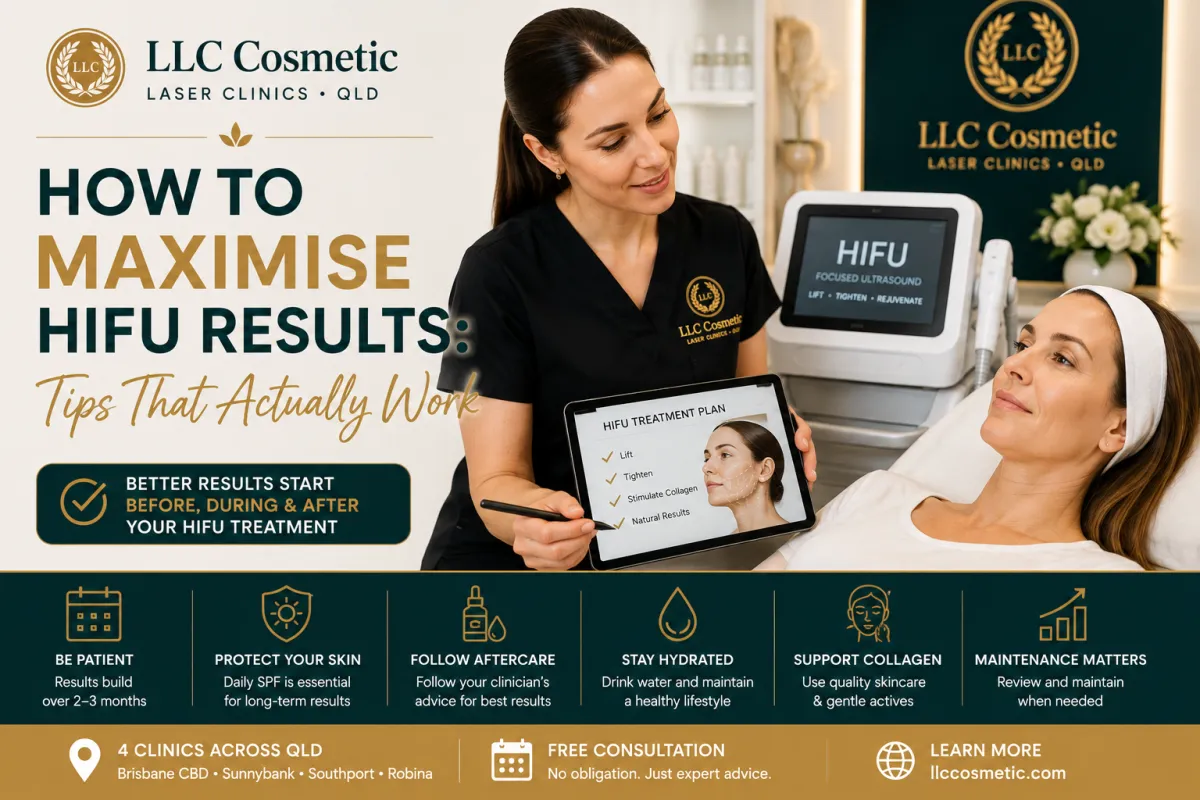
How to Maximise HIFU Results: Tips That Actually Work
If you have booked HIFU—or you are considering treatment—you may be wondering:
What can I do to maximise my HIFU results?
The honest answer is that there is no magic skincare product, supplement or at-home trick that can guarantee a dramatically better outcome.
However, there are practical things that can help you get the most realistic benefit from your treatment. These start with choosing the right treatment for your concerns, following your clinician's instructions and giving your skin time to respond.
Research on HIFU and microfocused ultrasound suggests that outcomes can vary depending on factors including patient selection, skin laxity, treatment protocols and device settings. Recent reviews also emphasise that optimising treatment protocols remains important.
So, if you want to know how to maximise HIFU results, focus on the things that actually matter.
Quick Answer: How Do You Maximise HIFU Results?
To get the most from HIFU:
Make sure HIFU is suitable for your concern
Choose an experienced clinic and appropriate technology
Follow your personalised treatment plan
Follow your clinician's aftercare instructions
Protect your skin from excessive sun exposure
Avoid expecting immediate final results
Give collagen remodelling time to develop
Maintain a stable, healthy lifestyle
Don't over-treat or chase results too quickly
Return for follow-up or maintenance when clinically appropriate
The biggest mistake is looking for a shortcut after treatment.
The best way to maximise HIFU results usually begins before the treatment even starts.
1. Start by Making Sure HIFU Is Actually Right for You
This is the most important step.
You can have access to an excellent HIFU machine and follow every aftercare instruction perfectly—but if HIFU is not the right treatment for your main concern, you may still be disappointed.
HIFU and related microfocused ultrasound technologies are generally used for non-surgical skin tightening and rejuvenation, particularly for mild to moderate facial laxity. Evidence reviews suggest outcomes may be more limited when skin laxity is more advanced.
Before treatment, a proper consultation should consider:
Your main skin concern
Your degree of skin laxity
Your facial anatomy
Your treatment goals
Your expectations
Your previous treatments
Whether another treatment may be more appropriate
The key principle:
The best way to maximise HIFU results is to start with the right indication.
If your main concern is significant skin laxity, deep volume loss, pigmentation or surface scarring, HIFU may not address every issue on its own.
2. Choose the Right Treatment Plan—Not Just the Cheapest Package
Not all HIFU treatments are planned in exactly the same way.
The treatment approach may vary depending on:
The device being used
The treatment area
The available treatment depths
The treatment protocol
The patient's individual characteristics
A 2025 systematic review of HIFU research highlighted protocol standardisation and patient selection as ongoing factors affecting how outcomes are optimised.
This means that choosing HIFU based only on a discounted price may not be the best strategy.
Instead, ask:
Why is this treatment plan recommended for me?
Which areas are being targeted?
What result is realistically expected?
Is one treatment sufficient for my goals?
When should my results be reviewed?
At LLC Cosmetic, the best place to start is a professional consultation so your treatment can be assessed against your individual concerns and goals.
LLC Cosmetic Laser Clinics QLD
3. Follow Your Clinician's Aftercare Instructions
Aftercare is not the same for every device, treatment plan or individual.
That's why the most important rule is:
Follow the instructions provided by your treating clinician.
Your clinician may provide specific guidance based on:
The technology used
The treatment area
Your skin condition
Any redness, tenderness or swelling
Other skincare products or treatments you use
Avoid relying entirely on random social media advice.
A TikTok or forum recommendation may not apply to:
Your HIFU technology
Your treatment settings
Your skin
Your medical history
Your recovery
If you are unsure about something after treatment, contact the clinic that treated you.
4. Protect Your Skin From Excessive Sun Exposure
Healthy skin management matters before and after aesthetic treatments.
While HIFU works differently from surface laser resurfacing, excessive UV exposure can contribute to skin ageing and photoageing, which may work against your broader skin-quality goals.
A practical long-term skin strategy includes discussing:
Daily sun protection
Appropriate skincare
Sun avoidance when advised
Your individual skin concerns
Think of it this way:
HIFU may be part of your skin-tightening strategy. It does not make your skin immune to ongoing environmental ageing.
If your clinician recommends a specific sun-protection routine, follow their advice.
5. Be Patient: HIFU Results Are Not Usually Immediate
This is one of the most important HIFU tips.
Many people judge their treatment too early.
Focused-ultrasound treatments are designed to produce biological changes that develop over time rather than delivering an instant surgical transformation.
Research evaluating microfocused ultrasound commonly measures improvement at later follow-up points, including around 90 days and beyond, and studies have reported continued improvement over longer follow-up periods.
So don't make the mistake of thinking:
"I don't see my final result after one week, so it didn't work."
Your timeline may vary.
The best person to explain your expected timeline is your treating clinician, based on the technology and treatment plan used.
6. Don't Compare Your Results Too Closely With Someone Else's
HIFU before-and-after images can be useful.
But they can also create unrealistic expectations.
Your outcome may differ because of:
Your starting level of skin laxity
Age-related skin changes
Facial anatomy
Treatment area
Device and protocol
Individual tissue response
Evidence reviews consistently show that HIFU outcomes are influenced by patient selection and treatment protocols, which is one reason identical results should not be expected from every person.
Instead of asking:
"Will I look exactly like this before-and-after?"
Ask:
"What improvement is realistic for my starting point?"
That is a much better conversation to have during your consultation.
7. Avoid Chasing Results With Too Much Treatment
More treatment is not automatically better.
If you are concerned that your results are developing slowly, don't immediately assume you need another treatment.
The right approach may depend on:
How long ago you were treated
Your expected result timeline
Your individual response
Your original treatment goal
Your clinician's assessment
A systematic review of HIFU research found that optimal treatment protocols remain an important area of investigation.
That is why a professional review is more useful than simply booking another treatment because you want faster results.
Don't chase results. Assess them properly.
8. Maintain a Stable and Healthy Lifestyle
HIFU is not a replacement for overall health or skincare.
For the best long-term approach to skin ageing, support your treatment with sensible lifestyle habits such as:
Staying well hydrated
Eating a balanced diet
Getting adequate sleep
Avoiding smoking
Managing excessive sun exposure
Maintaining a stable lifestyle
These habits cannot guarantee a specific HIFU result.
However, your skin continues to age after treatment, and lifestyle factors remain relevant to your overall skin health.
Think of HIFU as one component of a broader long-term aesthetic strategy.
9. Use Skincare That Supports Your Overall Goals
After HIFU, your skincare routine should be based on your individual skin needs and your clinician's advice.
Depending on your concerns, your broader skincare plan may focus on:
Hydration
Sun protection
Skin barrier support
Pigmentation management
Texture
Ageing prevention
But don't assume that adding more products automatically maximises HIFU.
Using multiple active ingredients without professional advice may cause irritation or simply create a complicated routine you cannot maintain.
The better approach is:
Use an appropriate skincare routine consistently.
Ask your clinician what products and ingredients are suitable for you after treatment.
10. Don't Smoke if You Want to Support Long-Term Skin Health
Smoking is associated with premature skin ageing and can affect skin health.
If your goal is to maintain a more youthful-looking appearance over the long term, avoiding smoking is a sensible part of a broader skin-health strategy.
This is bigger than HIFU.
No single aesthetic treatment can completely counteract ongoing lifestyle factors that contribute to visible ageing.
11. Manage Your Expectations Before Treatment
This may not sound like a "tip," but it can make a major difference to how satisfied you are with your result.
HIFU is a non-surgical treatment.
It should not be marketed as though every patient will receive a surgical facelift result.
Systematic reviews have generally found HIFU and microfocused ultrasound to be useful for non-surgical skin tightening, but outcomes are variable and research continues to examine optimal patient selection and protocols.
A good consultation should answer:
What can HIFU realistically improve?
What is unlikely to change?
When might I see results?
What are the limitations?
Are other treatments more appropriate?
The right expectations can be just as important as the right technology.
12. Attend Your Follow-Up if Recommended
If your clinic recommends a review appointment, attend it.
A follow-up gives your clinician an opportunity to assess:
How your skin has responded
Whether results are developing as expected
Whether your original concerns have improved
Whether further treatment is appropriate
This is more useful than trying to judge progress based on different bathroom mirrors and random photos taken under different lighting.
For a better comparison, before-and-after photos should ideally be assessed with:
Similar lighting
Similar facial position
Similar camera distance
Similar angles
Appropriate time between images
What Can Reduce or Limit HIFU Results?
Several factors may affect whether someone achieves the result they were hoping for.
1. HIFU was not the right treatment
The technology may not address the person's primary concern.
2. Expectations were too high
Non-surgical tightening may not create a dramatic surgical result.
3. The skin laxity was too advanced
Research suggests that patient selection and the severity of laxity can influence outcomes.
4. Results were judged too early
Treatment effects may develop over time.
5. The treatment plan was not appropriate
Device settings and treatment protocols are important variables in HIFU research.
6. The person expects HIFU to solve every skin concern
HIFU primarily targets tightening and lifting concerns. Other issues may require different treatment approaches.
Can You Improve HIFU Results With Supplements?
There is a lot of online marketing around:
Collagen supplements
Vitamins
Protein powders
"Skin boosters"
Anti-ageing supplements
However, you should be cautious about claims that a particular supplement will guarantee better HIFU results.
Current HIFU evidence focuses primarily on the technology, treatment protocols and patient outcomes—not on proving that a specific supplement can reliably multiply HIFU results.
A healthy diet may support overall wellbeing, but don't buy an expensive supplement package solely because someone promises it will dramatically improve your treatment outcome.
If you have questions about supplements, medications or your treatment, speak with an appropriately qualified healthcare professional.
How Long Do HIFU Results Take to Develop?
The exact timeline depends on the technology, treatment area and individual response.
Studies commonly evaluate microfocused ultrasound outcomes at around 90 days, with some evidence showing continued changes over longer follow-up periods.
The important point is:
Do not judge your final result immediately after treatment.
Your treating clinician should explain what timeline is appropriate for your specific treatment.
How Long Do HIFU Results Last?
There is no single answer for everyone.
Longevity can vary depending on:
Age
Skin condition
Degree of laxity
Treatment area
Lifestyle
Natural ageing
Individual response
Technology and treatment plan
Research has reported improvement continuing for months in some patients, although longer-term evidence remains an area where further research is needed.
Instead of looking for a universal number, ask your clinician:
"Based on my treatment and goals, when should I realistically consider a review?"
Should You Have More Than One HIFU Treatment?
Possibly—but not automatically.
The answer depends on:
Your treatment goal
The technology used
Your starting point
Your response
The treatment protocol recommended by your clinician
Don't assume that a second treatment is necessary simply because you have seen a package advertised online.
Your treatment plan should be based on your individual assessment.
The Best Way to Maximise HIFU Results: A Simple Checklist
Before treatment:
✓ Get a proper assessment
Make sure HIFU is appropriate for your concern.
✓ Ask about realistic outcomes
Understand what HIFU can—and cannot—do.
✓ Ask about your expected timeline
Don't expect final results immediately.
✓ Understand your treatment plan
Know what is being treated and why.
After treatment:
✓ Follow your clinician's instructions
Your individual aftercare matters more than generic internet advice.
✓ Protect your skin
Follow appropriate sun-protection advice.
✓ Give your results time to develop
Don't judge the final outcome too early.
✓ Maintain sensible long-term skin habits
Think beyond one treatment.
✓ Attend your review if recommended
Assess your results with your clinician.
How LLC Cosmetic Can Help You Get a Realistic HIFU Treatment Plan
If you're considering HIFU, the first step should not be choosing the cheapest package.
It should be understanding whether the treatment is suitable for your level of skin laxity, concerns and goals.
At LLC Cosmetic, you can start by discussing your concerns with the clinic team and exploring whether HIFU is an appropriate option for your treatment goals.
The most effective HIFU strategy is not:
“Do as much as possible.”
It is:
“Choose the right treatment, use an appropriate plan and give your skin time to respond.”
Ready to Explore HIFU?
If you're looking at HIFU for skin tightening or facial rejuvenation, start with a professional assessment.
Ask the questions that matter:
Is HIFU right for my concern?
What result is realistic?
When should I expect to see changes?
What should I do after treatment?
How will my results be reviewed?
A personalised treatment plan is more valuable than a generic promise of instant results.
Explore HIFU and consultation options at LLC Cosmetic
Frequently Asked Questions
How can I maximise my HIFU results?
Start with a proper suitability assessment, follow your clinician's treatment and aftercare instructions, protect your skin, maintain realistic expectations and give results time to develop.
What should I avoid after HIFU?
Follow the specific aftercare instructions provided by your treating clinician. Avoid relying on generic online advice because recommendations may vary depending on the device, treatment area and your individual circumstances.
Does drinking water improve HIFU results?
Staying adequately hydrated supports general health, but there is no strong evidence that simply drinking extra water guarantees significantly better HIFU results.
Do collagen supplements improve HIFU results?
There is no strong evidence that a specific collagen supplement can reliably or dramatically increase HIFU treatment outcomes. Be cautious about products that promise guaranteed results.
How long does HIFU take to work?
Results can develop gradually. Clinical studies commonly assess outcomes at approximately 90 days, with some studies reporting continued improvement over longer follow-up periods.
Can I get another HIFU treatment if I don't see results immediately?
Don't rush into another treatment. First, discuss your result timeline and response with your treating clinician.
Does HIFU work better for mild or severe skin laxity?
Research suggests that patient selection and the degree of skin laxity can influence outcomes, with microfocused ultrasound generally showing more useful results for mild to moderate facial laxity.
Medical Disclaimer
This article is for general educational purposes only and does not constitute medical advice, diagnosis or treatment recommendations. HIFU suitability, treatment protocols, risks, recovery and results vary between individuals. Always follow the advice and aftercare instructions provided by your treating clinician.