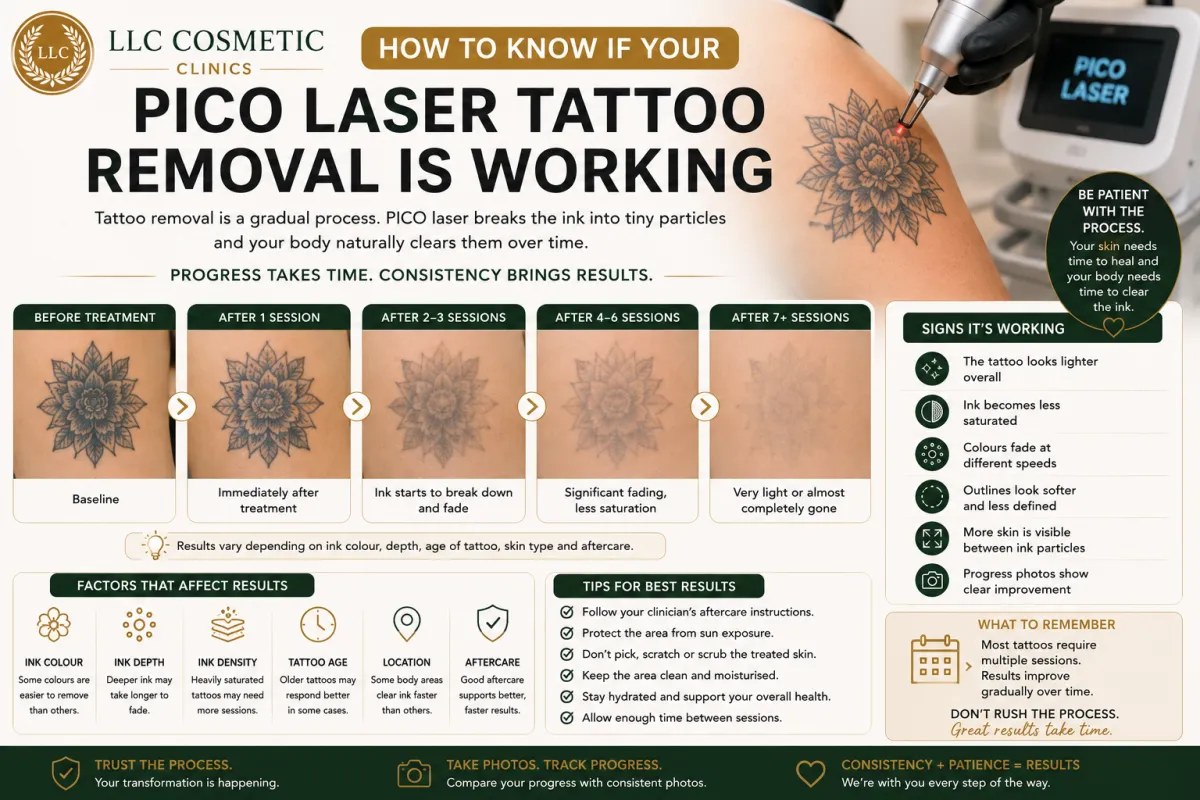
How to Know If Your PICO Laser Tattoo Removal Is Working
If you've started PICO laser tattoo removal, you may be wondering:
“How do I know if it's actually working?”
The answer isn't always obvious immediately after treatment.
PICO laser tattoo removal is a gradual process. The laser breaks tattoo pigment into smaller particles, and your body then works to clear those particles over time. Because of this, the tattoo may continue changing for weeks after each session rather than disappearing immediately.
You may notice the tattoo becoming lighter, certain colours fading faster than others, or previously hidden colours becoming more noticeable.
Here's what to look for.
PICO Laser Tattoo Removal: The Quick Answer
Signs that your tattoo removal may be progressing include:
The tattoo looks lighter than before
Black or dark areas become less intense
Individual sections of the tattoo begin fading
Some colours disappear faster than others
Previously dense areas become less saturated
The tattoo becomes less visible from a normal viewing distance
Your clinician can see measurable improvement in treatment photos
Don't expect the tattoo to disappear immediately after a session.
Research on picosecond tattoo removal shows that multiple treatments are commonly required, and improvement can continue between sessions. In one systematic review, the included human studies reported more than 70% pigment clearance in 69–100% of tattoos after 1–10 treatments, although the evidence varied considerably between studies.
1. Your Tattoo Starts Looking Lighter
One of the simplest signs is also one of the most important:
The tattoo gradually becomes less intense.
A solid black tattoo might begin looking more grey.
A dark blue tattoo may become less saturated.
Coloured sections may gradually lose their intensity.
Don't expect the change to happen overnight.
Instead, compare the tattoo with how it looked before your treatment course began.
2. Different Parts of the Tattoo Fade at Different Speeds
This is completely possible.
A multicoloured tattoo isn't necessarily going to fade evenly.
For example, you might notice:
Black areas: becoming lighter relatively quickly.
Blue areas: gradually losing their intensity.
Green areas: taking longer to respond.
Yellow areas: remaining visible after other colours have faded.
This happens because different tattoo pigments interact differently with laser wavelengths.
A systematic review comparing tattoo-removal lasers found that picosecond lasers showed particular advantages for blue, green and yellow pigments, while both picosecond and Q-switched lasers were effective for black tattoos.
So don't assume your treatment isn't working simply because one colour hasn't changed as much as another.
3. The Tattoo May Look Different Before It Looks Lighter
Immediately after treatment, the treated area can look different because of the normal skin response to laser treatment.
Depending on the treatment, you may experience:
Redness
Swelling
Sensitivity
Temporary whitening or frosting of the treated area
Small blisters
Crusting
These reactions aren't the same thing as long-term tattoo fading.
The important comparison is how the tattoo looks after the skin has settled and over the weeks that follow.
4. Take Photos to Track Your Progress
One of the best ways to determine whether your PICO tattoo removal is working is to take consistent photographs.
Your memory isn't always reliable when changes happen gradually.
Take a photo:
Before your first treatment
Then take additional photos at consistent intervals recommended by your clinic.
Try to keep these factors the same:
Lighting
Camera
Distance
Angle
Body position
Background
This makes subtle changes easier to see.
Professional clinical studies also use standardised photographs to assess tattoo clearance over time.
5. Compare the Tattoo With Your Original Photograph
Don't compare today's tattoo only with how it looked last week.
Instead, compare it with your baseline photograph.
For example:
Before treatment:
The tattoo appears dark and heavily saturated.
After several weeks:
Some areas appear lighter.
After another treatment:
The remaining pigment becomes less dense.
Later in the treatment course:
The tattoo may appear significantly lighter overall.
This gradual progression can be easier to see when you compare photographs side by side.
6. You May Need More Than One Treatment
One of the biggest misconceptions about tattoo removal is expecting one laser session to remove the tattoo.
That's usually unrealistic.
Laser tattoo removal commonly requires multiple sessions.
In a prospective study of picosecond laser tattoo treatment, 75% of patients who completed the study achieved more than 75% clearance after 2–4 treatments, with an average of 4.25 sessions needed to reach that level of clearance.
However, this does not mean you will need exactly four sessions.
Your treatment requirements can be very different depending on:
Tattoo colour
Ink density
Tattoo depth
Tattoo size
Tattoo location
Age of the tattoo
Professional versus amateur tattoo
Your skin type
Laser wavelength
Treatment settings
Your individual response
7. Your Tattoo Can Continue Fading Between Sessions
This is an important point.
Your PICO laser session is not necessarily the end of the process for that appointment.
The laser breaks pigment into smaller particles, and your body gradually clears the fragmented pigment.
That means you may continue noticing changes after you've left the clinic.
The fading process can therefore be gradual rather than immediate.
This is one reason clinicians normally allow time between treatments rather than repeatedly treating the same area too soon.
8. Some Colours May Take Longer Than Others
If you have a multicoloured tattoo, don't expect every colour to disappear at the same rate.
Some pigments can be more difficult to treat.
Research has shown promising results with picosecond lasers for several colours, but response varies according to pigment and wavelength.
This means your tattoo could look something like:
Stage 1: Black areas begin fading.
Stage 2: Blue and other darker colours become less intense.
Stage 3: More stubborn colours remain.
Stage 4: Further treatments target the remaining pigment.
The exact sequence will vary from tattoo to tattoo.
9. A Previously Hidden Colour May Become Visible
This can sometimes be surprising.
As darker pigment fades, another colour underneath may become more obvious.
For example, a tattoo may initially look predominantly dark, but after treatment, orange or another underlying pigment may become more noticeable.
This phenomenon has been documented in cosmetic tattoo removal. A 2023 retrospective study found unexpected colour changes after initial picosecond treatment in some patients, including unmasking of orange pigment.
This doesn't automatically mean your treatment has failed.
It can mean that another pigment has become visible as the surrounding or overlying pigment fades.
Your clinician can assess the remaining colour and determine whether a different wavelength or treatment approach is appropriate.
10. The Tattoo May Become Less Saturated
Another sign of progress is a change in ink density.
Instead of seeing a solid block of colour, you may begin noticing:
Lighter areas
More visible skin between pigment particles
Less intense outlines
Patchier pigment
Reduced overall contrast
This can be particularly noticeable with heavily saturated tattoos.
The tattoo may still be clearly visible, but it can look significantly less dense than it did before treatment.
11. Don't Judge Your Results Too Soon
This is one of the most important points.
If you've just had PICO laser tattoo removal and the tattoo doesn't look dramatically different, don't immediately assume it hasn't worked.
Your skin needs time to recover, and pigment clearance happens progressively.
Clinical studies evaluate tattoo clearance at follow-up points rather than assuming the immediate post-treatment appearance represents the final result.
Give your skin the recovery period recommended by your treating clinician before judging the outcome.
What If My Tattoo Isn't Fading?
If you've completed several treatments and you're seeing little or no change, don't simply assume you need stronger treatment.
There could be several explanations.
The pigment may be difficult to treat
Some colours and pigment formulations respond more slowly.
The wavelength may not be ideal
Different pigments absorb different wavelengths.
The ink may be very dense
Heavily saturated professional tattoos can require more treatments.
The pigment may be deep
Deeper pigment can take longer to clear.
Your treatment intervals may matter
Your body needs time to process fragmented pigment.
The tattoo may contain unusual pigments
Some cosmetic and tattoo pigments can behave unpredictably during laser treatment.
A qualified clinician should reassess the tattoo rather than simply increasing treatment intensity without considering the bigger picture.
What Does Successful PICO Tattoo Removal Look Like?
Success doesn't necessarily mean 100% invisible skin.
Depending on your goals, success could mean:
Significant fading:
The tattoo is much lighter and less noticeable.
Near-complete removal:
Only minimal residual pigment remains.
Cover-up preparation:
The tattoo has faded sufficiently for another tattoo to be placed over it.
Partial removal:
Specific sections or elements have been significantly faded.
Complete removal isn't guaranteed, and the final result varies between tattoos.
How Many PICO Laser Sessions Will You Need?
There's no universal number.
Some tattoos may respond relatively quickly, while others require a longer treatment course.
A systematic review of picosecond tattoo removal found that the studies included between 1 and 10 treatments, demonstrating how widely treatment requirements can vary.
More recent research continues to show that picosecond lasers can be effective, but outcomes depend on the tattoo type and treatment protocol.
Your clinician should therefore provide an estimated treatment pathway, not a guaranteed number of sessions.
How Can You Track Your PICO Tattoo Removal Progress?
A simple progress routine can make a big difference.
Step 1: Take a baseline photo
Take a clear photograph before your first treatment.
Step 2: Follow your clinic's aftercare instructions
Don't pick, scratch or aggressively treat the area.
Step 3: Wait for the recommended recovery period
Don't judge the final response immediately after treatment.
Step 4: Take consistent progress photos
Use similar lighting, distance and camera settings.
Step 5: Compare against your baseline
Look for changes in colour intensity and pigment density.
Step 6: Discuss the results with your clinician
Your provider can determine whether the treatment is progressing as expected and whether the treatment plan should be adjusted.
When Should You Contact Your Clinic?
Some temporary redness, swelling, tenderness or other skin reactions can occur after laser tattoo removal.
However, contact your clinic if you're concerned about a reaction or if symptoms are worsening rather than improving.
Seek appropriate medical attention for significant or rapidly worsening symptoms such as:
Severe or increasing pain
Spreading redness
Significant swelling
Pus or unusual drainage
Fever
Signs of infection
Unexpected or severe skin changes
Don't rely solely on online information when you're experiencing a concerning reaction.
PICO Laser Tattoo Removal: What Progress Really Looks Like
The biggest thing to remember is that tattoo removal is a process, not an instant result.
Your tattoo may gradually become:
Lighter
Less saturated
Less defined
More patchy
Less noticeable
Different colours may respond at different rates, and some tattoos require considerably more treatments than others.
Research supports the effectiveness of picosecond lasers for tattoo removal, but it also shows that outcomes vary and multiple treatments are commonly needed.
So if you're wondering whether your PICO laser tattoo removal is working, don't judge it by what you see immediately after one appointment.
Take consistent photos, give your skin time to recover, compare your progress with your baseline, and let your clinician assess the response between treatments.
That's a much more reliable way to understand your results.