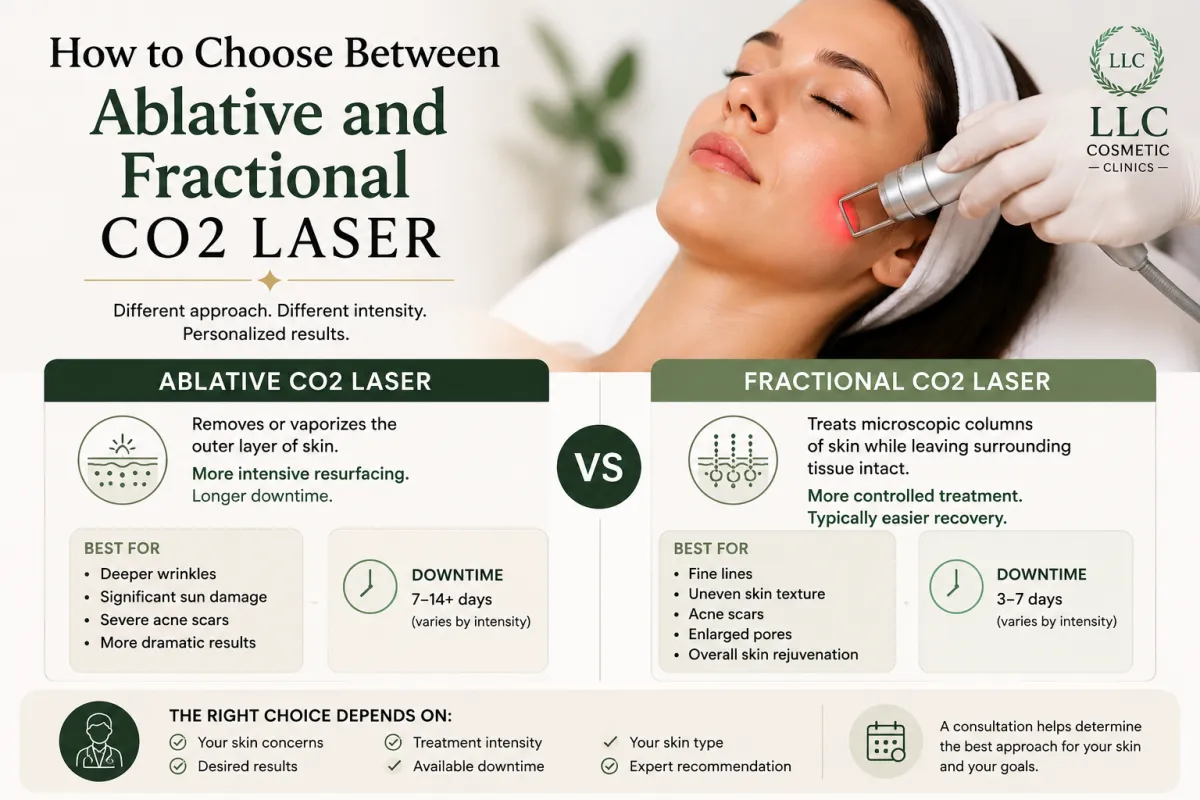
How to Choose Between Ablative and Fractional CO2 Laser
If you're considering CO2 laser resurfacing, you may come across terms such as ablative CO2 laser and fractional CO2 laser.
It can be confusing because these terms don't always describe completely separate treatments.
In fact, “ablative” and “fractional” refer to different aspects of how a laser treatment works. A CO2 laser can be ablative and fractional at the same time.
So, how do you choose the right approach?
The decision usually depends on your skin concerns, desired level of resurfacing, treatment intensity, recovery time and your practitioner's assessment.
Ablative vs Fractional CO2 Laser: The Quick Answer
Here's a simple way to understand the difference:
Ablative CO2
Removes or vaporises targeted layers of skin.
More intensive resurfacing may involve more downtime.
Fractional CO2
Treats microscopic columns of skin while leaving surrounding tissue untreated.
This can allow for a more controlled treatment and potentially easier recovery.
Fractional Ablative CO2
Uses an ablative CO2 laser in a fractional pattern.
It combines tissue removal with fractional treatment delivery.
Fully Ablative CO2
Treats a much broader area continuously.
It is generally more intensive and may require significant recovery.
The right choice isn't simply “stronger is better.”
The appropriate treatment depends on what you're trying to improve, the treatment intensity required, and how much downtime is reasonable for you.
What Does “Ablative” CO2 Laser Mean?
An ablative laser removes or vaporises controlled portions of the skin's surface.
With CO2 laser resurfacing, this can create a more significant resurfacing effect.
Depending on the treatment settings and technique, ablative resurfacing may be considered for concerns such as:
Significant skin texture changes
Certain types of scarring
Fine lines and wrinkles
Uneven skin surface
More pronounced signs of photodamage
Because the treatment can be more intensive, recovery may also be more involved.
What Does “Fractional” CO2 Laser Mean?
Fractional treatment means the laser doesn't necessarily treat every part of the skin surface continuously.
Instead, energy is delivered in microscopic treatment zones, leaving surrounding areas untreated.
The untreated skin between these zones can help support the healing process.
Fractional CO2 laser may be used when a practitioner wants to address concerns such as:
Uneven skin texture
Fine lines
Acne scarring
Enlarged-looking pores
Photodamage
Overall skin resurfacing
The intensity can vary considerably depending on the laser settings and treatment plan.
Is Fractional CO2 Less Powerful?
Not necessarily.
This is an important distinction.
Fractional doesn't automatically mean mild.
A fractional CO2 treatment can still be an ablative treatment and can be performed at different levels of intensity.
The outcome depends on factors such as:
Laser settings
Treatment density
Treatment depth
Number of passes
Treatment area
Individual skin characteristics
The practitioner's technique
Therefore, comparing treatments simply as “ablative vs fractional” can be misleading.
Which CO2 Laser Has More Downtime?
Generally, a more intensive resurfacing treatment can involve more visible healing and downtime.
A fully ablative treatment may require a more significant recovery period than a lighter fractional approach.
However, there isn't one fixed recovery time for every CO2 laser treatment.
Your recovery can depend on the intensity and settings used, as well as your individual healing response.
Your practitioner should explain the expected recovery before treatment.
Which Is Better for Acne Scars?
CO2 laser resurfacing can be considered for certain types of acne scarring, but not every scar responds the same way.
The type, depth and characteristics of the scar matter.
A practitioner may recommend fractional resurfacing for some acne-scar concerns because it can target areas of uneven texture while leaving surrounding skin untreated.
However, acne scars can sometimes require a combination of approaches rather than one treatment alone.
A consultation is important before deciding which treatment is appropriate.
Which Is Better for Fine Lines and Wrinkles?
CO2 laser resurfacing can improve the appearance of certain fine lines and signs of photoageing.
A practitioner may adjust the treatment intensity depending on:
Severity of the lines
Location
Skin condition
Desired results
Acceptable downtime
A more aggressive treatment isn't automatically the best choice.
The goal should be to achieve an appropriate level of resurfacing while considering your individual circumstances.
What About Skin Texture and Enlarged Pores?
If your primary concern is rough or uneven skin texture, fractional CO2 resurfacing may be one option your practitioner considers.
The treatment can create controlled areas of injury that stimulate a healing response and subsequent skin remodelling.
However, enlarged-looking pores can have multiple contributing factors, so CO2 laser isn't necessarily the answer for everyone.
How Do You Choose the Right Treatment?
Instead of starting with the question:
“Which CO2 laser is stronger?”
Start with:
“What am I actually trying to improve?”
Consider these factors:
1. Your main skin concern
Are you primarily concerned about:
Acne scars?
Fine lines?
Uneven texture?
Sun damage?
Skin laxity?
Overall resurfacing?
Different concerns may call for different treatment strategies.
2. Your desired level of resurfacing
A practitioner can determine how much resurfacing may be appropriate for your skin and goals.
3. Your available downtime
Consider your work, social commitments and upcoming events.
A more intensive treatment may require more time for visible recovery.
4. Your skin characteristics
Your practitioner should assess your skin before recommending treatment.
5. Your expectations
CO2 laser can improve the appearance of various skin concerns, but it isn't a guarantee of perfect or permanent skin.
Is Fractional CO2 Safer Than Fully Ablative CO2?
It's better not to describe one approach as universally “safer.”
Both treatments require appropriate patient selection, settings and professional technique.
Fractional treatment can leave untreated areas between treatment zones, which may influence the healing process, but fractional does not mean risk-free.
Potential side effects and recovery requirements should be discussed during your consultation.
Can You Have Different CO2 Laser Settings?
Yes.
CO2 laser treatments can be customised using different settings and treatment parameters.
This means two people can receive “fractional CO2 laser” while having quite different treatment experiences.
The treatment may differ in:
Depth
Density
Energy
Coverage
Number of passes
This is another reason why comparing treatments solely by their names can be confusing.
What Should You Ask During Your Consultation?
Before booking CO2 laser resurfacing, consider asking:
Is my treatment fully ablative or fractional?
If fractional, is it ablative fractional CO2?
What skin concern are we treating?
How intensive will the treatment be?
What downtime should I realistically expect?
What results are realistic for my skin?
What are the possible risks and side effects?
What aftercare will I need?
Are there reasons I may not be suitable for this treatment?
These questions can help you understand what you're actually being offered.
Ablative vs Fractional CO2: There Isn't One Winner
The biggest mistake is assuming that one treatment is automatically better.
A more intensive treatment may be appropriate for one person but unnecessary for another.
Likewise, a fractional approach may be a better fit when someone wants targeted resurfacing with a different recovery profile.
The best treatment is the one that matches your skin concerns, treatment goals and individual circumstances.
Final Takeaway
If you're wondering how to choose between ablative and fractional CO2 laser, don't focus only on which treatment sounds more powerful.
First identify what you want to improve, then consider the level of resurfacing required and how much recovery time you can realistically accommodate.
Most importantly, remember that “ablative” and “fractional” aren't always opposites. A treatment can be fractional ablative CO2, so it's important to ask your practitioner exactly what technology and treatment settings are being proposed.
At LLC Cosmetic, a consultation can help determine which treatment approach may be appropriate for your skin concerns and goals.