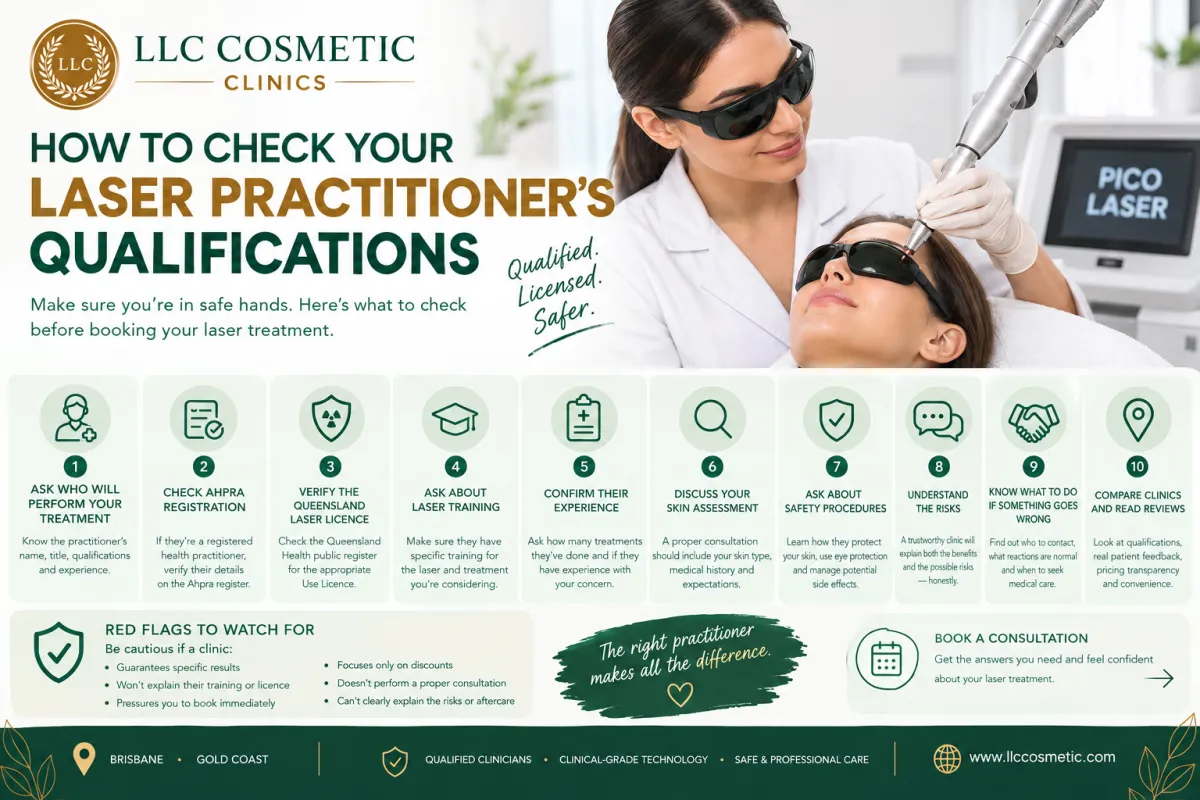
How to Check Your Laser Practitioner’s Qualifications
Choosing a laser clinic is about more than finding a convenient location or the cheapest treatment.
If you're considering laser hair reduction, pigmentation treatment, skin rejuvenation or tattoo removal, one of the most important questions to ask is:
How do you check your laser practitioner's qualifications?
The answer depends on what type of practitioner is performing your treatment and where you live. In Queensland, there are specific licensing requirements for people using certain cosmetic laser equipment.
A few minutes of checking can help you understand who is treating you, whether they hold the relevant registration or licence, and whether the clinic has appropriate safety processes in place.
Why Your Laser Practitioner's Qualifications Matter
Laser treatments involve concentrated energy and need to be selected and performed appropriately for the individual.
The wrong treatment or settings can potentially result in unwanted effects such as burns, pigmentation changes, irritation, eye injury or scarring.
Qualifications and licensing don't guarantee a particular result, but they are an important part of choosing a practitioner who has the appropriate training and regulatory requirements for the procedure.
In Queensland, people using Class 4 laser apparatus for cosmetic purposes need an appropriate Use Licence. Queensland Health says this licensing process includes laser safety and infection-control training, as well as competency requirements.
Step 1: Ask Who Will Actually Perform Your Treatment
Don't assume that the person conducting your consultation is the same person who will perform the laser procedure.
Before booking, ask:
"Who will be performing my laser treatment?"
Then ask for their:
Full name
Professional title
Relevant qualifications
Laser training
Experience with the specific treatment
Registration details, if applicable
Queensland laser Use Licence details, where required
A reputable clinic should be comfortable answering reasonable questions about practitioner qualifications and safety.
Step 2: Check Their Ahpra Registration If They Are a Registered Health Practitioner
If your practitioner tells you they are a nurse, medical practitioner or another Ahpra-registered health practitioner, you can check their registration through the Australian Health Practitioner Regulation Agency.
The Ahpra public register provides current registration information for registered health practitioners in Australia. It can show registration status and other information, including conditions or restrictions where applicable.
Check the Ahpra Register of Practitioners
What Should You Look For?
When checking the register, make sure the details match the person you are dealing with.
Look for:
Correct name
Profession
Current registration status
Registration number
Any conditions or restrictions
Other publicly available registration information
Ahpra recommends using the online register rather than relying on an old printed registration certificate because the online register is continuously updated.
Step 3: Don't Assume Ahpra Registration Is the Same as a Laser Licence
This is an important distinction.
Someone may be a registered nurse or medical practitioner, but that doesn't automatically tell you everything about their training or authorisation to perform a particular cosmetic laser procedure.
In Queensland, cosmetic laser use has its own radiation licensing requirements.
Queensland Health states that people using Class 4 laser apparatus for cosmetic services must hold an appropriate Use Licence. Cosmetic laser services covered by the licensing system include hair reduction, skin rejuvenation, capillary reduction and tattoo removal.
So you can think about the checks as two separate questions:
Is this person appropriately registered as a health practitioner, where applicable?
And:
Are they appropriately licensed and trained to use the laser for the procedure being performed?
Both questions can matter.
Step 4: Check the Queensland Radiation Licence
Queensland Health provides a Public Register where you can search radiation licence or certificate details for individuals and corporations.
The register can provide information such as:
Name
Licence or certificate number
Type of licence
Expiry date
Conditions attached to the licence
This is particularly useful if you're having a cosmetic laser procedure in Queensland.
Queensland Health Radiation Licence Public Register information
Step 5: Ask What Type of Laser Training They Have Completed
A generic statement such as "I'm laser trained" doesn't tell you very much.
Laser technology varies considerably.
Ask whether the practitioner has specific training relevant to the treatment you are considering.
For example:
"Have you been specifically trained to perform tattoo removal with this type of laser?"
Or:
"What training have you completed for this laser and this particular treatment?"
Queensland Health's cosmetic laser licensing requirements include theoretical and practical training and competency in safely using the relevant radiation source and procedure.
Queensland Health also states that approved cosmetic laser training should cover areas such as radiation risks, appropriate operating settings, safety measures, tools for assessing clients, and recognising and responding to incidents.
Step 6: Ask About Their Experience With Your Specific Treatment
Qualifications are important, but so is relevant experience.
A practitioner may have laser experience without necessarily having extensive experience with the exact procedure you're considering.
For example, ask:
How long have you performed this treatment?
How frequently do you perform it?
Have you treated people with similar skin characteristics?
How do you determine the appropriate settings?
What results should I realistically expect?
What are the potential risks?
What happens if my skin reacts unexpectedly?
A good consultation shouldn't feel like a sales pitch.
It should feel like an opportunity to determine whether the treatment is appropriate for you.
Step 7: Ask How They Assess Your Skin Before Treatment
A qualified practitioner shouldn't simply look at you and immediately start the laser.
The assessment should take into account the treatment area and your individual circumstances.
Depending on the procedure, this may include discussing:
Skin characteristics
Previous treatments
Current skincare
Medications
Recent sun exposure or tanning
Previous reactions to laser
Medical history where relevant
Previous scarring or pigmentation concerns
The specific concern being treated
Queensland Health's approved training information specifically highlights the importance of determining appropriate operating settings for individual clients and assessing treatment results.
Step 8: Ask About Safety Procedures
Don't be afraid to ask how the clinic manages laser safety.
For example:
"What eye protection is used during treatment?"
"How do you protect the surrounding skin?"
"What happens if I experience a reaction?"
"Who is responsible for radiation safety at the clinic?"
Queensland Health requires cosmetic laser businesses to meet radiation safety requirements. Possession licensees also have responsibilities involving radiation safety and protection plans, radiation equipment and premises compliance, and appointing a Radiation Safety Officer.
These aren't simply administrative details. They are part of the clinic's overall safety framework.
Step 9: Check Whether the Clinic Can Explain the Risks Honestly
Be cautious if a practitioner tells you that laser treatment is:
Completely risk-free
Guaranteed to work
Suitable for absolutely everyone
Guaranteed to produce a specific result
Guaranteed to cause no downtime or side effects
Every treatment has limitations.
A trustworthy practitioner should be willing to explain both the potential benefits and the potential risks.
They should also tell you when a particular treatment may not be appropriate.
Step 10: Ask What Happens If Something Goes Wrong
This is a question many people forget to ask.
Before treatment, you can ask:
"If I experience a significant reaction after treatment, who should I contact?"
You should know:
Who to contact after your appointment
What reactions are considered expected
What symptoms require urgent attention
Whether follow-up is available
When you should seek medical care
Queensland Health advises that if a client experiences an injury such as a burn or infection following cosmetic laser use, they should be advised to seek medical advice immediately.
What If the Practitioner Isn't Registered With Ahpra?
Not every person working with cosmetic lasers will necessarily be an Ahpra-registered health practitioner.
For example, Queensland's cosmetic laser licensing framework can apply to laser technicians, dermal technicians and beauty therapists as well as nurses and medical practitioners.
Therefore, not appearing on the Ahpra register doesn't automatically mean that someone is unqualified to perform every cosmetic laser service.
Instead, you should determine:
What profession or role does the person have?
What qualifications and training do they hold?
What laser procedure are they performing?
Does the procedure require a Queensland radiation Use Licence?
Does the practitioner hold the appropriate licence?
Is the clinic operating under the appropriate radiation safety requirements?
This is a much more useful approach than simply searching for a person's name on one register.
Red Flags When Choosing a Laser Practitioner
Be particularly cautious if:
They Won't Tell You Who Is Performing the Treatment
You have a reasonable right to know who will be treating you.
They Can't Explain Their Training
If the practitioner can't clearly explain their relevant laser training, consider asking more questions before proceeding.
They Guarantee Your Results
Laser results vary between individuals.
They Don't Perform a Proper Consultation
A one-size-fits-all approach isn't appropriate for every laser treatment.
They Encourage You to Ignore Aftercare
Aftercare is an important part of recovery.
They Pressure You to Book Immediately
You should have enough information to make an informed decision.
The Price Is the Only Thing They Want to Discuss
A cheap treatment isn't necessarily a good treatment if important safety and clinical considerations are being overlooked.
Questions to Ask Before Your Laser Appointment
If you're not sure what to ask, save these questions on your phone:
1. Who will perform my treatment?
2. What qualifications and laser training do they have?
3. If they're a registered health practitioner, can I verify their Ahpra registration?
4. Do they hold the appropriate Queensland laser Use Licence for this procedure?
5. How much experience do they have with this particular treatment?
6. How will you determine the settings for my skin?
7. What are the possible side effects and risks?
8. What aftercare will I need?
9. What should I do if I have an unexpected reaction?
10. What results are realistic for me?
A clinic that is willing to answer these questions clearly can give you much more confidence than a clinic that focuses only on promotions and discounts.
Does a Qualified Practitioner Guarantee Perfect Results?
No.
This is an important point.
A qualified and appropriately licensed practitioner can help reduce avoidable risks, but no practitioner can guarantee a specific cosmetic outcome.
Your response to laser treatment can depend on many factors, including your skin, the concern being treated, the laser technology, treatment settings, treatment intervals and your individual healing response.
The goal should be appropriate treatment and realistic expectations, not simply finding someone who promises the fastest or strongest result.
Choosing a Laser Clinic in Queensland
If you're looking for a laser clinic in Brisbane or on the Gold Coast, don't be afraid to ask questions before booking.
At LLC Cosmetic, treatment planning is based on an individual assessment, with treatments provided across four Queensland clinic locations: Brisbane CBD, Sunnybank, Southport and Robina.
The clinic states that its treatments are performed by credentialed clinicians using clinical-grade technology, with treatment plans beginning with a suitability consultation.
The most important thing isn't simply finding a clinic with a particular laser.
It's finding a clinic where you understand who is treating you, what training they have, why the treatment has been recommended and how your safety will be managed.
The Bottom Line
Knowing how to check your laser practitioner's qualifications doesn't have to be complicated.
Start by finding out who will actually perform your treatment. If they are a registered health practitioner, check their current registration through Ahpra. If you're having a cosmetic laser treatment in Queensland, ask about the relevant radiation Use Licence and check the Queensland Health public register where appropriate.
Then go beyond the paperwork.
Ask about their laser-specific training, experience, treatment assessment, safety procedures, potential risks and aftercare.
The right laser treatment starts with the right practitioner.
Taking a few minutes to verify qualifications and ask questions before your appointment can help you make a more informed decision about your skin and your treatment.