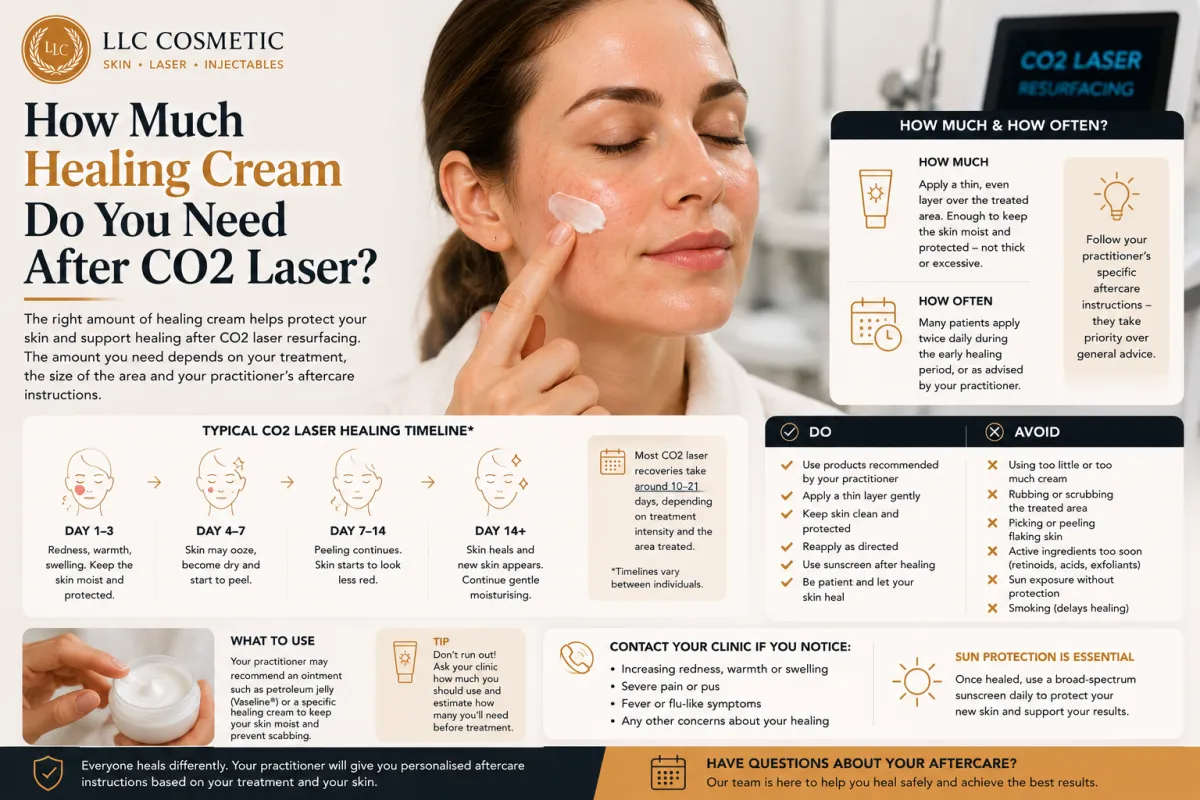
How Much Healing Cream Do You Need After CO2 Laser?
If you're preparing for CO2 laser resurfacing, you may already be thinking about the recovery period.
One question that often gets overlooked is:
“How much healing cream do I actually need after CO2 laser?”
It sounds simple, but there isn't one exact amount that works for everyone.
The amount of ointment, healing cream or moisturiser you need depends on the type and intensity of CO2 laser treatment, the size of the treated area, how your skin is healing and the specific aftercare instructions provided by your practitioner.
For more intensive CO2 resurfacing, the treated skin may need to be kept appropriately moist during the early healing period. Cleveland Clinic notes that after CO2 laser resurfacing, patients may be instructed to apply products such as petroleum jelly or certain moisturising creams to the treated area, with the goal of preventing the treated skin from becoming excessively dry and forming scabs.
But more cream isn't necessarily better.
The goal is generally to apply enough to keep the treated skin appropriately protected and moisturised without unnecessarily rubbing, irritating or manipulating the area.
Quick Answer: How Much Healing Cream Do You Need After CO2 Laser?
There is no universal number of grams, teaspoons or tubes that every CO2 laser patient needs.
A practical approach is to use a thin, even layer over the treated skin, unless your practitioner has specifically instructed you to use a different amount.
For fully ablative or more intensive CO2 resurfacing, your practitioner may recommend an ointment or occlusive product during the early healing period. Cleveland Clinic describes applying a thin layer of petroleum jelly or an occlusive moisturiser after laser resurfacing until the skin heals.
The amount you need will depend mainly on:
Size of the treatment area
Treatment intensity
Type of CO2 laser
Whether the treatment is fractional or more extensive
How quickly your skin heals
How often your practitioner tells you to reapply the product
Your clinic's specific aftercare instructions should take priority over any general amount mentioned online.
Why Do You Need Healing Cream After CO2 Laser?
CO2 laser resurfacing deliberately creates controlled injury in the skin.
During recovery, the treated skin can become:
Red
Warm
Swollen
Sensitive
Tight
Dry
Peeling
Crusted
Depending on the intensity of the treatment, the skin may also appear raw or produce some fluid during the early healing period.
An appropriate ointment or moisturising product can help maintain a suitable healing environment.
For ablative CO2 resurfacing, Cleveland Clinic specifically describes wound care involving products such as petroleum jelly or moisturising creams and explains that this care is intended to help prevent scab formation.
The American Academy of Dermatology also recommends keeping injured skin appropriately moist during wound healing because this helps prevent the wound from drying out and forming a scab.
Does More Healing Cream Make CO2 Laser Heal Faster?
Not necessarily.
Applying a huge amount of cream doesn't automatically make the skin heal faster.
The goal is to maintain appropriate moisture and protection while following your practitioner's aftercare plan.
Applying too little may allow the treated skin to become excessively dry.
Applying excessive amounts may be messy, uncomfortable and unnecessary.
More importantly, rubbing or repeatedly manipulating freshly treated skin can cause irritation.
Think:
Enough to cover and protect the treated area — not a thick layer simply for the sake of using more.
What Does a Thin Layer Look Like?
If your practitioner has instructed you to use an ointment such as petroleum jelly or another healing product, you generally want enough product to create a light, even coating over the treated area.
You should not need to aggressively massage it into the skin.
Instead:
Wash your hands.
Follow your clinic's cleansing instructions.
Apply the recommended product gently.
Spread it without rubbing aggressively.
Leave the skin protected according to your aftercare instructions.
Reapply according to the schedule provided by your practitioner.
The American Academy of Dermatology recommends gentle wound care and advises against scrubbing injured skin.
How Often Should You Apply Healing Cream After CO2 Laser?
The answer depends on your treatment and your practitioner's protocol.
For general laser resurfacing, Cleveland Clinic describes applying a thin layer of petroleum jelly or an occlusive moisturiser twice daily until the skin heals, but individual instructions can differ depending on the treatment performed.
Some patients may receive different instructions based on:
Laser settings
Treatment depth
Treatment area
Type of product prescribed or recommended
Amount of drainage
Healing progress
Don't automatically copy another patient's schedule.
Your friend's CO2 laser treatment may have been very different from yours.
How Many Tubes of Healing Cream Will You Need?
This is one of the hardest questions to answer with a single number.
A small fractional treatment covering a limited area may require significantly less product than a full-face, more intensive resurfacing treatment.
For example, someone having a small treatment area may use a relatively small amount, while someone recovering from extensive resurfacing may need considerably more.
Rather than purchasing a predetermined number of tubes, it makes more sense to ask your clinic:
“How much product should I apply each time, how often should I reapply it, and how long should I continue?”
Your practitioner can then estimate the amount you'll need based on your actual treatment area.
Does the Type of CO2 Laser Matter?
Yes.
CO2 laser treatments aren't all identical.
A fractional treatment can create microscopic treatment zones, while more extensive ablative resurfacing can involve a larger proportion of the skin surface.
This affects recovery.
Cleveland Clinic states that healing after CO2 laser resurfacing generally takes around 10–21 days, depending on the condition being treated and the intensity of the laser settings.
More intensive treatment generally requires more significant wound care and recovery.
That means the amount and duration of healing product you need may also differ.
What If You're Having Fractional CO2 Laser?
Fractional treatment generally leaves untreated areas between microscopic treatment zones, which can allow the skin to recover differently from fully ablative resurfacing.
DermNet notes that fractional laser treatment can cause peeling and that, following ablative therapy, petrolatum and gauze may be used during the healing phase according to treatment instructions.
Your practitioner may therefore recommend:
A healing ointment
A moisturising cream
Gentle cleansing
Specific post-treatment products
Sunscreen after the skin has healed
The exact routine depends on the treatment performed.
What If Your Skin Is Oozing After CO2 Laser?
Some drainage can occur after more intensive resurfacing.
Cleveland Clinic notes that laser-resurfaced skin can appear raw and may ooze yellow fluid during recovery.
If this happens, don't automatically keep adding more and more cream.
Instead, follow your clinic's instructions for cleansing and reapplication.
If the drainage appears unusual, increases unexpectedly or is accompanied by worsening pain, warmth, swelling, pus or other concerning symptoms, contact your treating practitioner.
Should You Let CO2 Laser Skin Dry Out?
For ablative resurfacing, deliberately allowing the treated skin to become very dry and heavily crusted is generally not the goal of standard wound-care approaches.
Cleveland Clinic describes the use of ointment or an occlusive moisturiser after CO2 laser resurfacing to help prevent scab formation.
The American Academy of Dermatology similarly explains that keeping wounds appropriately moist can help them heal and avoid scab formation.
However, your practitioner may use a specific protocol depending on the laser treatment they performed.
Follow their instructions rather than deliberately changing the wound-care approach yourself.
Can You Use Any Healing Cream After CO2 Laser?
No.
Don't assume that every moisturiser, balm or cream is appropriate for freshly resurfaced skin.
Immediately after CO2 laser, your skin can be significantly more sensitive than normal.
Your practitioner may recommend a specific:
Ointment
Petroleum-based product
Moisturiser
Barrier-repair product
Prescription product
The American Academy of Dermatology notes that products used on injured skin should be chosen carefully and that topical antibiotics aren't routinely necessary for uncomplicated wounds because they can cause irritation or allergic reactions.
Don't add active skincare ingredients unless your practitioner tells you to.
What Ingredients Should You Avoid Immediately After CO2 Laser?
Freshly resurfaced skin may be particularly sensitive to irritating ingredients.
Depending on your treatment, your practitioner may tell you to temporarily avoid products containing ingredients such as:
Retinoids
Glycolic acid
Strong exfoliating acids
Other irritating active ingredients
Fragrances or products that sting your skin
Cleveland Clinic specifically advises avoiding aggressive facial treatments such as tretinoin and glycolic acid for a period following laser resurfacing, with timing determined by the treatment and healthcare provider.
Don't restart your normal skincare routine simply because your skin looks better on the surface.
Ask your practitioner when each product can be safely reintroduced.
Can You Use Petroleum Jelly After CO2 Laser?
Petroleum jelly is commonly used as an occlusive wound-care product after ablative laser resurfacing.
Cleveland Clinic specifically lists petroleum jelly among products that may be applied following CO2 laser resurfacing.
The American Academy of Dermatology also recommends petroleum jelly for keeping minor wounds moist during healing.
However, this does not mean every patient should automatically use petroleum jelly.
Your treating practitioner should tell you what product is appropriate for your specific procedure.
Should You Use Antibiotic Cream?
Don't automatically apply an antibiotic cream simply because you've had laser treatment.
The American Academy of Dermatology states that most uncomplicated wounds don't require topical antibiotics and that these products can sometimes cause allergic reactions or irritation.
If your practitioner has specifically prescribed or recommended an antibiotic treatment, follow their instructions.
Otherwise, don't add one to your routine without professional guidance.
What Happens If You Apply Too Little Healing Cream?
If your aftercare protocol requires an ointment or moisturiser and you use too little, the treated skin may become excessively dry.
This can contribute to:
Tightness
Dryness
Crusting
Increased discomfort
Keeping healing skin appropriately moist is a common principle of wound care.
If your skin appears unusually dry despite following your aftercare instructions, contact your clinic and ask whether you should adjust the amount or frequency.
What Happens If You Apply Too Much Healing Cream?
More isn't automatically better.
A very heavy layer may:
Feel uncomfortable
Make the skin excessively greasy
Make it difficult to assess the treated area
Transfer onto pillows or clothing
Encourage unnecessary touching or wiping
The better approach is to use the amount needed to create the protective layer recommended by your practitioner.
How Long Do You Need Healing Cream After CO2 Laser?
Again, this depends on the treatment.
Cleveland Clinic states that CO2-treated areas generally heal in approximately 10–21 days, depending on treatment intensity and the condition treated.
That doesn't mean every patient needs the same cream for exactly 10–21 days.
Your practitioner may tell you to:
Use an ointment during the early wound-healing stage
Transition to a moisturiser as the skin closes
Begin sunscreen after the skin has healed
Gradually return to normal skincare
The transition should be based on how your skin is healing.
When Can You Stop Using Healing Cream?
Don't stop simply because the skin looks less red.
Your practitioner may consider whether:
The treated surface has fully re-epithelialised
There is no significant open or weeping skin
Peeling has settled
The skin barrier has recovered sufficiently
Cleveland Clinic recommends daily sunscreen after healing and moisturiser as directed by your healthcare provider.
If you're unsure whether you've reached this stage, contact your clinic before changing your routine.
When Can You Start Sunscreen After CO2 Laser?
Sun protection is extremely important after resurfacing.
However, the timing of sunscreen application matters.
Freshly treated or open skin may not tolerate ordinary sunscreen immediately.
Cleveland Clinic recommends daily broad-spectrum sunscreen after the treated skin has healed.
The American Academy of Dermatology likewise recommends protecting treated skin from the sun after laser treatment.
Your practitioner should tell you when it is appropriate to introduce sunscreen.
What About Moisturiser After the Healing Stage?
Once the skin has healed sufficiently, moisturising can continue to support the recovering skin barrier.
Cleveland Clinic recommends liberal moisturiser application after CO2 laser resurfacing once the skin has healed.
The exact product should be appropriate for your skin and recommended by your practitioner.
Does Healing Cream Reduce CO2 Laser Downtime?
Healing cream can support appropriate wound care, but it doesn't mean you can automatically shorten the biological healing process.
Your recovery depends on factors such as:
Laser intensity
Treatment depth
Treatment area
Fractional versus more extensive resurfacing
Individual healing
Aftercare
Skin type
Cleveland Clinic reports a general healing range of around 10–21 days for CO2 resurfacing, with stronger settings generally requiring longer recovery.
So don't use more cream simply because you want your skin to heal faster.
What Should You Do If Your Skin Feels Very Dry?
First, check that you're following the aftercare instructions provided by your practitioner.
If your skin is becoming increasingly dry, tight or uncomfortable, ask your clinic whether:
You're applying enough product
You're applying it often enough
You are using the correct product
You are cleansing too frequently
You have introduced another product that is irritating your skin
Don't add multiple new products at once.
When Should You Contact Your Clinic?
Some redness, swelling, sensitivity and discomfort are expected after CO2 laser.
However, contact your treating practitioner if you develop unexpected or worsening symptoms.
These may include:
Increasing rather than improving pain
Significant or worsening swelling
Pus
Increasing warmth or redness
Significant blistering
Fever
Unusual drainage
Concerns about infection
Delayed or abnormal healing
The American Academy of Dermatology identifies increasing redness, swelling, pain, warmth, pus and fever among symptoms that can indicate infection in a healing wound.
Your treating practitioner is best placed to assess your skin because they know the laser settings and treatment approach used.
How Can You Make Your CO2 Laser Healing Easier?
Following your aftercare instructions consistently is one of the most important things you can do.
Depending on your treatment, your practitioner may recommend:
Keep the skin appropriately moisturised
Use the recommended healing product as instructed.
Clean gently
Avoid scrubbing or aggressively rubbing the treated area.
Don't pick or peel
Allow peeling and crusting skin to come away naturally unless your practitioner gives you different instructions.
Avoid irritating skincare
Don't restart retinoids, acids or other active ingredients until your practitioner says it's appropriate.
Protect your skin from the sun
Once the skin has healed sufficiently, use appropriate broad-spectrum sun protection.
Don't smoke
Smoking can interfere with healing after laser resurfacing.
How Much Healing Cream Should You Buy Before CO2 Laser?
Instead of buying a specific number of tubes based on an online recommendation, ask your clinic three questions:
1. What exact product should I use?
2. How much should I apply each time?
3. How long should I expect to use it?
Once you know the treatment area and aftercare schedule, your clinic can give you a much more useful estimate.
This is particularly important if you're having a larger or more intensive treatment.
The Biggest Mistake: Thinking More Cream Means Faster Healing
It can be tempting to think:
“If a little healing cream is good, more must be better.”
That's not necessarily true.
The purpose of the product is to support appropriate wound care and maintain a suitable environment for healing.
You don't need to cover your face in a huge layer.
You also shouldn't let freshly resurfaced skin become excessively dry if your aftercare protocol calls for an occlusive product.
The goal is appropriate application—not maximum application.
Final Takeaway
So, how much healing cream do you need after CO2 laser?
There isn't one universal amount.
For many ablative CO2 laser treatments, an ointment or occlusive moisturiser may be used during the early healing period. Cleveland Clinic describes applying a thin layer of petroleum jelly or another appropriate occlusive moisturiser according to the post-treatment instructions.
The amount you need depends on:
The size of the treated area
Treatment intensity
Type of CO2 laser
Your individual healing response
The product recommended by your practitioner
How frequently you are instructed to apply it
Don't measure your recovery by how much cream you use.
Instead, focus on following your clinic's aftercare instructions, keeping the treated skin appropriately protected, avoiding unnecessary irritation and contacting your practitioner if your recovery doesn't seem normal.
When it comes to CO2 laser aftercare, the right product and the right amount matter more than simply using more.
Frequently Asked Questions
How much healing cream should I apply after CO2 laser?
Usually, the goal is an appropriate thin, even layer rather than a thick coating. Your practitioner should tell you the exact product, amount and frequency for your treatment.
How often should I apply healing cream after CO2 laser?
This varies. Cleveland Clinic describes thin-layer application of petroleum jelly or an occlusive moisturiser twice daily for some laser resurfacing protocols, but your clinic's instructions should take priority.
How many tubes of healing cream do I need?
There is no standard number. The amount depends on the treatment area, intensity and duration of aftercare.
Can I use Vaseline after CO2 laser?
Petroleum jelly is used in some CO2 laser aftercare protocols, including those described by Cleveland Clinic. However, use the product recommended by your treating practitioner.
Can I use any moisturiser after CO2 laser?
Not necessarily. Freshly resurfaced skin can be sensitive, so use the product recommended by your practitioner rather than introducing new skincare products without guidance.
Does more healing cream make CO2 laser heal faster?
No. Using a large amount doesn't automatically accelerate healing. The goal is appropriate wound care and protection.
When can I stop using healing cream after CO2 laser?
This depends on how your skin is healing and the intensity of your treatment. Your practitioner should tell you when to transition from an ointment or healing product to your regular moisturiser.
When can I use sunscreen after CO2 laser?
Sunscreen is important after healing, but freshly treated skin may not tolerate sunscreen immediately. Follow your practitioner's instructions regarding when to start.
What happens if I use too much healing cream?
A very thick layer is usually unnecessary and can feel uncomfortable or greasy. Follow the application amount recommended by your clinic.
What happens if my skin becomes very dry after CO2 laser?
Contact your treating clinic for guidance. They can determine whether you need to adjust the amount or frequency of your recommended healing product.