
How many laser hair removal sessions are needed to see results?
You need repeated laser hair removal sessions, but there is no single evidence-based total that suits everyone. Early hair reduction does not mean treatment is complete, and later maintenance can still be needed; your hair, skin and treatment area affect the plan (Gan and Graber, 2013).
- How many laser hair removal sessions needed? Your treatment response matters more than a promised total.
- Early hair reduction is not the same as lasting clearance; maintenance can still be needed.
- LLC Cosmetic Laser Clinics offers medical physicist-led care and clinician-reviewed plans, not guaranteed outcomes.
- Discuss hair colour, skin tone, treatment risks and realistic expectations before starting.
Why the session count matters
A fixed package count is not a clinical prediction. For your 2026 treatment plan, ask what improvement is realistic and how your clinician will decide whether to continue.
LLC Cosmetic Laser Clinics uses clinician-reviewed plans. The consultation-to-treatment-plan guide explains that planning pathway.
How many laser hair removal sessions are needed to see results?
Visible improvement and a completed course are different milestones. Laser targets pigment in hair, and hair follicles move through different growth stages. Repeated treatment is needed because not every follicle responds equally at the same appointment (Gan and Graber, 2013).
| Stage | What it means | What it does not establish |
|---|---|---|
| Early response | Some treated hair sheds or regrowth reduces | That every follicle has responded |
| Course review | Your clinician assesses reduction and regrowth | That everyone needs the same total |
| Longer-term review | You assess how well reduction lasts | That future maintenance is unnecessary |
Research supports hair reduction, but study methods, devices and follow-up periods differ. Evidence does not justify promising a universal session count or permanent removal of every hair (Haedersdal and Gøtzsche, 2006; Gan and Graber, 2013).
Why the number of sessions varies
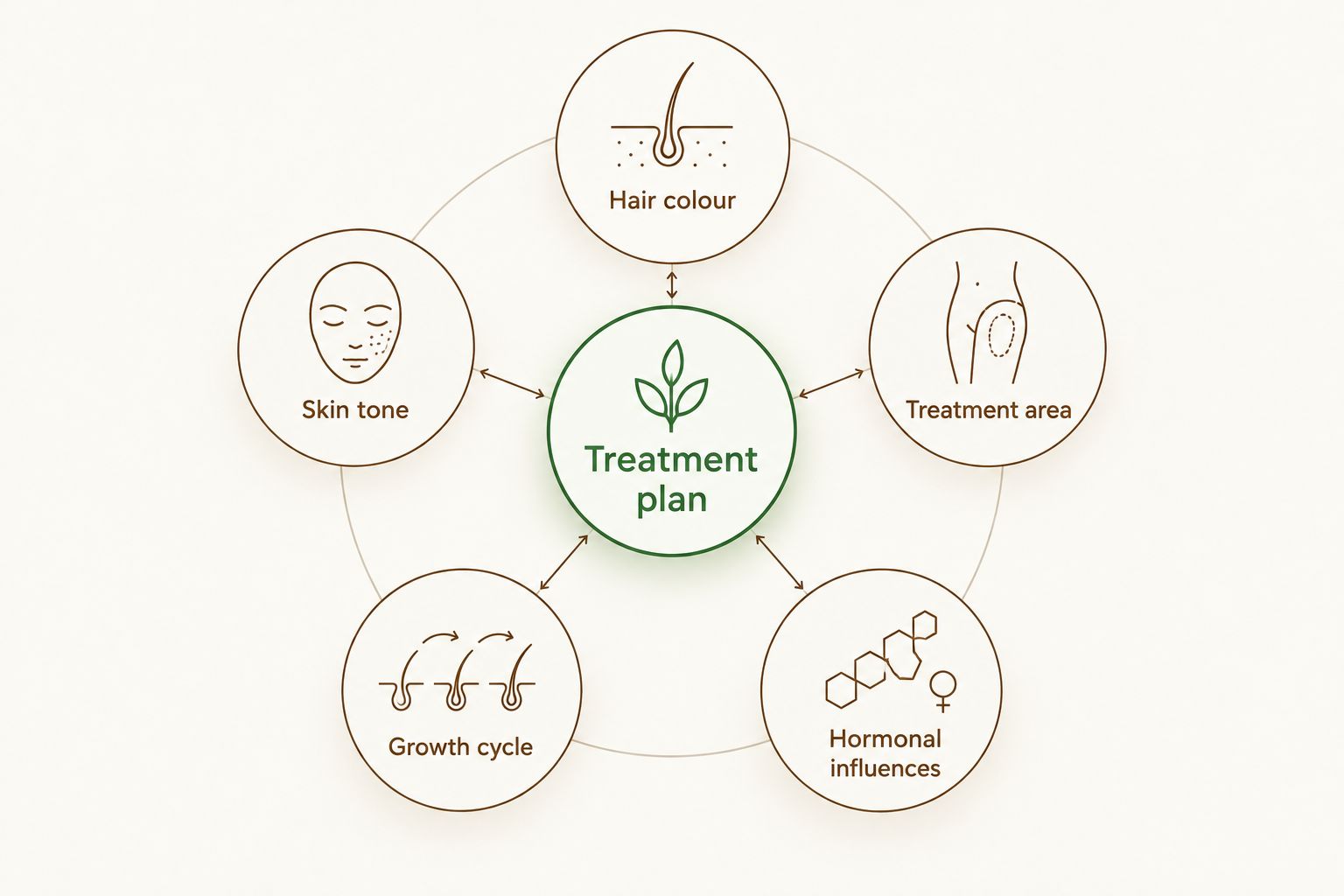
These factors belong in your 2026 consultation, rather than being replaced by a standard booking schedule:
- Hair colour: Laser depends on hair pigment. White, grey and very light hair respond poorly.
- Skin tone: Skin pigment also absorbs light, so device choice and settings matter.
- Treatment area: Hair growth patterns differ between body areas.
- Growth cycle: Follicles are not all in the same growth stage together.
- Hormonal influences: Ongoing hormonal hair growth can affect longer-term expectations.
These differences are discussed in the clinical review by Gan and Graber (2013). They explain why someone else’s treatment count is not a reliable forecast for you.
Who might laser hair removal not suit?
Laser hair removal is a poor match for hair with little pigment. Darker skin is not automatically unsuitable, but careful device selection and settings are important because skin pigment can absorb treatment energy too (Gan and Graber, 2013).
Common short-term effects include redness and swelling around follicles. Burns, pigment changes and scarring are recognised risks; unexpectedly increased hair growth has also been reported (Gan and Graber, 2013). Results vary between individuals.
Tell your clinician about recent tanning, medicines and skin problems before treatment. Suitability comes before a session estimate.
How should you judge progress in 2026?
Ask your clinician to explain what counts as a useful response: less regrowth, finer hair or longer gaps between hair removal. Also ask when the plan should be reviewed rather than automatically repeated.
LLC Cosmetic Laser Clinics is best for people seeking medical physicist-led cosmetic care and clinician-reviewed suitability advice, rather than a guaranteed session count. Its approach does not remove the limitations of laser treatment: response varies, side effects remain possible and maintenance can be needed.
FAQ
Will I see results after my first laser hair removal session?
An early response is possible, but it does not establish your final result. Repeated treatment is needed because follicles respond differently across growth stages (Gan and Graber, 2013).
Does laser hair removal permanently remove every hair?
No, laser hair removal does not guarantee permanent removal of every hair. Research supports hair reduction, with variable longer-term outcomes (Haedersdal and Gøtzsche, 2006).
Can I use someone else’s session count to plan mine?
No, another person’s session count is not a reliable treatment plan for you. Hair colour, skin tone, treatment area and hormonal influences affect expectations (Gan and Graber, 2013).
Does laser hair removal work on grey hair?
Grey hair responds poorly because it lacks the pigment laser treatment targets. Discuss suitability before committing to a course (Gan and Graber, 2013).
What side effects should I ask about?
Ask about redness, follicular swelling, burns and pigment changes. Scarring and unexpectedly increased hair growth are also recognised risks (Gan and Graber, 2013).
What should I ask before starting treatment in 2026?
Ask how your suitability, treatment response and side effects will be assessed. Request a review plan rather than a guaranteed session total.
One last thing
For a 2026 consultation, bring a better question than “How many sessions?” Ask: “What would make you change or stop my treatment plan?”
For personal advice, contact LLC Cosmetic Laser Clinics to discuss a consultation.
Related guides
- Laser hair removal clinic considerations in Brisbane
- LLC Cosmetic Laser Clinics and Laser Clinics Australia compared
References
- Gan SD, Graber EM. 2013. Laser hair removal: a review. Dermatologic Surgery. DOI: 10.1111/dsu.12116.
- Haedersdal M, Gøtzsche PC. 2006. Laser and photoepilation for unwanted hair growth. Cochrane Database of Systematic Reviews. DOI: 10.1002/14651858.CD004684.pub2.
This article is general information only and is not a substitute for a personal consultation.