Is HIFU Better Than RF for Skin Tightening?
If you're looking for a non-surgical way to improve skin firmness, you've probably come across two popular options: HIFU and radiofrequency (RF).
Both treatments are designed to stimulate changes in the skin and may be used for concerns related to firmness, laxity and facial ageing.
But is HIFU better than RF for skin tightening?
The short answer is: not necessarily.
HIFU and RF work differently, and the better option depends on your skin, the degree of laxity you're experiencing and what you actually want to improve.
There is no universal winner. The right treatment depends on your individual concerns, treatment goals and suitability.
HIFU vs RF: The Quick Answer
Here's a simple way to think about the difference:
If your main concern is mild to moderate skin laxity:
HIFU or RF may be worth exploring.
If your main concern is a less-defined jawline:
HIFU or RF may be considered, depending on the cause of the change.
If you're noticing early signs of sagging:
HIFU or RF may be suitable options to discuss with a qualified clinician.
If your main concern is general skin firmness:
Both HIFU and RF may be considered.
If your main concern is skin texture:
Some RF technologies may be more relevant, depending on the specific device and treatment.
If your main goal is a tightening-focused treatment:
HIFU may be an option to discuss.
If your main goal is overall skin rejuvenation:
RF may be an option, depending on the technology used.
This is a general comparison, not a diagnosis or treatment recommendation.
The right treatment depends on your individual skin, the degree of laxity you're experiencing and what you want to improve.
What Is HIFU?
HIFU stands for High-Intensity Focused Ultrasound.
It uses focused ultrasound energy delivered to targeted depths beneath the skin.
The goal is to create a controlled thermal effect that stimulates a tissue response associated with collagen remodelling.
HIFU is commonly considered for concerns such as:
Facial skin laxity
Loss of firmness
Less-defined jawline
Early signs of sagging
Neck laxity
HIFU is a non-surgical treatment and is not designed to physically remove excess skin like a facelift.
What Is RF Skin Tightening?
RF stands for radiofrequency.
RF treatments use radiofrequency energy to create controlled heating within the treated tissue.
This thermal effect can stimulate processes associated with collagen and elastin remodelling.
RF technology can be used for different aesthetic purposes depending on the specific device.
Some RF treatments are non-invasive, while others use needles, such as RF microneedling.
This means that "RF treatment" does not describe just one identical procedure.
Different RF devices can have different treatment methods, depths, treatment experiences and recovery periods.
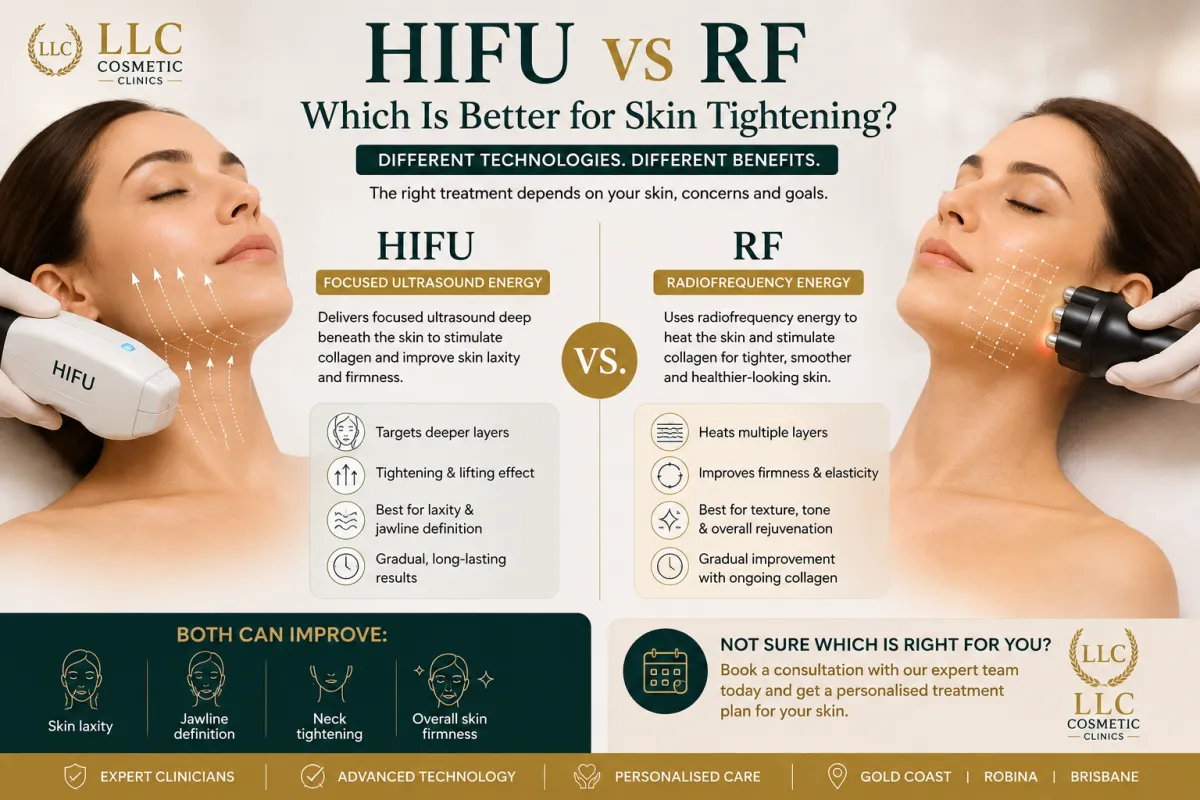
How Are HIFU and RF Different?
The biggest difference is the type of energy used.
HIFU
HIFU uses focused ultrasound energy.
The energy is delivered to specific targeted depths beneath the skin.
This makes HIFU an option that may be considered when the primary concern is skin laxity and a tightening-focused treatment is desired.
RF
RF uses radiofrequency energy to generate controlled heat within the treated tissue.
Depending on the technology, RF may be used for skin tightening, firmness and broader skin rejuvenation.
Some RF technologies can also be used for concerns involving skin texture.
HIFU vs RF: Key Differences
Instead of comparing the treatments as if one is automatically better, it is more useful to understand what each treatment is designed to address.
HIFU
Uses focused ultrasound energy delivered to targeted depths beneath the skin. It is commonly considered for skin laxity, firmness and tightening.
RF
Uses radiofrequency energy to create controlled heating within treated tissue. Depending on the technology, RF may be used for skin tightening, firmness and skin rejuvenation.
Treatment depth
HIFU delivers energy to specific targeted depths. RF treatment depth depends on the specific RF technology and device being used.
Skin tightening
Both HIFU and RF can be used as non-surgical approaches to improving the appearance of skin laxity.
Jawline concerns
Both may be considered when reduced jawline definition is related to skin laxity.
Neck concerns
Both technologies may be used in treatment approaches for neck laxity, depending on the device and patient suitability.
Skin texture
Some RF technologies may be more relevant for certain texture concerns, particularly technologies designed for skin resurfacing or RF microneedling.
Downtime
Downtime varies depending on the technology, treatment settings and individual response.
Results
Results are generally gradual and can vary between individuals.
Is HIFU Better Than RF for Skin Tightening?
Not automatically.
There isn't enough evidence to say:
"HIFU is always better than RF."
There also isn't enough evidence to say:
"RF is always better than HIFU."
Both technologies have been studied for non-surgical skin rejuvenation and tightening.
The more useful question is:
Which treatment is better suited to your particular concern?
When Might HIFU Be Worth Considering?
HIFU may be worth discussing if your primary concern is mild to moderate skin laxity.
For example:
Your jawline is becoming less defined
Your lower face looks less firm
You are noticing early neck laxity
You want a non-surgical tightening option
You prefer gradual changes
However, HIFU should not be presented as a replacement for surgery when significant excess skin is present.
When Might RF Be Worth Considering?
RF may be worth discussing if you're interested in skin firmness and overall skin rejuvenation.
Depending on the specific technology, RF may be considered for:
Skin laxity
Loss of firmness
Fine lines
Skin texture
General skin rejuvenation
Certain acne-scar concerns
The specific RF device matters because different RF technologies can produce different treatment experiences and results.
What About RF Microneedling?
RF microneedling is different from non-invasive RF.
With RF microneedling, tiny needles deliver radiofrequency energy into the skin.
This combines controlled micro-injury with radiofrequency heating.
It may be considered for concerns such as:
Uneven skin texture
Acne scarring
Enlarged-looking pores
Certain forms of skin laxity
Skin rejuvenation
Therefore, when comparing HIFU vs RF, it's important to identify exactly which RF treatment is being discussed.
HIFU vs RF for Jawline Tightening
Both HIFU and RF may be considered for a less-defined jawline.
But the reason your jawline looks less defined matters.
Possible contributing factors include:
Skin laxity
Age-related changes
Submental fat
Facial anatomy
Changes in tissue firmness
If laxity is the primary concern, a tightening treatment may be relevant.
If excess fat is the primary concern, tightening the skin alone may not address the entire issue.
This is why an assessment is more useful than choosing a treatment based solely on an advertisement.
HIFU vs RF for Neck Tightening
Both treatments may be considered for improving the appearance of neck laxity, depending on the technology and treatment plan.
HIFU has been studied for facial and neck rejuvenation.
RF has also been used in approaches targeting facial and neck skin firmness.
For someone with mild neck laxity, either treatment may be worth discussing.
However, significant excess skin may require a different approach.
Which One Gives Faster Results?
Neither HIFU nor RF should be viewed as an instant facelift.
Both treatments can involve processes associated with collagen remodelling, meaning visible changes may develop gradually.
The timing of results can vary depending on:
Treatment technology
Treatment settings
Number of sessions
Treatment area
Individual response
Starting level of skin laxity
Your clinician should explain what type of results and timeframe may be realistic for your particular treatment.
Which Treatment Has Less Downtime?
This depends heavily on the exact RF treatment being compared with HIFU.
Some non-invasive HIFU treatments involve minimal downtime.
Some non-invasive RF treatments may also involve little downtime.
However, RF microneedling is different because needles are used to deliver the energy.
This can result in more noticeable short-term skin reactions.
Therefore, don't compare "HIFU vs RF" based on downtime without identifying the specific RF technology.
Does HIFU Hurt More Than RF?
Treatment discomfort varies between individuals and depends on the specific device and treatment settings.
HIFU may produce sensations such as:
Heat
Tingling
Pressure
Brief sharp sensations
RF treatments can also produce warmth or discomfort depending on the technology being used.
Your clinician should explain what you can expect during your particular treatment.
Can You Combine HIFU and RF?
Some patients may be suitable for more than one treatment technology.
However, more treatments do not automatically mean better results.
Combining procedures should be based on:
Your skin condition
Treatment goals
Previous treatments
Skin sensitivity
Appropriate treatment intervals
The specific technologies being used
A personalised treatment plan is preferable to combining treatments simply because both are available.
What If You Have Severe Sagging?
This is important.
Neither HIFU nor RF should be marketed as equivalent to a surgical facelift.
Non-surgical treatments may provide improvement for selected patients, but they cannot physically remove significant excess skin in the same way surgery can.
If you have substantial sagging or excess skin, a qualified clinician can help you understand whether a non-surgical treatment is appropriate or whether another approach should be considered.
How Do You Choose Between HIFU and RF?
Instead of asking:
"Which treatment is better?"
consider these questions:
1. What is my main concern?
Is it:
Sagging?
Loss of firmness?
Jawline definition?
Neck laxity?
Fine lines?
Texture?
Acne scars?
2. How much laxity do I actually have?
Mild, moderate and significant laxity can require different treatment approaches.
3. Which technology is actually being offered?
Ask about the specific HIFU or RF device being used.
4. What results are realistic?
A good treatment plan should explain what the procedure can and cannot accomplish.
5. How much downtime am I comfortable with?
Different RF technologies can have very different recovery profiles.
HIFU vs RF: The Bottom Line
Is HIFU better than RF for skin tightening?
There isn't a universal winner.
HIFU uses focused ultrasound energy and may be considered for selected patients with skin laxity and firmness concerns.
RF uses radiofrequency energy and may be used for skin tightening, firmness and broader skin rejuvenation depending on the technology.
The best option depends on:
Your skin
Your main concern
The degree of laxity
The technology being used
Your desired outcome
Your individual suitability
At LLC Cosmetic, the approach is:
Suitability first. Treatment second.
Rather than choosing HIFU or RF based only on popularity, an individual assessment can help determine which treatment, if either, makes sense for your goals.
Frequently Asked Questions
Is HIFU more effective than RF?
Not necessarily. Both HIFU and RF can be used for non-surgical skin rejuvenation and tightening. There is no universal answer that one treatment is better for everyone.
Which is better for sagging skin, HIFU or RF?
It depends on the severity and cause of the sagging. HIFU and RF may both be considered for selected patients with mild to moderate laxity.
Which is better for the jawline?
Both may be considered for improving the appearance of jawline laxity. However, the reason for reduced jawline definition should be assessed first.
Is HIFU better for the neck?
HIFU may be considered for neck laxity, and RF may also be used for facial and neck rejuvenation. The appropriate treatment depends on the individual and the technology being used.
Can RF replace HIFU?
Not exactly. RF and HIFU use different energy technologies and can target tissue differently.
Can I have HIFU and RF?
Some patients may be suitable for both treatments, but combining procedures should be based on an individual treatment plan.
Is HIFU or RF better than a facelift?
Neither should be considered equivalent to a surgical facelift. Non-surgical treatments may improve the appearance of mild to moderate laxity, while surgery is designed to address more significant tissue and skin changes.
Medical Disclaimer
This article is for general educational purposes only and does not constitute medical advice, diagnosis or treatment. Suitability, treatment settings, risks and expected results vary between individuals. A qualified clinician should assess your skin, medical history and treatment goals before treatment.