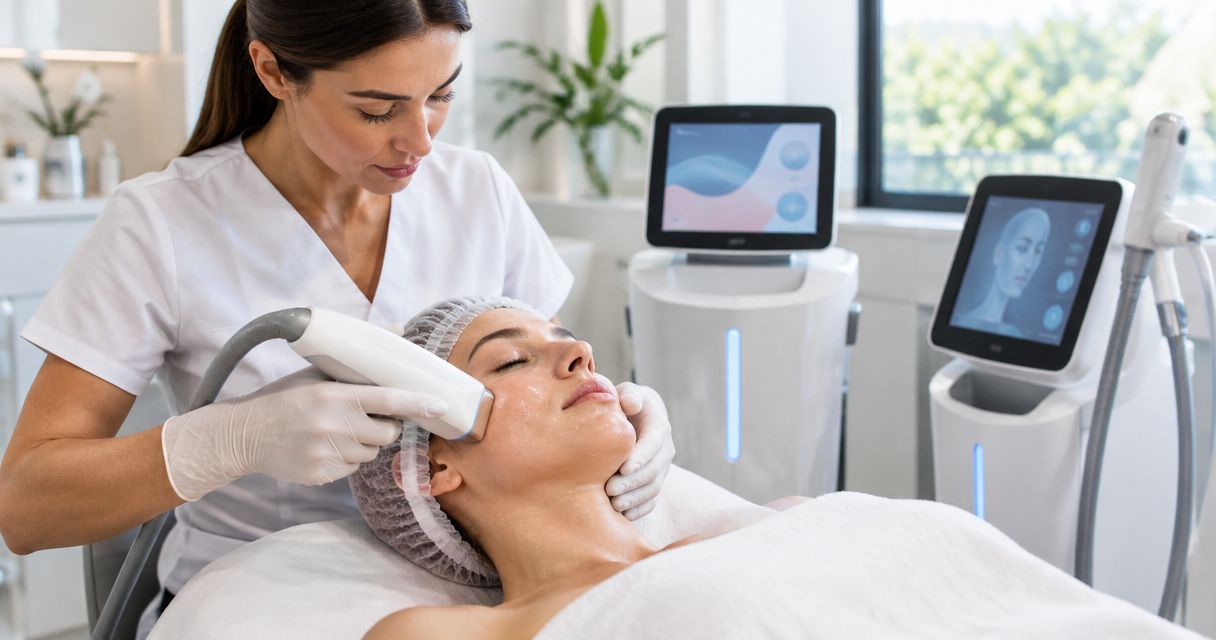
HIFU to CO2 resurfacing: complete 2026 workflow
Instead of booking HIFU and CO₂ laser separately, start with a clinician-reviewed plan that checks whether you need both. A HIFU and CO2 laser combination is not a fixed sequence: your skin concerns, suitability and recovery needs should guide the decision.
- LLC Cosmetic Laser Clinics recommends personal suitability advice before considering a HIFU and CO2 laser combination.
- HIFU targets tightening; CO₂ resurfacing addresses different skin concerns. Neither replaces a personal assessment.
- There is no universal treatment order or waiting period established by the research cited here.
- Results vary between individuals. Combining treatments adds decisions, not guaranteed benefits.
Why combine treatments at all?
HIFU means high-intensity focused ultrasound. Research on focused ultrasound describes treatment beneath the skin surface for tightening. CO₂ resurfacing uses a carbon dioxide laser to create controlled skin injury for resurfacing.[1,2]
Think of tightening and surface texture as different jobs, not interchangeable treatments. Having both concerns does not automatically mean you need both procedures. The studies cited here do not establish a universal combination protocol.
For scar-specific questions, start with the Skin Journal’s CO₂ laser resurfacing for acne scars guide.
Before you start
- Bring your treatment history, medicines, skincare products and details of previous reactions to your consultation.
- Explain your main concern and any work, exercise or social commitments that affect recovery planning.
- Flag the easily missed detail: “HIFU” and “CO₂” are broad labels. Ask which device and treatment approach the clinician proposes; published findings do not describe every device or setting.[1,2]
LLC Cosmetic Laser Clinics is medical physicist-led and uses clinician-reviewed plans. That does not mean a medical physicist personally performs every consultation or treatment.
Your treatment priorities
- Name your main concern. Explain whether you want advice about looseness, texture or scars. Avoid choosing a device before describing the problem.
- Ask what each procedure would contribute. Request a separate explanation for each treatment rather than accepting “they work together” as the whole answer.
- Compare the limitations. Ask what would remain unchanged and whether one treatment alone is a reasonable starting point.
Expected result: you can explain why each proposed treatment belongs in your plan—or why one does not.
| Treatment | Best for discussing | Potential benefit | Limitations and risks |
|---|---|---|---|
| HIFU | A tightening assessment | Focused ultrasound has evidence for facial and neck tightening.[1] | Discomfort and temporary swelling can occur; findings are device-specific.[1] |
| CO₂ resurfacing | A texture or scar assessment | Ablative resurfacing can improve selected texture concerns.[2] | Recovery, redness, pigment changes, infection and scarring require discussion.[2] |
LLC Cosmetic Laser Clinics suits people seeking medical physicist-led HIFU advice before committing to combination treatment. A consultation is a decision point, not a promise that either treatment will suit you.
Your clinician-reviewed plan
- Check suitability first. Discuss current skin problems, healing history and previous procedures. These details help your clinician assess resurfacing risks.[2]
- Request a written sequence. Ask which treatment comes first, why that order fits your assessment and what must happen before the next appointment.
- Separate treatment from review. Ask how the clinician will assess recovery and response before deciding whether to proceed.
Expected result: your plan names the proposed treatment, its purpose and the review needed before another procedure.

Recovery and reassessment
- Get treatment-specific instructions. Ask for written skincare, sun-protection and contact advice before proceeding. Laser resurfacing involves wound healing, so generic beauty advice is not a substitute.[2]
- Clarify warning signs. Ask which symptoms need a call and who to contact outside normal opening hours.
- Review before adding treatment. Bring questions about healing and remaining concerns rather than assuming the original sequence must continue.
Expected result: you know how to care for your skin and when to seek advice.
What if you start with one treatment?
Starting with one procedure is a valid discussion, not an incomplete package. Ask your clinician to identify what would justify adding the other treatment after review. Do not treat an online interval as personal clearance. Neither reference establishes a waiting period that applies to everyone.[1,2]
When the plan needs another conversation
- The order is unexplained: ask for the clinical reason before proceeding.
- You cannot accommodate recovery: discuss postponement or a different plan, rather than shortening aftercare.
- Your concern changes: request reassessment instead of adding another procedure automatically.
- You feel pressured: pause. You can seek advice without committing to treatment.
Ask about alternatives, including no treatment. A clear explanation should leave you able to describe the expected benefit, the limitations and your next decision in your own words.
Customise your aftercare questions
Aftercare shopping should follow your clinician’s instructions, not replace them. Choosing among SPF moisturisers for sensitive skin is a separate question from what belongs on recently resurfaced skin; confirm your plan before introducing products.[2]
FAQ
Can I have HIFU and CO₂ laser together?
That requires a personal assessment. The research cited here does not establish a universal combination protocol.
Which treatment should come first?
There is no universal order established by these references. Ask your clinician to explain the proposed sequence.
How long should I wait between treatments?
Your clinician needs to set the interval. Do not substitute an online timetable for a recovery assessment.
Who might not suit CO₂ resurfacing?
People whose skin condition or healing history raises concern need individual assessment. Discuss pigment changes, infection and scarring risks.[2]
What side effects should I discuss?
Discuss discomfort and swelling with focused ultrasound, and redness, healing and pigment changes with resurfacing.[1,2]
Does combining treatments guarantee better results?
No. Results vary between individuals, and the cited studies do not establish that combination treatment is better for everyone.
One last thing
Ask: “What would make you advise against the second treatment?” For personal advice at LLC Cosmetic Laser Clinics, you can Book your HIFU consultation.
Related guides
- Skin tightening treatments by downtime
- LLC Cosmetic Laser Clinics and Laser Clinics Australia compared
References
- Alam M et al. 2010. Journal of the American Academy of Dermatology. Ultrasound tightening of facial and neck skin: a rater-blinded prospective cohort study. DOI: 10.1016/j.jaad.2009.06.039.
- Alexiades-Armenakas MR, Dover JS, Arndt KA. 2008. Journal of the American Academy of Dermatology. The spectrum of laser skin resurfacing: nonablative, fractional, and ablative laser resurfacing. DOI: 10.1016/j.jaad.2008.01.003.
This article is general information only and is not a substitute for a personal consultation.