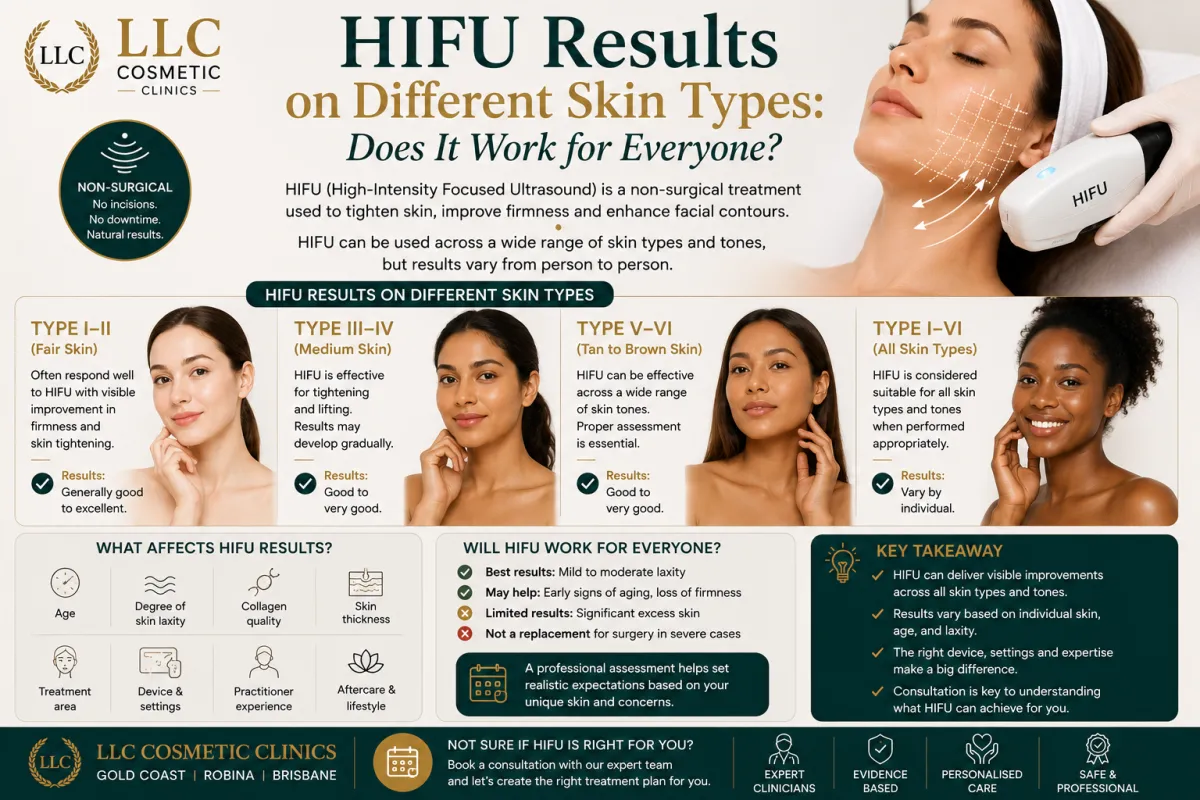
HIFU Results on Different Skin Types: Does It Work for Everyone?
HIFU is often promoted as a non-surgical treatment for firmer, tighter-looking skin. But one question many people have is whether HIFU works equally well for everyone.
Do HIFU results differ depending on your skin type or skin tone?
The short answer is: HIFU can be used across a wide range of skin types and tones, but results are not identical for everyone.
Factors such as skin laxity, age, skin thickness, treatment area, device settings and individual response can all influence the outcome.
Understanding these factors can help you set realistic expectations before treatment.
HIFU Results on Different Skin Types: The Quick Answer
HIFU uses focused ultrasound energy rather than light or laser energy.
This means that skin colour itself is generally not the only factor that determines whether someone may be suitable for HIFU.
However, that does not mean everyone will achieve the same result.
Your outcome can depend on:
Your level of skin laxity
Your age
Skin thickness
Treatment area
Degree of collagen loss
The HIFU device being used
Treatment settings
Practitioner experience
Your individual healing and collagen response
The most important question is therefore not simply:
"What is my skin type?"
It is:
"Is HIFU appropriate for my specific skin concerns and treatment goals?"
What Is HIFU?
HIFU stands for High-Intensity Focused Ultrasound.
It is a non-surgical treatment that delivers focused ultrasound energy to targeted depths beneath the skin.
The energy creates a controlled thermal effect that can stimulate a tissue response associated with collagen remodelling.
HIFU is commonly considered for concerns such as:
Mild to moderate skin laxity
Loss of firmness
Less-defined jawline
Early signs of sagging
Neck laxity
Facial contour concerns
HIFU does not remove excess skin in the same way that surgery does.
Does HIFU Work on All Skin Tones?
One of the reasons HIFU can be considered for a broad range of skin tones is that it does not rely on targeting melanin in the same way that many light-based treatments do.
HIFU uses ultrasound energy rather than relying on pigment absorption.
However, this does not mean that every person is automatically a candidate.
A proper assessment is still important because factors beyond skin colour can influence safety, suitability and expected results.
Does Skin Type Affect HIFU Results?
Yes, but skin type is only one part of the picture.
When people talk about skin type, they may mean different things.
For example, they could be referring to:
Skin tone
Oily or dry skin
Sensitive skin
Thick or thin skin
Mature or youthful skin
Fitzpatrick skin type
These characteristics do not all affect HIFU in the same way.
For HIFU, factors such as skin laxity, tissue thickness and treatment depth may be particularly important when determining whether the treatment is appropriate.
HIFU for Fair Skin
People with fair skin can be candidates for HIFU when they have appropriate treatment concerns.
For example, someone with:
Early facial laxity
Reduced firmness
Less-defined jawline
Mild neck laxity
may discuss HIFU with a qualified practitioner.
However, having fair skin does not guarantee better results.
The degree of laxity and the individual's response to treatment are still important.
HIFU for Medium Skin Tones
HIFU may also be considered for people with medium skin tones.
As with other skin tones, the treatment plan should be based on the individual's:
Skin condition
Treatment area
Degree of laxity
Desired outcome
Medical history
Suitability for the procedure
Results should be considered individually rather than predicted based solely on skin tone.
HIFU for Tan and Brown Skin
HIFU can also be considered for people with darker skin tones.
Because HIFU uses focused ultrasound energy rather than relying on melanin absorption, it is different from certain light- and laser-based treatments where pigmentation can be a more significant consideration.
However, darker skin does not automatically mean that treatment requires no assessment.
The practitioner still needs to consider the treatment area, skin condition, device and appropriate treatment parameters.
HIFU for Darker Skin Tones
People with deeper skin tones may understandably have questions about whether energy-based treatments are suitable for them.
HIFU is different from many laser and light-based procedures because its mechanism does not depend on targeting melanin at the skin surface.
That can make it an option worth discussing for appropriate patients.
However, "suitable for all skin tones" should never be interpreted as "suitable for everyone."
Individual assessment remains important.
What Actually Determines HIFU Results?
Your skin tone is only one factor.
Several other factors can have a much bigger influence on the result.
1. Degree of Skin Laxity
HIFU is generally more relevant to mild to moderate laxity than significant excess skin.
If there is substantial loose skin, non-surgical treatment may have limitations.
2. Age
Age itself does not automatically determine whether HIFU will work.
However, age-related changes in collagen, elastin and tissue structure can influence the degree of improvement that may be achievable.
3. Skin Thickness
Different areas of the face and neck have different tissue characteristics.
Treatment therefore needs to be planned according to the area being treated.
4. Treatment Area
The jawline, cheeks, chin and neck can respond differently because they have different anatomy and tissue characteristics.
5. Device and Treatment Settings
Not all HIFU systems are identical.
The technology, treatment depth and settings used can influence the treatment experience and expected outcome.
6. Practitioner Experience
Accurate treatment planning and appropriate application are important when using energy-based aesthetic treatments.
7. Individual Response
Two people receiving similar treatments may not experience identical results.
Your body's response to treatment and collagen remodelling can vary.
Does HIFU Work Better on Younger Skin?
Not necessarily.
A younger person may have less skin laxity, meaning the change they are looking for may be subtle.
Someone with mild age-related laxity may notice a more meaningful improvement.
The important factor is not simply age.
It is whether the treatment addresses the concern the person actually has.
Can HIFU Work on Sensitive Skin?
Having sensitive skin does not automatically mean that HIFU is unsuitable.
However, your skin condition should be assessed before treatment.
If you currently have irritation, inflammation, infection or another active skin concern, treatment may need to be postponed or reconsidered.
Always tell your practitioner about relevant skin conditions and previous treatments.
HIFU Results: What Should You Realistically Expect?
HIFU should not be presented as an instant facelift.
Results can develop gradually as the tissue response and collagen remodelling occur.
You may notice changes such as:
Firmer-looking skin
Improved appearance of skin laxity
A more defined-looking jawline
Improved appearance of facial contours
A firmer-looking neck
The degree of improvement varies between individuals.
Some people may notice a subtle change, while others may experience a more noticeable improvement.
Can HIFU Work for Severe Sagging?
This is where expectations are especially important.
HIFU is not a surgical facelift.
If someone has significant excess skin or advanced tissue laxity, a non-surgical treatment may not provide the degree of lifting they are expecting.
In those situations, a consultation can help determine whether HIFU is appropriate or whether another treatment approach should be considered.
HIFU Results on Different Skin Types: What Matters Most?
Instead of focusing only on whether you have fair, medium or dark skin, consider the bigger picture.
Your skin tone
HIFU does not rely on melanin absorption in the same way as many light-based treatments.
Your skin condition
Active irritation or certain skin conditions may affect whether treatment should proceed.
Your level of laxity
Mild to moderate laxity may be more appropriate for a non-surgical tightening approach.
Your treatment goal
Someone wanting subtle firmness may have different expectations from someone wanting significant lifting.
Your anatomy
Facial and neck anatomy differs between individuals and can affect treatment planning.
Your treatment plan
The device, settings, treatment area and practitioner experience all matter.
Is HIFU Suitable for Everyone?
No.
Although HIFU may be suitable for a broad range of skin tones, it is not appropriate for every person or every skin concern.
A professional assessment is important before treatment.
Your practitioner should consider:
Your medical history
Skin condition
Previous aesthetic treatments
Treatment area
Degree of laxity
Desired outcome
Potential contraindications
This helps ensure that the treatment is selected based on your individual circumstances rather than simply your skin type.
How to Get the Best Possible HIFU Results
If you are considering HIFU, focus on realistic expectations rather than searching for a particular skin type that supposedly gets "the best" results.
Before treatment:
Choose the right treatment for the problem.
Have your skin assessed.
Ask what type of HIFU device is being used.
Discuss realistic results.
Ask about potential risks and downtime.
Follow the clinic's aftercare instructions.
Most importantly, understand that HIFU is designed to produce gradual changes rather than replicate the results of surgery.
The Bottom Line
Does HIFU work for everyone?
No.
But HIFU can be considered across a wide range of skin tones and types when the treatment is appropriate.
Your skin tone alone does not determine your results.
Factors such as skin laxity, tissue characteristics, treatment area, device, treatment settings and individual response can all influence the outcome.
At LLC Cosmetic, the approach is:
Suitability first. Treatment second.
Rather than choosing a treatment based only on your skin type, a personalised assessment can help determine whether HIFU is appropriate for your skin and what results may realistically be achievable.
Frequently Asked Questions
Does HIFU work on dark skin?
HIFU can be considered for people with darker skin tones because it uses focused ultrasound energy rather than relying on melanin absorption. However, individual suitability still needs to be assessed.
Does HIFU work better on lighter skin?
Not necessarily. Skin tone alone does not determine how effective HIFU will be. Other factors such as skin laxity, tissue characteristics, treatment settings and individual response are important.
Can HIFU be used on all skin types?
HIFU may be suitable for a broad range of skin tones, but not everyone is a suitable candidate. A professional assessment should be performed before treatment.
Does HIFU work for mature skin?
HIFU may be considered for selected people experiencing mild to moderate skin laxity. The degree of laxity and the individual's overall skin condition are more important than age alone.
Can HIFU tighten very loose skin?
HIFU may improve the appearance of mild to moderate laxity, but it should not be considered equivalent to surgery for significant excess skin.
How long does it take to see HIFU results?
Results can develop gradually. The timing and degree of visible improvement vary between individuals and depend on the treatment area, device, treatment plan and individual response.
Medical Disclaimer
This article is for general educational purposes only and does not constitute medical advice, diagnosis or treatment. Suitability, treatment settings, risks and expected results vary between individuals. A qualified clinician should assess your skin, medical history and treatment goals before treatment.