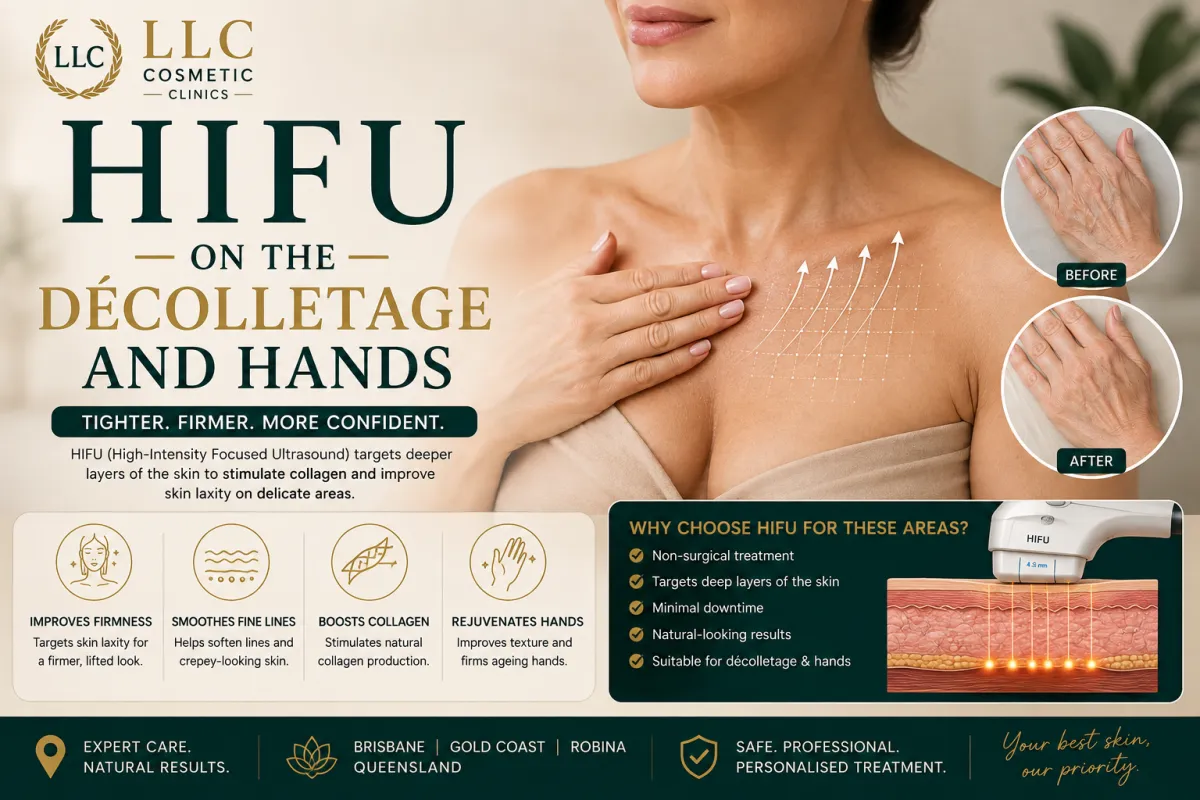
HIFU on the Décolletage and Hands: What Can It Actually Do?
When people think about HIFU, they often think about facial skin tightening, jawline definition or the neck. But what about areas that can also show visible signs of ageing, such as the décolletage and hands?
These areas can develop concerns such as reduced firmness, fine lines and changes in skin texture over time. However, HIFU isn't automatically the right treatment for every concern.
The most important question is not simply whether HIFU can be used on an area. It's whether the treatment is appropriate for the specific skin concern, treatment area and device being used.
HIFU on the Décolletage and Hands: The Quick Answer
HIFU uses focused ultrasound energy to create a controlled thermal effect at targeted depths beneath the skin.
For suitable treatment areas, the goal is generally to stimulate a tissue response associated with collagen remodelling and skin tightening.
However, treatment of the décolletage and hands can differ from facial HIFU.
Décolletage
HIFU may be considered to improve the appearance of skin laxity and support firmer-looking skin, depending on the treatment area, device and practitioner assessment.
Hands
HIFU may be considered for selected concerns related to skin firmness, depending on the device, treatment protocol and individual treatment plan.
HIFU isn't primarily a pigmentation or surface-resurfacing treatment.
If your main concern is significant pigmentation, sun damage, prominent veins or major changes in skin texture, another treatment may be more appropriate.
What Is the Décolletage?
The décolletage generally refers to the upper chest area extending from the lower neck toward the upper chest.
It's an area that can become visibly affected by ageing and cumulative sun exposure.
Common concerns include:
Fine lines
Reduced skin firmness
Crepey-looking skin
Uneven-looking texture
Visible signs of sun exposure
Because the décolletage is often exposed to sunlight, protecting the area from UV exposure is also an important part of maintaining its appearance.
Can HIFU Be Used on the Décolletage?
Potentially, but treatment suitability depends on the specific HIFU device, treatment protocol and practitioner assessment.
HIFU works by delivering focused ultrasound energy beneath the skin rather than simply exfoliating the surface.
For an appropriate treatment area, the intended effect may involve a controlled thermal response that supports collagen remodelling.
However, not every HIFU device is designed or cleared for every body area.
That's why you shouldn't assume that a device suitable for facial treatment is automatically appropriate for the décolletage.
Before treatment, ask:
Is this particular device suitable for the décolletage?
What depth or applicator will be used?
What skin concern is the treatment intended to address?
What results are realistically expected?
Are there reasons treatment should be postponed or avoided?
A qualified practitioner should be able to explain these points before treatment.
What About HIFU on the Hands?
The hands are another area where treatment should be approached carefully.
Hands can show visible signs of ageing through:
Thinner-looking skin
Fine lines
Loss of firmness
Changes in skin texture
More prominent veins and tendons
However, HIFU isn't a universal solution for all of these concerns.
For example, if the main concern is volume loss that makes veins or tendons appear more prominent, tightening the skin may not address the underlying issue.
Similarly, if pigmentation or sun spots are the primary concern, a resurfacing or pigmentation-focused treatment may be more relevant.
This is why the treatment should start with identifying what you actually want to improve.
HIFU for the Décolletage vs HIFU for the Hands
The two areas shouldn't necessarily be treated in exactly the same way.
Décolletage
The treatment goal may focus more on:
Skin firmness
Fine lines
Crepey-looking skin
Overall skin quality
Hands
The concerns may involve:
Skin laxity
Fine lines
Thin-looking skin
Loss of youthful-looking firmness
But again, the treatment plan should be individualised.
The appropriate settings, treatment depth and technique depend on the device and the practitioner.
What Results Can You Expect?
It's important to keep expectations realistic.
HIFU isn't designed to produce the same result as surgical lifting or resurfacing treatments.
For suitable patients, the goal may be gradual improvement in firmness and skin appearance rather than an immediate dramatic transformation.
Results can also vary depending on:
Age
Skin condition
Degree of skin laxity
Treatment area
Device used
Treatment settings
Individual healing and collagen response
Previous cosmetic treatments
A consultation is therefore more useful than comparing your expected results with someone else's before-and-after photographs.
Does HIFU Remove Sun Damage on the Décolletage?
Not necessarily.
This is an important distinction.
The décolletage is frequently exposed to UV radiation, which can contribute to visible signs of photoageing.
If your main concern is:
"My chest has pigmentation and sun spots."
HIFU may not be the treatment that directly addresses that concern.
If your concern is:
"The skin on my chest looks less firm and more crepey."
A practitioner may discuss whether a tightening treatment such as HIFU is appropriate.
Different problems require different treatment approaches.
Is HIFU on the Hands the Same as Facial HIFU?
No—not automatically.
The anatomy, skin characteristics and treatment goals are different.
Facial HIFU is commonly discussed in relation to concerns such as:
Jawline definition
Facial laxity
Lower-face firmness
Selected neck concerns
The hands have different anatomical structures and may require a different approach.
Never assume that facial HIFU settings should simply be transferred to the hands.
The practitioner should use a protocol appropriate for the treatment area and device.
Are the Décolletage and Hands More Sensitive?
These areas can feel different from the face during treatment.
HIFU works by delivering focused energy at specific depths, and the sensation can vary according to:
Treatment area
Energy settings
Treatment depth
Individual sensitivity
Device used
Some people may experience temporary sensations such as warmth, tingling or tenderness.
Your practitioner should explain what you may experience before beginning treatment.
If you have concerns about discomfort, discuss them during your consultation rather than assuming every HIFU treatment will feel the same.
What About Downtime?
One reason people consider non-surgical treatments is the possibility of limited downtime.
However, the expected recovery experience can vary depending on the treatment area, device and settings.
You may experience temporary:
Redness
Tenderness
Sensitivity
Swelling
Tingling
Your practitioner should provide specific aftercare instructions based on your treatment.
If you're planning an important event, holiday or extensive outdoor activity, mention this before booking.
HIFU vs Other Treatments for the Décolletage and Hands
HIFU isn't the only option for improving the appearance of these areas.
Depending on your concern, a practitioner may discuss other treatment categories.
If your main concern is skin laxity
A tightening-focused treatment may be considered.
If your main concern is pigmentation
A pigmentation-focused treatment may be more appropriate.
If your main concern is surface texture
A resurfacing or skin-renewal treatment may be considered.
If your main concern is volume loss
A different treatment approach may be necessary.
This is why choosing a treatment based solely on a trending procedure isn't always the best strategy.
Start with the concern, then determine the appropriate treatment.
Who May Not Be a Suitable Candidate?
HIFU isn't appropriate for everyone.
Your practitioner should review your medical history, skin condition, treatment area and previous procedures before treatment.
Tell your practitioner if you:
Have an active skin problem in the treatment area
Have recently had another cosmetic procedure
Have implants or other medical devices in or near the treatment area
Are taking medications or have medical conditions that may affect treatment
Have recently experienced significant sun exposure or skin irritation
The exact contraindications and precautions depend on the specific device and treatment protocol.
A professional assessment should always come before treatment.
How to Choose a Clinic for HIFU on the Décolletage or Hands
If you're specifically looking for HIFU on the décolletage and hands, don't choose a clinic based only on a low price.
Ask the clinic:
1. Is the device suitable for this treatment area?
Different devices have different indications and applicators.
2. Who will perform the treatment?
Ask about the practitioner's qualifications and experience.
3. How often do you treat this area?
Experience with the specific treatment area matters.
4. What results are realistic?
A reputable practitioner shouldn't promise dramatic or guaranteed results.
5. What alternatives should I consider?
A good consultation should consider whether another treatment might better address your concern.
HIFU on the Décolletage and Hands: What to Remember
HIFU may be worth discussing if your concern involves skin firmness or laxity, but treatment of the décolletage and hands requires an individual assessment.
The most important things to remember are:
HIFU is primarily a focused ultrasound treatment.
It is not automatically a solution for pigmentation or all forms of skin ageing.
Facial HIFU protocols shouldn't automatically be applied to the hands or décolletage.
Device suitability matters.
Results vary between individuals.
A qualified practitioner should assess the treatment area before proceeding.
Sun protection remains important, particularly for areas such as the décolletage and hands that are frequently exposed.
The goal shouldn't be to find the strongest treatment. It's to find the treatment that makes sense for your specific concern.
Frequently Asked Questions
Can HIFU be used on the décolletage?
Some HIFU devices and treatment protocols may be suitable for the décolletage. However, suitability depends on the specific device, treatment area and practitioner assessment.
Can HIFU be used on the hands?
HIFU may be considered for selected concerns involving skin firmness, but the hands have different anatomy from the face. Treatment should only be performed using an appropriate device and protocol.
Does HIFU remove wrinkles on the chest?
HIFU may support a firmer-looking appearance in suitable patients, but it shouldn't be presented as a guaranteed way to remove wrinkles. Other treatments may be more appropriate depending on whether the concern is primarily laxity, pigmentation or surface texture.
Is HIFU good for ageing hands?
It depends on what is causing the aged appearance. If the concern is primarily skin laxity, tightening may be worth discussing. If the concern is volume loss, pigmentation or prominent veins, a different approach may be more suitable.
How long do HIFU results last?
Results vary between individuals and depend on the treatment area, device, treatment plan and individual response. Your practitioner should provide realistic expectations during your consultation.