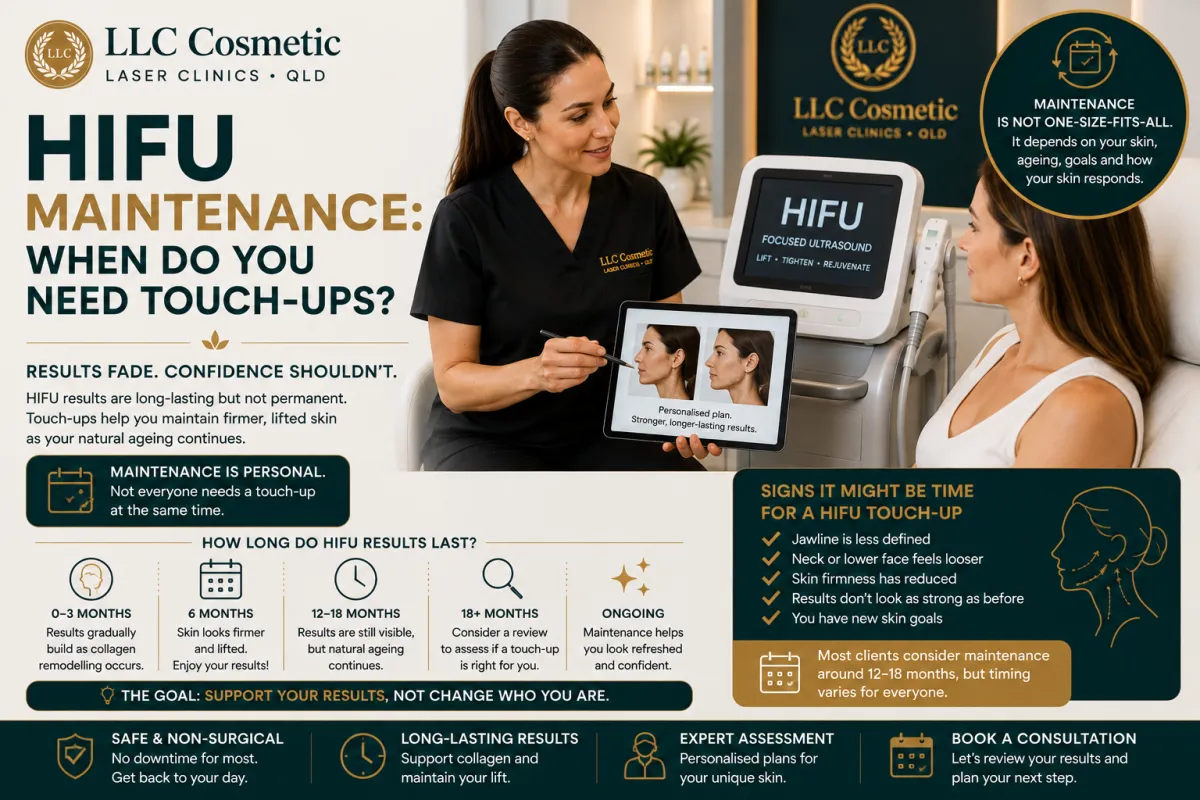
HIFU Maintenance: When Do You Need Touch-Ups?
HIFU can be appealing because it is not a treatment you necessarily need to repeat every few weeks. But after your initial treatment, a common question eventually comes up:
When do I need a HIFU touch-up?
The honest answer is: there is no single maintenance schedule that suits everyone.
Your need for a HIFU maintenance treatment can depend on your age, degree of skin laxity, treatment area, treatment response, natural ageing and personal goals. Current evidence also shows that HIFU protocols vary, which is another reason maintenance should be individualised rather than automatically scheduled on a fixed date.
At LLC Cosmetic, HIFU treatment planning is based on your treatment area, skin laxity, comfort level and goals, with a free suitability consultation available before treatment.
So, rather than asking:
“Exactly how often should I have HIFU?”
A better question is:
“Has my skin changed enough that a maintenance treatment is worth considering?”
Quick Answer: When Do You Need HIFU Maintenance?
For many people, HIFU maintenance may be considered around 12–18 months after treatment, depending on how long their results last and how their skin changes over time.
However, some people may want an earlier review, while others may not feel they need a touch-up until later.
LLC Cosmetic's published HIFU information has described maintenance planning at approximately 12–18 months, while also emphasising individual factors and follow-up assessment.
A sensible approach is:
Allow your initial result time to fully develop
Review your progress before assuming you need more treatment
Consider a maintenance session when natural laxity begins to return
Have your clinician assess whether HIFU is still the right option
First: Don't Rush Into a Touch-Up
One of the biggest mistakes people make is deciding too early that their first HIFU treatment has “worn off” or did not work.
HIFU-related collagen remodelling develops gradually.
LLC Cosmetic's current HIFU treatment page states that results typically build over approximately two to three months as the skin firms.
Clinical research has also found that improvement can continue over months. A systematic review reported continued improvements up to one year in some studies, although longer-term data remain limited and treatment protocols vary.
A practical rule:
Don't schedule a maintenance treatment before you have had enough time to properly assess your initial result.
For many people, this means reviewing progress after the expected results timeline discussed by their clinician rather than judging the treatment after only a few weeks.
What Is a HIFU Maintenance Treatment?
A HIFU maintenance treatment, sometimes called a touch-up, is a follow-up treatment considered after your original treatment result has developed and natural ageing begins to reduce some of the visible tightening.
It does not necessarily mean:
The first treatment failed
You need a full treatment every time
Everyone requires the same amount of treatment
More energy automatically produces better results
Maintenance should ideally be based on what has actually changed.
Your clinician may review:
Jawline definition
Facial firmness
Neck laxity
Your original treatment goals
Your response to the previous treatment
Your current level of skin laxity
At LLC Cosmetic, HIFU suitability and planning are intended to be based on the individual's treatment area, laxity and goals.
How Long Do HIFU Results Last?
There is no universal answer.
Different studies, devices, treatment protocols and patients can produce different timelines.
LLC Cosmetic's published HIFU content has commonly described results lasting approximately 12–18 months, with individual factors influencing longevity.
Research also supports the idea that results may continue for months after treatment, but high-quality evidence on the ideal long-term retreatment schedule remains limited. A 2025 systematic review noted that HIFU research still requires better standardisation and higher-quality evidence.
The most realistic answer is:
HIFU maintenance should be based on how your individual result develops and changes over time—not simply on a calendar reminder.
When Should You Consider a HIFU Touch-Up?
You may want to discuss maintenance if you begin noticing changes similar to your original concern.
1. Your jawline is becoming less defined again
If your initial goal was improved jawline firmness and you gradually notice softness returning, it may be worth having a review.
2. Your neck laxity is becoming more noticeable
Natural ageing continues after HIFU.
A maintenance assessment can help determine whether HIFU is still appropriate for the current degree of laxity.
3. Your facial skin no longer looks as firm as it did after treatment
You may not suddenly “lose” your results.
Instead, you may gradually notice that the improvement you previously saw is becoming less obvious.
Comparing consistent photographs can sometimes be more useful than relying on memory.
Try to compare:
Similar lighting
Similar facial position
Similar camera distance
Similar angles
4. Your goals have changed
Perhaps your first treatment focused on the jawline, but you are now more concerned about the neck.
A maintenance appointment should not automatically repeat your old treatment plan.
Your current concerns should be reassessed.
5. You are approaching your recommended review period
If your clinician suggested reviewing your results around a particular timeframe, this can be a good opportunity to discuss whether maintenance is appropriate.
LLC Cosmetic's published HIFU information has described maintenance as potentially being discussed around the 12–18 month period, depending on individual results.
A Realistic HIFU Maintenance Timeline
Immediately After Treatment
Do not judge your final result yet.
Some people may notice temporary tissue tightening, but the longer-term treatment effect develops gradually.
Around 2–3 Months
LLC Cosmetic states that HIFU results typically build during this period as collagen-related changes develop.
This is often a more useful time to begin assessing your response.
Around 3–6 Months
Depending on your treatment plan and individual response, your clinician may use this period to review progress and discuss whether your original goals were met.
A single treatment should not automatically be repeated simply because a few months have passed.
Around 12–18 Months
For some people, this may be a reasonable time to consider a maintenance review.
But remember:
12–18 months is a general planning range—not a guarantee or mandatory schedule.
Some people may require a different approach depending on their skin, goals and response.
Do You Need a Full HIFU Treatment Every Time?
Not necessarily.
A maintenance appointment should be personalised.
You may not need the same:
Treatment areas
Treatment intensity
Treatment coverage
Treatment pathway
that you had originally.
For example, someone whose main concern was the face and neck may later only want to discuss one area.
That is why reassessment matters.
More treatment is not automatically better treatment.
A systematic review of microfocused ultrasound found that outcomes and protocols vary across studies, reinforcing the importance of treatment planning rather than applying one fixed regimen to everyone.
What Factors Affect How Often You Need HIFU Maintenance?
Your age
Natural skin ageing and collagen changes continue over time.
However, age alone should not determine your maintenance schedule.
Your starting level of skin laxity
Someone with mild early laxity may have different expectations and maintenance needs from someone with more noticeable laxity.
Research suggests that microfocused ultrasound is particularly useful for selected patients with mild to moderate skin laxity.
The treatment area
The face, jawline and neck may age differently.
Your maintenance needs may also differ by area.
Your individual response
Some people notice longer-lasting improvement than others.
Your previous treatment response is useful information when planning future care.
Lifestyle and sun exposure
Your skin continues to be affected by environmental exposure and the natural ageing process.
Long-term skin health strategies, including appropriate sun protection, can be part of a broader maintenance plan.
Your treatment goals
Some people are happy with subtle improvement and may wait longer before considering another treatment.
Others may want to maintain a particular level of contour or firmness.
Neither approach should be assumed without discussion.
Does HIFU Maintenance Mean You Will Need Treatment Forever?
No.
HIFU maintenance is a choice based on your changing goals.
HIFU does not stop the ageing process.
That means your skin can continue to change after treatment, but you are not automatically committed to repeating HIFU indefinitely.
You may choose to:
Have another HIFU session
Wait longer
Explore a different treatment
Combine treatments where appropriate
Do nothing further
The right decision depends on your current concern and desired outcome.
Can You Have HIFU Too Often?
This is one reason not to create your own aggressive maintenance schedule.
HIFU is an energy-based treatment and should be planned appropriately.
A 2025 systematic review and meta-analysis found that treatment-related effects can include erythema, swelling, bruising and tenderness, although these were generally mild to moderate in the analysed studies.
The goal should not be:
“How soon can I do HIFU again?”
It should be:
“Is another treatment clinically appropriate and likely to add meaningful benefit?”
If you are concerned about maintaining results, discuss your treatment history and goals with your clinician.
Signs You May Not Need a Touch-Up Yet
You may not need immediate HIFU maintenance if:
Your results are still developing
You are happy with your current result
Your original concern remains improved
You have not yet reached your clinician's expected review period
You have not noticed meaningful changes in skin laxity
The absence of an immediate follow-up treatment does not mean your maintenance plan is incomplete.
Sometimes the correct answer is simply:
“Wait and reassess later.”
How to Help Maintain Your Skin Between HIFU Treatments
HIFU is only one part of a long-term skin strategy.
You can support your overall skin goals by discussing an appropriate routine with your clinician.
This may include:
Sun protection
UV exposure contributes to visible skin ageing and collagen breakdown.
Consistent skincare
Your skincare should match your individual skin concerns rather than being based only on social media trends.
Healthy lifestyle habits
General habits such as avoiding smoking and maintaining overall health can support long-term skin health.
Regular reviews when appropriate
You do not need to book treatment at every review.
A review can simply help determine whether your current concerns still match the treatment you originally had.
Should You Combine HIFU With Other Treatments Instead of Having Another HIFU Session?
Sometimes, your new concern may not be primarily about skin laxity.
For example, you may now be more concerned about:
Pigmentation
Uneven skin tone
Acne scarring
Surface texture
Volume changes
In that situation, repeating HIFU alone may not address your main concern.
LLC Cosmetic offers different treatment pathways, including HIFU for tightening concerns, PICO Laser for pigmentation and uneven tone, and CO₂ resurfacing for texture, scars and fine lines.
This is why a reassessment before maintenance is useful.
Don't repeat a treatment just because it worked for you before. Repeat it because it still matches your current concern.
HIFU Maintenance vs Starting Over
A maintenance treatment is not always the same as “starting from zero.”
You may still have benefits from your original treatment while natural ageing gradually continues.
The purpose of maintenance is generally to assess whether additional treatment could help support your current goals—not to promise that your face will remain permanently unchanged.
A 2025 review found promising evidence for microfocused ultrasound in improving skin sagging, but also noted the need for more high-quality and standardised research.
That is why realistic expectations remain important.
How LLC Cosmetic Approaches HIFU Maintenance
At LLC Cosmetic, the current HIFU pathway emphasises:
Skin assessment
Treatment planning
Treatment and aftercare
Reviewing your individual next steps
Suitability is based on your treatment area, skin laxity, comfort level and goals.
If you are considering a HIFU touch-up, the best next step is not to assume you need the same treatment again.
Instead, review:
What your original concern was
What improved
What has changed since treatment
What your current goals are
Whether HIFU remains the best option
Final Answer: When Do You Need HIFU Touch-Ups?
There is no universal HIFU maintenance schedule.
For many people, a maintenance review may be considered around 12–18 months, but some may want earlier or later treatment depending on their individual response, degree of skin laxity and goals.
The best approach is:
Allow your results to develop, enjoy the improvement, and reassess when natural changes begin to return or when your clinician recommends a review.
You don't necessarily need HIFU again just because a certain number of months have passed.
Maintenance should follow your skin—not a generic calendar.
If you are unsure whether you need a HIFU touch-up, a suitability consultation can help determine whether maintenance, a different treatment or simply more time is appropriate.
Frequently Asked Questions
How often do you need HIFU maintenance?
There is no universal schedule. Many people discuss maintenance around 12–18 months, but timing should depend on individual results, skin laxity and goals.
Do I need a HIFU touch-up every year?
Not necessarily. Annual maintenance may suit some people, but others may need treatment earlier, later or not at that time.
Can I have HIFU again after six months?
Possibly, but this should be based on your treatment response and clinician assessment rather than an automatic schedule.
How do I know if I need HIFU maintenance?
Consider a review if your original concerns gradually become noticeable again, your skin laxity has changed or you want to discuss new treatment goals.
Will HIFU results disappear completely?
Natural ageing continues after HIFU, so treatment-related improvements may gradually become less noticeable over time. This does not necessarily mean your results suddenly disappear.
Can I maintain HIFU results with skincare alone?
Good skincare and sun protection can support overall skin health, but they are not guaranteed substitutes for a treatment designed to address deeper laxity.
Is a HIFU touch-up the same as a full treatment?
Not always. Your clinician may recommend a different treatment area or plan based on your current concerns.
Medical Disclaimer
This article is for general educational purposes only and does not constitute medical advice, diagnosis or a personalised treatment recommendation. HIFU suitability, treatment intervals, risks and expected outcomes vary between individuals. A qualified clinician should assess your individual circumstances before treatment.