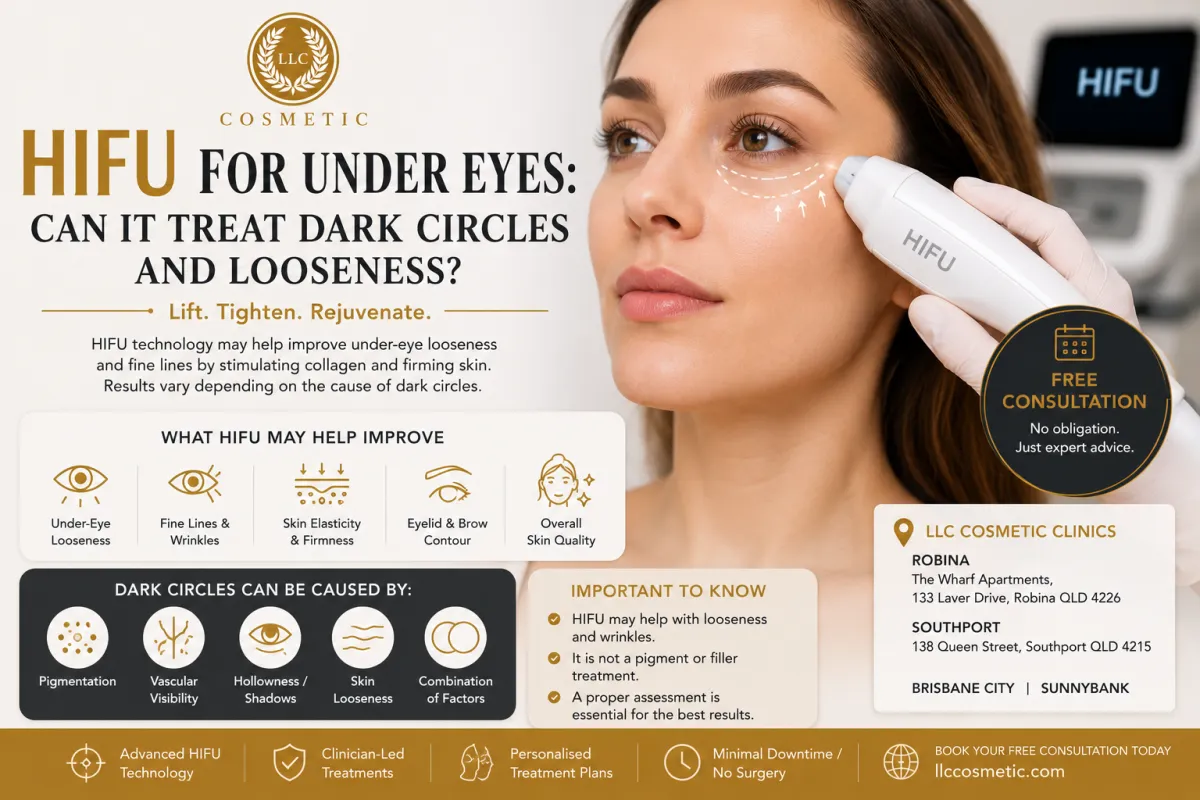
HIFU for Under Eyes: Can It Treat Dark Circles and Looseness?
The under-eye area is one of the first places where many people notice signs of ageing. Skin can become thinner, fine lines may appear more noticeable, the eyelids may look slightly looser and dark circles can become more obvious.
This has led many people to search for:
Can HIFU treat under-eye concerns?
The answer is more nuanced than a simple yes or no.
HIFU may help improve certain under-eye concerns related to skin laxity, wrinkles and tissue firmness. However, it is not a universal treatment for all types of dark circles.
That distinction is important.
Dark circles can be caused by pigmentation, blood vessels, shadowing from hollowness, skin laxity or a combination of several factors. A recent systematic review of under-eye treatments specifically highlights the importance of an anatomy-driven approach because different causes require different treatment strategies.
So before asking:
“Can HIFU remove my dark circles?”
A better question is:
“What is actually causing my under-eye concern?”
At LLC Cosmetic, treatment suitability is intended to be assessed before treatment, with the clinic reviewing the area of concern, skin laxity and treatment goals.
Quick Answer: Can HIFU Treat Under Eyes?
Potentially, yes—but primarily for concerns related to skin laxity and wrinkles.
Current research suggests HIFU-based technologies may improve:
Periorbital wrinkles
Skin elasticity
Surface texture
Eyebrow or eyelid contour
Certain signs of tissue laxity around the eyes
However, the evidence specifically for the periorbital area remains limited and heterogeneous. A 2026 systematic review found favourable outcomes across 10 studies, but concluded that the certainty of evidence was very low because of differences in study design and treatment protocols.
HIFU is not automatically the best treatment for dark circles caused by pigment, vascular visibility or significant under-eye hollowness.
What Causes Dark Circles Under the Eyes?
This is the most important section of the article.
Not all dark circles are actually caused by “dark” skin.
The appearance of dark circles can result from:
1. Pigmentation
The skin itself contains increased pigment, creating a darker brown appearance.
2. Vascular Visibility
Thin under-eye skin can make underlying blood vessels more visible, sometimes creating a blue, purple or reddish appearance.
3. Under-Eye Hollowness
Loss of volume can create a shadow beneath the eyes.
The area may look dark even when there is no significant increase in pigment.
4. Skin Laxity
Loose or crepey skin can change the way light falls across the under-eye area and contribute to a tired-looking appearance.
5. A Combination of Causes
Many people have more than one factor contributing to their under-eye appearance.
A systematic review of periorbital hyperpigmentation similarly describes dark circles as having pigmentary, structural, vascular and mixed causes.
This is why one treatment cannot realistically be expected to solve every type of dark circle.
How HIFU May Help Loose Skin Under the Eyes
HIFU uses focused ultrasound energy to target specific tissue depths beneath the skin.
In the broader facial setting, microfocused ultrasound is used to support skin tightening and collagen remodelling.
For the area around the eyes, the goal may be to improve concerns such as:
Mild skin laxity
Crepey-looking skin
Fine lines
Periorbital wrinkles
Mild changes in eyelid or brow contour
A 2026 systematic review of HIFU for periorbital rejuvenation found improvements in wrinkle severity, biomechanical skin elasticity, skin surface topography and eyebrow or eyelid contour across the included studies.
However, it is important to set realistic expectations:
HIFU may support firmer-looking skin around the eyes, but it is not designed to recreate the results of eyelid surgery or eliminate every type of under-eye concern.
Can HIFU Remove Dark Circles?
Not necessarily.
Whether HIFU can improve the appearance of your dark circles depends on what is causing them.
If Dark Circles Are Mainly Caused by Loose Skin
HIFU may potentially improve the appearance of the area by addressing mild tissue laxity.
If the skin becomes firmer-looking, shadows and fine lines may become less noticeable for some people.
However, improvement should not be guaranteed.
If Dark Circles Are Caused by Pigmentation
HIFU may not be the most direct treatment approach.
Pigment-based concerns may require a pigmentation-focused strategy instead.
LLC Cosmetic currently positions PICO Laser for concerns including pigmentation, sun spots and uneven tone.
If Dark Circles Are Caused by Under-Eye Hollowness
HIFU does not replace lost facial volume.
Structural hollowness can create shadows that make the under-eye area appear darker.
In a systematic review of periorbital hyperpigmentation, soft tissue fillers and autologous fat grafting were reported as more effective options for dark circles related to volume loss.
If Dark Circles Have Multiple Causes
A combination approach may sometimes be more appropriate.
For example, someone may have:
Mild pigmentation
Thin skin
Fine lines
Some skin laxity
Mild hollowness
In this situation, treating only one issue may not completely change the overall appearance of the under-eye area.
That is why consultation and diagnosis of the underlying concern matter.
What Does the Research Say About HIFU Around the Eyes?
The research is promising but should be interpreted carefully.
A 2026 systematic review evaluated HIFU technologies for periorbital rejuvenation and included 10 studies involving adults treated for concerns around the eyes.
Across the included studies, improvements were reported in:
Wrinkle severity
Skin elasticity
Skin texture
Eyebrow contour
Eyelid contour
Most adverse effects were described as mild and temporary, including redness, swelling and pain. However, rare complications were reported, and the review concluded that the certainty of evidence was very low because the studies were heterogeneous and mostly non-randomised.
This gives us a realistic conclusion:
HIFU shows potential for periorbital rejuvenation, but more high-quality research is still needed to establish the best devices, protocols and treatment approaches.
Is the Under-Eye Area Suitable for HIFU?
The eye area is delicate.
That means treatment should never be approached casually.
The suitability of HIFU around the eyes can depend on:
The exact area being considered
Your degree of skin laxity
Your anatomy
Your existing under-eye concerns
The device being used
The treatment protocol
Practitioner assessment
The current HIFU evidence shows substantial variation in treatment devices, focal depths, energy settings and protocols.
This is one reason a person should not assume that every HIFU clinic offers the same type of treatment around the eyes.
Can HIFU Help With Crepey Under-Eye Skin?
Potentially, yes, for suitable candidates.
Crepey skin is often associated with:
Reduced skin elasticity
Fine lines
Collagen changes
Mild skin laxity
HIFU may help support collagen-related remodelling and firmer-looking skin.
The recent systematic review of periorbital HIFU found improvements in skin elasticity and surface texture across the included studies.
However, the result may be limited when:
The skin laxity is advanced
Significant excess skin is present
The main concern is volume loss
The primary problem is pigmentation
Can HIFU Reduce Under-Eye Bags?
This depends on what you mean by “bags.”
Under-eye bags can involve:
Fat protrusion
Fluid retention
Skin laxity
Structural anatomy
HIFU may potentially improve mild skin laxity in selected cases, but it should not be assumed to remove prominent fat pads or correct every form of under-eye puffiness.
For significant structural under-eye bags, another treatment approach may be more appropriate.
HIFU for Under Eyes vs Dark Circle Treatments
The best treatment depends on the cause.
Concern: Loose or Crepey Skin
A tightening-focused approach such as HIFU may be worth discussing.
Concern: Pigmentation
A pigmentation-focused treatment may be more relevant.
Concern: Volume Loss and Shadowing
A structural or volume-focused approach may be more appropriate.
Concern: Surface Texture and Fine Lines
Depending on the skin and treatment plan, resurfacing or other skin-quality treatments may be considered.
LLC Cosmetic currently offers different treatment pathways for different concerns rather than positioning HIFU as a solution for every skin problem. HIFU is positioned for sagging and laxity, while PICO Laser and CO₂ resurfacing are directed toward other concerns such as pigmentation, texture and fine lines.
The right treatment depends on the problem—not simply the body area.
How Long Does It Take to See HIFU Results Around the Eyes?
HIFU results generally develop gradually.
LLC Cosmetic states that HIFU results typically build over approximately two to three months as the skin firms.
Research on microfocused ultrasound has also found that skin improvements can continue over several months after treatment.
This means you should not judge the final outcome immediately after treatment.
A realistic timeline may involve:
Immediately After Treatment
You may notice temporary redness or mild swelling.
Over the Following Weeks
The treated area continues through its natural recovery and remodelling process.
Over Several Months
Changes in skin firmness and texture may gradually become more noticeable.
Your exact timeline should depend on your treatment plan and clinician's assessment.
Does HIFU Hurt Around the Eyes?
The treatment experience varies.
The eye area is sensitive, and comfort should be discussed before treatment.
In a 2025 systematic review and meta-analysis of microfocused ultrasound with visualisation, patients reported moderate treatment discomfort on average, while common adverse effects such as redness, swelling, bruising and tenderness were generally mild to moderate.
Your clinician should explain:
What the treatment feels like
How the eye area is protected
What temporary effects may occur
What aftercare is recommended
When to contact the clinic after treatment
Is There Downtime After Under-Eye HIFU?
HIFU is generally chosen because it is a non-surgical treatment with limited disruption for many patients.
LLC Cosmetic describes HIFU as having no downtime for most clients and notes that many can return to their normal day immediately.
However, temporary effects can still occur.
These may include:
Mild redness
Temporary swelling
Tenderness
Sensitivity
Because the eye area is delicate, individual aftercare advice should always come from the treating clinician.
Who May Be a Good Candidate for HIFU Under the Eyes?
You may want to discuss HIFU if your primary concern includes:
Mild under-eye skin laxity
Crepey-looking skin
Fine lines around the eyes
Early signs of tissue laxity
A desire for non-surgical skin tightening
The strongest candidates are not necessarily those with the darkest under-eye circles.
They are people whose concerns actually match what a skin-tightening treatment may be able to address.
Who May Need a Different Treatment?
HIFU may not be the most suitable first option if your primary concern is:
Significant pigmentation
Deep under-eye hollowness
Pronounced structural bags
Advanced excess skin
A desire for an immediate dramatic transformation
This does not mean your concern cannot be treated.
It simply means:
HIFU may not be the treatment that best matches the cause.
What Should You Ask Before Booking HIFU for Under Eyes?
Before booking, consider asking:
Is my under-eye concern caused mainly by laxity, pigment, hollowness or something else?
Is the exact area I want treated appropriate for HIFU?
What improvement is realistically possible?
What device and treatment protocol will be used?
How is the eye area protected?
How long should I wait before judging the final result?
Would another treatment better address my primary concern?
These questions can help you avoid spending money on a treatment that does not match your actual problem.
How LLC Cosmetic Approaches HIFU Suitability
LLC Cosmetic's current HIFU treatment pathway emphasises:
Skin assessment
Review of the treatment area
Assessment of skin laxity and goals
Treatment planning before booking
The clinic states that suitability depends on the treatment area, skin laxity, comfort level and goals.
For under-eye concerns, this type of assessment is especially important because “dark circles” can describe several different problems.
Final Answer: Can HIFU Treat Dark Circles and Under-Eye Looseness?
HIFU may help improve under-eye concerns related to mild skin laxity, wrinkles and skin firmness.
Current evidence suggests that HIFU-based technologies can improve periorbital wrinkles, elasticity, texture and certain contour changes around the eyes. However, the research remains limited and the certainty of evidence is low.
HIFU is not a guaranteed treatment for dark circles.
If your dark circles are mainly caused by:
Pigmentation
Blood vessels
Under-eye hollowness
Fat protrusion
another treatment approach may be more appropriate.
The most important step is identifying why your under-eye area looks dark, tired or loose before choosing a treatment.
Treat the cause—not just the appearance.
If you are unsure whether HIFU is appropriate for your under-eye concerns, start with a professional suitability assessment rather than choosing a treatment based only on online before-and-after photos.
Frequently Asked Questions
Can HIFU remove dark circles?
Not necessarily. HIFU may help if skin laxity contributes to the appearance of the under-eye area, but dark circles caused by pigmentation, vascular visibility or hollowness may require a different approach.
Is HIFU safe around the eyes?
HIFU has been studied for periorbital rejuvenation, with generally mild and temporary adverse effects reported in the available studies. However, the eye area is delicate, and treatment suitability and protocol should be assessed carefully by a qualified clinician.
Can HIFU tighten loose under-eye skin?
It may help improve mild skin laxity and skin elasticity in suitable candidates. Research has reported improvements in elasticity, wrinkle severity and periorbital contour, but outcomes vary.
Can HIFU get rid of under-eye bags?
Not all under-eye bags are caused by loose skin. If prominent fat protrusion or structural anatomy is the main issue, HIFU may not provide the result you want.
How long does HIFU take to work around the eyes?
Results may develop gradually over weeks to months. LLC Cosmetic currently advises that HIFU results typically build over approximately two to three months.
Is HIFU good for crepey under-eye skin?
Potentially, for suitable candidates whose concern is related to mild laxity and reduced skin elasticity. It is not a guarantee for every person or every degree of crepey skin.
Is HIFU better than laser for dark circles?
They address different concerns. HIFU is primarily a tightening-focused treatment, while laser approaches may be more relevant for certain pigmentation or surface concerns. The best option depends on the cause of your dark circles.
Medical Disclaimer
This article is for general educational purposes only and does not constitute medical advice, diagnosis or a personalised treatment recommendation. The under-eye area is delicate, and HIFU suitability, risks, protocols and expected outcomes vary between individuals. A qualified clinician should assess your specific concerns before treatment.