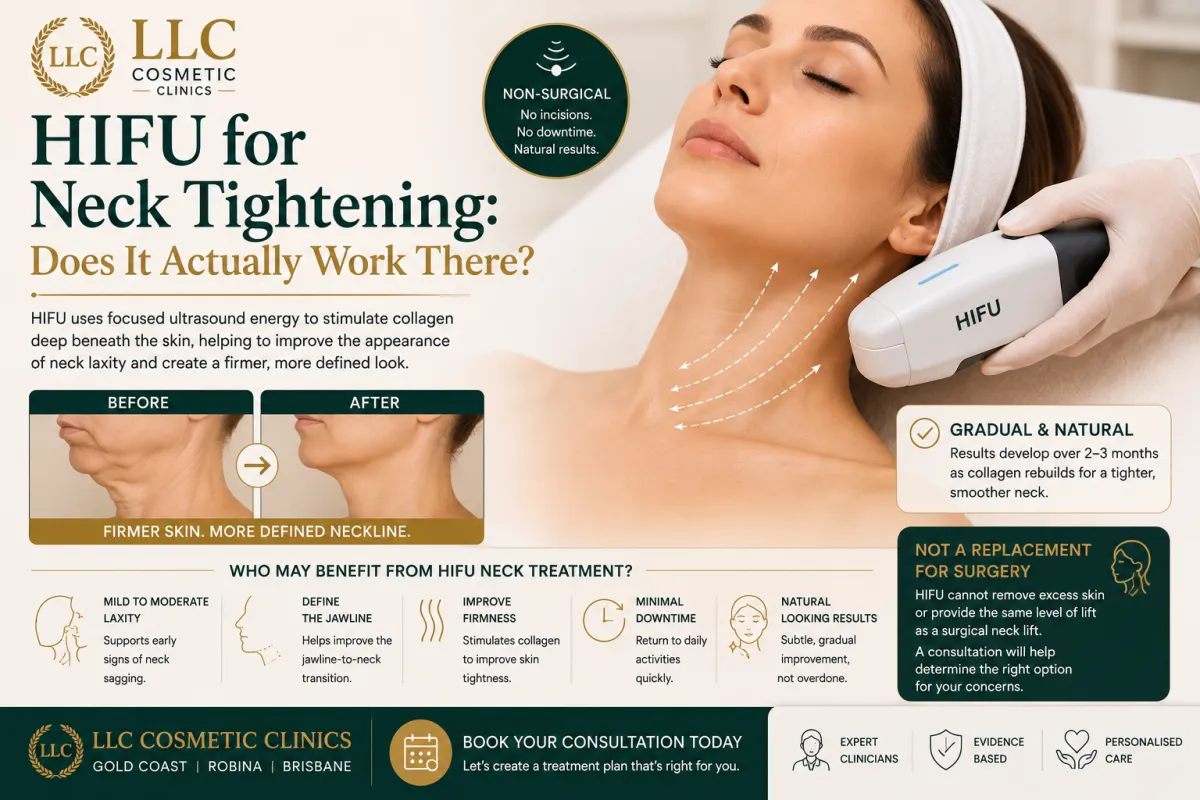
HIFU for Neck Tightening: Does It Actually Work There?
When people think about HIFU, they often think about the jawline, cheeks or lower face.
But what about the neck?
If you're noticing loose-looking skin, early sagging or a less-defined transition between your jaw and neck, you may be wondering:
Does HIFU actually work for neck tightening?
The answer is yes, HIFU can be used to target neck skin laxity in appropriate patients, but realistic expectations are important.
Clinical studies and reviews have found that focused ultrasound can improve the appearance of facial and neck skin laxity, with results generally developing gradually rather than appearing like an immediate surgical lift.
HIFU isn't designed to remove excess skin or replace neck-lift surgery. Instead, it is a non-surgical treatment option for selected people who want to improve the appearance of firmness and laxity.
HIFU for Neck Tightening: The Quick Answer
If your main concern is:
“My neck is starting to look loose or less firm.”
HIFU may be a treatment worth discussing.
If your concern is:
“I have a large amount of excess skin.”
HIFU may not provide the degree of correction you're expecting.
The difference comes down to how much laxity is present and what is causing it.
HIFU uses focused ultrasound energy at targeted depths beneath the skin. Research involving the face and neck has reported improvements in skin laxity and rejuvenation, although the overall effect is generally described as moderate.
What Is HIFU?
HIFU stands for High-Intensity Focused Ultrasound.
It is a non-surgical treatment that delivers focused ultrasound energy to specific depths beneath the skin.
The energy creates controlled thermal effects within targeted tissue, stimulating a response associated with collagen remodelling.
Over time, this can contribute to an improvement in the appearance of:
Skin firmness
Skin laxity
Neck definition
Jawline definition
Loose-looking skin
The treatment is different from a laser because it doesn't primarily work by resurfacing the outermost layer of the skin.
Does HIFU Work on the Neck?
It can.
The neck has been specifically studied as a treatment area for microfocused ultrasound.
One prospective study evaluating microfocused ultrasound for facial and neck skin laxity reported improvements at follow-ups extending to one year, although the study was small and used a specific treatment protocol.
Another clinical study evaluating microfocused ultrasound for face and upper-neck laxity reported improvement in physician-assessed outcomes at both 90 and 180 days after treatment.
A 2020 systematic review and meta-analysis covering 17 studies and 477 participants concluded that HIFU had a moderate effect on face and neck rejuvenation and a generally favorable short-term safety profile.
More recent evidence continues to support the potential for HIFU to improve skin tightening, including in the neck, although researchers note that treatment protocols and patient selection are not completely standardized.
So the answer isn't simply “HIFU works” or “HIFU doesn't work.”
The better answer is:
HIFU can improve the appearance of neck laxity in suitable patients, but the amount of improvement varies.
What Does HIFU Actually Do to the Neck?
HIFU is primarily intended to address skin laxity and firmness.
As we age, the skin and underlying supporting tissues can become less firm.
This can contribute to:
A softer-looking jawline
Early neck sagging
Less-defined facial contours
Loose-looking skin underneath the chin
Changes in the appearance of the neck
HIFU aims to stimulate a tissue response that can support collagen remodelling.
The result is generally gradual tightening rather than an instant lift.
Can HIFU Tighten Loose Neck Skin?
It depends on how loose the skin is.
HIFU may be more appropriate when the concern involves mild to moderate laxity.
For example, you may notice:
Early signs of loose skin
Mild neck laxity
Slight loss of firmness
A less-defined jawline
Early changes underneath the chin
Research suggests that excessive skin laxity can be associated with less favorable outcomes from microfocused ultrasound treatments.
That means HIFU isn't necessarily the right answer for everyone with a sagging neck.
What If You Have Significant Excess Skin?
This is where realistic expectations become especially important.
HIFU doesn't surgically remove excess skin.
If you have substantial loose skin or pronounced neck ageing, a non-surgical tightening treatment may not create the level of correction you want.
Surgical neck-lifting procedures are fundamentally different because they can address excess tissue and deeper structural changes.
So if someone has significant excess skin, it may be more appropriate to discuss surgical options with a qualified surgeon rather than expecting HIFU to produce a surgical result.
HIFU for Neck Tightening vs Neck Lift
These treatments shouldn't be considered interchangeable.
HIFU
Non-surgical
HIFU uses focused ultrasound energy to target tissue beneath the skin.
It may be considered for:
Mild to moderate laxity
Early neck ageing
Loss of firmness
Less-defined contours
Results are generally gradual.
Surgical Neck Lift
Surgical
A neck lift is a surgical procedure designed to address more significant changes in the neck.
Depending on the procedure and individual anatomy, surgery may address:
Excess skin
Deeper tissue laxity
More pronounced neck sagging
Significant contour changes
It involves surgery and therefore has a different risk profile and recovery process.
The important point is:
HIFU is not a non-surgical version of neck-lift surgery.
Can HIFU Improve a Double Chin?
This depends on what is creating the appearance of a double chin.
A fuller-looking area underneath the chin can involve different factors, including:
Skin laxity
Fat
Anatomy
Muscle and soft-tissue structure
If loose skin is a significant part of the concern, tightening may potentially improve the appearance of the area.
However, HIFU should not automatically be viewed as a fat-removal treatment.
If the primary concern is excess submental fat rather than skin laxity, a different treatment approach may be more appropriate.
This is why an assessment is important before choosing a treatment.
Can HIFU Define the Jawline and Neck?
Potentially, yes — particularly when mild laxity is contributing to a less-defined contour.
Improving skin firmness can make the transition between the jawline and neck appear more defined.
But again, HIFU isn't removing large amounts of tissue.
The result depends on your starting anatomy and the cause of the lack of definition.
How Long Does It Take to See HIFU Neck Results?
One of the biggest misconceptions about HIFU is expecting an immediate transformation.
HIFU results generally develop gradually.
Clinical studies have assessed outcomes at approximately 90 days, 180 days and even one year after treatment.
This makes sense because the treatment is associated with a collagen-remodelling process rather than simply pulling the skin tighter mechanically.
You may therefore notice changes progressively rather than waking up the next morning with a dramatically tighter neck.
What Kind of HIFU Neck Results Are Realistic?
A realistic goal is usually:
firmer-looking skin + improved definition + a gradual tightening effect
rather than:
a completely lifted neck with all excess skin removed.
Clinical evidence suggests the degree of improvement varies significantly between patients and treatment protocols. A 2025 systematic review found improvements in skin laxity across several anatomical areas, including the neck, while also noting the need for greater standardisation in treatment protocols and patient selection.
So before treatment, it's worth asking:
“What improvement is realistic for my particular neck?”
rather than:
“How much can HIFU lift?”
Does HIFU Hurt on the Neck?
HIFU can cause discomfort during treatment.
The experience varies between individuals and depends on the device, treatment settings, treatment area and individual sensitivity.
A systematic review of HIFU for face and neck rejuvenation reported a mean pain score in the moderate range, although different studies used different protocols.
Another systematic review of microfocused ultrasound reported moderate pain as a common treatment experience, with temporary redness, swelling or tenderness also reported.
Your practitioner should explain what sensations to expect before treatment.
Is There Downtime After HIFU on the Neck?
One of the reasons people consider HIFU is that it is non-surgical.
Temporary effects such as:
Redness
Swelling
Tenderness
Bruising
Sensitivity
can occur.
Most reported adverse effects in clinical literature have been mild and temporary, although complications can occur, particularly if treatment is not performed appropriately.
Your practitioner should provide specific aftercare instructions based on the treatment performed.
Who May Be a Good Candidate for HIFU Neck Tightening?
HIFU may be worth discussing if you:
Have mild to moderate neck skin laxity
Are noticing early signs of sagging
Want a non-surgical treatment
Want gradual improvement
Have realistic expectations
Want to improve the appearance of firmness
It may be less suitable if your main concern is significant excess skin or if you're expecting a facelift-level result.
Suitability should always be assessed individually.
Who May Need a Different Treatment?
HIFU isn't the answer to every neck concern.
You may need a different approach if your primary concern is:
Significant excess skin
A surgical assessment may be more appropriate.
Excess fat
A treatment specifically designed to address submental fat may need to be considered.
Skin pigmentation
A pigmentation-focused treatment may be more relevant.
Surface texture
A resurfacing treatment may be more appropriate.
Fine lines and wrinkles
Depending on the cause, different skin-rejuvenation options may be considered.
This is why “What treatment should I get?” is often less useful than asking:
“What is actually causing my concern?”
HIFU for Neck Tightening: What the Evidence Says
The research is encouraging, but it's important not to oversell it.
A systematic review and meta-analysis found that HIFU can provide a moderate improvement in facial and neck rejuvenation.
A 2025 systematic review covering 45 clinical trials and cohort studies found evidence of skin-tightening benefits, including in the lower face and neck, while also identifying variation in treatment protocols and the need for further research.
Other studies have reported improvement in neck laxity following microfocused ultrasound treatment.
At the same time, evidence isn't perfect.
Different studies use different devices, energy settings, treatment protocols and ways of measuring improvement.
That's why a responsible clinic should avoid promising identical results for every client.
Why Your HIFU Neck Results May Differ From Someone Else's
Two people can have the same treatment and experience different results.
Factors can include:
Age
Degree of skin laxity
Skin characteristics
Facial and neck anatomy
Treatment area
Device used
Treatment settings
Treatment technique
Individual biological response
Previous treatments
This is one reason before-and-after photographs should be interpreted carefully.
A result that looks impressive on one person may not be achievable for another person with a different starting point.
HIFU for Neck Tightening: The Bottom Line
Does HIFU actually work for neck tightening?
For suitable patients, yes, HIFU can improve the appearance of neck skin laxity and firmness.
Research supports its use as a non-surgical option for facial and neck rejuvenation, with studies showing gradual improvements in skin laxity.
But HIFU has limitations.
It isn't designed to remove significant excess skin, and it shouldn't be expected to produce the same level of correction as surgery.
The most realistic way to think about HIFU is:
A non-surgical option for improving the appearance of mild to moderate skin laxity — not a replacement for every type of neck-lifting procedure.
Considering HIFU for Neck Tightening?
If you're noticing early neck sagging, loss of firmness or a less-defined jawline, an assessment can help determine whether HIFU is appropriate for your concerns.
At LLC Cosmetic, the goal should be suitability first, treatment second.
Instead of choosing a treatment simply because you've seen it advertised, it's better to understand:
What is causing your concern?
How much skin laxity is present?
What level of improvement is realistic?
Is HIFU appropriate for you?
Would another treatment be more suitable?
Book a consultation with LLC Cosmetic to discuss your neck-tightening goals and explore your treatment options.
Frequently Asked Questions
Does HIFU work on the neck?
Yes. Clinical studies and systematic reviews have found that focused ultrasound can improve the appearance of neck skin laxity and firmness in suitable patients.
Is HIFU good for a sagging neck?
HIFU may be appropriate for mild to moderate skin laxity. Significant excess skin may require a different treatment approach.
Can HIFU remove neck fat?
HIFU should not automatically be considered a fat-removal treatment. A double chin can have several causes, including fat and skin laxity, and the appropriate treatment depends on the underlying concern.
How long does HIFU neck tightening take to work?
Results are generally gradual. Studies have assessed improvement at approximately 90 and 180 days, with some studies following patients for up to one year.
How long do HIFU neck results last?
The duration varies between individuals and depends on factors including the treatment protocol, degree of laxity and individual response. Research has reported improvements lasting months and, in some studies, up to a year, but longer-term evidence remains limited.
Is HIFU better than a neck lift?
HIFU and a surgical neck lift are different treatments. HIFU is non-surgical and generally suited to less pronounced laxity, while surgery can address more significant excess skin and structural changes.
Does HIFU hurt on the neck?
HIFU can cause moderate discomfort during treatment. The experience varies depending on the individual, device and treatment settings.
Medical Disclaimer
This article is for general educational purposes only and does not constitute medical advice, diagnosis or treatment. Suitability, treatment settings, potential risks and expected results vary between individuals. A qualified clinician should assess your skin, medical history and treatment goals before treatment.