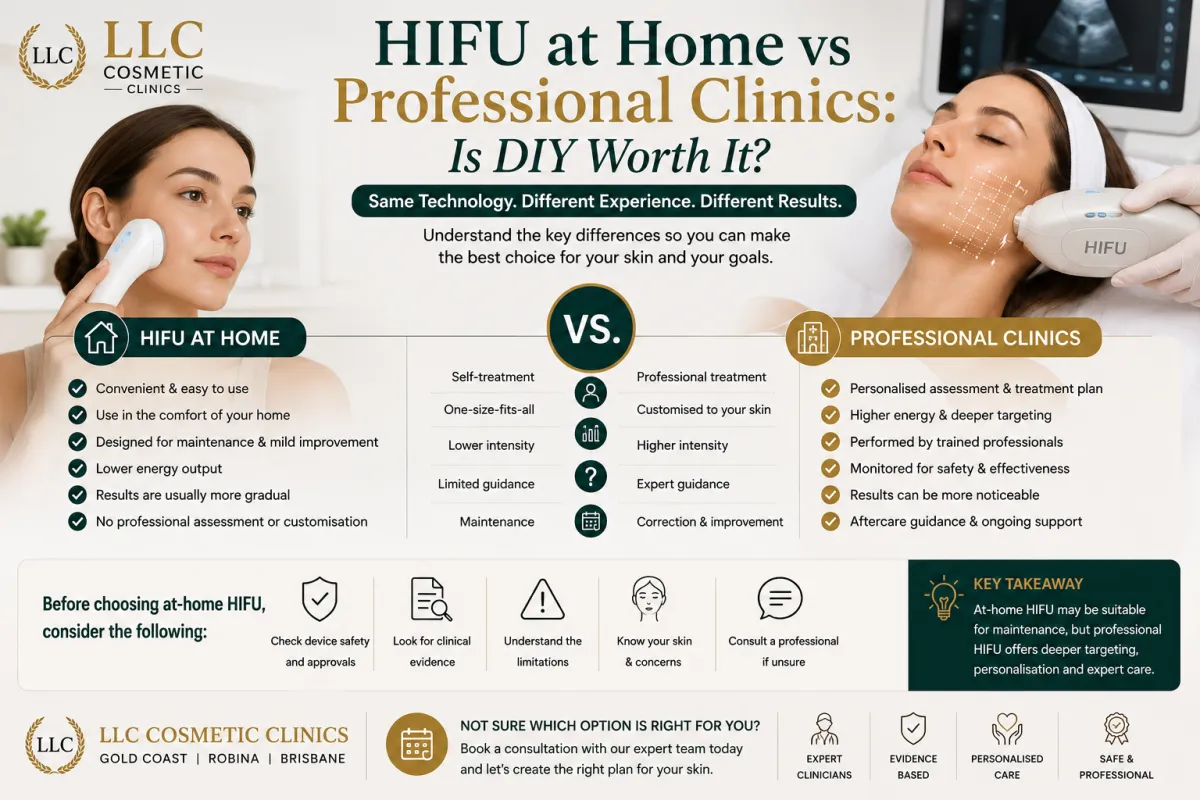
HIFU at Home vs Professional Clinics: Is DIY Worth It?
If you've been researching HIFU for skin tightening, you've probably seen handheld beauty devices marketed for use at home.
They can look appealing because they're convenient, don't require a clinic appointment and may cost less than professional treatment.
But that raises an important question:
Is at-home HIFU actually comparable to professional treatment?
The answer is not necessarily.
Home-use devices and professional aesthetic treatments can differ significantly in energy output, treatment depth, device design, safety controls and how the treatment is selected and performed. Evidence for home-use skin devices also varies considerably depending on the technology.
If your goal is meaningful skin tightening, it's important to understand the difference before deciding whether DIY treatment is worth it.
HIFU at Home vs Professional HIFU: The Quick Answer
Here's the simplest way to think about it:
At-home device:
Designed for consumer use, convenience and self-treatment.
Professional treatment:
Performed using professional equipment and a treatment protocol selected for the individual.
At-home treatment may be more convenient:
You can use a consumer device without travelling to a clinic.
Professional treatment may provide a more controlled approach:
A qualified practitioner can assess your skin, treatment area and suitability before treatment.
The devices are not necessarily equivalent:
A device marketed as "HIFU" for home use should not automatically be assumed to deliver the same treatment as a professional HIFU system.
For significant skin laxity:
DIY treatment should not be assumed to provide the same results as a professionally performed procedure.
What Is HIFU?
HIFU stands for High-Intensity Focused Ultrasound.
HIFU uses focused ultrasound energy to create a controlled thermal effect at targeted depths.
In aesthetic medicine, HIFU has been studied for applications including skin tightening and facial rejuvenation. A 2025 systematic review identified 45 clinical trials and cohort studies evaluating HIFU for aesthetic applications such as skin tightening and body contouring.
The goal is generally to stimulate a tissue response associated with collagen remodelling and improvement in the appearance of skin laxity.
However, not every ultrasound or "HIFU" device is the same.
The device, energy level, treatment depth and treatment protocol all matter.
What Is At-Home HIFU?
At-home HIFU refers to consumer devices marketed for people to use themselves outside a professional clinic.
The important thing to understand is that the term "HIFU" alone does not tell you everything about a device.
Before purchasing any home-use device, you should check:
What technology it actually uses
Its intended cosmetic purpose
Whether it is authorised for home use in your country
The manufacturer's instructions
Contraindications and warnings
Whether there is credible clinical evidence supporting its specific claims
The FDA notes that home-use medical devices can create additional safety considerations because sophisticated devices may be used without professional supervision.
Why Professional HIFU Is Different
Professional treatment isn't simply about having access to a more expensive machine.
A professional treatment involves several steps before the device is even used.
These can include:
Assessing your skin
Identifying the treatment concern
Reviewing relevant medical history
Determining whether the treatment is appropriate
Selecting appropriate treatment areas
Selecting treatment parameters
Positioning the device correctly
Monitoring your response during treatment
Providing aftercare instructions
This matters because the treatment needs to match the person, not just the machine.
Does Professional HIFU Use More Energy?
You should be careful with claims that professional HIFU is simply "stronger."
The more accurate distinction is that professional and consumer devices may be designed for different purposes and operate under different specifications.
A professional HIFU system may be designed to deliver focused ultrasound to defined treatment depths under a controlled clinical protocol.
A consumer device may be designed with limitations appropriate for home use.
Therefore, you shouldn't assume:
"More energy = better results."
Higher energy can also mean greater potential for adverse effects if the device is inappropriate or incorrectly used.
The FDA identifies potential risks associated with therapeutic ultrasound, including pain, swelling, blisters, burns and nerve damage.
Can You Get the Same Results at Home?
This is where expectations matter.
You shouldn't assume that an at-home device will produce the same results as professional HIFU.
Research on home-use dermatologic devices suggests that many consumer devices operate at lower energy levels and may provide more modest or gradual results compared with professional equipment.
There are clinical studies showing that certain home-use devices can produce measurable improvements.
However, these studies are device-specific.
For example, one 2024 randomized study evaluated a particular home-use device combining low-level light, low-dose RF, microcurrent and low-intensity ultrasound. That study does not establish that every home-use "HIFU" device is effective or equivalent to professional HIFU.
That's an important distinction when evaluating online claims.
What Are the Main Advantages of HIFU at Home?
At-home devices can have some practical advantages.
Convenience
You don't need to travel to a clinic for every use.
Privacy
Some people prefer performing cosmetic treatments privately at home.
Accessibility
A consumer device may allow you to incorporate a treatment into your personal skincare routine.
Potential maintenance use
Some appropriately designed home-use devices may be intended for ongoing maintenance rather than significant correction.
However, these advantages don't automatically mean the device is suitable for everyone.
What Are the Disadvantages of DIY HIFU?
There are also important limitations.
You may not know whether you're a suitable candidate
A consumer device cannot replace an individual clinical assessment.
You may not know what you're actually treating
Skin laxity, facial volume changes, excess fat and skin texture can look similar to an untrained eye but may require very different approaches.
Incorrect use can cause injury
Ultrasound energy can produce biological effects in tissue. Depending on the device and application, inappropriate use can cause burns or other complications.
Online marketing can be misleading
A device being advertised as "HIFU" doesn't automatically establish that it is equivalent to a professional aesthetic HIFU system.
Results may be limited
Home-use devices may be designed for lower-intensity treatment and maintenance rather than significant skin tightening.
Is At-Home HIFU Safe?
The answer depends on the specific device and how it is used.
Don't assume that every device sold online is safe simply because it is marketed as a beauty device.
The FDA has specifically warned consumers about certain unauthorised ultrasound devices marketed for home use, citing potential adverse effects including pain, bruising, burns, scarring, nerve damage, muscle weakness and numbness.
That warning does not mean every home-use ultrasound device is dangerous.
It means consumers should verify the device, its intended use and its regulatory status rather than relying solely on advertising claims.
What Should You Check Before Buying an At-Home HIFU Device?
If you're considering DIY treatment, don't purchase based only on before-and-after photographs.
Instead, check:
1. Is the device actually intended for home use?
Look for clear manufacturer information stating that the device is designed for consumer use.
2. What is the intended use?
Check exactly what the manufacturer says the device is designed to do.
3. Is there credible evidence?
Look for clinical evidence relating to the specific device, rather than evidence for HIFU in general.
4. What are the contraindications?
Read the manufacturer's warnings and determine whether any apply to you.
5. Is the device properly authorised or registered?
Regulatory requirements differ between countries, so check the relevant authority for where you live.
6. Is there proper customer support?
You should be able to access clear instructions and safety information.
HIFU at Home vs Professional HIFU
Instead of using a complicated comparison table, here's the practical difference:
Treatment selection
At home: You decide what area to treat.
Professional clinic: The practitioner assesses your concerns and determines whether treatment is appropriate.
Device selection
At home: You choose a consumer device.
Professional clinic: The clinic uses a professional system appropriate for the treatment being performed.
Treatment parameters
At home: You generally follow the manufacturer's consumer instructions.
Professional clinic: Treatment parameters can be selected according to the device, treatment area and clinical protocol.
Assessment
At home: There is no professional assessment unless you seek one separately.
Professional clinic: Your suitability can be assessed before treatment.
Monitoring
At home: You are responsible for monitoring your own treatment.
Professional clinic: A practitioner performs and monitors the treatment.
Treatment goals
At home: Usually focused on convenience, maintenance or gradual cosmetic improvement.
Professional clinic: Can be planned around specific concerns such as skin laxity and facial contour.
Is DIY HIFU Worth It?
For someone looking for convenience and a potentially modest maintenance treatment, a properly designed home-use skincare device may have a place in a broader skincare routine.
But if your main goal is noticeable improvement in skin laxity or facial tightening, you shouldn't assume a consumer device will provide the same outcome as professional treatment.
The biggest advantage of professional treatment isn't simply the equipment.
It's the combination of:
Assessment + appropriate technology + treatment planning + controlled application.
What About HIFU for Jowls?
Jowls can develop for several reasons, including changes in skin laxity, tissue support and facial structure.
If you're considering HIFU specifically for jowls, a professional assessment can help determine whether skin tightening is actually the appropriate approach.
DIY treatment may not address the underlying reason for reduced jawline definition.
For example, if the primary concern is excess fat or significant excess skin, ultrasound skin tightening alone may not produce the result you're expecting.
What About HIFU for the Neck?
The same principle applies to the neck.
HIFU has been studied for facial and neck rejuvenation, but treatment suitability varies between individuals.
If you're considering treatment for neck laxity, a professional assessment can help determine whether HIFU is appropriate and what level of improvement may realistically be expected.
Can At-Home HIFU Replace Professional Treatment?
Not automatically.
At-home devices and professional treatments should not be treated as interchangeable simply because they use similar terminology.
A home-use device may be appropriate for a specific consumer skincare purpose.
Professional HIFU is a different treatment context involving clinical assessment and professional application.
If you're looking for significant correction of skin laxity, it's better to discuss your options with a qualified practitioner rather than assuming a DIY device can reproduce a professional result.
What About the Cost?
At-home treatment can appear cheaper because you purchase a device instead of paying for individual clinic sessions.
But cost shouldn't be the only consideration.
Think about:
Device quality
Evidence supporting the device
Safety
Expected results
How frequently it needs to be used
Whether the device is appropriate for your concern
The potential cost of treating complications if something goes wrong
A cheaper treatment isn't necessarily better value if it doesn't address the problem you're trying to solve.
The Bottom Line: Is DIY HIFU Worth It?
HIFU at home can sound appealing, but it shouldn't automatically be considered a substitute for professional treatment.
Home-use devices can offer convenience, and some consumer skincare technologies have evidence supporting modest improvements when used appropriately.
However, professional HIFU involves a different treatment environment, including assessment, treatment planning, device selection and controlled application.
If your main concern is mild skin laxity, jowls, jawline definition or neck tightening, a professional assessment can help determine whether HIFU is actually appropriate for your goals.
At LLC Cosmetic, the approach is:
Suitability first. Treatment second.
Rather than choosing a DIY device based on an online advertisement, understand what you're treating and whether the technology is appropriate for your skin.
Frequently Asked Questions
Is at-home HIFU as effective as professional HIFU?
You should not assume that it is. Home-use devices may operate differently from professional systems and are often designed for lower-intensity consumer use. Evidence also varies substantially between individual devices.
Can I use HIFU at home for sagging skin?
Some devices are marketed for home cosmetic use, but their suitability and effectiveness depend on the specific device. Significant skin laxity should be assessed by a qualified professional rather than treated solely based on an online product claim.
Is DIY HIFU safe?
Safety depends on the specific device, its intended use and whether it is used according to the manufacturer's instructions. Ultrasound-based devices can have risks, including burns and nerve injury when used inappropriately.
Can home HIFU replace a professional HIFU treatment?
Not necessarily. Home-use and professional systems may have different specifications, intended uses and treatment protocols.
Does home HIFU work for jowls?
Results depend on the device and the reason for the jowling. If reduced jawline definition is caused by significant skin laxity, excess fat or other structural changes, a home device may not address the underlying issue.
Is professional HIFU worth the extra cost?
For someone seeking a more targeted approach to skin laxity, the benefit of professional treatment includes assessment and treatment planning in addition to the device itself. Whether it is worth the cost depends on your individual goals and suitability.
Medical Disclaimer
This article is for general educational purposes only and does not constitute medical advice, diagnosis or treatment. Suitability, treatment settings, risks and expected results vary between individuals. A qualified clinician should assess your skin, medical history and treatment goals before treatment.