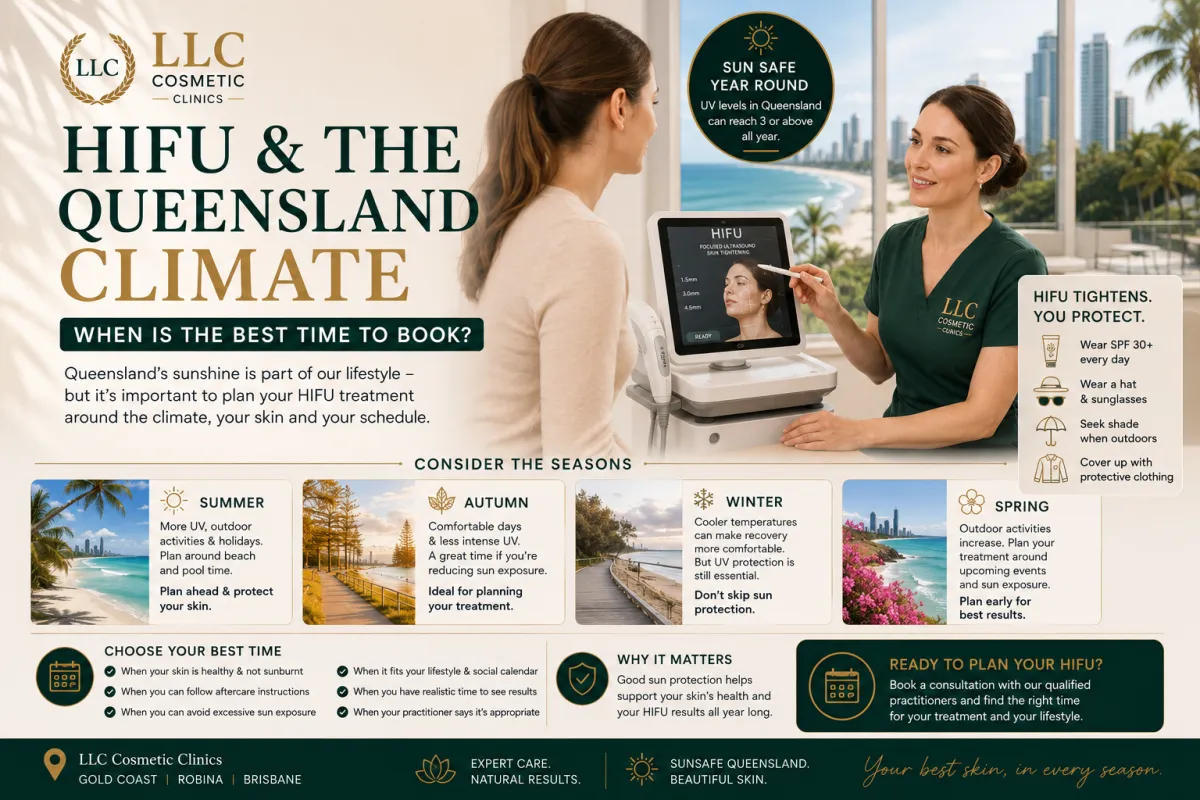
HIFU and the Queensland Climate: Best Time of Year to Book
Queensland is famous for its sunshine, warm weather and outdoor lifestyle—but if you're considering HIFU, the local climate is something worth thinking about.
The good news is that there isn't one specific season when HIFU must be performed. HIFU is a non-surgical treatment and does not generally involve the same type of surface resurfacing as treatments such as CO₂ laser.
However, Queensland's high UV environment means that sun exposure and your ability to follow good sun-protection habits are important considerations throughout the year. Queensland Health notes that UV Index levels can reach 3 or above year-round in Queensland, including winter.
So, when is the best time to book HIFU?
It may be less about the calendar and more about your skin condition, upcoming activities, sun exposure and ability to follow your practitioner's aftercare advice.
HIFU and the Queensland Climate: The Quick Answer
If you're deciding when to book HIFU in Queensland, each season has different things to consider:
Summer
More intense UV exposure, outdoor activities and beach or pool time can make sun protection more challenging.
Autumn
Often a comfortable time to plan treatment if you're reducing outdoor exposure.
Winter
Cooler temperatures may make treatment more comfortable, but UV protection is still necessary.
Spring
Outdoor activity increases, so it's important to plan around sun exposure and your upcoming activities.
There is no universally "best" season for HIFU.
Instead, choose a time when you can comfortably follow your clinic's aftercare instructions and avoid unnecessary intense sun exposure.
Why Does Queensland's Climate Matter?
The biggest issue isn't simply the temperature.
It's ultraviolet (UV) exposure.
Queensland Health explains that sun protection is recommended when the UV Index reaches 3 or above, and Queensland experiences these levels throughout the year.
That means a cool winter day isn't automatically a low-UV day.
You can have:
Cool weather + high UV
or
Cloudy weather + significant UV exposure.
UV radiation can pass through clouds, so temperature isn't a reliable indicator of how much sun protection your skin needs.
Is Winter the Best Time for HIFU in Queensland?
Winter can be a convenient time for some people.
Queensland's cooler months may make it easier to:
Spend less time in direct sunlight
Avoid very hot outdoor conditions
Wear more protective clothing
Plan appointments around outdoor activities
Maintain a consistent skincare and sun-protection routine
However, winter does not mean you can stop protecting your skin from UV.
Queensland Health specifically warns that UV levels can remain high during winter. Recent Queensland health guidance notes that Brisbane's winter UV can still reach levels requiring protection.
So if you're thinking:
"I'll book HIFU in winter because there isn't much sun."
That's not necessarily true.
Winter may be convenient—but sun protection is still important.
What About Summer HIFU?
You don't necessarily have to avoid HIFU during summer.
However, summer can require more planning.
Queensland's warm weather often means more:
Beach trips
Swimming
Outdoor exercise
Holidays
Boating
Outdoor events
Extended periods in the sun
If your appointment falls immediately before a beach holiday, for example, ask your practitioner whether the timing is appropriate.
Rather than asking:
"Can I have HIFU in summer?"
ask:
"Can I safely have HIFU now considering my upcoming sun exposure and activities?"
That gives your practitioner more useful information when planning your treatment.
Can You Have HIFU If You've Been in the Sun?
This depends on the condition of your skin and your practitioner's assessment.
If you've recently experienced significant sun exposure or have sunburn, irritated or damaged skin, tell your practitioner before treatment.
Don't assume that because HIFU doesn't work primarily by resurfacing the outer skin, recent sun exposure automatically doesn't matter.
Your practitioner can determine whether your skin is suitable for treatment or whether it would be better to wait.
A simple rule:
Don't try to hide recent sun exposure from your practitioner.
Tell them about:
Recent sunburn
Beach holidays
Outdoor activities
Tanning
Excessive UV exposure
Any unusual skin irritation
This helps them make a more appropriate treatment decision.
Does HIFU Have the Same Sun Concerns as CO₂ Laser?
Not exactly.
This is an important distinction.
HIFU
HIFU uses focused ultrasound energy at targeted depths beneath the skin.
It is primarily used for concerns related to:
Skin laxity
Firmness
Jawline definition
Certain areas of the neck
Overall lifting and tightening goals
CO₂ Laser
CO₂ laser is a resurfacing treatment that works much more directly with the skin's surface.
Because CO₂ laser involves controlled skin resurfacing, sun exposure and post-treatment skin protection can be particularly important during recovery.
That doesn't mean HIFU can be treated as completely unaffected by sun exposure.
Your clinic's specific aftercare instructions should always take priority.
What Is the Best Season for HIFU?
There are advantages and disadvantages to every season.
🌞 Summer
Potential advantage: Convenient if you want to start treatment without waiting for cooler weather.
Potential challenge: More intense outdoor activity and UV exposure.
Summer may not be the easiest time if you're planning multiple beach days immediately after treatment.
🍂 Autumn
Autumn can be convenient for people who want to reduce their outdoor exposure after the busy summer period.
It may also be easier to schedule treatment before winter events or the end-of-year social season.
❄️ Winter
Winter is often attractive because of the cooler temperatures.
You may find it easier to:
Avoid intense heat
Stay indoors
Wear sun-protective clothing
Reduce prolonged outdoor exposure
But remember:
Queensland winter still has UV exposure.
Queensland Health recommends year-round sun protection when UV levels are 3 or above.
🌸 Spring
Spring can be a good time to plan ahead.
However, outdoor activities often increase as the weather becomes warmer.
If you're considering HIFU before an important event, don't leave the appointment until the last minute.
Ask your practitioner how long it may take for your results to develop and whether the timing is appropriate.
When Should You NOT Book HIFU?
Instead of focusing only on the season, pay attention to your skin and your schedule.
You may want to postpone treatment and speak with your practitioner if you have:
Active sunburn
Significant skin irritation
An active skin condition in the treatment area
Recently undergone another treatment
An upcoming period of intense sun exposure
An upcoming holiday where you expect prolonged outdoor activity
Your practitioner can advise whether treatment should be delayed.
What About a Queensland Beach Holiday?
This is one of the biggest practical considerations.
Imagine you have booked a week-long Gold Coast holiday.
Your schedule looks like:
Monday: HIFU
Tuesday: Beach
Wednesday: Pool
Thursday: Boat trip
Friday: Outdoor sightseeing
That's a situation where you should talk to your practitioner before booking HIFU on Monday.
The issue isn't simply whether HIFU and summer are compatible.
The issue is whether your planned activities fit with the clinic's specific aftercare recommendations.
Sun Protection Still Matters After HIFU
Queensland Health recommends sun-protective behaviours when UV levels are 3 or above, including protective clothing, sunscreen, a hat, shade and sunglasses.
For someone undergoing cosmetic skin treatments, maintaining good sun-protection habits is particularly sensible.
Consider:
Slip
On protective clothing.
Slop
On broad-spectrum sunscreen as appropriate.
Slap
On a broad-brimmed hat.
Seek
Shade whenever practical.
Slide
On UV-protective sunglasses.
These habits aren't just about your HIFU appointment—they're part of protecting your skin from ongoing UV damage.
Should You Book HIFU Before or After a Holiday?
If you're planning a holiday with lots of outdoor activities, don't automatically schedule HIFU immediately before the trip.
Instead, ask your practitioner about the timing.
You may be better off scheduling the treatment when you can:
Follow aftercare instructions
Avoid excessive sun exposure
Avoid activities your practitioner recommends limiting
Give your skin appropriate time to settle
Focus on your treatment rather than your holiday schedule
What If I Have HIFU in Brisbane, Robina or the Gold Coast?
The same general principle applies.
Whether you're having HIFU in:
Brisbane
Robina
Gold Coast
or another Queensland location, the local UV environment means sun protection remains relevant throughout the year.
The exact weather can vary between locations, but temperature alone shouldn't determine whether you're protecting your skin.
Check the UV Index rather than simply looking at whether the day feels hot or cool.
The Best Time to Book HIFU May Be When Your Schedule Allows Proper Aftercare
This is probably the most useful way to think about HIFU and the Queensland climate.
Instead of:
"Which month is best for HIFU?"
Ask:
"When can I realistically follow my practitioner's treatment and aftercare advice?"
That might be winter for one person.
It might be autumn for another.
Someone else may prefer summer because they have fewer work commitments.
There is no universal calendar date that guarantees better HIFU results.
HIFU and the Queensland Climate: Final Takeaway
HIFU doesn't have to be restricted to one particular season in Queensland.
However, Queensland's year-round UV exposure means that sun protection should remain part of your routine regardless of whether your appointment is in January or July.
Winter may feel like a convenient time because temperatures are cooler, but UV exposure can still be significant.
Summer can also be suitable, but you may need to plan around beach trips, swimming, outdoor activities and other periods of prolonged sun exposure.
The most important factors are:
Your skin's current condition
Your treatment goals
Your upcoming activities
Your expected sun exposure
Your practitioner's assessment
Your ability to follow aftercare instructions
The best time for HIFU is not necessarily the coldest month or the month with the least sunshine—it's the time when the treatment is appropriate for you and you can properly follow your practitioner's advice.
Frequently Asked Questions
Is winter the best time for HIFU in Queensland?
Winter can be convenient because temperatures are cooler and some people spend less time outdoors. However, Queensland still experiences UV levels that can require sun protection during winter, so it shouldn't be considered a completely sun-safe season.
Can I have HIFU in summer?
HIFU can be performed during summer, but discuss your upcoming outdoor activities and sun exposure with your practitioner before treatment.
Can I go to the beach after HIFU?
Follow your clinic's specific aftercare instructions. If you're planning significant sun exposure, swimming or a beach holiday, tell your practitioner before treatment so they can advise you about appropriate timing.
Does Queensland's climate affect HIFU results?
The climate itself isn't necessarily what determines your results. However, sun exposure, your skin condition and how well you follow your practitioner's aftercare instructions can be important considerations.
Is HIFU better in winter than summer?
There isn't a universally better season. Winter may be more convenient for some people because of cooler weather and fewer outdoor activities, but Queensland's UV levels can still be high enough to require sun protection.