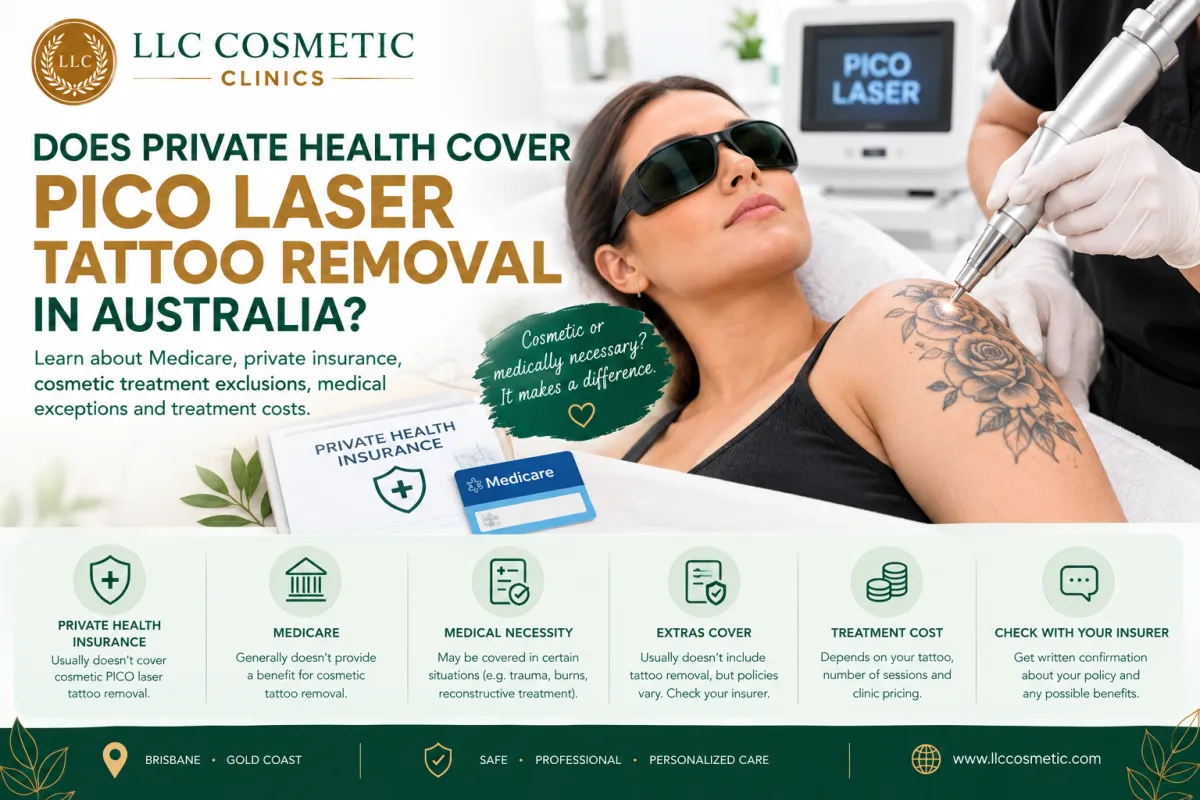
Does Private Health Cover PICO Laser Tattoo Removal in Australia?
If you're considering removing an unwanted tattoo, one of the first things you may wonder is:
“Will my private health insurance pay for PICO laser tattoo removal?”
For most Australians, cosmetic PICO laser tattoo removal is not covered by private health insurance or Medicare.
However, the details can depend on why the treatment is being performed, your policy and whether the treatment is considered medically necessary. Understanding the difference between cosmetic and medically necessary treatment can help you avoid unexpected costs.
Does Private Health Cover PICO Laser Tattoo Removal in Australia?
Generally, private health insurance does not cover tattoo removal when it is performed for cosmetic reasons.
Australian private health insurance is broadly divided into hospital cover and general treatment, or extras, cover. What is covered depends on the individual policy. Government guidance also explains that services that are not listed on the Medicare Benefits Schedule, including elective cosmetic procedures, may not be covered by private hospital insurance.
So, if you're removing a tattoo because:
You no longer like the design
You regret getting the tattoo
You want a different style
You need to remove a visible tattoo for work
You want to lighten it before a cover-up
The tattoo is simply no longer meaningful to you
you should generally expect to pay for the treatment yourself.
Does Medicare Cover PICO Laser Tattoo Removal?
For routine cosmetic tattoo removal, Medicare does not generally provide a benefit.
Services Australia states that Medicare does not cover cosmetic surgery, while the Australian Government's private health information service explains that Medicare does not cover medical and hospital services that are not clinically necessary or surgery performed solely for cosmetic reasons.
PICO laser tattoo removal performed simply to remove unwanted ink would generally fall into the cosmetic category.
That means having a Medicare card does not automatically make PICO tattoo removal claimable.
What If Tattoo Removal Is Medically Necessary?
This is where things can become more complicated.
There may be situations where treatment involving a tattoo or tattoo pigment is part of managing a medical or reconstructive problem.
For example, medically necessary treatment can be treated differently from a procedure performed purely for appearance. Private health insurance clinical categories include treatment of medically necessary skin conditions and medically necessary plastic and reconstructive surgery.
However, this doesn't mean a standard cosmetic tattoo removal treatment becomes claimable simply because it is performed by a healthcare professional.
The reason for treatment, procedure, setting, applicable MBS item and your insurance policy can all matter.
If you believe your situation is medically necessary, speak with your GP or specialist and contact your insurer before booking treatment.
Can Extras Cover Pay for PICO Tattoo Removal?
Usually, you shouldn't assume that extras cover will pay for PICO tattoo removal.
Extras policies can cover services such as dental, optical, physiotherapy and other listed treatments, but the services and limits vary between policies.
Tattoo removal is not a standard extras benefit simply because it uses a laser.
Before making an appointment based on the expectation of an insurance rebate, check your policy directly.
What About Gold, Silver or Bronze Hospital Cover?
Having a higher level of hospital cover doesn't necessarily mean cosmetic laser treatments will be covered.
Private hospital insurance is structured around particular clinical categories and eligible services. Government guidance notes that cosmetic procedures that are not Medicare-benefit services may not be covered.
So having Gold Hospital Cover doesn't automatically mean you can claim PICO laser tattoo removal.
Your policy needs to specifically provide cover for the relevant treatment.
How Can You Check Your Health Insurance?
If you want to be completely certain, contact your insurer before treatment.
Ask:
“Does my policy provide any benefit for PICO laser tattoo removal?”
You can also ask:
Is tattoo removal specifically excluded?
Is the treatment considered cosmetic?
Does my policy cover any medically necessary tattoo removal?
Is a referral required?
Does the treatment need to occur in a hospital?
Is pre-approval required?
Would there be any rebate or benefit available?
What would my expected out-of-pocket cost be?
The Australian Government's private health insurance website also provides a tool for checking what particular policies cover.
Why Is Cosmetic Tattoo Removal Usually Paid Privately?
The main distinction is medical necessity versus cosmetic treatment.
If someone wants a tattoo removed because they have changed their mind, the treatment is generally considered cosmetic.
Private health insurance is not designed to cover every treatment that improves a person's appearance.
The Commonwealth Ombudsman also explains that cosmetic and non-surgical cosmetic procedures are not recognised by Medicare and health insurers generally do not pay benefits for these procedures.
How Much Does PICO Laser Tattoo Removal Cost?
If you're paying privately, it's important to look beyond the cost of one appointment.
The total cost can depend on:
Tattoo size
Ink colours
Ink density
Tattoo depth
Tattoo age
Location
Previous laser treatment
Your individual response
Number of sessions required
At LLC Cosmetic, tattoo removal is priced per session, with the current listed price starting from $158 per session. The clinic assesses the tattoo before providing an individual session estimate.
This is important because there is no universal number of sessions that applies to every tattoo.
Why Do You Usually Need Multiple PICO Laser Sessions?
PICO laser tattoo removal is not normally a one-session procedure.
The laser breaks tattoo pigment into smaller particles, after which your body gradually clears the fragmented pigment.
This process takes time.
LLC Cosmetic currently recommends spacing tattoo removal sessions approximately 6–8 weeks apart, allowing time for the body to clear pigment between treatments.
The number of sessions can vary significantly.
For example, an older black tattoo may respond differently from a dense, multicoloured professional tattoo.
Is PICO Laser Tattoo Removal Worth Paying for Yourself?
That depends on your goals.
For someone who genuinely wants an unwanted tattoo removed or significantly faded, the treatment may be worthwhile even without an insurance rebate.
The important thing is to understand the total expected investment before starting.
Rather than asking only:
“How much is one session?”
consider asking:
“Based on my tattoo, how many sessions might I realistically need, and what could the overall treatment cost be?”
A proper assessment can give you a much more useful starting point.
What If You're Removing a Tattoo for a Cover-Up?
You may not need complete tattoo removal.
Some people simply want their existing tattoo lightened enough for a new design to be placed over it.
In that situation, your treatment plan may be different from someone aiming for maximum possible fading.
Tell your practitioner if you're planning a cover-up.
The tattoo's colour, density, depth and the proposed new design can all influence the treatment plan.
What About Radiotherapy Tattoos?
There is an important distinction here.
Not every tattoo removal situation is cosmetic.
Some people have small positioning marks from radiotherapy that they would like removed after completing cancer treatment.
LLC Cosmetic currently offers free removal of radiotherapy positioning tattoos as a community service.
This is very different from saying that private health insurance generally covers cosmetic tattoo removal.
If your tattoo is related to medical treatment, discuss your specific circumstances with your healthcare provider and insurer.
Should You Check With Your Insurer Before Booking?
Yes.
Even though cosmetic PICO tattoo removal is generally something you'll pay for yourself, checking your policy is worthwhile if you think your situation may be medically necessary.
Don't rely on:
A friend saying they received a rebate
An online forum
A clinic assuming your policy covers it
An old insurance statement
A general assumption that “laser treatments” are covered
Your insurer can tell you what your particular policy covers.
The Bottom Line
So, does private health cover PICO laser tattoo removal in Australia?
For the typical person removing an unwanted tattoo for cosmetic reasons, private health insurance generally won't cover the treatment, and Medicare doesn't generally provide a benefit for cosmetic procedures.
If your situation involves a medical condition, injury, reconstruction or another medically necessary reason, the situation may be different and should be assessed individually.
If you're considering PICO laser tattoo removal, the best first step is to have your tattoo assessed and ask for a realistic treatment plan and cost estimate before committing to a course.
At LLC Cosmetic, tattoo assessments consider factors such as ink colour, age, depth, location and your skin, with a written session estimate provided before you decide whether to proceed.