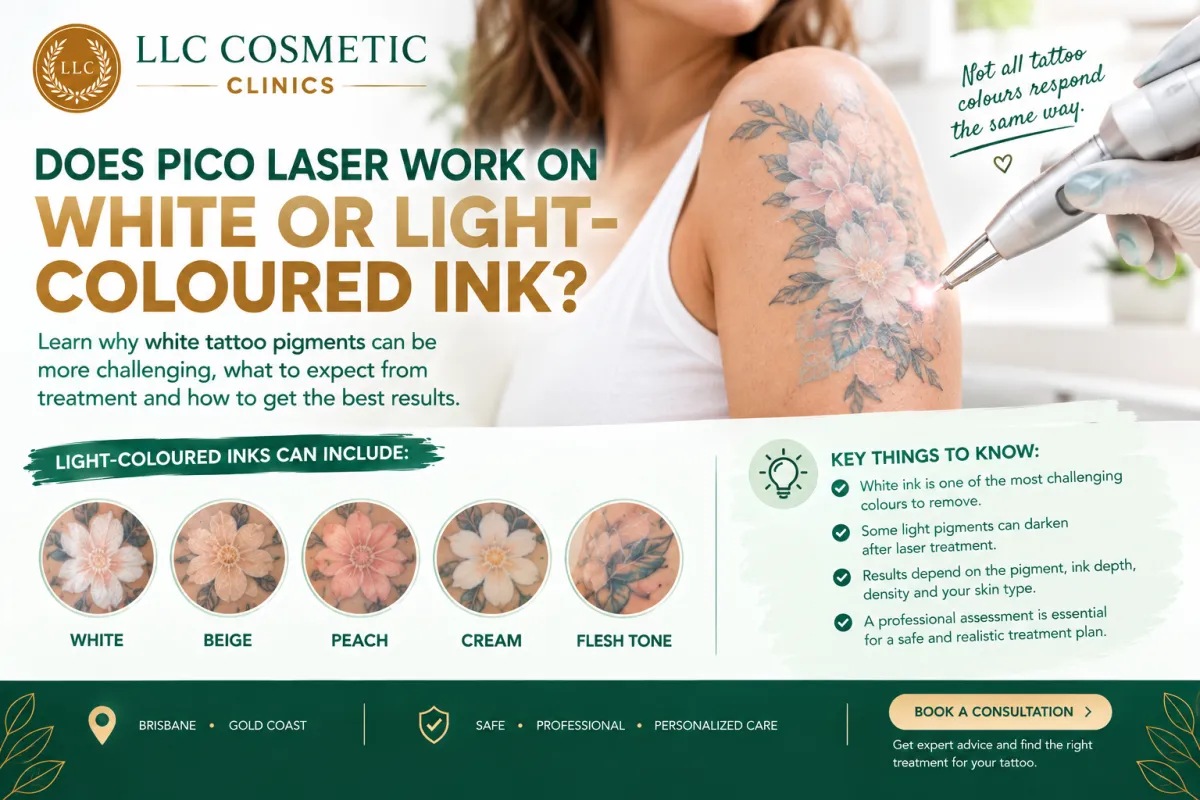
Does PICO Laser Work on White or Light-Coloured Ink?
If you have a tattoo with white, cream, beige, peach, or other light-coloured ink, you may be wondering whether PICO laser tattoo removal can actually remove it.
The short answer is: sometimes, but white and very light-coloured tattoo inks can be more difficult and unpredictable to treat than darker inks.
The reason isn't simply the colour itself. Tattoo ink contains different pigments and chemical compounds, and some light-coloured or cosmetic tattoo pigments can behave differently when exposed to laser energy.
In some cases, certain white or light pigments may even become darker after laser treatment, which is why a proper assessment before treatment is particularly important. Research has associated poor response and paradoxical darkening with pigments containing compounds such as titanium dioxide.
Does PICO Laser Work on White Ink?
PICO laser can be used to assess and treat some light-coloured tattoo pigments, but white ink is generally considered one of the more challenging colours to remove.
Evidence specifically examining white cosmetic tattoo ink has found poor response to 1064 nm picosecond treatment in an animal model, although the same study found better responses for flesh-coloured and brown pigments.
This is important because it shows why you shouldn't assume that a PICO laser will work equally well on every tattoo colour.
PICO technology can be highly effective for many tattoo pigments, but its effectiveness depends on factors such as:
The colour and chemical composition of the ink
Ink depth
Ink density
Tattoo size
Tattoo location
The wavelength being used
Your skin type
Previous laser treatments
How your skin responds and heals
A systematic review of picosecond tattoo removal found good evidence for treatment of several tattoo colours, but much of the research has focused on black and blue inks rather than white ink.
Why Is White Tattoo Ink So Difficult to Remove?
White tattoo ink can contain pigments such as titanium dioxide, which can behave differently from darker tattoo pigments during laser treatment.
Instead of simply becoming lighter, some tattoos containing certain light pigments can experience paradoxical darkening.
This means the tattoo can appear darker after laser treatment rather than lighter.
Research has reported an association between titanium dioxide-containing tattoo pigments and poor response or darkening after laser treatment.
This doesn't mean every white tattoo will turn dark.
It means that the possibility needs to be considered before treatment.
Can White Ink Turn Dark After PICO Laser?
Yes, it can happen with certain pigments.
Paradoxical darkening has been reported particularly with some white, flesh-coloured, pink, peach and cosmetic tattoo pigments.
The chemical composition of the pigment matters.
For example, cosmetic tattoos may contain white or metallic compounds that can darken when exposed to certain laser wavelengths.
This is one reason why a professional assessment is important before treating a light-coloured tattoo.
A practitioner may need to determine:
What type of tattoo you have
What colours are present
Whether it is a cosmetic tattoo
Whether the pigment may contain titanium dioxide or iron oxide
Whether it has previously been treated
Which wavelength may be appropriate
Whether a cautious test area should be considered
What About Cream, Beige, Peach or Flesh-Coloured Ink?
These colours can also be complicated.
Light cosmetic tattoo pigments are particularly important to assess because they may contain pigment combinations that don't respond in the same way as conventional black tattoo ink.
Research into cosmetic tattoos has found that some flesh-coloured pigments can respond to picosecond treatment, while white pigments may respond poorly.
This means "light-coloured" isn't one single category.
A cream tattoo and a white tattoo may contain completely different pigments.
A peach tattoo may also behave differently from a beige tattoo.
That's why the practitioner shouldn't make a treatment decision based only on what the tattoo looks like from the outside.
Does PICO Work Better Than Traditional Laser for White Ink?
Not necessarily.
PICO lasers have advantages for many tattoo pigments, and research has shown good results for several colours. However, there is not enough evidence to say that PICO will reliably remove all white or light-coloured tattoo ink.
A systematic review found that picosecond lasers can be effective for tattoo removal, but much of the evidence involved black and blue tattoos.
Another systematic review found that picosecond lasers showed advantages for some blue, green and yellow pigments, while both picosecond and Q-switched lasers were effective for black tattoos.
The important point is that laser selection should be based on the pigment, not simply the fact that the machine is marketed as "PICO."
What If My White Ink Becomes Darker?
Don't panic, but don't assume that continuing with exactly the same treatment is automatically the right approach.
If a light tattoo pigment becomes darker following laser treatment, the practitioner should reassess the tattoo and determine what type of pigment is present.
Further treatment may sometimes be possible depending on the pigment and laser wavelength, but the approach needs to be individualised.
There are published reports describing successful treatment of paradoxically darkened tattoo pigments using different picosecond wavelengths, but these are specific clinical cases rather than a guarantee for every tattoo.
How Many PICO Sessions Will White Ink Need?
There is no reliable number of sessions that applies to every white tattoo.
Dark, older tattoos may sometimes respond more predictably than dense, light or mixed-colour tattoos.
White or light-coloured ink may require a different treatment strategy and may not completely clear.
The American Academy of Dermatology explains that tattoo removal usually requires multiple treatments because laser energy breaks the ink into smaller particles and the body then clears those particles over time.
Your treatment plan may therefore depend on how the tattoo responds after each session rather than following a fixed number of appointments.
Can PICO Completely Remove White Tattoo Ink?
Complete removal cannot be guaranteed.
This is particularly important when dealing with white or light-coloured pigments.
Your tattoo may:
Fade significantly
Fade partially
Respond slowly
Show different responses between colours
Develop temporary or persistent pigment changes
Become darker with certain pigments
Leave some residual pigment
DermNet notes that white and yellow pigments are among the most difficult tattoo pigments to eradicate and that complete clearance is not always possible.
A realistic treatment plan should therefore focus on your individual tattoo rather than promising 100% removal.
What Should You Ask Before Treating a White Tattoo?
If you're considering PICO laser for a white or light-coloured tattoo, ask the clinic:
"What type of pigment do you think is in my tattoo?"
Also ask:
Have you treated white or light-coloured ink before?
Could this pigment contain titanium dioxide or other metallic compounds?
What wavelength would you use?
Is there a risk of paradoxical darkening?
What happens if the pigment becomes darker?
How many sessions might I realistically need?
How long will you wait between treatments?
What results should I realistically expect?
What happens if some of the pigment doesn't respond?
These questions can help you understand whether the treatment is appropriate before you commit to a full course.
What About White Ink in Cosmetic Tattoos?
Extra caution is needed with cosmetic tattoos such as:
Eyebrow tattoos
Lip tattoos
Eyeliner
Permanent makeup
Flesh-coloured camouflage tattoos
Some cosmetic pigments contain iron oxides, titanium dioxide or other compounds that may behave unexpectedly when exposed to laser energy.
For this reason, cosmetic tattoo removal should be assessed differently from a simple black tattoo.
The Bottom Line
So, does PICO laser work on white or light-coloured ink?
Sometimes, but white and light-coloured pigments can be among the most challenging tattoo colours to remove.
PICO laser can treat many tattoo pigments, but the outcome depends heavily on the actual composition of the ink, the wavelength used, tattoo density, depth, skin characteristics and previous treatments.
White ink can be particularly unpredictable, and certain pigments may even become darker after laser treatment.
That's why a professional assessment is more important than simply choosing a clinic because it advertises PICO laser.
If you're considering PICO laser tattoo removal in Brisbane or the Gold Coast, LLC Cosmetic Clinics can assess your tattoo and discuss whether treatment is appropriate for the specific colours and pigments involved.