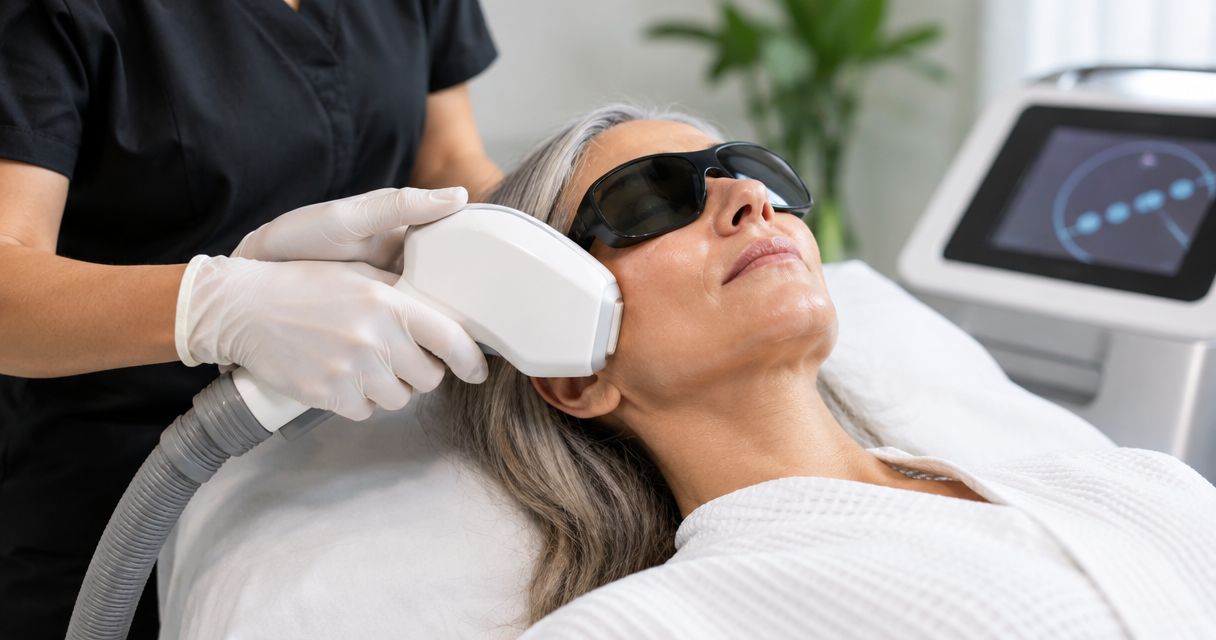
Does laser hair removal work on grey hair?
Laser hair removal does not reliably work on fully grey or white hair because it needs pigment in the hair to absorb light. If you have a mixture of dark and grey hairs, laser can target the darker hairs while leaving the grey ones behind. Before booking in 2026, ask whether electrolysis is a better match for the hairs you actually want removed.[1]
- Does laser hair removal work on grey hair? Not reliably: grey and white hairs lack enough target pigment.
- Laser can reduce dark hairs in a mixed patch without removing the grey hairs.[1]
- Electrolysis treats individual follicles without relying on hair colour.[1]
- LLC Cosmetic Laser Clinics prioritises honest suitability advice and clinician-reviewed plans.
Does laser hair removal work on grey hair?
Not reliably. Hair-removal lasers target melanin, the pigment that gives hair its colour. The absorbed light produces heat that damages the follicle, the small structure where hair grows. Fully grey or white hairs lack enough pigment for this process to work reliably.[1]
Think of pigment as the target, not just the colour you see. A stronger setting cannot simply replace a missing target.
For your 2026 consultation, a clinician-reviewed treatment plan should distinguish between dark hairs that laser can target and grey hairs it cannot reliably treat.
Why this matters before you book
A patch of hair can look grey overall while containing both dark and white strands. Laser can reduce the darker strands, but the lighter ones can remain.[1] That distinction matters when you picture the result.
LLC Cosmetic Laser Clinics suits people seeking medical physicist-led care and honest treatment suitability advice. The useful question is not just whether treatment is available, but whether it matches your hair.
Why results vary
These factors help explain why someone else's result is not a promise for yours:[1,2]
- Hair pigment: darker hair provides a clearer target than white or fully grey hair.
- Hair thickness: fine hair is harder to target than coarse, pigmented hair.
- Skin pigment: the clinician must account for pigment in the surrounding skin.
- Growth stage: hairs do not all grow in the same phase, which affects treatment response.
Results vary between individuals. Published reviews describe variable outcomes; they do not support promising complete removal for everyone.[1,2]
What are the alternatives for grey hair?
For a 2026 treatment decision, separate methods that depend on pigment from those that do not.[1]
| Method | Best for | Benefit | Limitation |
|---|---|---|---|
| Laser hair removal | Suitable dark, pigmented hair | Longer-term hair reduction | Does not reliably target fully grey or white hair |
| IPL | Suitable pigmented hair | Light-based hair reduction | Also depends on pigment; not a workaround for grey hair |
| Electrolysis | Individual grey or white hairs | Does not rely on hair pigment | Treats follicles individually, making treatment time-intensive |
IPL means intense pulsed light. It uses a different light source from a laser, but the missing-pigment problem remains.[1]
Electrolysis uses a fine probe and electrical energy to treat individual follicles. It is an option to discuss for grey hair, not a guarantee of an effortless result.[1]
Who should pause before treatment?
Laser is a poor match when the unwanted hair is fully white or grey. Your skin colour, recent tanning and medical history also need assessment before treatment.[1]
Common laser side effects include redness and swelling around follicles. Burns, pigment changes and scarring are recognised complications; darker skin needs particular attention to device choice and settings.[1] Electrolysis can also cause discomfort and skin reactions, so practitioner skill matters.[1]
What should you ask at a consultation?
Use this simple checklist before committing in 2026:
- Check colour: ask which hairs contain enough pigment to target.
- Discuss risks: ask about side effects and suitability for your skin.
- Choose treatment: compare realistic options rather than buying a package first.

FAQ
Will laser remove the dark hairs among my grey hairs?
Laser can target suitable dark hairs within a mixed patch, while grey or white hairs remain. Each hair's pigment matters, not just the patch's overall appearance.[1]
Is IPL better than laser for grey hair?
IPL is not a reliable solution for fully grey or white hair because it also depends on pigment absorbing light.[1]
Can stronger laser settings remove white hair?
Stronger settings do not replace missing hair pigment. Settings must account for skin safety, not simply be increased to chase an unsuitable target.[1]
Is electrolysis worth discussing for grey facial hair?
Electrolysis is worth discussing because it treats individual follicles without relying on hair colour. Its limitations include treatment time, discomfort and possible skin reactions.[1]
Does laser hair removal guarantee permanent removal?
Laser hair removal does not guarantee complete permanent removal. Reviews support hair reduction, with outcomes varying by treatment and individual characteristics.[1,2]
What should I ask LLC Cosmetic Laser Clinics before booking?
Ask whether your unwanted hairs contain enough pigment for laser treatment. Request honest advice about suitability, risks and alternatives before committing to a course.
One last thing
For your 2026 decision, look at the hairs, not the machine's marketing. The pigment requirement explains why treating a mixed patch can leave its grey strands behind.[1]
Related guides
- Choosing a laser hair removal clinic in Brisbane
- Simply Laser alternatives
- Silk Laser Clinics alternatives
References
- Gan SD, Graber EM. 2013. Laser hair removal: a review. Dermatologic Surgery. DOI: 10.1111/dsu.12116.
- Haedersdal M, Wulf HC. 2006. Evidence-based review of hair removal using lasers and light sources. Lasers in Surgery and Medicine. DOI: 10.1002/lsm.20277.
For personal advice, contact LLC Cosmetic Laser Clinics to ask about a consultation.
This article is general information only and is not a substitute for a personal consultation.