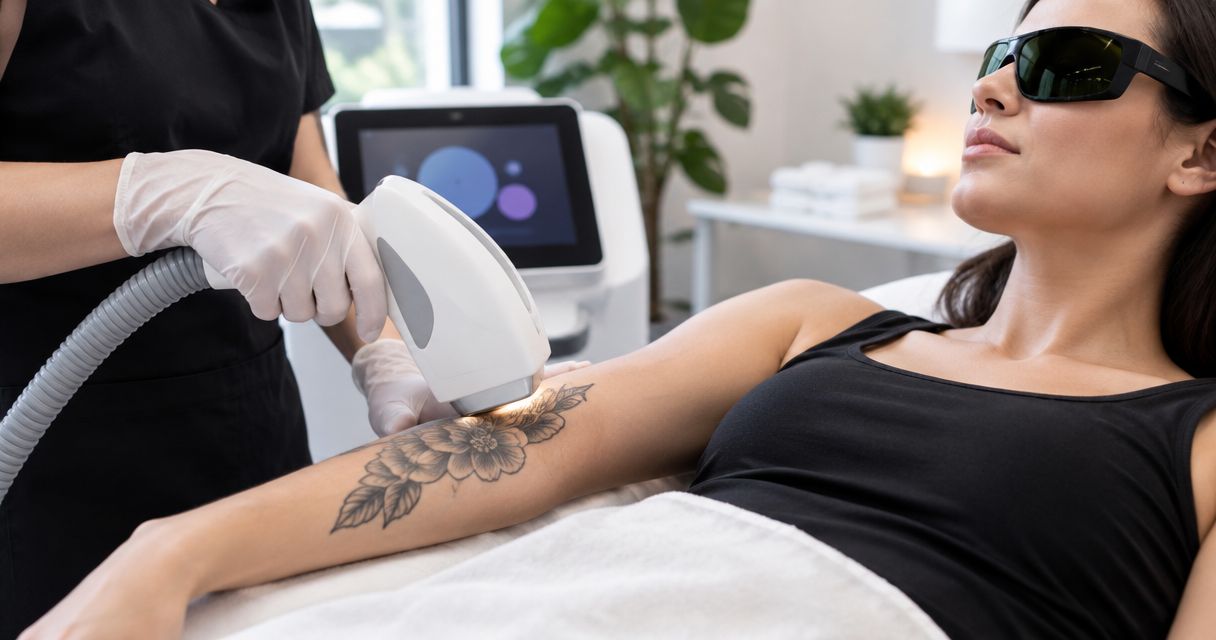
Does IPL remove tattoos as well as laser?
No—IPL is not a recommended substitute for laser tattoo removal. IPL delivers broad-spectrum light rather than the very short, targeted pulses used by tattoo-removal lasers; treating tattooed skin with IPL can cause burns and scarring.[1] The useful question is which tattoo-removal laser suits your ink and skin—not whether IPL is a cheaper shortcut.
- Does IPL remove tattoos? IPL is not recommended as an alternative to tattoo-removal laser.[1]
- Tattoo-removal lasers need to match your skin and ink colours; no single setting suits everyone.[1]
- Laser treatment can leave residual ink, pigment changes or scarring. Results vary between individuals.[1]
- LLC Cosmetic Laser Clinics offers medical physicist-led care and clinician-reviewed plans.
Does IPL remove tattoos as well as laser?
IPL and tattoo-removal laser are not interchangeable. IPL stands for intense pulsed light. It produces a band of wavelengths, while tattoo-removal lasers use selected wavelengths and very short pulses to target ink particles.[1]
Think of the difference as a broad wash of light versus a carefully selected tool. That analogy explains the distinction, not a promise that laser leaves surrounding skin untouched.
If you are researching a larger piece, the Skin Journal guide to PICO laser tattoo removal for large tattoos covers that specific planning question.
| Option | Best for | Benefit | Limitation |
|---|---|---|---|
| IPL: broad-spectrum light | Not recommended for tattoo removal | Has other skin-treatment uses | Tattoo ink can absorb the light, risking burns and scarring |
| Q-switched tattoo laser: short pulses | Suitable ink assessed by a trained clinician | Established tattoo-removal approach | Multiple treatments and incomplete clearance remain possible |
| Picosecond tattoo laser: short pulses | Tattoos assessed as suitable for its wavelength | Another laser approach to breaking down ink | Shorter pulses do not guarantee complete clearance |
These distinctions and limitations are described in the clinical review listed below.[1] A device name alone does not establish suitability.
Why this matters before you book
A treatment used for hair removal or pigmentation is not automatically suitable for a tattoo. Tattoo ink creates a different target in the skin, so the treatment purpose, wavelength and pulse duration matter.[1]
Tell the practitioner about every tattoo in the proposed treatment area, including cosmetic tattoos. Do not assume an IPL appointment includes a tattoo-removal assessment.
Why tattoo-removal results vary
Laser treatment is a process, not an eraser. A clinician needs to assess the tattoo and your skin before discussing likely benefits and limits.[1]
Factors include:
- Ink colour: different pigments absorb different wavelengths.
- Ink depth and density: the amount and placement of pigment affect treatment response.
- Skin colour: natural skin pigment also absorbs light and affects treatment selection.
- Tattoo layering: cover-ups add pigment and complexity.
- Existing skin changes: scarring or texture changes need separate assessment.
These factors help explain why another person’s treatment course cannot predict yours.[1] Results vary between individuals, and complete removal is not guaranteed.
Who might need to delay treatment or avoid it?
Laser tattoo removal does not suit every person or every tattoo. Active infection in the area, a history of abnormal scarring, an allergic reaction within the tattoo, or medicines that affect light sensitivity require clinical assessment before treatment.[1]
Tell your clinician about recent tanning, previous removal attempts and any changes in the tattoo. An assessment that recommends waiting—or not treating—is still a useful outcome.
Medical physicist-led care at LLC Cosmetic Laser Clinics includes clinician-reviewed plans and honest suitability advice. That description does not mean a medical physicist personally performs every consultation or treatment.
What side effects should you understand?
Laser tattoo removal can cause pain, redness, swelling, blistering and crusting. Pigment changes, scarring and incomplete clearance are also possible.[1]
Ask how to care for the area and which symptoms require prompt advice. Do not pick healing skin or improvise aftercare; follow the instructions supplied for your treatment.[1]
Is PICO laser automatically the best choice?
No—“PICO” alone does not establish the best treatment for your tattoo. Picosecond describes pulse duration, not a guarantee of better clearance for every ink colour or skin type.[1]
Ask which wavelength is proposed, why it suits your tattoo and what outcome is realistic. The research cited here describes promising picosecond results but does not justify a universal winner.[1]
FAQ
Can I use a home IPL device to fade my tattoo?
Do not use home IPL over a tattoo to try to fade it. Tattoo pigment can absorb the light and cause skin injury.[1]
Is IPL the same thing as PICO laser?
No. IPL produces broad-spectrum light, while picosecond tattoo lasers deliver very short laser pulses at selected wavelengths.[1]
Will laser completely remove my tattoo?
Complete tattoo removal is not guaranteed. Residual ink, pigment changes and scarring are possible, and results vary between individuals.[1]
Can every tattoo colour use the same laser?
No. Different ink colours absorb different wavelengths, so treatment needs to match the tattoo and skin.[1]
Does laser tattoo removal hurt?
Laser tattoo removal can hurt. Discuss comfort measures and aftercare during your personal consultation.[1]
What should I ask before tattoo removal?
Ask about suitability, wavelength, likely limitations, side effects and aftercare. Also ask who will perform your treatment and how complications are managed.
One last thing: ask about your goal
Wanting enough fading for a cover-up is different from wanting as much clearance as possible. Explain your goal before agreeing to a plan; it gives the consultation a clear purpose without assuming complete removal is achievable.
For personal advice, you can book your PICO consultation with LLC Cosmetic Laser Clinics and discuss whether treatment suits your tattoo.
Related guides
References
[1] Ho SG, Goh CL. 2015. Laser tattoo removal: a clinical update. Journal of Cutaneous and Aesthetic Surgery, 8(1), 9–15. DOI: 10.4103/0974-2077.155066.
This article is general information only and is not a substitute for a personal consultation.