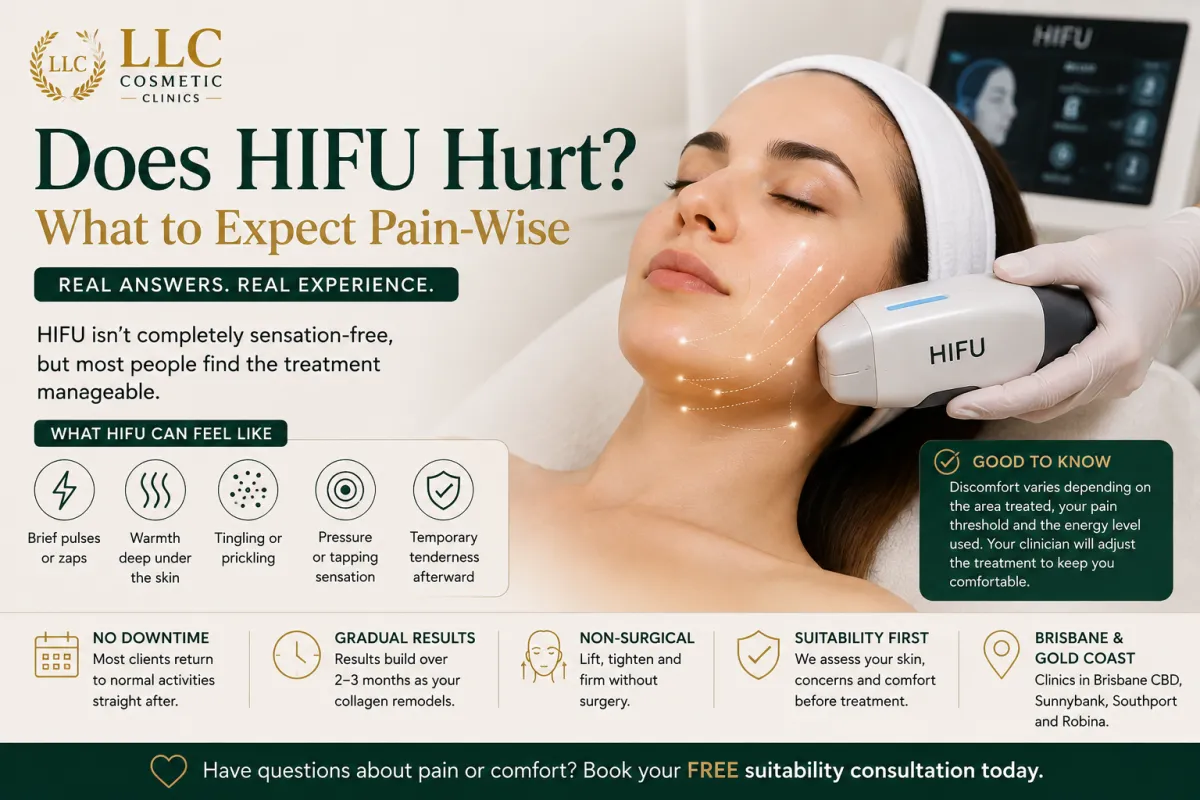
Does HIFU Hurt? What to Expect Pain-Wise
If you're considering HIFU but keep wondering “does HIFU hurt?”, you're not alone.
Pain and discomfort are among the most common questions people have before booking a HIFU treatment.
The honest answer is: HIFU can cause some discomfort, but the sensation varies from person to person and from one treatment area to another.
At LLC Cosmetic, HIFU is described as involving mild, brief discomfort at worst, with your clinician explaining what the treatment is likely to feel like before treatment begins.
So, what does HIFU actually feel like?
Let's break it down.
Does HIFU Hurt? The Quick Answer
HIFU isn't completely sensation-free, but most people find the treatment manageable.
During treatment, you may notice sensations such as:
Brief warmth
Tingling
Prickling
Small pulses or zaps
A deeper sensation beneath the skin
Temporary tenderness afterward
The exact sensation depends on the treatment area, energy settings, individual sensitivity and your personal pain threshold.
LLC Cosmetic's HIFU information specifically notes that treatment is planned around the treatment area, skin laxity and comfort level.
The important distinction is between discomfort and severe pain.
You should not simply assume that significant or worsening pain is something you have to tolerate.
What Does HIFU Feel Like?
Unlike a laser treatment that works primarily at the skin's surface, HIFU delivers focused ultrasound energy into targeted tissue beneath the skin.
When each pulse is delivered, you may feel a brief sensation.
People can describe it differently.
Some describe HIFU as:
“A quick prick.”
Others describe:
“A small electric-like pulse.”
Or:
“A warm sensation deep under the skin.”
The experience isn't necessarily continuous pain. The sensation generally occurs as energy is delivered.
LLC Cosmetic's HIFU treatment guide explains that people may feel a build-up of heat or deep tingling, particularly around areas such as the jawline where there is less soft tissue.
Why Does HIFU Feel Uncomfortable?
The sensation comes from the way focused ultrasound energy is delivered.
HIFU concentrates ultrasound energy at selected depths beneath the skin.
At those focal points, energy produces controlled heating designed to trigger a tissue-remodelling response.
That means you're not simply having a cool ultrasound wand moved across your skin.
The treatment is deliberately delivering energy to targeted areas.
This is why you can feel individual pulses during treatment.
Does HIFU Hurt More on the Jawline?
It can.
Some areas may feel more sensitive than others.
The jawline is one area where people may notice stronger sensations because of the anatomy and the amount of tissue between the treatment device and underlying structures.
LLC Cosmetic's HIFU guide notes that sensations can be particularly noticeable around bony areas such as the jawline.
You may therefore experience different sensations across different parts of your face.
For example:
Cheeks
You may experience warmth, tingling or brief pulses.
Jawline
Some people may notice stronger or sharper sensations.
Under the chin
The sensation can vary depending on tissue thickness and treatment settings.
Neck
Sensitivity can vary considerably from person to person.
This is why HIFU should be adjusted according to the individual rather than treating every person exactly the same way.
Does HIFU Hurt More If You Have Sensitive Skin?
Not necessarily.
Skin sensitivity is only one factor.
Your individual pain threshold, treatment area, energy level and anatomy can all influence how HIFU feels.
Two people receiving treatment on the same area can have very different experiences.
Someone might describe the treatment as mildly uncomfortable.
Another person might find particular pulses more noticeable.
Neither response necessarily means something has gone wrong.
What Happens During a HIFU Appointment?
Understanding the process can make the treatment feel less intimidating.
A typical HIFU appointment at LLC Cosmetic involves several stages.
1. Consultation and Assessment
Before treatment, your clinician reviews your concerns, treatment area and expectations.
LLC Cosmetic uses a suitability-first approach and offers a free suitability consultation before treatment.
This is an important opportunity to tell your clinician if you're particularly concerned about pain or have a low pain threshold.
2. Skin Preparation
The treatment area is cleansed and prepared.
Ultrasound gel is applied to allow appropriate contact between the handpiece and the skin.
3. Treatment Mapping
Your clinician identifies the areas to be treated and plans the treatment according to your goals.
The treatment isn't simply about applying the same amount of energy everywhere.
Treatment planning considers the area being treated and your individual circumstances.
4. HIFU Energy Delivery
The HIFU handpiece is placed against the skin.
Focused ultrasound pulses are then delivered to the selected treatment depths.
This is when you may notice the warmth, tingling or brief pulses associated with the treatment.
5. Comfort Adjustments
If you're uncomfortable, tell your clinician.
This is one of the most important things to remember.
You don't win a prize for silently tolerating discomfort.
Your clinician can assess your response and adjust the treatment approach where appropriate.
LLC Cosmetic states that HIFU is planned around the client's comfort level, and its treatment information explains that technique and settings can be adjusted to help keep the experience manageable.
How Painful Is HIFU on a Scale of 1–10?
There isn't a scientifically reliable universal pain score for HIFU.
Giving every patient a number such as “HIFU is a 3/10” would be misleading because discomfort varies significantly between individuals.
A better way to think about it is:
Mild → moderate, brief and variable discomfort rather than continuous pain.
Some people may barely notice certain areas.
Others may find specific pulses more uncomfortable, particularly over sensitive or bony areas.
Your own experience may therefore be different from someone else's.
What Does HIFU Feel Like After Treatment?
The treatment sensation doesn't necessarily disappear the second you leave the clinic.
Some people may experience temporary:
Tenderness
Tightness
Mild swelling
Redness
Tingling
Sensitivity when touching the treated area
LLC Cosmetic's HIFU information describes HIFU as having no downtime for most clients, although individual post-treatment experiences can vary.
Another LLC Cosmetic guide notes that mild redness, swelling, tenderness or a bruised feeling can occur after treatment.
These effects are generally different from severe or persistent pain.
Can You Go Back to Work After HIFU?
For most people, HIFU doesn't require significant time away from normal activities.
LLC Cosmetic currently describes HIFU as having no downtime for most clients.
That makes it appealing to people who want a non-surgical treatment without planning several days of recovery.
However, you should follow the specific aftercare instructions given by your clinician.
What If HIFU Is Too Painful During Treatment?
Tell your clinician immediately.
This is important.
There's a difference between experiencing expected treatment sensations and experiencing pain that feels excessive or unusual.
Your clinician can assess what you're feeling and determine whether the treatment should be adjusted or stopped.
A good treatment experience shouldn't depend on you pretending everything is fine.
At LLC Cosmetic, the clinic states that its clinicians explain what a specific treatment feels like before it begins and that comfort measures are available where relevant.
Is HIFU More Painful Than Laser Treatment?
There isn't one universal answer.
HIFU and laser treatments work differently, so they produce different sensations.
HIFU delivers focused ultrasound energy beneath the skin.
Laser treatments use light energy and can create sensations ranging from warmth and snapping to more intense heat depending on the treatment.
For example, CO₂ laser resurfacing is designed to affect the skin surface and has a very different treatment and recovery experience from HIFU.
So rather than asking:
“Which treatment hurts more?”
A better question is:
“Which treatment is appropriate for the concern I'm trying to treat?”
HIFU is primarily used at LLC Cosmetic for lifting and firmness, while treatments such as CO₂ and PICO laser address different skin concerns.
Does HIFU Hurt More Than Microneedling?
Again, the experience is different rather than simply “better” or “worse.”
Microneedling creates controlled micro-injuries at the skin surface using fine needles.
HIFU delivers focused ultrasound energy beneath the skin.
The sensations are therefore different.
If your main concern is:
Sagging or loss of firmness → HIFU may be worth exploring.
If your main concern is:
Acne scarring, uneven texture or enlarged-looking pores → microneedling may be more relevant.
The treatment should be selected based on the problem you're trying to solve, not simply which procedure sounds less uncomfortable.
Is HIFU Worth It If You're Worried About Pain?
For many people, the attraction of HIFU is the combination of:
Non-surgical treatment
No needles
Minimal downtime
Gradual results
Treatment focused on lifting and firmness
LLC Cosmetic currently describes HIFU as a non-surgical treatment with no downtime for most clients, with results building over approximately 2–3 months.
If your primary concern is avoiding surgery and significant recovery time, a short period of treatment discomfort may be acceptable to you.
But that decision is personal.
A consultation can help you understand whether the expected benefits make sense for your particular goals.
What Can Make HIFU More Uncomfortable?
Several factors can influence the experience.
Treatment Area
The face, jawline and neck can feel different from one another.
Treatment Depth
Different treatment depths can create different sensations.
Energy Settings
Treatment parameters influence the intensity of the sensation.
Individual Pain Threshold
Everyone experiences discomfort differently.
Anatomy
Areas with less soft tissue or more prominent underlying structures can feel more noticeable.
Anxiety
Being nervous about pain can also make you more aware of every sensation.
This is another reason why understanding the process before treatment can help.
How Can You Prepare for a More Comfortable HIFU Treatment?
You don't need to “toughen up” before your appointment.
Instead:
Tell your clinician about your pain concerns.
If you're worried about discomfort, say so before treatment starts.
Eat and hydrate normally.
Arriving comfortable and well hydrated can make the overall appointment easier.
Avoid arriving rushed.
Give yourself enough time to get to the clinic without unnecessary stress.
Ask what you'll feel.
Knowing what to expect can make unfamiliar sensations less alarming.
Communicate during treatment.
If something feels significantly more uncomfortable than expected, tell your clinician.
HIFU Pain: What Is Normal and What Isn't?
Some temporary discomfort can occur.
However, severe, escalating or unusual pain shouldn't simply be ignored.
Contact your treating clinician if you experience concerning symptoms such as:
Severe or persistent pain
Significant or worsening swelling
Blistering
Persistent or unusual numbness
Other symptoms that concern you
An LLC Cosmetic HIFU guide specifically advises contacting the clinician if severe pain, blistering or concerning persistent symptoms occur.
When it comes to cosmetic treatments, it's always better to ask than assume something is normal.
Does HIFU Hurt? The Bottom Line
So, does HIFU hurt?
The honest answer is:
HIFU can feel uncomfortable, but most people describe the sensation as brief and manageable rather than severe continuous pain.
You may experience:
Warmth
Tingling
Prickling
Brief pulses
Deeper sensations
Temporary tenderness afterward
The experience varies depending on the treatment area, settings, anatomy and individual sensitivity.
At LLC Cosmetic, HIFU is planned around your treatment area, skin laxity and comfort level, with a suitability assessment before treatment.
If you're interested in HIFU but pain is the main thing holding you back, the best next step isn't guessing how it will feel.
Talk to a clinician about your specific treatment area, expected sensations and comfort options before booking.
Frequently Asked Questions
Does HIFU hurt?
HIFU can cause brief discomfort, including warmth, tingling, prickling or pulse-like sensations. The level of discomfort varies between individuals and treatment areas. LLC Cosmetic describes most treatment discomfort as mild and brief.
Is HIFU very painful?
HIFU isn't necessarily pain-free, but it is generally designed to be tolerable. Some areas, particularly around bony structures such as the jawline, may feel more noticeable.
Does HIFU hurt on the face?
It can cause brief sensations during energy delivery. The experience varies across the cheeks, jawline, chin and other treatment areas.
Does HIFU hurt on the neck?
Neck sensitivity varies between people. Your clinician should adjust the treatment approach according to the area and your comfort.
Does HIFU hurt more on the jawline?
The jawline can feel more sensitive because of its anatomy. LLC Cosmetic notes that deeper tingling or heat can be particularly noticeable around bony areas such as the jawline.
How long does HIFU discomfort last?
Treatment sensations are generally brief and occur as ultrasound pulses are delivered. Some temporary tenderness or sensitivity may remain after treatment.
Is there downtime after HIFU?
LLC Cosmetic currently states that HIFU has no downtime for most clients. Individual reactions can vary.
Can HIFU cause pain after treatment?
Temporary tenderness, tightness or sensitivity can occur. Severe or persistent pain should be discussed with your treating clinician.
Can I tell my clinician if HIFU feels too uncomfortable?
Yes. You should communicate throughout the treatment. Your clinician can assess your response and determine whether adjustments are appropriate.
Ready to Find Out If HIFU Is Right for You?
If you're considering HIFU for skin laxity, jawline definition, neck firmness or a non-surgical lift, LLC Cosmetic offers a free suitability consultation.
During your consultation, you can discuss:
Your treatment goals
Your skin concerns
Expected results
What the treatment will feel like
Your comfort concerns
Treatment options
Pricing
LLC Cosmetic currently has four Queensland locations: Brisbane CBD, Sunnybank, Southport and Robina.
Book a free HIFU suitability consultation and get a personalised treatment plan before you decide.
Medical Disclaimer
This article is provided for general educational purposes and is not medical advice, diagnosis or a substitute for an individual consultation. HIFU suitability, treatment settings, sensations, risks and results vary between individuals. A qualified clinician should assess you before treatment.